

In any industrial or commercial facility, the highest priority is the safety of your people. Within the electrical domain, few risks are as severe or instantaneous as an arc flash. As authorities across the UAE and Saudi Arabia continue to raise safety standards in line with global best practices, ensuring compliance is no longer just a good idea—it is a legal and moral imperative.
Entities in the UAE (like Dubai Civil Defence and ADDC) and Saudi Arabia (including SASO and the Saudi Electricity Company) are increasing their enforcement of these standards. Understanding and navigating this evolving regulatory landscape is critical to protecting your team and your operations. As local experts in GCC electrical safety, Elecwatts can guide you through achieving full compliance.
The Regulatory Landscape in 2025
While local regulations from civil defense and utility providers are the ultimate authority, they are heavily based on a foundation of proven international standards. Understanding these benchmarks is key to understanding local requirements.
- NFPA 70E (Standard for Electrical Safety in the Workplace): This is the global benchmark for arc flash safety. It is not a law in itself, but it provides the framework for safe work practices, PPE selection, and maintenance procedures that are adopted by regulators worldwide.
- IEEE 1584 (Guide for Performing Arc-Flash Hazard Calculations): This is the engineering “how-to” guide. It provides the definitive, scientifically-backed formulas and methodologies for calculating the incident energy (the severity) of a potential arc flash, which is the core data point of any study.
UAE Focus
In the UAE, adherence to international standards like NFPA 70E is often a de facto requirement for securing project permits, passing civil defense inspections, and maintaining valid insurance coverage. For new or modified electrical systems, demonstrating a compliant arc flash program is becoming a non-negotiable step in the approval process.
Saudi Arabia Focus
Under the ambitious Vision 2030, the Kingdom has placed a major emphasis on achieving world-class safety and operational standards. Major entities like Saudi Aramco and the Saudi Electricity Company (SEC) have their own rigorous standards that mandate comprehensive arc flash studies for all facilities connected to their systems, making compliance a prerequisite for operation.
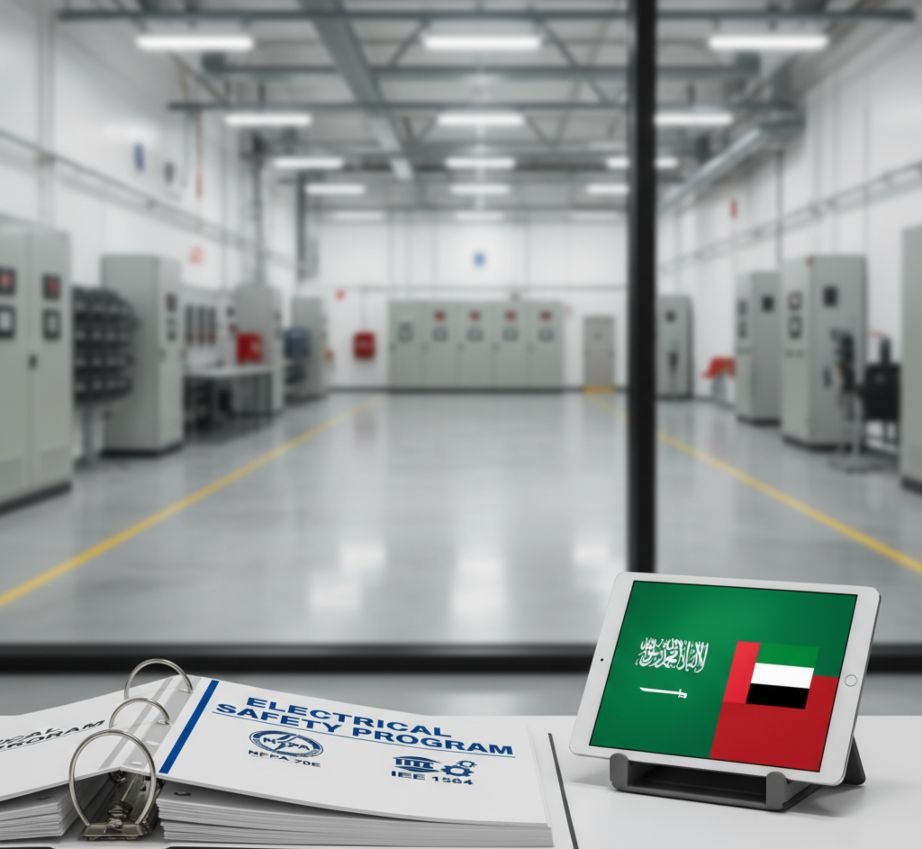
The 5-Step Compliance Checklist for 2025
Achieving compliance for your Arc Flash study 2025 follows a clear, structured path. Here are the five mandatory steps every facility manager must take.
Step 1: Conduct a Comprehensive Arc Flash Hazard Study
What it is: This is a detailed engineering analysis of your entire electrical system. It is a multi-part study that includes a Short-Circuit Analysis, a Protective Device Coordination study, and finally, the Arc Flash calculations themselves to determine the specific hazards at each piece of equipment.
Why it’s Mandatory: This is the foundational step. Without the data from a formal study, you cannot quantify your risk, determine the required PPE, create accurate labels, or prove due diligence to regulators.
Step 2: Generate and Install Compliant Arc Flash Labels
What it is: Every piece of electrical equipment that requires service while energized (e.g., switchgear, panelboards, MCCs) must have a specific warning label. This label must clearly show the incident energy, the arc flash boundary, and the required level of PPE.
Why it’s Mandatory: These labels provide critical, at-a-glance safety information that warns workers of the specific hazard before they interact with the equipment. Labels must be durable and follow ANSI Z535.4 standards for design and content.
Explore Power System Analysis in Dubai at Elecwattsgcc
Step 3: Develop and Implement an Electrical Safety Program
What it is: This is your company’s formal, documented policy for electrical safety. It must outline safe work practices, define procedures for Lockout/Tagout (LOTO), establish an energized electrical work permit system, and detail the training requirements for employees.
Why it’s Mandatory: Both NFPA 70E and local OHS regulations require a documented safety program. It is the core evidence that you have a systematic approach to managing electrical risk, not just a one-time study.
Step 4: Equip Workers with Proper PPE
What it is: Based on the hazard levels identified in the study, you must provide employees with the appropriate Arc-Rated (AR) clothing and personal protective equipment. This includes everything from shirts and coveralls to hoods, gloves, and face shields.
Why it’s Mandatory: It is the employer’s fundamental legal responsibility to provide a safe work environment, which includes providing the necessary PPE to protect workers from identified hazards.
Step 5: Conduct Regular Training and Audits
What it is: All “qualified” electrical workers must receive annual, documented training on arc flash hazards, the details of your electrical safety program, and how to properly use their PPE. Regular audits of the program are also required to ensure it is being followed.
Why it’s Mandatory: Regulations require documented proof of training. This ensures that the life-saving procedures are not just written down, but are actively understood and followed by the people working on the front lines.

The Consequences of Non-Compliance in 2025
Ignoring these regulations carries severe and multi-faceted consequences that go far beyond a simple warning.
- Safety & Human Cost: This is the most important consequence. A preventable arc flash incident can cause catastrophic, life-altering injuries or fatalities.
- Legal & Financial Cost: In the event of an incident, non-compliance can lead to hefty fines from authorities, government-mandated work stoppage orders, and massive legal liability.
- Operational Cost: An arc flash incident can destroy equipment, leading to extended downtime. Furthermore, many insurance providers can invalidate claims if it is found that the facility was not compliant with recognized safety standards. A poor safety record can also cause significant damage to your corporate reputation.
Frequently Asked Questions (FAQ)
1. How often does an Arc Flash study need to be updated?
According to NFPA 70E, the study must be reviewed every five years, or any time a significant modification is made to the electrical system (e.g., a new transformer, a utility change, or large new motor loads).
2. What is the difference between Arc-Rated (AR) and Flame-Resistant (FR) clothing?
While all AR clothing is flame-resistant, not all FR clothing is arc-rated. FR clothing is designed to resist ignition and self-extinguish, but only AR clothing is specifically tested to protect against the intense thermal energy of an electrical arc flash. You must use AR-rated PPE for this hazard.
3. Do Arc Flash Regulations in the UAE apply to low-voltage equipment?
Yes. A dangerous arc flash can occur on systems rated as low as 240 volts. The study will determine the exact level of risk, but low voltage does not mean no risk.
4. Can my in-house team perform the study?
The study must be performed by “qualified persons” with deep expertise in power systems and the use of specialized software (per IEEE 1584). Unless your team has certified engineers with specific experience in these studies, it is required to use a qualified third-party consultant.
5. What is the most common reason for failing a compliance audit?
The most common failures are outdated studies, missing or non-compliant equipment labels, and a lack of documented annual training for electrical staff.
Achieve Full Arc Flash Compliance and Protect Your Team in 2025.
Our certified engineers are experts in both the international standards and local GCC enforcement. We provide end-to-end solutions: from the initial Arc Flash Hazard Assessment and labeling to supporting your safety program development.