

In the landscape of GCC mega-projects—from the giga-projects of Saudi Arabia to the high-rise complexities of Dubai—there is a universal pain point known as the “battle of the trades.” A project can have a world-class Civil contractor, a top-tier Electrical firm, and a highly experienced MEP team, yet still fail to meet its deadline. The failure rarely lies in the individual execution of tasks, but in the chaotic “white space” between contractual boundaries.
In 2026, successful project delivery isn’t just about managing tasks; it is about mastering managing contractor interfaces construction. The interface between structure, mechanical systems, and electrical power is the primary battlefield where schedules are won or lost. This guide provides the blueprint for proactive interface management to ensure your project doesn’t become a casualty of coordination failure.
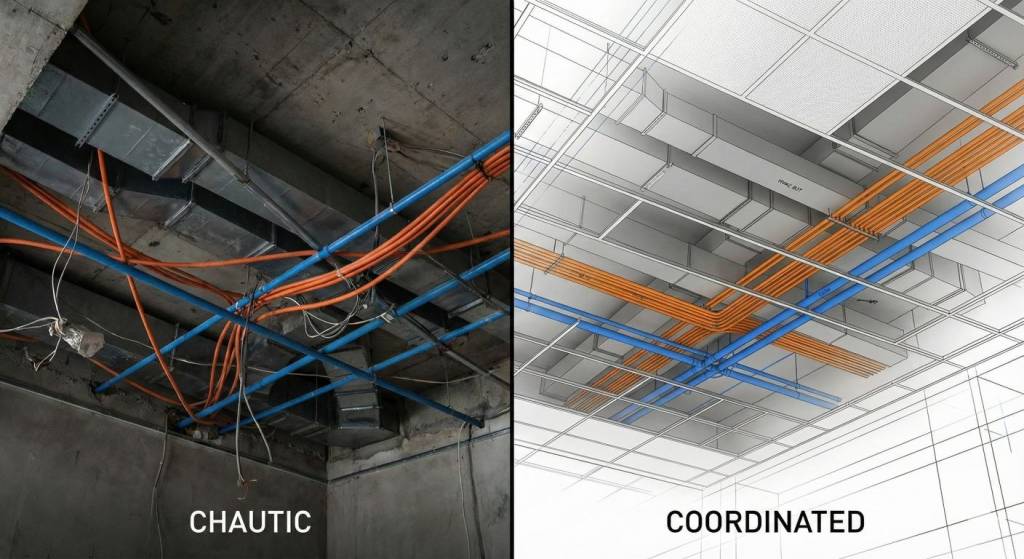
The High Cost of Interface Failure: More Than Just Rework
When interfaces fail, the result is more than just a heated argument in a site meeting. It leads to sequential work stoppages, destructive rework (tearing down walls to install forgotten conduits), and a flood of Requests for Information (RFIs).
- Financial Impact: Industry data suggests that interface-related rework and construction claims interface disputes can account for 5-15% of the total project cost.
- Schedule Impact: A single clash in a critical riser shaft can halt progress on every floor above it, creating a domino effect of delays.
Stop the chaos before it starts. Explore our Project Lead Engineering & Management services.
The 4 Core Interface “Battlefields” and Their Clash Points
To win the battle, you must know where the fighting happens. These are the four zones where MEP coordination challenges GCC projects face are most acute.
1. Ceiling Void & Vertical Risers
The classic clash zone. HVAC ducts are bulky and rigid; gravity plumbing lines need specific slopes; electrical cable trays need separation. Without strict zoning, the first contractor on site takes the easiest route, blocking everyone else.
2. Plant Room & Substation Layout
These are high-density areas. Conflicts arise regarding equipment placement (Civil/MEP), maintenance clearance zones (often ignored until handover), and cable entry points (Civil/Electrical). A common error is MEP drainage pipes running directly over electrical switchgear—a code violation that requires massive rework.
3. Structural Penetrations & Embedments
This is a timing battle. Electrical and MEP teams need sleeves and openings in concrete walls and slabs. If these are missed or mislocated by the Civil team during the pour, the project faces costly core drilling, structural integrity concerns, and delays.
4. Sequencing & Access Conflicts
This is a logistical battle. The electrical team needs to pull cable above a ceiling, but the interior contractor has already closed the grid. The Civil team pours a slab, burying conduits that were never inspected. Multi-disciplinary project management is essential to align these schedules.
The Proactive Interface Management Framework
Moving from reactive firefighting to proactive control requires a systematic framework.
1. Pre-Construction: The “Single Source of Truth”
Mandate a fully integrated 3D Building Information Model (BIM). Conduct weekly Virtual Design Coordination (VDC) sessions where clash detection BIM software identifies conflicts digitally. Solving a clash in the model costs pennies; solving it on site costs thousands.
2. The Interface Responsibility Matrix (IRM)
Ambiguity breeds conflict. Develop an IRM—a live document that defines exactly who does what at every physical interface.
- Example: For a wall penetration, the IRM clarifies: Civil provides the hole; MEP installs the pipe; Civil seals the fire-stop.
3. The Interface Management Plan (IMP)
This is the rulebook. It defines communication protocols, meeting schedules (e.g., daily coordination huddles), clash resolution workflows, and the ultimate authority of the Interface Manager to make tie-breaking decisions.

The Role of the Lead/Interface Engineer: The Project’s “Air Traffic Controller”
Successful interface management requires a specific role: the Lead or Interface Engineer. This role is non-negotiable for mega-projects. Acting as the project’s “Air Traffic Controller,” their responsibilities include:
- Chairing coordination meetings and enforcing the IMP.
- Maintaining the master construction sequence planning log.
- Validating that site work matches the coordinated design.
- Being the neutral arbiter to resolve disputes between trades.
Leveraging 2026 Technology for Seamless Coordination
Modern tools make this framework executable at scale.
- Common Data Environment (CDE): A cloud platform (like BIM 360 or Procore) where all contractors access the latest, approved composite drawings, ensuring everyone builds from the same sheet.
- Field Technology: Using Augmented Reality (AR) on tablets to overlay the BIM model onto the physical site, allowing engineers to verify sleeve locations before concrete is poured.
- Digital Punch Lists: Tagging interface issues directly on site photos and assigning them to specific contractors for immediate rectification.
Frequently Asked Questions (FAQs)
Q1: Who should own and lead the interface management process?
Ideally, the Project Owner should appoint an independent Lead/Interface Engineer (often part of the Owner’s Engineering team). This ensures neutrality. If the EPC contractor leads it, there is often a conflict of interest when adjudicating disputes between their own sub-contractors.
Q2: Our project isn’t using full BIM. Can we still manage interfaces well?
It is exponentially harder, but possible with extreme diligence. It requires creating “composite 2D drawings” that overlay all services on one sheet, rigorous weekly coordination meetings with all foremen, and building physical mock-ups of congested areas (like corridor ceilings) before full installation.
Q3: How do we handle interface issues that arise from the contract documents themselves?
This is common (e.g., a “scope gap”). The solution is a contractual interface review during the design phase. The Lead Engineer identifies gaps or conflicts between different work packages (e.g., Civil scope vs. Electrical scope) and ensures they are clarified and added to the tender documents before contractors bid.
Q4: What’s the one thing we can do immediately to improve?
Institute daily 15-minute “coordination huddles” with the foremen of Civil, MEP, and Electrical trades on site. Focus solely on the next 48-72 hours: “Who needs access where? What are you handing over to whom tomorrow?” This simple habit solves 80% of day-to-day conflicts.
Conclusion
Interface management is the art and science of preventing a sum of excellent individual contracts from resulting in a chaotic, delayed project. It is the defining discipline of modern complex construction.
Don’t let your project’s success be undermined by the gaps between contracts. Our project lead engineering and interface management services provide the experienced, neutral oversight and rigorous processes needed to align Civil, MEP, and Electrical teams, ensuring your GCC project is built on time, to spec, and without costly clashes.
Contact us to discuss integrating our interface management into your next project.