

It is a nightmare scenario that has played out in industrial zones from Jebel Ali to Jubail: A critical feeder cable, sized perfectly for the electrical load according to standard tables, suffers a catastrophic insulation failure just two years after commissioning. The post-mortem reveals no electrical overload. The breaker never tripped. The cable simply disintegrated.
The cause? A combination of thermal cycling in the harsh soil, chemical attack from ground contaminants, and micro-fractures in the insulation caused by exceeding the bend radius during a difficult installation in 45°C heat.
In the world of electrical engineering consulting, there is a dangerous over-reliance on Ampacity, the current-carrying capacity of a cable. While ampacity is critical, it represents only about 20% of the engineering required to design a robust cable system. The remaining 80% involves a complex interplay of Mechanical, Thermal, and Chemical factors.
For project managers and engineers in the GCC, ignoring these non-electrical factors is a recipe for failure. A cable is not just a conductor; it is a complex composite structure that must survive mechanical stress during installation, dissipate heat into highly resistive desert soils, and resist chemical degradation from harsh saline environments. This guide moves beyond the ampacity tables to explore the holistic Cable Design Engineering principles necessary for system integrity.
The GCC Environmental Trifecta: Heat, Sand, and Corrosion
Designing a cable system for Northern Europe is fundamentally different from designing one for the Middle East. The GCC presents an environmental “trifecta” that aggressively attacks cable infrastructure.
1. Extreme Heat and UV Radiation
Standard international tables often assume an ambient air temperature of 30°C and a ground temperature of 20°C. In the Gulf, ambient temperatures regularly exceed 50°C, and ground temperatures at burial depth can reach 35-40°C.
- Impact: This drastically reduces the cable’s current-carrying capacity (derating). Furthermore, intense UV radiation degrades standard PVC sheaths, causing them to crack and expose the armor or insulation within a few years.
2. Sand and Mechanical Abrasion
Fine desert sand is abrasive. During desert cable installation, dragging heavy cables over sand and rock without proper rollers can scour the outer sheath.
- Impact: Once the sheath is compromised, moisture enters. In the presence of voltage, this leads to “water treeing” in XLPE insulation, a microscopic breakdown phenomenon that eventually leads to insulation failure.
3. Coastal Corrosion and Sabkha Soil
Much of the industrial infrastructure in the UAE and Qatar is built on coastal land or “Sabkha” (salt flats).
- Impact: The soil is highly saline and corrosive. If the cable’s outer sheath is damaged, the galvanized steel wire armor (SWA) or aluminum wire armor (AWA) will corrode rapidly, destroying the cable’s mechanical protection and earth fault path.
Mechanical Factor 1: Pulling Tensions and Bend Radii Calculations
The most dangerous day in a cable’s life is the day it is installed. Without rigorous cable pulling calculations, the installation contractor can invisibly damage the cable before it is even energized.
Maximum Pulling Tension
Every cable has a maximum tensile strength, determined by the conductor cross-section and the pulling method (pulling eye vs. basket grip).
- The Formula: Engineers must calculate the expected tension ($T$) based on friction coefficients ($\mu$), cable weight ($W$), and length ($L$).
$$T = L \times W \times \mu$$
- GCC Challenge: In hot weather, the cable jacket softens, increasing the coefficient of friction against the duct or rollers. Lubricants can evaporate quickly. If the calculated tension exceeds the cable’s limit, the copper conductor elongates, reducing its cross-section and creating a permanent “hot spot.”
Sidewall Pressure and Bend Radius
The “Bend Radius” is the minimum radius a cable can be bent without damaging the insulation or shielding.
- The Risk: In congested industrial plants, installers often force cables around tight corners. This crushes the insulation against the conductor (Sidewall Pressure).
- The Standard: Generally, this is $15 \times \text{Outer Diameter}$ for MV cables. Exceeding this creates micro-voids in the insulation, which become sites for partial discharge and eventual failure.
Mechanical Factor 2: Terminations and Connections – The Weakest Links
Statistics show that over 50% of MV cable failures occur at the terminations or joints, not in the cable run itself. In the Gulf, Electrical Construction & Commissioning Management practices are tested by extreme thermal cycling.
Thermal Expansion and Contraction
A cable operating at full load heats up and expands. At night, or when the load drops, it cools and contracts.
- The Failure Mode: This cycle creates a “pumping” action. If the termination is not designed with adequate stress relief loops, this mechanical movement can pull the conductor out of the lug or crack the termination bushing.
Material Compatibility (Creep)
Aluminum conductors are popular for cost savings, but aluminum “creeps” (deforms) under pressure and heat more than copper.
- The Fix: Using standard copper lugs on aluminum cables is a fire hazard. Bi-metallic lugs (Al-Cu) with proper oxide-inhibiting grease and calibrated torque wrench installation are mandatory. In high-vibration environments (like near large pumps), mechanical shear-bolt lugs are often preferred over crimped lugs for better reliability.
Thermal Factor 1: Soil Thermal Resistivity – The Underground Challenge
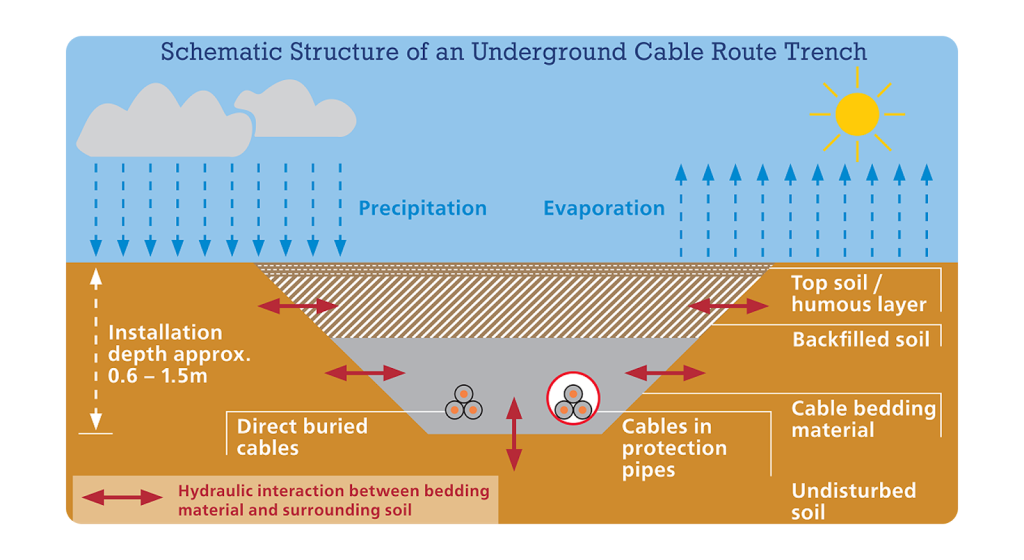
Underground cables rely on the surrounding soil to act as a heat sink. If the soil cannot conduct heat away, the cable overheats, regardless of its ampacity rating.
The Physics of Heat Dissipation
Heat moves from the cable core (90°C) to the soil. The soil’s ability to conduct this heat is measured as Thermal Resistivity (Rho, measured in K·m/W).
- The GCC Problem: Dry, aerated desert sand is an excellent thermal insulator (high Rho). It traps heat around the cable.
- Standard vs. Reality: Tables often assume a Rho of 1.0 or 1.2. In dry UAE sand, Rho can be 2.5 or 3.0. Using standard tables leads to massively undersized cables.
Soil Thermal Resistivity Testing
Before finalizing cable derating calculations, engineers must perform field testing (IEEE 442) to measure the actual soil Rho.
- The Solution: If the native soil is poor, the design must specify “Thermal Backfill”, a specialized weak-mix concrete or engineered sand with a guaranteed low thermal resistivity (e.g., Rho < 1.0) to encase the cable ducts.
Thermal Factor 2: Grouping and Derating – When Cables Interact
Cables are rarely installed alone. In industrial plants, they travel in packs, stacked on cable trays or bundled in trenches.
The Proximity Effect
When cables are grouped, they heat each other up. IEC 60364-5-52 provides specific grouping factors.
- The Calculation: A cable tray with 6 cables touching each other might require a derating factor of 0.75. This means a 100A cable is now only good for 75A.
- The GCC Multiplier: Add to this the ambient temperature derating. A cable tray on a roof in Dubai (50°C ambient + direct sun) might reach 70°C inside the tray before current even flows.
Spacing Strategies
Cable tray design Dubai standards often mandate specific spacing:
- Trefoil Formation: For single-core cables to balance magnetic fields.
- One-Diameter Spacing: Maintaining a gap equal to the cable diameter between cables on a tray significantly improves air circulation and reduces the derating penalty.
Chemical Factor 1: Oil, Chemical, and UV Resistance Requirements
In the petrochemical-heavy economies of Saudi Arabia and Abu Dhabi, cables are frequently exposed to hydrocarbons.
The Hydrocarbon Attack
Standard PVC or XLPE sheaths can swell, soften, or crack when exposed to oil, diesel, or chemical vapors.
- The Specification: For refineries (e.g., Ruwais, Ras Laffan), specifications must call for a Lead Sheath (the ultimate barrier) or a multi-layer sheath incorporating High-Density Polyethylene (HDPE) or a Nylon barrier for chemical resistant cable sheaths.
UV Degradation
Carbon black is added to cable sheaths to absorb UV radiation. Cheap cables with insufficient carbon black content will turn brittle and “chalky” after just two summers in the Gulf sun. Once the sheath cracks, water ingress destroys the cable.
- Requirement: Specify “UV Stabilized” or “Carbon Loaded” outer sheaths for all outdoor installations.
Chemical Factor 2: Fire Performance – Smoke, Toxicity, and Flame Spread
Safety regulations in the GCC have tightened significantly following several high-profile high-rise fires. Fire performance cables Saudi Arabia and UAE regulations (like the UAE Fire and Life Safety Code) are now among the strictest in the world.
The Categories of Fire Performance
- Flame Retardant (IEC 60332): The cable will eventually burn, but it won’t act as a fuse, carrying the fire to a new room.
- Fire Resistant (IEC 60331 / CWZ): The cable continues to conduct electricity even while burning (Circuit Integrity). This is mandatory for fire pumps, emergency lighting, and smoke extraction fans.
- Low Smoke Zero Halogen (LSZH): Standard PVC releases thick black smoke and toxic hydrochloric acid gas when it burns. LSZH cables do not.
The GCC Standard
For all indoor installations, especially in manned facilities, LSZH is now the industry standard. It ensures that in a fire, visibility remains high for evacuation and sensitive electronic equipment isn’t destroyed by acidic gas.

The Cable System Specification Matrix: Creating Comprehensive Requirements
To ensure holistic integrity, engineers should use a “Specification Matrix” rather than a generic datasheet. This matrix defines the performance criteria for every layer of the cable.
The Matrix Checklist
- Conductor: Material (Cu/Al), Shape (Circular/Sector), Water Blocking (Swellable powder/tape).
- Insulation: Material (XLPE/EPR), Thickness (based on voltage), Triple Extrusion (for MV).
- Screening: Copper tape vs. Copper wire (Wire is preferred in GCC for higher fault current capacity).
- Armor: SWA (Steel) for multi-core; AWA (Aluminum) for single-core to prevent magnetic heating.
- Outer Sheath: Material (PVC/HDPE/LSZH), Color (Red/Black), UV Rating, Termite Protection (for desert burial).
- Approvals: Must appear on the Approved Vendor List (AVL) of the local utility (DEWA, ADDC, SEC).
Total Cost of Ownership Analysis: Why Holistic Design Saves Millions
The “cheapest cable” is often the most expensive system. Total cost of ownership electrical analysis reveals the truth.
The 25-Year View
- Scenario A (Cheap Design): Aluminum cables, PVC sheath, direct burial in native sand.
- Result: Lower Capex. Higher losses (I²R). Cable failure in Year 7 due to sand abrasion and water treeing. Cost of excavation, replacement, and downtime is 500% of the initial cable cost.
- Scenario B (Holistic Design): Copper cables, HDPE sheath, thermal backfill, proper pulling calculations.
- Result: Higher Capex (+20%). Zero failures in 25 years. Lower energy losses.
Case Example: Red Sea Project
Major sustainable tourism projects like the Red Sea Project utilize this holistic approach. By investing in higher quality cables with lower environmental impact and higher reliability, they ensure the pristine environment is not disturbed by frequent maintenance excavation, aligning with their sustainability goals.
Frequently Asked Questions (FAQ)
1. Can we use Aluminum cables for underground distribution in the UAE?
Yes, but with strict caveats. Aluminum is lighter and cheaper but requires larger ducts (larger diameter for same ampacity) and extremely careful termination. Many utilities (like DEWA) prefer Copper for MV networks due to reliability, but Aluminum is acceptable for private LV networks if installed by certified jointers using bi-metallic lugs.
2. What is the difference between XLPE and PVC insulation?
XLPE (Cross-linked Polyethylene) can withstand higher operating temperatures (90°C) compared to PVC (70°C). This means an XLPE cable can carry more current than a PVC cable of the same size. XLPE also has better moisture resistance and is the standard for almost all modern power cables in the GCC.
3. Do we really need to test soil thermal resistivity for every project?
For small projects, you might use conservative assumptions (high Rho). But for any project with large feeders or high-voltage cables, testing is mandatory. Assuming a standard Rho of 1.2 when the reality is 2.5 can lead to cables overheating and failing within months of operation.
4. What is “Water Treeing” in cables?
Water treeing is a degradation phenomenon where moisture penetrates the insulation in the presence of an electric field, forming microscopic tree-like channels. Over time, these channels bridge the insulation, leading to a short circuit. Using cables with “water swellable tape” or “powders” under the sheath helps prevent this.
5. Why must single-core cables use Aluminum Wire Armor (AWA) instead of Steel (SWA)?
If you use steel armor on a single-core AC cable, the magnetic field induces a current in the steel armor itself. This generates massive heat and can melt the cable. Aluminum is non-magnetic, preventing this heating effect
Conclusion: Engineering for Resilience
In the GCC, cable design is an act of environmental defense. The engineer is not just routing electrons; they are battling heat, sand, salt, and time. By moving beyond simple ampacity tables and embracing a holistic design philosophy, one that accounts for the mechanical stresses of installation, the thermal realities of the desert soil, and the chemical aggression of the atmosphere, project managers can deliver electrical infrastructure that lasts.
Integrity is not an accident; it is engineered.
Need a robust cable design strategy?
Don’t let your project’s lifecycle be defined by a cable failure. Elecwatts is a leading electrical engineering consultancy in the GCC, specializing in complex underground and above-ground cable systems. From soil resistivity testing interpretation to pulling tension calculations and DEWA-compliant specifications, we ensure your power distribution network is built to withstand the region’s toughest conditions.
Contact Elecwatts today to secure the integrity of your power network.