

The industrial landscape of the Gulf Cooperation Council (GCC) is undergoing a metamorphosis of unprecedented scale. Driven by national transformation frameworks like Saudi Vision 2030, the UAE Industrial Strategy “Operation 300bn”, and Qatar’s National Vision 2030, the region is shifting aggressively from a hydrocarbon-dependent economy to a diverse manufacturing and industrial powerhouse. We are seeing the rapid development of gigaprojects, specialized economic zones, and high-tech industrial cities rising from the desert.
In this era of hyper-growth, the primary challenge for project owners and engineers is no longer just building capacity; it is designing for scalability. An industrial plant commissioned today in Jubail or Jebel Ali may need to double its capacity in five years to meet market demand.
The critical decision that dictates this future flexibility is made at the very beginning of the industrial plant design GCC phase: Do we adopt a traditional “Stick-Built” approach, constructing electrical infrastructure on-site? Or do we pivot to a “Modular” philosophy, utilizing prefabricated, pre-tested E-Houses and skids?
This choice is not merely logistical; it is strategic. It impacts capital expenditure (CAPEX), speed to market, quality control, and, most critically in the Gulf, how well the facility withstands the harsh environmental realities of extreme heat and dust. For Electrical Project Management professionals and engineers in the GCC, ignoring these factors is a recipe for failure. This guide provides a deep-dive comparison to help project stakeholders navigate this pivotal engineering decision.
The Stick-Built Approach: Traditional Design for Fixed Requirements
For decades, the “Stick-Built” method has been the standard for traditional electrical design services in the region. This approach involves transporting loose materials, steel beams, blockwork, cable trays, individual switchgear panels, to the construction site and assembling the electrical buildings and substations in situ.
The Anatomy of Stick-Built Construction
In a stick-built project, the electrical substation is essentially a civil building project first.
- Civil Works: Extensive excavation, foundations, and concrete pouring for the substation building.
- Structural/Architectural: Building blockwork walls, roofing, and installing false flooring.
- Electrical Installation: Only once the building is weather-tight can the switchgear, transformers, and control panels be delivered and installed.
- Interconnection: Miles of cabling are pulled, terminated, and tested on-site in the uncontrolled environment of the construction zone.
Where Stick-Built Shines
Despite the trend toward modularization, stick-built construction remains the superior choice for certain project types:
- Hyper-Customization: For unique, irregular footprints or brownfield sites where a rectangular module simply won’t fit, stick-built offers infinite geometric flexibility.
- Local Content Optimization: Stick-built projects rely heavily on local civil contractors, labor, and raw materials (concrete, steel). This can be advantageous for meeting strict In-Kingdom Total Value Add (IKTVA) or In-Country Value (ICV) targets, as a larger portion of the spend remains within the local economy compared to importing a high-value module.
- Heavy Petrochemical Legacy: Many existing plants in Yanbu or Ruwais have established standards based on concrete substations. Integrating a new module into a legacy stick-built infrastructure can sometimes create interface headaches that outweigh the benefits.
The Modular Revolution: Prefabricated, Pre-tested, Plug-and-Play
In contrast, the modular revolution is transforming how we think about modular substation design. Instead of building a substation on the site, we build the substation off the site and ship it as a product.
The “Product” Philosophy
In this approach, the electrical building (E-House) is designed, assembled, wired, and tested in a controlled factory environment.
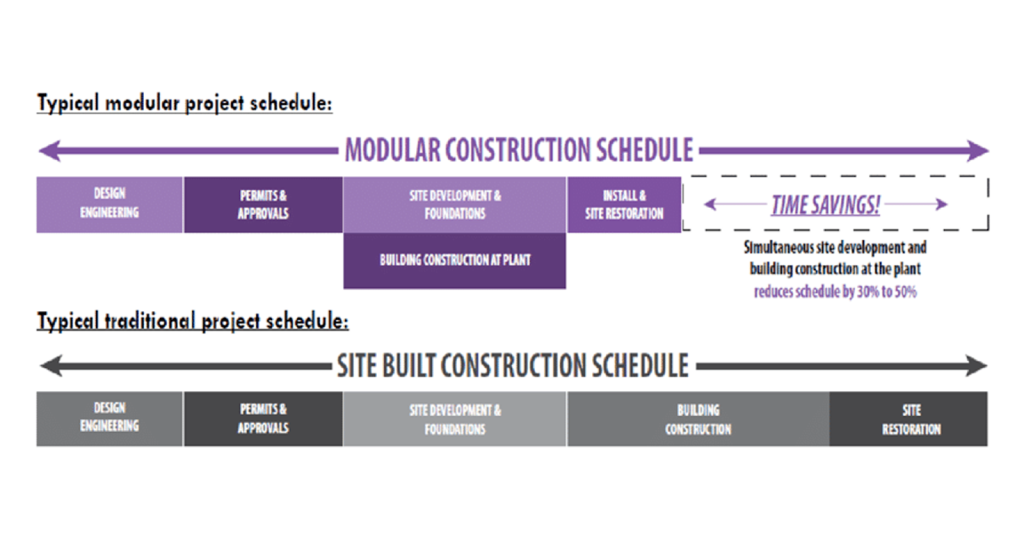
- Parallel Processing: While the site team is pouring foundations in Riyadh, the electrical room is being built and tested in a factory in Dammam or Dubai. This parallel workflow can shave 20-30% off the total project schedule.
- Factory Acceptance Testing (FAT): The most significant advantage is quality. In a prefabricated electrical system, the entire substation, switchgear, UPS, HVAC, and Fire Alarm, is energized and tested together at the factory. Any faults are fixed instantly by factory engineers, rather than troubleshooting in 45°C heat on a remote site.
Logistics in the Gulf
Transporting modules in the GCC requires careful planning. While the road networks in UAE and Saudi Arabia are excellent, moving a 20-meter long, 100-ton E-House requires specialized multi-axle trailers and route surveys to navigate bridges and roundabouts. However, the reduction in on-site manpower and the elimination of thousands of man-hours of high-risk work in extreme weather often makes the logistics cost a worthwhile investment.
GCC Climate Consideration 1: Heat Management in Enclosed Modules
The GCC environment is the ultimate stress test for electrical equipment. When designing scalable power distribution systems, managing the intense solar heat gain is paramount.
The Thermal Challenge
A traditional concrete substation has significant thermal mass; it takes a long time to heat up. A modular steel E-House, however, has low thermal mass and conducts heat rapidly. Without specific engineering interventions, the internal temperature can skyrocket, derating switchgear and shortening equipment life.
Modular Cooling Solutions
Successful modular cooling solutions in the Gulf rely on redundant, oversized HVAC systems specifically designed for the region.
- Wall Construction: Modules for the GCC must use double-skin walls with high-density rockwool insulation to achieve U-values comparable to or better than concrete.
- Solar Shielding: Advanced designs incorporate “sun shields” or secondary roofs, a physical shade structure installed over the module to block direct solar radiation, significantly reducing the cooling load.
- Redundancy: HVAC systems are typically designed as N+1 or 2N. If one AC unit fails in July, the backup must kick in immediately to prevent the substation from tripping on over-temperature.
GCC Climate Consideration 2: Sand and Dust Protection Standards
Heat is not the only enemy; the pervasive, fine desert dust is equally destructive. It is electrically conductive when humid and acts as a thermal insulator when it settles on components.
The Fortress Concept
Whether modular or stick-built, dust protection electrical designs must treat the substation as a pressurized fortress.
- Positive Pressure: The HVAC system must maintain a positive pressure inside the room (typically 25-50 Pa) relative to the outside. This ensures that when a door is opened, air blows out, preventing dust from blowing in.
- Sand Trap Louvers: Fresh air intakes must be equipped with specialized inertial sand trap louvers capable of filtering out heavy sand particles before they reach the fine filters.
IP Ratings for Desert Conditions
For modular units, the external shell must be rated IP ratings desert conditions compliant (often IP55 or higher). Joints between module sections are critical weak points. In stick-built construction, poor workmanship in sealing cable penetrations or door frames often leads to ingress. Factory-built modules generally offer superior sealing quality, provided the site installation team correctly seals the shipping splits.
Scalability Analysis: Phased Expansion Without Operational Disruption
The true test of a design philosophy is not day one; it is day 1,000 when the plant needs to expand. This is where phased expansion planning becomes critical.
The “Hot” Connection Advantage
In a traditional stick-built substation, expanding usually means knocking down a wall to extend the room, creating dust and debris next to live high-voltage equipment. This often requires a full plant shutdown to ensure safety.
Modular design revolutionizes this with minimum downtime expansion:
- Pre-Engineered Interfaces: The original module is designed with a “removable end wall” and pre-installed busbar extensions.
- Plug-and-Play Expansion: When expansion is needed, a new module (Module B) is built and tested off-site.
- The Weekend Tie-In: Module B is shipped to site and placed next to Module A. The busbars are connected via a specialized link. The plant might only need a short outage, hours instead of days, to energize the new section.
Case Study 1: Modular Design Success – UAE Food Processing Plant
A major food and beverage manufacturer in Dubai Industrial City needed to triple its production capacity over a decade but could not afford extended shutdowns.
- The Approach: They adopted a modular design case study approach. Phase 1 included a master E-House containing the MV switchgear and the first set of LV MCCs (Motor Control Centers).
- The Expansion: Three years later, for Phase 2, a second E-House containing additional MCCs and VFDs was delivered.
- The Result: The interconnection was completed during a scheduled 12-hour maintenance window. The facility avoided an estimated $2 million in lost production that a traditional stick-built extension would have incurred due to construction constraints and safety shutdowns.
Case Study 2: Stick-Built Necessity – Saudi Specialized Chemical Facility
Conversely, a specialized petrochemical plant in Jubail chose a traditional design case study approach.
- The Constraint: The process required highly irregular, blast-resistant concrete bunkers for electrical equipment due to proximity to hazardous reactors.
- The Challenge: The layout was extremely constrained by existing pipe racks, making the installation of large prefabricated modules impossible.
- The Outcome: A stick-built approach allowed the electrical rooms to be “molded” into the available non-hazardous pockets of the site. While construction took 4 months longer than a modular option, it was the only viable engineering solution given the spatial and safety constraints of the brownfield site.
The Decision Framework: 10-Point Evaluation Matrix for GCC Projects
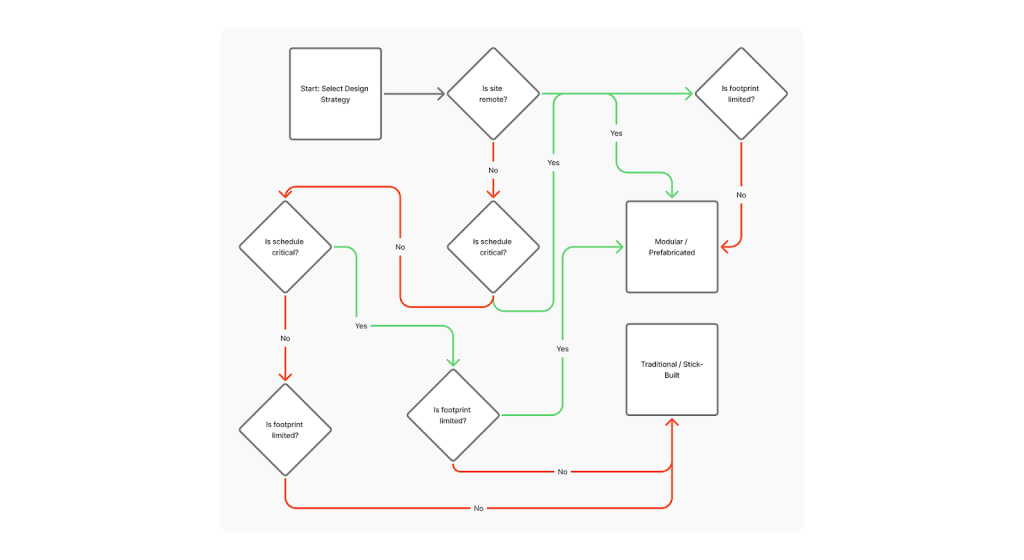
How does a project manager choose? We recommend a weighted project evaluation matrix. Score your project on these 10 factors:
- Site Accessibility: Can a heavy trailer reach the foundation? (Yes = Modular / No = Stick)
- Schedule Pressure: Is the deadline aggressive? (Yes = Modular)
- Local Labor Costs: Is on-site labor cheap and available? (Yes = Stick)
- Quality Control Needs: Is the site environment extreme/uncontrolled? (Yes = Modular)
- Standardization: Is the electrical design repeatable? (Yes = Modular)
- Space Constraints: Is the footprint irregular? (Yes = Stick)
- Future Scalability: Is rapid expansion likely? (Yes = Modular)
- Blast Rating: Are high blast pressures required? (Concrete Stick-Built often preferred)
- Local Content (ICV/IKTVA): Can the module be sourced locally?
- CAPEX vs. OPEX: Can the project absorb higher upfront shipping for lower long-term maintenance?
[Placement for Image 2]
Future-Proofing Your Decision: Design for Unknown Future Requirements
The industrial sector is facing a “double disruption”: decarbonization and digitalization. Future-proof industrial design means creating infrastructure that can adapt to technologies we haven’t fully deployed yet.
- The Hybrid Approach: We are seeing a trend toward adaptable electrical systems where the primary infrastructure (MV switchgear) is stick-built in permanent concrete bunkers for longevity, while downstream distribution (LV MCCs, Solar Inverters, EV Charging infrastructure) is deployed in flexible, replaceable modules.
- Tech-Ready Spaces: Whether modular or stick, designs must now include 20-30% spare space, not just for more breakers, but for edge computing servers, AI processors for predictive maintenance, and battery storage integration.
Frequently Asked Questions (FAQ)
1. Is modular construction always more expensive than stick-built?
Not necessarily. While the material and transport cost of a module is often higher, the total project cost is frequently lower. This is because modularization eliminates site logistics costs, reduces camp/accommodation requirements for workers, drastically cuts waste, and avoids the high costs of schedule delays.
2. How do modular electrical rooms handle the extreme GCC summer temperatures compared to concrete buildings?
Modern E-Houses use high-efficiency thermal insulation (mineral wool sandwich panels) that can equal or exceed the thermal performance of blockwork. When combined with properly sized HVAC systems and solar roofs (sun shields), they maintain internal temperatures of 23°C even when it is 50°C outside.
3. Can we use modular design for brownfield projects in existing plants?
Yes, but site access is the limiting factor. If you can crane the module over existing pipe racks or transport it to the foundation, it is often the preferred method for brownfield projects because it minimizes hot work permits and safety risks in live operating plants.
4. How does modular design impact the In-Kingdom Total Value Add (IKTVA) score in Saudi Arabia?
It depends on where the module is built. Importing a finished module from Europe will hurt your score. However, there is a growing ecosystem of high-quality modular fabricators within KSA and the UAE. Sourcing from these local integrators creates a “High IKTVA” solution.
5. What is the typical lifespan of a modular E-House vs. a concrete substation?
A concrete substation is built for 50+ years. A steel E-House is typically designed for 25-30 years, though with high-spec marine-grade paint systems (C5-M) and proper maintenance, this can be extended. For projects with a defined lifecycle (e.g., 20 years), modular is often the perfect match.
Conclusion: Making the Strategic Choice for Scalability
The choice between Modular and Stick-Built is not a binary one of “Right vs. Wrong,” but rather “Fit for Purpose.” In the fast-paced, climatically harsh environment of the GCC, the modular philosophy offers compelling advantages in speed, quality assurance, and scalability that align perfectly with the region’s industrial ambitions. However, the traditional stick-built approach retains its value for highly complex, permanent infrastructure where customization is king.
For project managers, the key is to assess the specific DNA of your project, its timeline, its location, and its future. By treating the electrical design philosophy as a strategic business decision rather than just a construction detail, you lay the foundation for a facility that is robust, compliant, and ready for growth.
Need help defining your design strategy?
Navigating these trade-offs requires engineering expertise rooted in local reality. Elecwatts is a premier electrical design consultancy serving the GCC region. We help industrial clients conduct feasibility studies, develop 10-point evaluation matrices, and engineer scalable power systems, whether stick-built, modular, or hybrid, that stand the test of time.
Contact Elecwatts today to future-proof your industrial expansion.