

Dubai is rapidly cementing its position as the premier digital hub of the Middle East. With global hyperscale cloud providers, local enterprises, and government entities driving a massive digital transformation, the demand for robust data center electrical infrastructure has reached unprecedented levels. However, designing these mission-critical facilities in the United Arab Emirates presents a unique and monumental engineering challenge: maintaining ultra-low server inlet temperatures and guaranteeing absolute, 100% uptime in a punishing environment where summer ambient temperatures routinely exceed 50°C.
For an engineering firm like Elecwatts, executing flawless Dubai data center design means simultaneously battling the harsh climatic elements while navigating the strict regulatory frameworks of local authorities. A data center is arguably the most power-dense structure built today. A single rack of modern high-density servers can consume upwards of 20kW to 40kW of power, concentrating immense heat and electrical stress into a remarkably small footprint. To achieve the coveted “five nines” of reliability (99.999% uptime), every component of the electrical architecture—from the incoming high-voltage utility grid down to the final receptacle on the server rack—must be engineered with uncompromising redundancy. This comprehensive guide details the critical electrical design strategies, DEWA compliance protocols, and cooling methodologies required to successfully deploy and operate Tier-rated data centers in Dubai.
DEWA Power Feed Strategies for Uptime Institute Tiers
The foundation of a data center’s reliability begins outside the property line. The Uptime Institute’s Tier Classification System sets the global benchmark for data center performance. Tier III facilities require concurrently maintainable infrastructure, meaning any component can be shut down for maintenance without impacting the IT load. Tier IV facilities demand complete fault tolerance, meaning a single catastrophic failure of any component will not disrupt the servers.
Securing the Dual Feed
To achieve these high-tier certifications in Dubai, securing a DEWA dual power feed is an absolute, non-negotiable prerequisite. Because a multi-megawatt data center cannot be supported by a standard low-voltage connection, developers must work with the Dubai Electricity and Water Authority (DEWA) to secure two independent, dedicated high-voltage feeds (typically 11kV or 33kV).
Diverse Routing and Physical Separation
Simply pulling two cables from the same DEWA substation defeats the purpose of redundancy. To safeguard Tier IV data center power, the electrical design must demonstrate “diverse routing.”
- Substation Diversity: The primary and secondary feeds should ideally originate from two geographically distinct DEWA primary substations.
- Trench Separation: As the high-voltage cables enter the data center plot, they must be routed in physically separated trenches, ideally entering the building from opposite sides of the campus. This strict separation guarantees that a single catastrophic event—such as an errant construction backhoe severing a trench, or a localized street fire—cannot wipe out both utility feeds simultaneously, preserving the facility’s connection to the primary grid.
Generator Backup and Fuel Storage Regulations
When the DEWA grid experiences a blackout, the data center must instantly transform into a self-sustaining power plant. The emergency diesel generator array is the ultimate safety net for the IT load.
Sizing for Continuous Operation
Data center generator sizing is vastly different from sizing a generator for a commercial office building. Data center generators must be sized with a “Continuous” or “Data Center Continuous” (DCC) rating, meaning they are certified by the manufacturer to run at full load for an unlimited number of hours.
- Redundancy Models: For a Tier III facility, the generator plant is typically configured in an N+1 arrangement (e.g., if four generators are needed to carry the total facility load, a fifth is installed as a spare). For Tier IV, a 2N architecture (two completely separate groups of generators, each capable of handling 100% of the load) is often required, governed by massive paralleling switchgear that synchronizes the alternators perfectly.
Navigating DCD Fuel Mandates
The sheer volume of diesel required to keep a 20MW data center running for 48 to 72 hours presents a massive fire risk. Dubai Civil Defense (DCD) strictly enforces DCD fuel storage regulations.
- Bulk Storage vs. Day Tanks: The design must incorporate deeply buried or blast-protected bulk underground fuel tanks. Fuel is then pumped via redundant, double-walled piping systems to smaller “day tanks” located near the generators. The rooms housing these day tanks must be isolated as 2-hour fire compartments and equipped with automated clean-agent fire suppression systems and foam deluge setups to satisfy stringent DCD life-safety codes.
Tackling the Massive Cooling Electrical Load
In a Dubai data center, you are not just powering servers; you are powering the machines that keep those servers from melting. Due to the extreme outdoor temperatures, “free cooling” (using outside air to cool the facility) is virtually impossible for most of the year.
The Dominance of HVAC Power
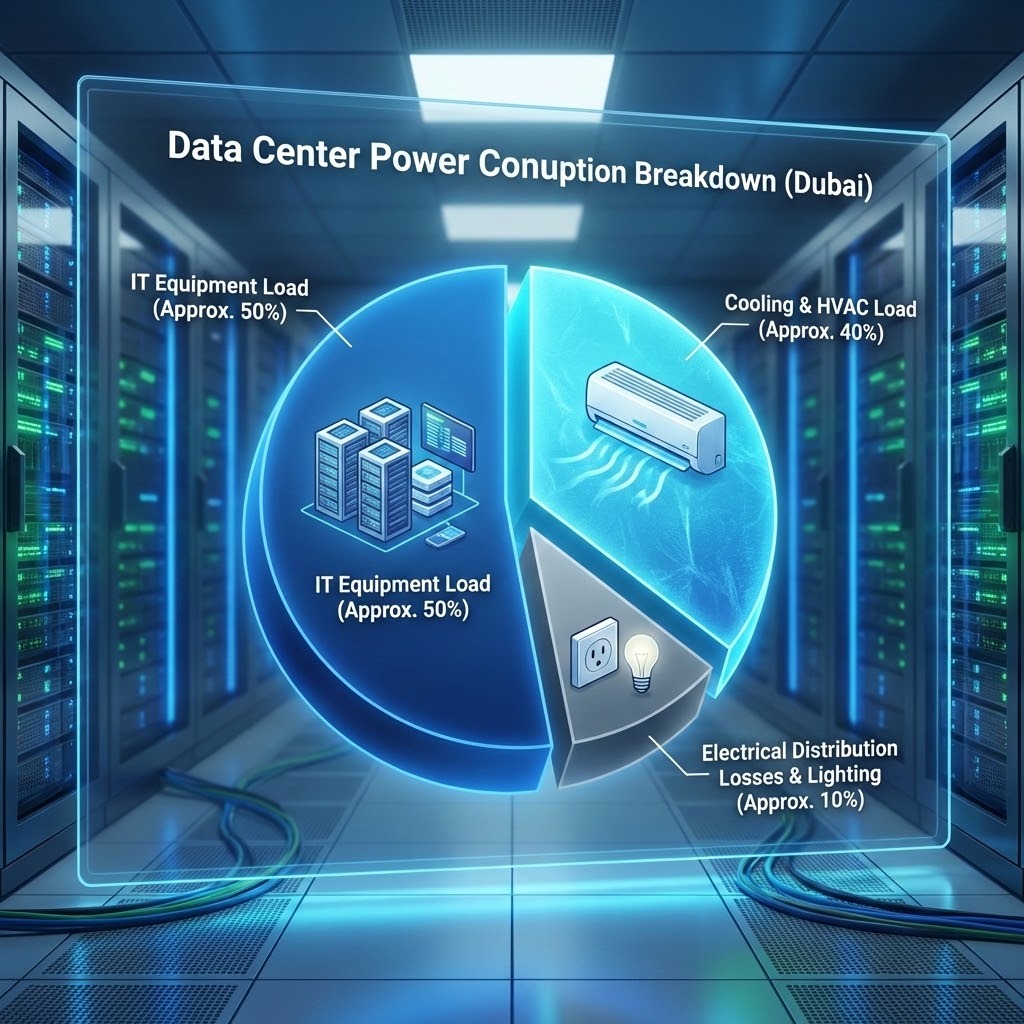
As a result, mechanical cooling relies heavily on massive water-cooled chillers, cooling towers, and Computer Room Air Conditioning (CRAC) units. The data center cooling load is staggering, frequently accounting for 40% to 50% of the entire facility’s electrical power draw. Understanding the immense CRAC unit power requirements and precisely balancing the electrical distribution to these mechanical loads is as critical as powering the IT equipment itself.
VFDs and Harmonic Mitigation
To optimize efficiency, modern chillers and CRAC units utilize Variable Frequency Drives (VFDs) to modulate compressor and fan speeds based on real-time server heat output. However, thousands of VFDs operating simultaneously inject massive amounts of harmonic distortion (electrical noise) back into the data center’s power grid. This distortion can overheat transformers and cause sensitive IT power supplies to malfunction. Rigorous power systems analysis is required during the design phase to accurately model this distortion. Engineers must specify heavy-duty active harmonic filters within the Motor Control Centers (MCCs) to scrub the dirty power and ensure the facility remains compliant with DEWA power quality standards.
UPS Systems: Battery Technologies for High Ambient Heat
Between the millisecond the DEWA grid fails and the 15 seconds it takes for the massive diesel generators to start, synchronize, and take the load, the data center relies entirely on its Uninterruptible Power Supply (UPS) systems.
The Topology of Uptime
Modern enterprise data centers rely on “Online Double-Conversion” UPS topologies. The utility AC power is constantly converted to DC to charge the batteries, and then inverted back to perfectly clean, regulated AC power for the servers. This ensures a literal zero-millisecond transfer time during a blackout.
VRLA vs. Lithium-Ion in the GCC
Data center UPS design in the Middle East is heavily influenced by ambient temperature. Traditionally, facilities relied on rooms filled with thousands of Valve-Regulated Lead-Acid (VRLA) batteries. However, VRLA chemistry is highly sensitive to heat; for every 8°C the room temperature rises above 25°C, the lifespan of a VRLA battery is cut in half.
- The Lithium Advantage: Consequently, the transition to a lithium ion UPS Dubai strategy is accelerating rapidly. Li-ion batteries tolerate significantly higher ambient temperatures, boast a lifespan up to three times longer, and weigh drastically less, saving valuable structural loading capacity on elevated floors.
- Thermal Runaway Risks: The tradeoff is that Li-ion batteries carry a risk of “thermal runaway” (an unstoppable, cascading chemical fire). Designing for Li-ion requires advanced Battery Management Systems (BMS) that monitor the voltage and temperature of every single cell, integrated tightly with very early warning aspirating smoke detection (VESDA) and DCD-approved off-gas venting systems.
Modular and Scalable Electrical Architecture
A 10MW data center is rarely filled with 10MW worth of servers on its opening day. It may launch with only 2MW of active IT load and scale up over several years as new tenants are onboarded.
Avoiding Stranded Capital
If the electrical system is built entirely as a monolithic block on day one, massive amounts of capital are stranded in idle transformers and switchgear that are operating at incredibly poor efficiency curves. The solution is designing a scalable data center power architecture. White spaces (the server floors) and gray spaces (the electrical/mechanical plant rooms) must be engineered using a modular, “pay-as-you-grow” block methodology.
The Power of Busway Systems
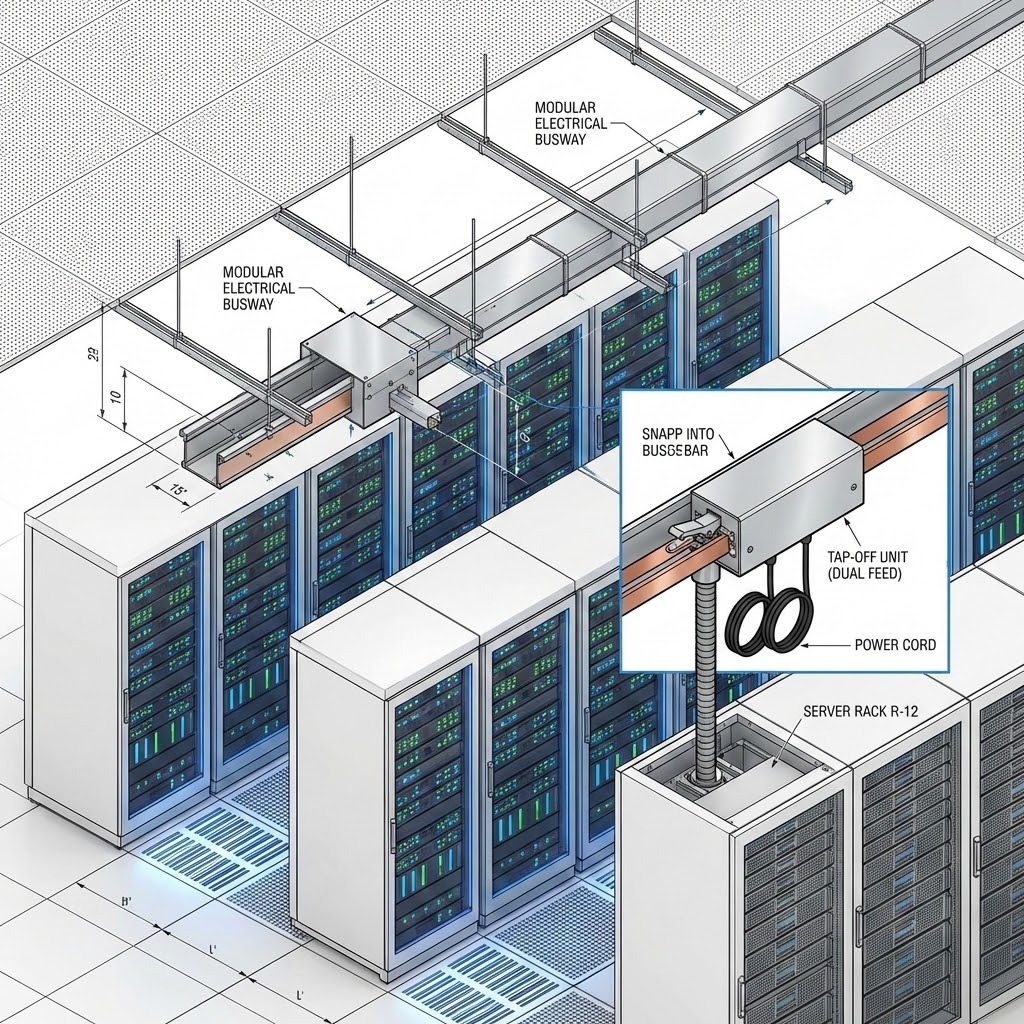
Traditionally, server racks were powered by thick bundles of flexible cables (“whips”) routed under a raised floor. This method severely restricted under-floor cooling airflow and made adding new racks a logistical nightmare.
- Overhead Distribution: Today’s standard is server rack busway distribution. Engineers design a network of heavy-duty, solid copper or aluminum busbars suspended directly above the rows of server cabinets. When a new rack is rolled in, a technician simply snaps a “tap-off box” containing the necessary circuit breakers directly into the live busway overhead. This plug-and-play architecture allows the data center capacity to scale dynamically, safely, and without ever requiring a shutdown of the existing critical load.
Earthing and Lightning Protection for Sensitive IT
In a standard commercial building, earthing is primarily designed for human life safety. In a data center, earthing is the foundation of data integrity. Modern servers operate on extremely low internal DC voltages; even a minor electrical transient or a “noisy” ground can corrupt millions of data packets.
The Signal Reference Grid (SRG)
Data center earthing design is remarkably complex. The facility requires a massive, deeply driven external earth mesh designed to achieve an absolute maximum resistance of less than 1 ohm.
- Clean Earth Systems: Internally, engineers must design clean earth IT systems. This involves installing a Signal Reference Grid (SRG)—a vast lattice of bare copper wires laid directly underneath the raised floor of the white space. Every server rack, PDU, and CRAC unit is bonded to this SRG. This creates a massive equipotential zone that safely dissipates high-frequency electrical noise and static electricity away from the sensitive microprocessors.
Lightning Protection in the Desert
While rain is sparse in Dubai, violent winter thunderstorms do occur. The sprawling, flat, highly conductive roofs of data centers (often covered in massive chillers and generator exhaust stacks) are prime targets for lightning strikes. The design must feature a rigorous Faraday cage or early streamer emission (ESE) lightning protection system, flawlessly bonded to the external earth mesh, to ensure a multi-million-volt strike is channeled harmlessly into the deep desert sand without inducing destructive magnetic surges inside the server halls.
PUE (Power Usage Effectiveness) and Sustainability Targets
As the data center footprint in the UAE expands, the government and DEWA are increasingly focused on the environmental impact of these massive power consumers. The defining metric of efficiency is PUE (Power Usage Effectiveness).
The PUE Calculation
PUE is calculated by dividing the total amount of power entering the facility by the power actually used by the IT equipment (the servers). A PUE of 2.0 means that for every 1 Watt used to compute data, another 1 Watt is wasted on cooling, lighting, and electrical distribution losses. The closer the PUE gets to 1.0, the more efficient the facility.
Electrical Optimization Strategies
While mechanical cooling optimization drives the largest PUE improvements, data center PUE optimization also requires brilliant electrical engineering. To create an energy efficient data center Dubai, engineers must minimize the $I^2R$ (heat) losses inherently found in copper cables and transformers.
- Higher Distribution Voltages: A primary strategy is shifting from traditional 230V/400V distribution to higher voltages. By stepping down power from the UPS to 415V/240V and delivering that higher voltage directly to the back of the server rack, the current (Amperage) is reduced. Lower current means significantly lower heat losses in the power cables and fewer required step-down transformers on the data hall floor, directly shaving points off the facility’s PUE score.
Procurement Challenges for Specialized Equipment
A data center is not built with standard, off-the-shelf electrical components. The equipment required to handle these massive, critical loads is highly specialized and manufactured to order.
Navigating the Global Supply Chain
The single greatest threat to a data center’s construction schedule is not the physical installation, but the global supply chain. Data center equipment procurement is notoriously difficult. Massive 3,000kVA cast-resin transformers, enterprise-grade 1MW UPS modules, and the complex paralleling controls required for custom switchgear sourcing UAE often command lead times of 12 to 18 months from European or American factories.
Strategic Sourcing
Because hyperscale cloud providers demand aggressive, fast-track launch dates, standard sequential procurement is guaranteed to fail. Engaging expert Electrical Plant Procurement teams early in the concept design phase is vital. These specialists lock in factory manufacturing slots and conduct rigorous Factory Acceptance Testing (FAT) on the switchgear long before the building’s concrete foundations are poured, ensuring that the critical path of the project schedule is protected from international supply chain shocks.
Frequently Asked Questions (FAQ)
1. What is the required DEWA power feed for a Tier IV data center in Dubai?
Tier IV requires absolute fault tolerance. This means securing at least two active, independent 11kV or 33kV utility feeds from DEWA. Ideally, these feeds should originate from two geographically distinct primary substations and be routed through physically separated trenches to prevent any single point of failure (like a street excavation) from severing both connections.
2. Why are Lithium-Ion UPS systems preferred over traditional batteries in the GCC?
Traditional Valve-Regulated Lead-Acid (VRLA) batteries degrade rapidly in high ambient temperatures—their lifespan halves for every 8°C the room temperature rises above 25°C. Lithium-ion batteries tolerate significantly higher heat, last up to three times longer, and have a much smaller, lighter footprint, making them ideal for the harsh GCC climate, provided advanced fire suppression is installed.
3. How does Dubai’s ambient heat affect data center PUE?
Power Usage Effectiveness (PUE) is heavily impacted by cooling. In Dubai’s 50°C summer, chillers must work substantially harder to reject heat, drawing massive electrical loads. This naturally drives the PUE higher compared to colder climates where “free cooling” (using outside air) is possible. Rigorous electrical and mechanical engineering is required to keep Dubai data center PUEs competitive.
4. What is a “diverse routing” requirement for data center power?
Diverse routing ensures that primary and secondary power cables, as well as fiber optic data lines, do not share the same physical path, conduit, or entry room into the building. If construction work severs one trench, the diverse secondary trench remains entirely untouched, ensuring zero downtime for the servers.
5. Are there specific Dubai Civil Defense (DCD) rules for data center backup generators?
Yes, DCD enforces strict fire safety regulations regarding the massive bulk diesel storage required for 48-72 hours of continuous generator operation. This includes mandated underground or blast-rated bulk tanks, 2-hour fire-rated day tank rooms, and specialized foam or clean-agent fire suppression systems.
Conclusion & Next Steps: Engineering Zero Downtime
Executing data center electrical design in Dubai is simultaneously a relentless battle against extreme ambient heat and an intense race for peak energy efficiency. A successful facility requires an uncompromising approach to mission critical electrical design, where resilience and redundancy are layered into every single kilowatt of power, from the incoming high-voltage utility trench down to the final microprocessor.
The margin for error in this sector is virtually zero. A dropped server load doesn’t just result in an unhappy tenant; it causes cascading data corruption, breached Service Level Agreements (SLAs), and potentially millions of dollars in financial penalties. It demands engineering rigor that anticipates the worst-case scenarios and designs infrastructure capable of surviving them effortlessly.
Are you designing a colocation or enterprise facility in the UAE?To achieve absolute reliability, you must consult with the leading data center consultants Dubai has to offer. Partner with Elecwatts to design a highly scalable, Uptime Institute Tier-compliant electrical architecture that guarantees zero downtime. Contact Elecwatts today to secure the resilient, future-proof power infrastructure your data demands.