

Dubai is accelerating its transition toward a sustainable, zero-emission future, driven aggressively by the Dubai Green Mobility Initiative. As the adoption of electric vehicles (EVs) surges across the Emirate, developers, facility managers, and contractors are facing a profound infrastructural challenge. Integrating high-demand EV chargers into existing or new building electrical grids is not a simple plug-and-play operation; it is a complex engineering task that, if mishandled, can easily trip main breakers or overload aging transformers. Partnering with a specialized electrical engineering consultancy in dubai early in your project lifecycle is essential to navigate this transition safely. The surge in EV charging infrastructure Dubai requires a fundamental shift in how we calculate, distribute, and manage power in residential and commercial developments.
For developers, ignoring this shift is no longer an option. Future-proofing buildings means guaranteeing EV readiness, which in turn demands a deep understanding of Dubai green mobility electrical regulations. Providing a few charging points is a start, but designing a scalable, robust electrical backbone that satisfies the strict connection protocols of the Dubai Electricity and Water Authority (DEWA) is the true mark of a premium, future-ready facility. This guide breaks down the critical electrical considerations, load calculation methodologies, and DEWA approval steps required to successfully deploy EV charging networks in the UAE.
Understanding Charger Types and Their Load Impacts
Before pulling a single cable, engineers must define the specific use case of the facility, as the type of charger selected dictates the entire upstream electrical architecture. The power demands of EVs are uniquely intense; unlike intermittent loads such as elevators or water pumps, an EV draws maximum current continuously for several hours.
AC Level 2 vs. DC Fast Charging
- AC Level 2 Chargers: These are the standard for residential towers, office basements, and hotels where vehicles are parked for extended periods. They typically operate at 7kW (Single Phase, 32A) or 11kW/22kW (Three Phase, 16A/32A). While seemingly modest, adding fifty 11kW chargers to a residential tower basement introduces over half a megawatt of new, continuous load.
- DC Fast Chargers (Level 3): Deployed at highway petrol stations, commercial fleet depots, and premium retail hubs, these chargers bypass the car’s onboard converter to deliver direct current straight to the battery. Their EV charger power draw is staggering, ranging from 50kW up to 350kW+ per unit.
The Transformer Impact
The DC fast charger electrical requirements are so severe that a hub featuring just four 350kW ultra-fast chargers commands a 1.4 MW load, roughly equivalent to the peak demand of a 20-story residential tower. For developers, incorporating these units means the immediate requirement for dedicated 11kV/400V transformers and heavy-duty, heavily derated cabling to withstand the continuous thermal stress inherent to the GCC climate.
Mastering the Electrical Load Calculations for EVs
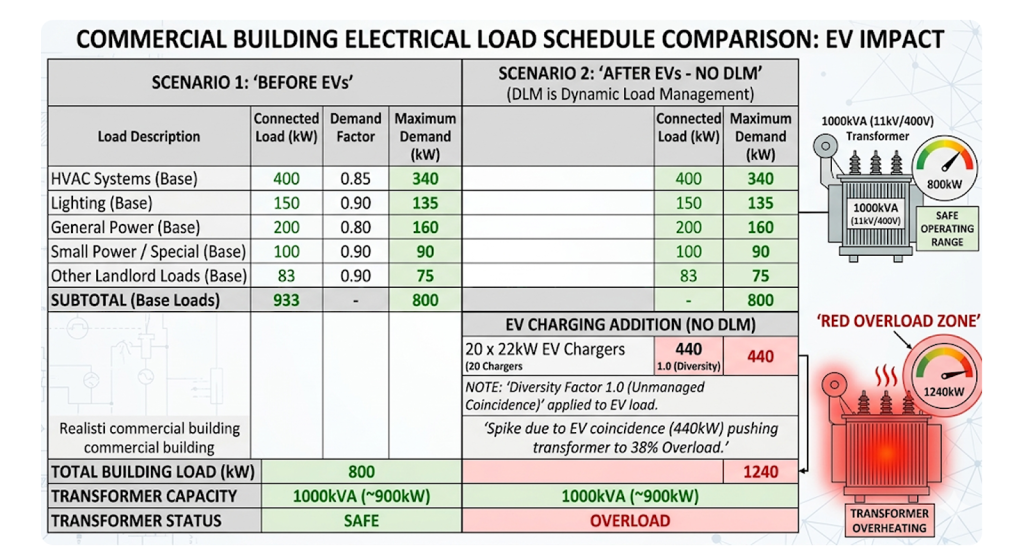
The most common point of failure in DEWA submissions for EV infrastructure is the miscalculation of the Maximum Demand (MD). Traditional electrical design relies heavily on “Diversity Factors”, the statistical assumption that not all lights, sockets, or AC units will run at 100% capacity simultaneously.
The Diversity Factor Dilemma
When it comes to EV load calculation Dubai, standard diversity rules do not apply. If a developer installs twenty 11kW chargers in an office building, it is highly probable that all twenty will be used simultaneously at 9:00 AM when employees arrive.
- The DEWA Approach: Historically, utilities mandate a DEWA diversity factor EV of 1.0 (100% concurrency) for EV chargers unless a certified, fail-safe load management system is in place. If an engineer incorrectly applies a 0.4 diversity factor (treating them like standard sockets), the main incoming cables will be drastically undersized, leading to severe overheating, voltage drops, and immediate DEWA rejection.
Justifying the Load
To avoid oversizing the building’s main transformer and incurring massive capital expenditure, complex power load flow analysis is highly recommended. This analysis dynamically models the building’s base load against the proposed EV charging curves, mathematically proving to DEWA exactly how much spare capacity exists and how the new EV load will be safely accommodated without compromising the existing building supply.
Navigating the DEWA Green Charger Connection Protocols
Installing an EV charger in Dubai is not as simple as wiring it to the nearest distribution board. DEWA has established strict protocols to maintain visibility and safety over these high-draw devices.
The NOC and Approval Process
Securing a Green charger DEWA NOC requires a methodical approach:
- Preliminary Assessment: Submitting the proposed load schedule and Single Line Diagram (SLD) to DEWA to confirm that the local street network and the building’s main incomer have the capacity to handle the new load.
- Dedicated Infrastructure: DEWA mandates that EV chargers cannot share distribution boards with standard building loads (like lighting or HVAC). You must design a dedicated smart EV distribution board (SMDB-EV).
- Specific Metering: To track the growth of green mobility, DEWA requires the installation of specific “Green Charger” tariff meters. The architectural layout must allocate compliant spatial dimensions for these new meter cabinets inside the electrical room.
Failure to strictly segregate the EV electrical network from the general building network on the SLD is the fastest route to a DEWA EV charger approval rejection.
Smart Load Management and Dynamic Balancing
If applying a 1.0 diversity factor to your EV load calculation pushes your building over its DEWA-sanctioned power limit, you are faced with a choice: pay for a massive, expensive transformer upgrade, or implement intelligence.
The Role of Dynamic Load Management (DLM)
EV dynamic load management is a software-hardware ecosystem that acts as a traffic controller for electrons. By installing smart Current Transformers (CTs) on the building’s main incoming supply, the DLM system monitors the total building load in real-time.
- How it Works: Suppose your building’s maximum limit is 1,000 Amps. At 2:00 PM on a July afternoon, the HVAC chillers are running at maximum capacity, drawing 900 Amps. If ten plugged-in EVs attempt to draw 150 Amps, the main breaker will trip. The DLM system detects this impending overload in milliseconds and automatically communicates with the networked EV chargers, digitally “throttling” their output. It might slow the charging rate from 11kW to 3kW per car until the building’s AC load drops in the evening, at which point it releases full power back to the vehicles.
By proving the integration of a certified DLM system, engineers can legitimately negotiate with DEWA to apply a lower diversity factor to the EV network, saving building owners millions in avoided infrastructure upgrades.
Earthing and Safety Systems for Outdoor UAE Installations
EV charging involves moving massive amounts of electrical energy in environments where users are exposed to the elements, making stringent safety protocols non-negotiable.
The Threat of DC Faults and Earthing
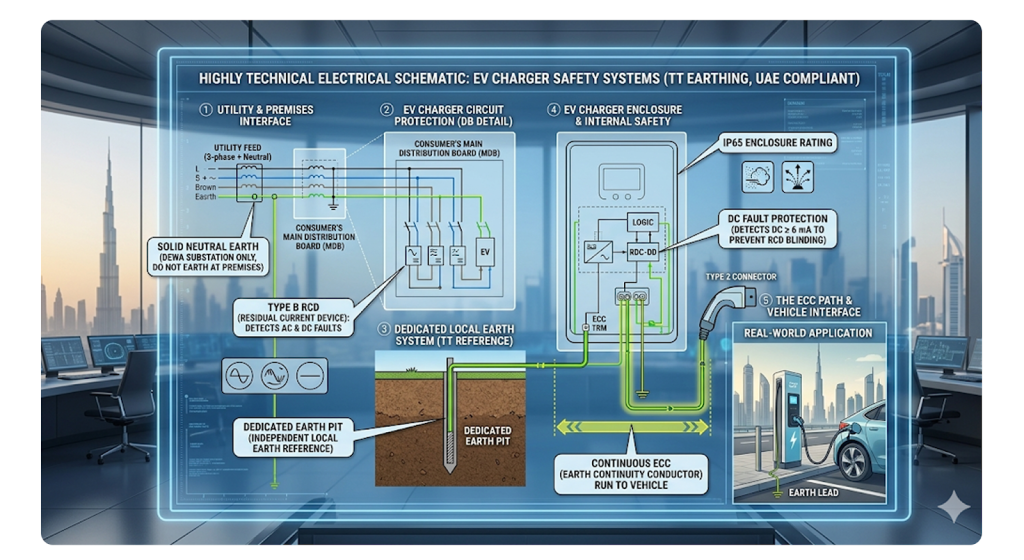
Dubai predominantly utilizes a TT earthing system for low-voltage distribution.
- The DC Leakage Risk: Standard AC Earth Leakage Circuit Breakers (Type AC or Type A RCDs) are “blinded” if a fault in the electric vehicle injects a smooth DC current back into the building’s electrical system. If this happens, the RCD will fail to trip during a subsequent AC fault, potentially resulting in a lethal shock.
- The Requirement: EV charger earthing UAE regulations dictate that every charging point must be protected by a Type B RCD (which detects both AC and smooth DC faults) or a Type A RCD paired with specialized 6mA DC detection built directly into the charger.
Environmental Resilience
For chargers installed in outdoor, open-air car parks, outdoor electrical safety Dubai standards must account for the brutal GCC climate. The chargers and their isolators must carry an IP65 or IP66 rating to withstand fine desert dust and high-pressure water jets from cleaning. Furthermore, plastic enclosures must be heavily UV-stabilized to prevent them from becoming brittle and shattering after a single summer in direct sunlight. Cables must be oversized to account for extreme thermal derating when routed through sun-baked outdoor conduits.
Retrofitting Older Buildings for EV Readiness
While new developments can plan for EVs from Day One, retrofitting EV chargers into 20-year-old towers in Deira, Bur Dubai, or older sections of Sheikh Zayed Road presents a labyrinth of engineering challenges.
The Basement Bottleneck
- Maxed-Out Panels: Older Main Distribution Boards (MDBs) rarely have spare breaker slots, let alone spare power capacity.
- The Retrofit Strategy: To execute a basement parking electrical upgrade, engineers must often install a new, dedicated EV tap-off box directly from the main busbar (requiring DEWA approval and a coordinated shutdown). If the building is near its maximum DEWA load, the consultant must perform a rigorous 7-day load recording study. By attaching data loggers to the main incomer, the engineer can scientifically prove the building’s actual peak demand versus its connected load, often revealing hidden “spare capacity” that DEWA will allow to be reallocated for EV chargers.
- Spatial Constraints: Old basements lack space for new cable trays. Routing heavy, rigid armored cables around existing HVAC ducts and plumbing requires meticulous 3D coordination and precise, non-invasive installation techniques to maintain fire compartmentation.
Synergizing EV Charging with Solar PV (Shams Dubai)
As sustainability goals converge, the ultimate green mobility solution involves powering zero-emission vehicles with zero-emission electricity.
The Rise of the Solar Carport
Integrating a solar EV carport Dubai is a highly efficient use of space, providing much-needed shade for vehicles while generating power. However, bridging the gap between solar generation and EV consumption requires complex Shams Dubai EV integration.
- The Technical Interface: The solar PV inverters (generating AC power) and the EV chargers (consuming AC power) must be synchronized at a common distribution board. If the EVs are drawing power while the sun is shining, the electrons flow directly into the cars. If the cars are full or absent, the power is exported to the DEWA grid via the net metering system.
- Protection Challenges: This bidirectional flow requires sophisticated Interface Protection (IP) panels to ensure that if the DEWA grid fails, both the solar panels and the EV chargers are instantly isolated to prevent dangerous islanding conditions.
Designing for Commercial Fleets and Delivery Hubs
The transition to electric mobility is not limited to passenger cars. Global logistics giants operating in JAFZA and Dubai South are aggressively electrifying their delivery van fleets.
Heavy-Duty Hubs
Commercial fleet EV charging represents an industrial-scale electrical challenge. When a logistics hub transitions 100 delivery vans to electric, they must all be recharged simultaneously overnight to be ready for the morning dispatch.
- The Design Shift: This logistics hub electrical design requires transitioning from standard LV distribution to deploying dedicated containerized substations in the parking yard.
- Power Quality Mitigation: Fleet depots utilizing dozens of simultaneous DC Fast Chargers will inject severe harmonic distortion into the local grid. The electrical design must incorporate heavy-duty Active Harmonic Filters (AHF) and specialized K-rated isolation transformers to ensure the facility complies with IEEE 519 power quality standards, preventing the chargers from destroying the facility’s own sensitive automated sorting equipment.
Frequently Asked Questions (FAQ)
1. Can I plug my EV into a standard 13-Amp wall socket in my Dubai villa?
While physically possible using a “Granny Cable,” it is highly discouraged and often unsafe for daily use. Standard 13A sockets and their internal wiring in the UAE are not designed to handle a continuous 10-amp to 13-amp maximum load for 12 to 18 hours straight. This continuous thermal stress can melt the socket and cause a fire. Always install a dedicated, DEWA-approved wall box charger on its own distinct circuit breaker.
2. What is a Type B RCD and why is it mandatory for EVs?
An RCD (Residual Current Device) protects against lethal electric shocks. Standard RCDs (Type AC or A) only detect AC faults. Because an EV converts AC to DC to charge its battery, a fault in the car can send a smooth DC current back into your house. This DC current “blinds” standard RCDs, stopping them from working. A Type B RCD is specially designed to detect both AC and DC faults, ensuring total safety.
3. Does DEWA charge a different tariff for electricity used by EV chargers?
For public charging stations registered under the DEWA Green Charger initiative, DEWA sets specific tariffs (measured per kWh) which are billed to the user’s EV Green Charger account. For private residential chargers installed behind your own home’s DEWA meter, the electricity consumed by the charger is simply added to your standard monthly residential electricity bill at your standard tier rate.
4. What happens to EV charging during the intense 50°C GCC summer?
Heat is the enemy of electrical efficiency. High-quality EV chargers and the vehicles themselves have active thermal management systems. However, in extreme ambient temperatures, a DC Fast Charger may automatically “derate” (throttle down) its power output from 150kW to 50kW to protect its internal electronics and the car’s battery from overheating. Providing shade (like a solar carport) drastically improves summer charging speeds.
5. If I install Dynamic Load Management (DLM), will my car take longer to charge?
Only during peak building hours. If you plug your car in at 2:00 PM when the building’s AC is at maximum capacity, the DLM will slow your charge to protect the building. However, by 8:00 PM when the building load drops, the DLM automatically gives your car full power. For overnight residential charging, DLM rarely impacts your ability to achieve a 100% charge by morning.
Conclusion & Next Steps: Future-Proofing Your Parking Lots
The era of electric mobility in Dubai is no longer on the horizon; it is already parked in our basements. However, the proliferation of EVs is placing an unprecedented, continuous strain on commercial and residential electrical grids. Treating EV chargers as simple appliances leads to overloaded transformers, failing cables, and rejected DEWA applications.
True future-proofing requires viewing EV infrastructure as a dynamic, high-capacity electrical network. By mastering precise load calculations, implementing intelligent dynamic load management (DLM) systems, and strictly adhering to DEWA’s green charger protocols, developers can transform their parking facilities into powerful, resilient assets that attract premium tenants and align perfectly with Dubai’s sustainable vision.
Is your facility truly ready for the EV revolution?
Navigating the complex intersection of high-power DC charging, DEWA regulations, and dynamic load balancing requires specialized engineering rigor. As a leading EV electrical design consultant, Elecwatts helps developers and fleet operators design and integrate robust, future proof building electrical architectures. From retrofitting legacy basements to designing multi-megawatt solar-powered fleet depots, we ensure your infrastructure is safe, scalable, and compliant.
Contact Elecwatts today to engineer a seamless transition to electric mobility for your property.