

Dubai is undergoing a monumental infrastructural shift, evolving rapidly from a traditional consumer of electricity into a highly responsive, digital energy ecosystem. Driven by a massive AED 7 billion investment, the DEWA smart grid strategy is transforming the Emirate into a world-leading smart city. This transition is not merely a background utility upgrade; it fundamentally alters the dynamic of how commercial and residential buildings must interact with the power network. To navigate this complex technological leap, partnering with an expert electrical engineering consultancy in dubai is essential to ensure your property remains compliant and competitive.
For decades, the relationship between a building and the grid in Dubai was entirely passive: power flowed in, meters spun forward, and a monthly bill was issued. The advent of the Dubai smart city electrical revolution obliterates this one-way street. The grid is becoming a bidirectional, intelligent, and highly communicative organism. Buildings will no longer just consume power; they will generate it, store it, and dynamically negotiate their consumption based on real-time grid stress and pricing signals.
For property developers, facility managers, and owners, preparing for these future requirements is not an option, it is a financial and operational imperative. Buildings that fail to adapt their electrical infrastructure to “speak the language” of the smart grid will face higher operational costs, stranded assets, and potential regulatory non-compliance. This comprehensive guide outlines the core pillars of DEWA’s smart grid initiatives and details the exact engineering strategies required to future-proof your facility.
The AMI Rollout (Advanced Metering Infrastructure)
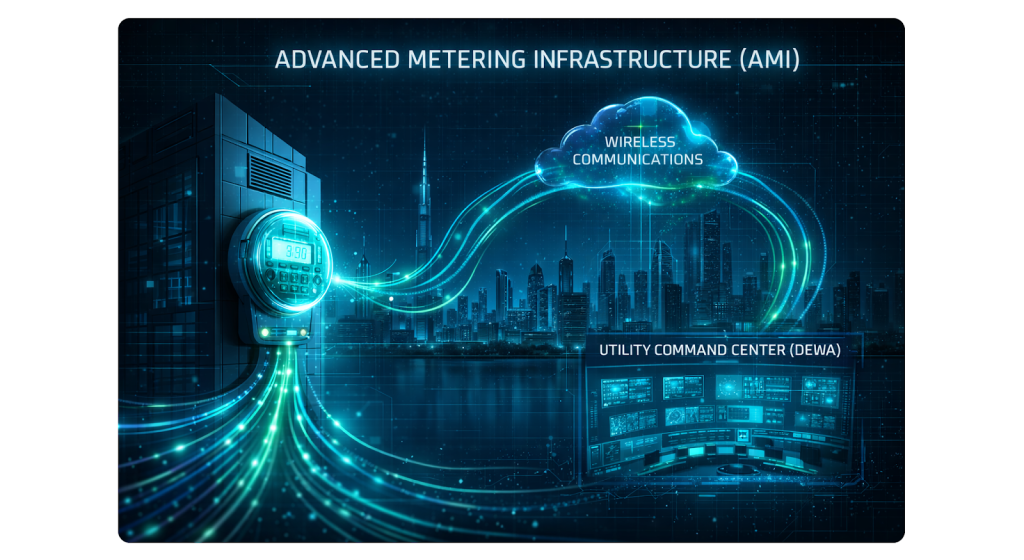
The foundational layer of any smart grid is visibility. You cannot manage what you cannot measure in real-time. This is the driving force behind DEWA’s complete replacement of traditional, analog electromechanical meters with a comprehensive Advanced Metering Infrastructure (AMI).
The Shift to Smart Meters
DEWA smart meters are vastly different from their predecessors. They are sophisticated digital devices equipped with embedded communication modules (often utilizing RF mesh networks or cellular telemetry).
- Two-Way Communication: Unlike legacy meters that require a human meter reader to visit the site monthly, AMI meters transmit consumption data back to DEWA’s central head-end system at granular intervals (e.g., every 15 minutes). Furthermore, DEWA can communicate to the meter, enabling remote connects/disconnects and pushing firmware updates.
- Granular Visibility and Anomaly Detection: This continuous stream of data provides unprecedented transparency. For DEWA, it means the ability to instantly detect localized power outages, voltage sags, and non-technical losses (power theft). For the building owner, tapping into this AMI infrastructure Dubai means the end of estimated billing and the beginning of real-time energy profiling. Owners can now pinpoint exactly when their building hits peak demand, identifying energy-wasting anomalies, such as chillers running unnecessarily at 3:00 AM, with surgical precision.
Demand Side Management (DSM) and Time-of-Use Tariffs
Historically, electricity in Dubai has been billed at a flat rate or a simple tiered rate based on total monthly consumption. The smart grid enables a far more sophisticated economic model designed to protect the grid from extreme peak loads, particularly during the grueling GCC summer afternoons.
The Mechanism of DSM
DEWA demand side management (DSM) aims to incentivize consumers to shift their heavy electrical loads away from peak hours (when generating power is most expensive and polluting) to off-peak hours.
- Time-of-Use (TOU) Tariffs: While not fully rolled out to all consumer classes yet, TOU tariffs are the inevitable future of the smart grid. Under a TOU structure, power consumed at 2:00 PM in July will be significantly more expensive than power consumed at 2:00 AM.
- Preparation Strategy: Building owners must begin time of use tariff preparation immediately. This requires upgrading main electrical panels to support load-shedding contactors and integrating Thermal Energy Storage (TES) systems. By producing chilled water or ice at night (when power is cheap) and circulating it during the day, a commercial tower can drastically slash its peak-hour electrical consumption, turning a regulatory shift into a massive financial advantage.
Integrating Distributed Energy Resources (DERs)
The smart grid is designed to support a decentralized power generation model. Rather than relying solely on massive coastal gas turbines, the grid of the future will rely on thousands of micro-generators distributed across the city’s rooftops.
Managing Localized Generation
The integration of solar panels (via the Shams Dubai initiative) and eventually localized Battery Energy Storage Systems (BESS) introduces complex engineering hurdles.
- Bidirectional Power Flow: Building distribution boards must be engineered for safe, bidirectional power flow. When a building’s solar array generates more power than the building consumes, the excess is pushed backward through the meter into DEWA’s network.
- The Synchronization Challenge: Smart grid solar integration requires profound precision. The solar inverters must perfectly match the voltage, frequency (50Hz), and phase angle of the DEWA grid before injecting power. If thousands of buildings inject unsynchronized power, or if they fail to instantly disconnect during a utility blackout (a failure of anti-islanding protection), it can cause catastrophic frequency instability across the entire DER synchronization network. Building owners must ensure their Interface Protection (IP) panels are equipped with utility-grade, smart-grid-compliant relays to manage this delicate interaction.
Building Management System (BMS) Interoperability
In older Dubai buildings, the Building Management System (BMS) is a “siloed” network. It controls the chillers, the lighting, and the pumps, but it operates in total isolation from the outside world. In the smart grid era, a closed BMS is obsolete.
The Era of the IoT-Ready Building
To capitalize on demand-side management, the building must be able to “listen” to the grid.
- Smart Grid Communication: DEWA’s smart grid will eventually send digital “demand response” signals directly to commercial buildings during peak stress events (e.g., “The grid is nearing maximum capacity; please reduce load by 10% for the next hour”).
- BMS Smart Grid Integration: For this to work, buildings require IoT electrical panels and an open-protocol BMS (using BACnet or Modbus IP over secure gateways) capable of interpreting these utility signals. The BMS will then automatically execute pre-programmed algorithms, such as raising the ambient temperature setpoint by 1 degree Celsius or dimming non-essential corridor lighting by 20%, to instantly drop the building’s megawatt load without requiring human intervention.

Automated Fault Restoration and Self-Healing Grids
One of the primary goals of DEWA’s smart grid investment is to achieve world-class reliability metrics (SAIDI and SAIFI) by virtually eliminating prolonged power outages.
The Self-Healing Mechanism
A self healing smart grid utilizes advanced Fault Location, Isolation, and Service Restoration (FLISR) technology.
- How it Works: If an underground 11kV cable faults in Business Bay, smart sensors detect the short circuit instantly. Automated motorized switches in the surrounding Ring Main Units (RMUs) open to isolate the damaged section, and alternative switches close to reroute power from an adjacent substation. This entire automated fault restoration process happens in milliseconds; customers might experience only a brief flicker of lights rather than a two-hour blackout.
- The Internal Engineering Challenge: While this is excellent for reliability, it poses a hidden threat to the building owner. Rapid, automated switching on the utility side can generate severe “transient overvoltages” (surges) that travel into the building’s internal network. Ensuring that your building’s internal main switchgear can handle these rapid switching events requires deep power systems analysis and the rigorous installation of properly coordinated Surge Protection Devices (SPDs) at the main incoming panels.
Cybersecurity for Connected Electrical Infrastructure
Connecting a building’s critical electrical infrastructure to the internet introduces a threat vector that simply did not exist twenty years ago: cyberattacks.
The New Threat Landscape
When switchgear, smart meters, and solar inverters are equipped with IP addresses for remote monitoring and control, they become potential targets for hackers. A compromised IoT switchgear security system could allow a malicious actor to remotely trip main breakers, plunging a hospital or data center into darkness, or manipulate meter readings.
- Securing the Perimeter: Smart grid cybersecurity must be integrated into the electrical design phase, not bolted on afterward. This involves establishing strict network segmentation, ensuring that the Operational Technology (OT) network controlling the electrical breakers is entirely isolated from the building’s public IT Wi-Fi network. It requires implementing robust firewalls, enforcing end-to-end encryption for all BMS-to-Grid communications, and adopting a “zero-trust” architecture for any remote maintenance access ports on the main distribution boards.
Vehicle-to-Grid (V2G) Readiness
The proliferation of electric vehicles (EVs) in Dubai is not just a transportation shift; it is a massive energy storage revolution.
The Building as a Battery
Currently, EVs pull power from the grid. However, DEWA’s long-term smart grid strategy envisions a future of Vehicle-to-Grid (V2G) technology.
- The Concept: A commercial office tower might have 200 EVs parked in its basement. Collectively, those cars represent several megawatt-hours of battery storage. During a peak pricing event at 3:00 PM, the smart grid could signal those cars to stop charging and instead discharge a small portion of their battery power back into the building, effectively powering the building’s chillers and entirely erasing the facility’s peak demand charge for the day.
- Infrastructural Requirements: Preparing for this requires highly specialized V2G electrical infrastructure. Standard AC chargers are generally unidirectional. V2G requires the installation of sophisticated DC bidirectional chargers. The building’s main electrical panels must be designed with bi-directional EV charging in mind, requiring advanced protection coordination to safely manage high-voltage DC power flowing backward from the parking garage into the main LV busbars.
Retrofitting Older Assets for Smart Compliance
While a new tower in Dubai Creek Harbour can be designed from the ground up for smart grid interoperability, what about a 30-year-old commercial building in Deira or Bur Dubai?
The Roadmap for Legacy Buildings
Retrofitting for smart grid compliance is a phased, strategic process. You cannot simply plug an IoT cable into a 1990s distribution board.
- Phase 1: Metering & Measurement: The first step in legacy electrical modernization is replacing archaic analog meters with smart, communicative sub-meters on all major tenant distribution boards and main chiller feeds. This establishes the baseline data required for future optimization.
- Phase 2: Intelligent Retrofitting: Instead of replacing massive, expensive Main Distribution Boards (MDBs) entirely, owners can retrofit existing panels with intelligent Molded Case Circuit Breakers (MCCBs) equipped with digital trip units and communication modules.
- Phase 3: The Gateway: Finally, a smart gateway device is installed to act as a translator, taking the raw data from these newly intelligent breakers and converting it into modern protocols (like MQTT or BACnet) that a cloud-based energy management system can read and optimize. This phased approach allows heritage buildings to integrate into DEWA’s smart grid without requiring a financially ruinous total strip-out of their electrical infrastructure.
Frequently Asked Questions (FAQ)
1. What is the difference between an old electricity meter and a DEWA smart meter?
An old analog meter simply mechanically records total power consumed, requiring a physical visit to read. A DEWA smart meter (AMI) is a digital device that records power usage continuously, measures power quality (voltage drops, etc.), and communicates this data wirelessly and securely back to DEWA several times a day for precise, real-time billing and grid management.
2. How will Time-of-Use (TOU) tariffs affect my commercial building’s utility bill?
Under TOU, electricity is not a flat rate. Power will be significantly more expensive during peak daytime hours (when grid demand is highest) and cheaper at night. If your commercial building runs its chillers and massive loads during the peak afternoon hours, your bills will increase. To save money, you will need to invest in smart controls or thermal storage to shift your power consumption to the cheaper night-time hours.
3. Can a hacker turn off my building’s power through the smart grid?
If your building’s internal IoT electrical panels and BMS are not properly secured, it is theoretically possible. This is why strict cybersecurity measures, like air-gapping operational technology (OT) from standard IT networks, using encrypted communication protocols, and changing default factory passwords on all smart breakers, are now mandatory elements of modern electrical engineering.
4. What is a “Self-Healing” grid and do I need to buy special equipment for it?
A self-healing grid is DEWA’s automated system that instantly reroutes power around a broken cable or fault, minimizing blackout times. As a building owner, you don’t buy the grid equipment, but you must ensure your building’s main incoming breakers are equipped with high-quality Surge Protection Devices (SPDs). The rapid, automated switching on DEWA’s side can send brief, high-voltage spikes into your building that can fry sensitive electronics if left unprotected.
5. Are bidirectional EV chargers available in Dubai now?
While the technology exists globally, the widespread deployment of bidirectional (V2G) chargers in Dubai is still in its infancy, largely pending finalized regulatory frameworks and tariff structures for discharging power back to the grid. However, forward-thinking developers are sizing their electrical rooms, conduits, and main breakers now to ensure they have the physical capacity to install V2G systems easily over the next 3 to 5 years.
Conclusion & Next Steps: Capitalizing on the Smart Grid
The rollout of DEWA’s smart grid initiatives represents the most significant evolution in Dubai’s electrical infrastructure in half a century. We are moving from a paradigm of blind, passive consumption to an era of dynamic, data-driven energy management.
For building owners, the writing is on the wall. Properties that fail to adapt, those running on “dumb” switchgear and isolated, analog management systems, will suffer from escalating operational costs, inability to capitalize on favorable tariff structures, and rapid depreciation in the eyes of technologically sophisticated, premium tenants. Conversely, owners who proactively embrace IoT panels, automated demand response, and bidirectional readiness will dramatically reduce their OPEX and future-proof their asset value for decades to come.
Don’t let your building get left behind in the analog age.
Transitioning your facility to meet the demands of a digital grid requires a partner with deep expertise in power systems, automation, and cybersecurity. Achieve absolute smart grid readiness Dubai by engaging our expert team. As a forward-thinking future proof electrical consultant, Elecwatts provides comprehensive electrical system design audits, legacy modernization strategies, and smart grid integration planning to ensure your facility thrives in the new energy economy.
Contact Elecwatts today to schedule a comprehensive smart grid readiness audit for your property.