

Entering the rapidly expanding industrial and commercial landscape of the Sultanate of Oman requires an uncompromising focus on infrastructure reliability. Securing an Oman electrical grid connection is a complex regulatory journey that spans multiple state-owned utilities and licensing boards. To smoothly navigate this multi-layered framework, partnering with an experienced electrical engineering consulting firm is essential to avoid costly project delays. Understanding how the regulatory bodies interface with private developers is the key to unlocking seamless, first-time approvals for any major capital investment.
The electrical sector in Oman is highly structured. The Authority for Public Services Regulation (APSR) acts as the supreme regulator, establishing the broad safety, economic, and performance standards for the country. Beneath APSR, the Nama Group (formerly holding the various regional unbundled utilities) serves as the master holding company managing the transmission and distribution assets.
While Omani utilities have undergone recent mergers and brand consolidations under the unified “Nama” banner, the technical procedures, regional offices, and engineering networks remain grounded in their historical operating territories. Navigating this network requires mastering both local municipal codes and Nama’s internal technical review gates to achieve a successful Nama Group electricity approval.
Identifying Your Distribution Company
A common point of confusion for international developers is assuming that a single utility governs the entire Sultanate. While transmission-level assets are centralized, distribution-level connections are managed regionally.
Depending entirely on the physical location of your plot, consultants must submit their engineering applications to the specific regional distribution company:
- Muscat Governorate: Historically managed by the Muscat Electricity Distribution Company (MEDC), securing an MEDC electrical approval is mandatory for all projects in the capital region, including major commercial complexes in Seeb, Ruwi, and Muttrah.
- Northern & Interior Regions: Projects located in Al Batinah, Ad Dakhiliyah, or Ash Sharqiyah fall under the jurisdiction of the former Mazoon Electricity Company. Securing a Mazoon electricity connection requires navigating a highly spread-out network of regional municipal offices.
- Western & Border Regions: Majan Electricity Company governs Al Dhahirah, Al Buraimi, and North Al Batinah.
- Dhofar Governorate: The southern region, centering around the industrial port city of Salalah, is managed by Dhofar Integrated Services Company (DISC).
The Climatic Challenge
Oman’s unique geography—stretching from the intense, humid coastal plains of Muscat to the rocky, high-altitude interior mountains of Jabal Akhdar and the monsoon-affected southern plains of Salalah—introduces severe design challenges. The utility distribution companies enforce localized equipment ratings to ensure assets do not degrade under these micro-climates, making geographical identification your very first engineering task.

The Oman Electrical Standards (OES) Framework
Every single wire, switchboard, and transformer installed in Oman must conform to the Oman Electrical Standards (OES). Developed to guarantee absolute safety and grid compatibility in the harsh Middle Eastern climate, the OES is the unyielding law of the Sultanate’s power sector.
The OES wiring regulations are incredibly precise, mandating specific rules that consultants must design for:
- Voltage Levels: Standard low-voltage distribution is maintained at $415\text{H}/240\text{V}$ three-phase at $50\text{Hz}$.
- System Grounding: Oman heavily prioritizes TT and TN-S earthing configurations depending on the consumer’s load and transformer ownership.
- Harmonic Limits: Non-linear loads (like VFDs and massive UPS systems) must not inject excessive harmonic pollution back into the grid, requiring strict adherence to OES harmonic limits.
- Thermal Design: Designers must assume extreme ambient temperatures (up to $50^\circ\text{C}$ air ambient) when calculating cable ampacity and sizing air-conditioning for electrical rooms, ensuring equipment does not overheat during the peak desert summer.
Failing to demonstrate absolute compliance with OES wiring regulations during the design phase will result in an immediate rejection of your engineering submittals.
The Initial NOC and Load Approval Stage
The physical journey to securing power begins long before any electrical rooms are constructed. It starts with establishing your power quota.
Securing the Municipal Clearance
The developer must first apply for an Oman electrical NOC (No Objection Certificate) through the unified municipal portals (such as the Muscat Municipality or Ministry of Housing and Urban Planning). This NOC coordinates the electrical path with other infrastructure, ensuring your proposed cable trenches do not clash with water mains, sewer lines, or telecom ducts.
The Load Demand Assessment
Once the municipal NOC is in hand, the formal application is submitted for MEDC load approval (or the relevant regional distribution utility).
- The Calculation: Engineers must submit a highly detailed load schedule calculating the connected load and Maximum Demand. This must incorporate specific diversity factors as mandated by OES guidelines.
- LV vs. MV Connection: The size of your Maximum Demand dictates how the utility connects you to the grid. If your demand is less than $100\text{kW}$, the utility will provide a standard Low Voltage (LV) connection. If your demand exceeds $100\text{kW}$, you must allocate land on your plot for a dedicated substation, transitioning the connection to Medium Voltage (MV) at $11\text{kV}$ or $33\text{kV}$.
High Voltage Connections and OETC Grid Code
For massive heavy industries, petrochemical plants in Sohar or Duqm, and large-scale utility projects, connecting at standard distribution voltages is impossible. These mega-developments require direct connections to the high-voltage transmission network.
The Role of the OETC
The Oman Electricity Transmission Company (OETC) is the sole owner and operator of the national high-voltage transmission grid (operating at $132\text{kV}$, $220\text{kV}$, and $400\text{kV}$). Securing an OETC grid connection is an intense, multi-disciplinary engineering effort.
Complying with the Grid Code
Developers must prove that their massive industrial facility will not destabilize the national network. This requires strict adherence to the Oman transmission grid code.
- Dynamic Simulations: The transmission grid code mandates the submission of advanced dynamic simulations, including transient stability studies, fault ride-through (FRT) compliance, and power quality impact assessments. The facility’s protection systems must be designed to execute fast fault clearing to ensure that any internal short-circuits do not cause localized voltage dips that ripple through the national high-voltage network.
Design Submission: SLDs and Substation Layouts
With the load approval and connection voltage locked in, the detailed engineering design phase begins. This is where the physical assets of the facility are drawn, calculated, and coordinated.
The Blueprint Package
Securing Oman electrical drawings approval requires the compilation of an airtight engineering package, including:
- Single Line Diagrams (SLD): Detailing the exact electrical distribution hierarchy, breaker ratings, metering locations, and protection relay configurations.
- Substation Layouts: If your load requires an on-plot substation, the MEDC substation design must adhere strictly to standardized utility dimensions. The room must feature direct street access for heavy utility maintenance vehicles, proper oil-containment pits (if using oil-filled transformers), and 2-hour fire-rated structural barriers.
- Power Quality Calculations: Detailed voltage drop and short-circuit studies proving that the selected equipment can safely handle normal and fault conditions.
Squeezing out Inefficiencies
At this stage, incorporating sustainable electrical systems design principles is highly advantageous. By optimizing cable routing, specifying ultra-high-efficiency transformers, and designing advanced lighting controls, consultants create energy-efficient layouts that align perfectly with the APSR’s national conservation goals, reducing your long-term operating costs.
Equipment Approval and DCRP Registration
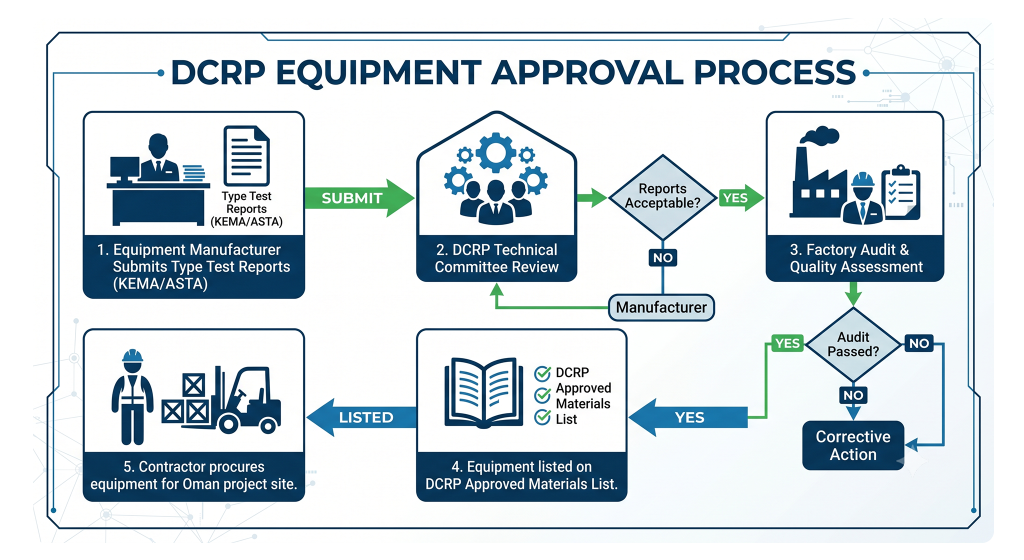
Oman’s power sector enforces a highly strict quality control firewall to prevent sub-standard materials and unqualified contractors from entering their grid. This firewall is managed by the Distribution Code Review Panel (DCRP).
Contractor Licensing
You cannot hire a generic electrical contractor to build your substation. The contractor must be a DCRP approved contractor Oman, holding a valid competency license graded (Grade A, B, C, etc.) based on the voltage level they are authorized to work on.
The Approved Materials Firewall
Similarly, every major piece of electrical equipment specified in your approved design—from high-voltage cables and RMUs to transformers and low-voltage distribution boards—must be sourced from the DCRP list of approved equipment. Obtaining Oman electrical equipment approval requires proving that the manufacturer has undergone rigorous type-testing at independent, accredited global laboratories (like KEMA or ASTA). Sourcing a cheaper, non-DCRP-approved transformer will result in an immediate rejection during the final site inspection, halting your project indefinitely.
Renewable Energy: The Sahim Initiative
The Sultanate is actively pushing to diversify its energy mix, targeting 30% renewable generation by 2030. For commercial and residential building owners, the primary vehicle for this transition is the “Sahim” (meaning “contribute” in Arabic) initiative.
The Distributed Solar Framework
The Sahim solar Oman program regulates the installation of small-scale, grid-tied rooftop solar PV systems. Connecting solar power to the grid requires specialized engineering.
- Interface Protection: The Oman solar grid connection requires the installation of a dedicated, utility-approved Interface Protection (IP) panel between the solar inverters and the main distribution board.
- Smart Inverters: Inverters must be selected from the DCRP-approved list, programmed with specific reactive power (Volt-VAR) capabilities to prevent local voltage rises during peak midday generation, and equipped with certified anti-islanding protection to ensure safety during utility grid blackouts.
Site Inspections and Testing Protocols
The final, high-pressure gateway to energization is the physical verification of the installation. Designing a compliant system on paper means nothing if the execution on-site is flawed.
The Inspector’s Checklist
The Oman electrical site inspection is notoriously thorough. The utility inspector will arrive with your approved SLD to verify that the physical installation matches the drawings exactly. They will scrutinize:
- Earthing Values: Physically measuring the earth pit resistance to ensure it complies with OES limits (typically $<1\text{ ohm}$ for substations).
- Workmanship: Checking for proper cable glanding, phase color-coding, and warning signage.
- Protection Relay Testing: Verifying that the relays are calibrated to the approved protection settings.
Achieving First-Time Success
To survive this high-stakes phase without failing, implementing robust Electrical Construction & Commissioning Management is vital. Meticulous commissioning management ensures that all contractor “pre-tests”—including primary and secondary injection testing, transformer insulation checks, and cable pressure tests—are perfected, documented, and signed off weeks before the official MEDC commissioning process or regional inspector arrives, ensuring a flawless, first-time switch-on.
Frequently Asked Questions (FAQ)
1. What is the role of the DCRP in Oman?
The Distribution Code Review Panel (DCRP) is a central regulatory body in Oman responsible for reviewing and approving the technical qualifications of electrical contractors and the quality standards of electrical equipment. Only DCRP-licensed contractors can execute work, and only DCRP-approved equipment can be connected to the Oman electrical grid.
2. What is the “Sahim” initiative and how does it work?
Sahim is Oman’s national program for distributed solar PV. It allows residential and commercial property owners to install grid-tied solar panels on their roofs. The solar power generated is consumed locally, and any excess is exported back to the grid via a net-metering scheme, offsetting the owner’s monthly Nama Group electricity bill.
3. What is the difference between an MEDC and a Mazoon electricity connection?
The technical standards (OES) are identical. The difference is purely geographical. MEDC (Muscat Electricity Distribution Company) governs the capital Muscat region, which is highly urbanized. Mazoon Electricity Company historically governed the vast northern and interior regions, which are more geographically dispersed. Under the unified Nama Group, these regional divisions maintain localized offices for processing applications.
4. What is the standard low-voltage distribution standard in Oman?
Oman operates on a three-phase $415\text{V}$ and single-phase $240\text{V}$ standard at $50\text{Hz}$ frequency. This is slightly higher than some neighboring countries (like Saudi Arabia or Dubai which use $400\text{V}/230\text{V}$), meaning electrical equipment specified for Oman must be rated to handle these higher voltage tolerances safely.
5. Why do Oman utility inspectors reject earthing systems?
The most common reason for rejection is high earth pit resistance, often caused by the exceptionally dry, rocky terrain of Oman’s interior regions. Standard shallow grounding rods cannot achieve the required low resistance ($<1\text{ ohm}$). Designers must use deep-drilled earth electrodes and specialized, moisture-retaining chemical grounding backfill to pass the site inspection.
Conclusion: Connecting the Sultanate
Successfully navigating the electrical grid connection process in the Sultanate of Oman is a demanding task that requires deep technical expertise, absolute OES compliance, and a clear understanding of the Nama Group’s regional administrative landscape. From the initial load demand assessments to the rigorous e-NOC clearances, DCRP material sourcing, and high-pressure site inspections, every phase represents a critical gateway that can delay your project if mismanaged.
Relying on generic designs, unapproved equipment, or uncertified contractors is a direct path to rejection. Achieving a seamless, first-time energization requires a dedicated, localized engineering strategy.
Developing critical infrastructure or a commercial facility in Oman?
Do not let regulatory bottlenecks or technical rejections stall your project. Partner with an expert electrical engineering consulting firm to manage your grid connections end-to-end. As a leading Oman electrical consultant, Elecwatts possesses the deep regulatory fluency, advanced system simulation capabilities, and technical due diligence required to navigate the Muscat electrical engineering and Nama Group approval processes flawlessly, getting your facility powered up safely and on schedule.
Contact Elecwatts today to secure your grid connections in Oman.