

In the heavy industrial sectors of the Gulf Cooperation Council (GCC), reliability is the ultimate measure of operational success. Whether managing a sprawling petrochemical complex in Jubail, a seawater desalination plant in Shuaiba, or a high-tech manufacturing facility in Dubai, unplanned downtime carries a devastating financial penalty. To safeguard these multi-million-dollar assets from catastrophic failure, developers partner with a premier electrical engineering consulting firm to move away from legacy, reactive work cultures.
In industrial operations, relying on a “fix it when it breaks” philosophy is a recipe for physical and financial disaster. When a critical low-voltage switchboard or a medium-voltage transformer fails unexpectedly, the cost of emergency repairs is only a fraction of the total loss. The true penalty is the staggering cost of halted production—which can easily exceed $\$100,000$ per hour in petrochemical and heavy refining sectors.
Building a highly structured, predictive electrical maintenance schedule is the only way to transition from chaotic firefighting to planned, data-driven reliability. Implementing a robust schedule tailored for GCC industrial plant maintenance ensures that your infrastructure is engineered to endure the harshest environmental stresses on the planet.
Stratifying Your Equipment (Criticality Analysis)
A common pitfall in industrial operations is treating every electrical asset with the exact same level of maintenance intensity. Attempting to run exhaustive predictive tests on every minor motor starter is a massive waste of technical resources. Conversely, underservicing a primary substation transformer guarantees an eventual catastrophic failure.
An optimized O&M program begins with a rigorous assessment of electrical equipment criticality. Engineers must divide the facility’s electrical assets into three distinct tiers using a comprehensive maintenance tiering strategy:
- Tier 1 (Critical to Operations and Life Safety): These are single-point-of-failure assets that immediately halt production or compromise human life if they fail. This tier includes the main incoming $33\text{ kV}$ or $11\text{ kV}$ substations, primary power transformers, emergency standby generators, main low-voltage switchgear (MDBs), and critical uninterruptible power supply (UPS) systems.
- Tier 2 (Important but Redundant): Assets that are vital to the process but feature built-in redundancy ($N+1$ or $2N$ configurations). This includes sub-main distribution boards, redundant process pumps, and secondary variable frequency drives (VFDs).
- Tier 3 (Run-to-Failure): Non-critical assets where the cost of preventative maintenance exceeds the cost of simple replacement. This includes office lighting circuits, small exhaust fans, and non-essential auxiliary systems.
Daily and Weekly Routines: The Visual Checks
The first line of defense in your maintenance schedule is the high-frequency, non-intrusive walkthrough. These visual and auditory audits are designed to catch early indicators of equipment stress before they escalate into active faults.
Technicians must execute a structured daily electrical inspection across all primary electrical rooms. This routine walkthrough relies on the sensory expertise of the maintenance team, requiring them to perform:
- Visual Switchgear Checks: Inspecting the indicators on all circuit breakers to verify they are in their normal operating state, checking for tripped flags, and ensuring that mimic panel layouts are correct.
- Environmental Auditing: Verifying that the dedicated HVAC units in the electrical rooms are running continuously and maintaining a stable, dust-free indoor climate. In the GCC, if an electrical room HVAC fails, the internal panel temperatures can spike past $50^\circ\text{C}$ in minutes, causing rapid thermal degradation of protection relays and control PLC systems.
- Sensory Inspections: Listening for unusual, high-pitched hums from dry-type transformers (indicating core clamping loosening) and checking for the distinct, sweet smell of burning insulation or ozone gas (indicating active corona discharge).
Monthly to Quarterly: Thermography and Cleaning
Moving beyond simple visual checks, the monthly and quarterly intervals introduce specialized diagnostic tools and physical interventions to combat the unique environmental enemies of the Middle East.
The relentless wind of the Arabian Peninsula carries ultra-fine desert sand that penetrates even high-IP-rated enclosures. When sand ingress combines with coastal humidity, it forms a highly conductive paste that coats insulators, causing devastating “tracking” faults and short circuits.
- The Cleaning Protocol: Quarterly schedules must prioritize comprehensive switchgear dust cleaning. This involves safely de-energizing non-critical panels to vacuum out internal dust, clean insulator surfaces with specialized solvent wipes, and verify the integrity of the panel’s mechanical dust seals.
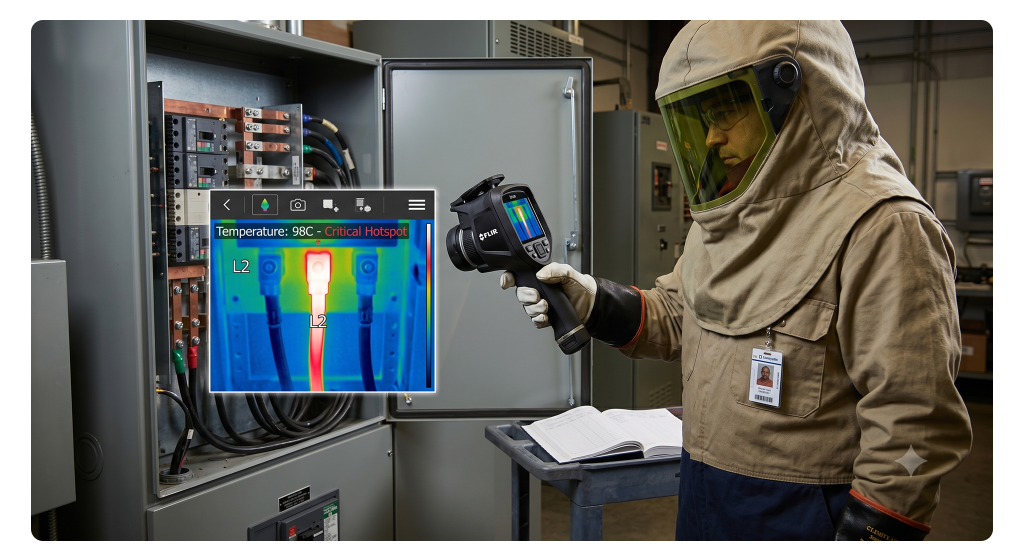
- The Thermographic Audit: Simultaneously, engineers must execute a comprehensive electrical thermography GCC scan. Using high-resolution infrared cameras, technicians scan live, under-load switchboards, busbars, and cable terminations. This non-destructive test instantly identifies “hot spots”—localized zones of intense thermal heat caused by loose bolted connections or unbalanced phase currents. Catching these high-resistance hotspots early prevents them from escalating into explosive phase-to-phase arc-flash fires.
Semi-Annual: Battery Systems and Backup Power
At the six-month mark, the focus of the maintenance schedule shifts to the critical safety nets of the facility—the systems designed to keep the plant safe and controlled during a primary grid blackout.
- UPS Battery Maintenance: Uninterruptible Power Supply (UPS) systems protect the digital brains (PLCs, DCS, and SCADA servers) of the industrial plant. Technicians must conduct meticulous battery health audits. This involves checking individual battery cell voltages, measuring internal resistance, and inspecting terminals for corrosive white sulfur buildup. A single failed cell in a battery string can cause the entire UPS bank to collapse during a grid transition.
- Generator Load Bank Testing: Emergency diesel generators must be physically tested under realistic operating conditions. Simply starting a generator and letting it idle is insufficient; it leads to “wet stacking”—unburned fuel buildup in the exhaust. The semi-annual schedule must incorporate rigorous generator load bank testing. Technicians connect temporary resistive-inductive load banks to the generator, forcing the engine to run at $100\%$ capacity for several hours, verifying its fuel systems, cooling loops, and automatic voltage regulators (AVR) under actual load stress.
Annual Shutdowns: Deep Testing and Lubrication
The annual planned plant shutdown is the most intensive and high-pressure phase of your maintenance program. It is the only window where engineers can safely de-energize primary substations to execute invasive mechanical and electrical testing.
This annual electrical shutdown requires a highly coordinated, military-grade execution sequence:
- Circuit Breaker Servicing: Massive draw-out air circuit breakers (ACBs) and vacuum circuit breakers (VCBs) must be racked out of their cradles. Technicians clean and lubricate the mechanical spring-charging mechanisms, inspect the arc chutes for carbon pitting, and measure the contact resistance of the primary poles.
- Primary Relay Testing: Commissioning teams connect secondary injection test sets to the digital protection relays to verify they still operate precisely according to the approved trip curves.
- Substation Cleaning: The entire substation structure is de-energized, allowing for deep cleaning of the high-voltage busbars, insulators, and cable basements, completely eliminating any accumulated environmental contamination.
3-to-5 Year Cycle: Oil Sampling and Advanced Diagnostics
Long-term predictive maintenance focuses on harvesting deep, molecular-level diagnostic data from your primary assets to map their remaining physical lifespan.
- Transformer DGA Testing: Large power transformers rely on insulating oil to cool and insulate their internal high-voltage windings. Over years of service, thermal and electrical stresses cause the oil to slowly break down, releasing microscopic trace gases. By executing transformer DGA testing (Dissolved Gas Analysis), laboratory chemists extract an oil sample and analyze the exact concentrations of dissolved gases like acetylene, methane, and hydrogen. This is the molecular equivalent of a blood test for the transformer, allowing engineers to identify active internal arcing or paper insulation degradation years before a physical failure occurs.
- Partial Discharge Mapping: For critical medium-voltage underground cables, engineers execute high-frequency partial discharge mapping. This test detects the microscopic electrical sparks (partial discharges) that occur inside degraded cable joints or water-damaged insulation layers, locating the exact physical coordinate of the defect along the cable run.
The System-Level Health Check
At this 5-year milestone, it is also critical to look beyond individual assets and evaluate the health of the entire power grid. Over a 5-year operational lifecycle, industrial plants undergo constant modifications—adding new production lines, modifying motor sizes, or expanding warehouses.
To ensure these additions haven’t compromised safety, developers must recalculate the system’s power load flow analysis. Running an updated simulation on your digital grid model mathematically proves that your branch cables are not overloaded, that voltage drops remain compliant, and that the original electrical plant engineering uae design boundaries are still fully intact under current load profiles.
Transitioning to Condition-Based Monitoring (CBM)
While calendar-based maintenance schedules are highly effective, the future of industrial reliability lies in transitioning away from fixed, arbitrary testing cycles and moving toward continuous, real-time tracking.
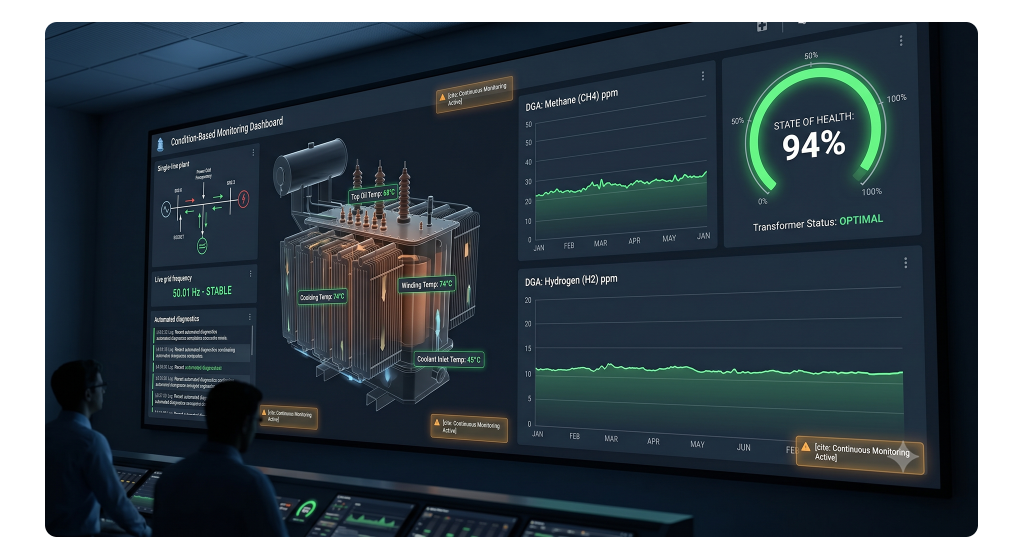
Implementing a highly sophisticated condition based electrical monitoring program relies on the deployment of advanced IoT switchgear sensors:
- Continuous Thermal Sensors: Non-intrusive wireless infrared or surface acoustic wave (SAW) sensors are permanently mounted directly onto critical busbar joints and cable terminations inside the switchboard.
- Continuous PD Sensors: High-frequency transient earth voltage (TEV) and ultra-high frequency (UHF) sensors continuously listen for the electromagnetic and acoustic signatures of active partial discharge inside medium-voltage cabinets.
- The Smart Transition: These smart sensors stream real-time health data directly into the plant’s computerized maintenance management system (CMMS). Instead of waiting for the annual shutdown to inspect a panel, the CMMS automatically triggers a high-priority work order the exact millisecond a busbar joint’s temperature rises by even $2^\circ\text{C}$ over normal operating thresholds, allowing for target-focused, predictive interventions.
Enforcing Strict LOTO and Arc Flash Safety Protocols
No electrical maintenance schedule, no matter how technically advanced, is viable if it does not prioritize the physical safety of the human technicians executing the work. Electrical maintenance in high-voltage industrial environments is inherently hazardous.
Every physical maintenance task—from a simple quarterly panel cleaning to the most complex annual shutdown—must be governed by rigid safety systems:
- Arc Flash Safety GCC: All technicians must be fully trained and equipped with the correct Category-rated personal protective equipment (PPE)—including flame-resistant suits, insulated gloves, and arc-flash face shields. Panels must feature permanently mounted, highly visible Arc Flash Hazard labels showing the calculated incident energy levels and safe boundary distances.
- Electrical LOTO Procedure: The golden rule of electrical safety is Lockout/Tagout. Before a technician opens a panel door or touches a terminal, the source circuit breaker must be physically racked out, locked in the “OFF” position using dedicated padlocks, and marked with a highly visible safety tag. The technician who owns the padlock is the only individual who holds the key, ensuring that no breaker can be accidentally energized while human hands are inside the switchboard.
Frequently Asked Questions (FAQ)
1. What is the difference between preventative and predictive electrical maintenance?
Preventative maintenance is a calendar-based schedule (e.g., cleaning switchgear every 3 months or servicing a breaker every year) regardless of the actual condition of the equipment. Predictive maintenance uses advanced diagnostic tools (like infrared thermography, oil DGA testing, or real-time IoT sensors) to evaluate the actual physical state of the asset, predicting and scheduling maintenance only when early signs of degradation are detected.
2. Why is “wet stacking” a major risk for industrial emergency generators?
Wet stacking occurs when a diesel generator is test-run without a sufficient electrical load. Without a heavy load, the engine does not reach its optimal operating temperature. Consequently, fuel is only partially burned, leaving a thick, sticky carbon residue (unburned fuel and oil) to accumulate in the engine’s cylinders and exhaust system. This degrades engine performance and poses a severe fire hazard. Generator load bank testing prevents this by forcing the engine to run at full thermal capacity.
3. How often should we conduct an infrared thermographic scan?
For heavy industrial sites operating under continuous load, an infrared thermographic scan should be conducted at least once every 6 months, ideally timed once during the peak summer load (July/August) and once during the lower winter load (January/February) to capture the thermal performance of your switchgear under different environmental stresses.
4. What is a “Dissolved Gas Analysis” (DGA) and how does it prevent failures?
DGA is a laboratory test performed on the insulating oil of a transformer. When localized overheating, electrical arcing, or partial discharges occur inside the transformer, they break down the chemical bonds of the oil, generating trace gases like acetylene, ethylene, and methane. By measuring the exact concentrations and ratios of these gases, engineers can diagnose active internal faults and schedule repairs long before a catastrophic explosion occurs.
5. Why is a system-level “power load flow analysis” required every 5 years?
As industrial plants grow, they constantly add new machinery, HVAC systems, and sub-panels. These modifications change the impedance and overall load profile of the facility’s power network. An updated power load flow analysis simulates the current state of your grid, verifying that your cables are not silently overloaded, that your voltage drops are within utility limits, and that your existing breakers are still coordinated to prevent site-wide blackouts.
Structuring for Reliability
Designing, scheduling, and executing a robust electrical maintenance schedule is the defining factor that separates a highly resilient, cost-effective, and safe industrial facility from an operational disaster zone. By stratifying your equipment based on criticality, enforcing strict visual, thermal, and chemical testing routines, and integrating advanced condition-based monitoring systems with your CMMS, you preserve the physical integrity of your multi-million-dollar power infrastructure for decades.
Relying on legacy, reactive maintenance cultures is a direct path to premature equipment failure, catastrophic blackouts, and devastating financial downtime.
Need to build a utility-compliant maintenance program?
Do not gamble your facility’s safety or risk massive insurance rejections on unverified maintenance schedules. Partner with our specialized engineering team to design a customized reliability roadmap for your facility. As a premier industrial O&M consultant, Elecwatts provides the certified technical due diligence, advanced system simulations, and comprehensive electrical engineering consulting required to build an ironclad, highly optimized electrical reliability schedule tailored to your exact industrial process.
Contact Elecwatts today to secure the operational health and reliability of your industrial asset.