

Executing massive infrastructure megaprojects in the Emirate of Abu Dhabi requires balancing technical complexity with regulatory compliance. At the forefront of this economic expansion are Zayed International Airport (formerly known as the Midfield Terminal) and the Khalifa Industrial Zone Abu Dhabi (KIZAD). To support these high-stakes capital investments, engaging a specialized electrical engineering consultancy early in the planning phase is vital to establish reliable, zero-downtime power networks.
Developing the Abu Dhabi Midfield Terminal electrical network and the surrounding KIZAD infrastructure design projects demands two vastly different, yet highly sophisticated, engineering approaches. While the airport terminal represents a highly sensitive, ultra-secure civil aviation environment where a single millisecond of power loss can compromise national security and life safety, KIZAD functions as a heavy industrial powerhouse, supporting massive aluminum smelters, chemical plants, and logistics cold-storage. Balancing these diverse operational profiles requires a deep understanding of Abu Dhabi’s specialized grid codes and utility structures.
Navigating ADDC and RSB Baseline Regulations
Regardless of whether a project is situated within KIZAD’s free zone or inside the airport’s security perimeter, the engineering baseline is governed by the same regulatory authorities.
All designs must strictly align with the RSB Abu Dhabi regulations (mandated by the Regulation and Supervision Bureau) and the detailed distribution codes enforced by the Abu Dhabi Distribution Company (ADDC). Achieving ADDC electrical compliance for high-capacity megaprojects is a rigorous, multi-tiered process.
Designers must submit comprehensive load flow studies, short-circuit calculations, and protection coordination maps through ADDC’s single-window portal. The utility will not allocate power or issue a No Objection Certificate (NOC) until the design proves mathematically that the proposed connection will not introduce harmonic pollution, voltage flicker, or power factor instability into the capital’s public grid.
Aviation-Specific Electrical Demands (Midfield Terminal)
The Zayed International Airport terminal is essentially a self-contained, high-density micro-city with highly specialized electrical demands that go far beyond standard commercial lighting and HVAC systems.
The core of aviation electrical design revolves around managing unique, high-frequency utility loads.
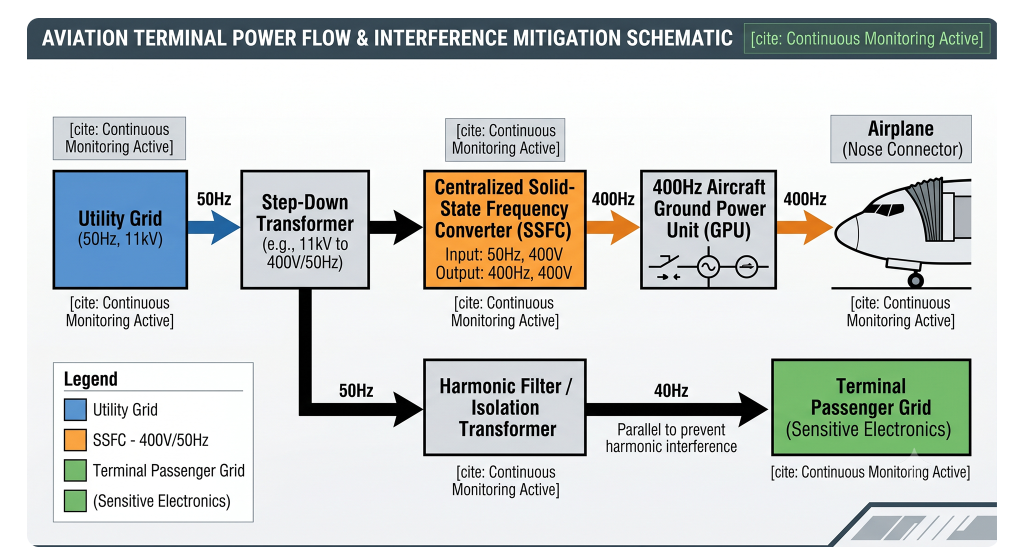
- The 400Hz Challenge: Modern aircraft parked at the passenger boarding bridges cannot run their auxiliary jet engines for power due to noise, emissions, and fuel costs. Instead, they must plug directly into the terminal’s airport 400Hz power supply system. Because transformer weight and size are inversely proportional to frequency:
- $$W \propto \frac{1}{f}$$
- utilizing a $400\text{ Hz}$ supply allows aircraft to use significantly lighter onboard components.
- The Power Conversion: This requires installing massive, centralized solid-state frequency converters (SSFCs) or rotary frequency changers that take the standard utility $50\text{ Hz}$ feed and convert it to $400\text{ Hz}$.
- Design Isolation: Utilizing expert electrical system design is mandatory to isolate these highly non-linear, harmonic-heavy frequency converters from the delicate passenger terminal grids, preventing interference with flight-control networks, baggage handling SCADA systems, and complex Airfield Ground Lighting (AGL) arrays.
[Placement for Image 1]
Industrial Heavy Loads at KIZAD
Shifting focus from the passenger terminal to the industrial heart of the Emirate, the KIZAD electrical infrastructure presents an entirely different set of heavy-engineering challenges.
KIZAD supports some of the most energy-intensive manufacturing facilities in the Middle East.
- Managing Inrush Currents: A primary concern is managing the startup surges of massive industrial motors. Starting a $15\text{ MW}$ compressor motor Direct-On-Line (DOL) can pull an inrush current up to six times its nominal operating current. This sudden draw represents an immense industrial motor load Abu Dhabi grids must absorb.
- Mitigation Sizing: To prevent localized voltage sags that can trip adjacent factories offline, the design must incorporate advanced Variable Frequency Drives (VFDs), soft starters, or localized capacitor banks, calculated to meet the strict voltage flicker limits set by ADDC.
2N and N+1 Redundancy Architectures
For both the airport terminal and critical industrial zones in KIZAD, power outages are completely unacceptable. Achieving zero-downtime reliability requires deploying highly redundant electrical architectures.
Critical operations—such as air traffic control, baggage sorting systems, and continuous-process chemical lines—utilize strict electrical redundancy Abu Dhabi standards, often designed to Tier-IV reliability guidelines:
- 2N Redundancy: The facility is fed by two completely independent, physically separated $33\text{ kV}$ or $11\text{ kV}$ utility lines from different ADDC primary substations. If one substation collapses or a street cable is cut, the secondary line instantly supports the entire load.
- N+1 Redundancy: For the airport backup power generators and UPS systems, an extra unit ($+1$) is always kept on standby. If the plant requires four synchronized diesel generators to support emergency flight systems, the design specifies five units ($4\text{+1}$), ensuring that even during generator maintenance, the system retains full emergency capacity.
[Placement for Image 2]

Complex Cable Routing in Infrastructure Megaprojects
The sheer physical scale of the Midfield Terminal and KIZAD makes cable routing an intensive civil-electrical coordination effort.
- The Spatial Challenge: Millions of meters of high-voltage and medium-voltage cables must navigate these zones. Rather than relying on simple direct burial, which is difficult to maintain and vulnerable to excavation damage, these projects utilize dedicated underground utility tunnels or massive overhead pipe racks.
- The Routing Mandate: Managing a utility tunnel cable routing layout requires advanced engineering. The tunnels are crowded environments containing electrical, telecom, and wet services.
- Preventing Thermal Runaway: Applying precise Cable Design Engineering is essential. Engineers must calculate precise grouping and thermal derating factors, taking into account the restricted ventilation inside the concrete tunnels to prevent thermal runaway. Cables must be specified with low-smoke zero-halogen (LSZH) sheathing and installed on heavy-duty, fire-stopped metallic trays, ensuring a safe high voltage cable layout that prevents fire propagation.
Estidama Pearl Rating and Sustainable Integration
Abu Dhabi is a global leader in enforcing sustainable, green building practices through its mandatory Estidama (“sustainability” in Arabic) Pearl Rating System.
Every new government or commercial building, including the airport terminal extensions and KIZAD administrative hubs, must meet strict Estidama Pearl targets (typically a minimum of a 2-Pearl or 3-Pearl rating).
- The Design Impact: Achieving Estidama electrical compliance heavily alters the baseline electrical design. Designers must incorporate high-efficiency dry-type transformers with low core losses, smart metering systems that track consumption at every sub-panel, daylight harvesting systems that automatically dim office lights based on natural sunlight, and roof-mounted solar PV systems. This integrated approach ensures the facility meets the strict energy-reduction targets of the Abu Dhabi green building codes.
SCADA and Smart Grid Integration
Operating massive industrial zones and airport terminals as unified, efficient systems requires advanced digital automation. These facilities do not rely on local, manual switching; they operate as smart micro-cities.
Both KIZAD and Zayed International Airport are monitored by a highly centralized, redundant infrastructure SCADA system.
- Real-Time Monitoring: This control network connects thousands of Intelligent Electronic Devices (IEDs)—including smart protection relays, power meters, transformer temperature sensors, and UPS controllers—via a highly secure, fiber-optic ring network.
- The Smart Interface: This smart grid integration allows operations teams to monitor real-time power quality, execute automated load-shedding schemes during utility grid events, and perform automated switching sequences remotely, bridging the facility with the broader smart grid Abu Dhabi initiatives.
Staggered Commissioning and FAT Requirements
The final transition from construction to operations in a megaproject is a highly complex logistical process. You cannot simply turn the entire facility on at once.
To manage this safely, the project must implement a staggered commissioning schedule.
- Verifying at the Source: Long before on-site commissioning begins, all customized medium-voltage switchboards, SSFCs, and power transformers must undergo a rigorous switchgear FAT Abu Dhabi (Factory Acceptance Test) at the manufacturer’s facility, witnessed by certified inspectors and ADDC representatives.
- Phased Energization: During the final site phase, the megaproject commissioning GCC methodology must manage the phased energization of specific airport concourses or KIZAD industrial plots. The testing teams must establish strict physical and electrical safety barriers to ensure that live, energized substations are completely isolated from adjacent sectors where construction and cable pulling are still actively underway.
Frequently Asked Questions (FAQ)
1. Why do airports use a 400Hz power supply instead of the standard 50Hz/60Hz?
Aircraft use $400\text{ Hz}$ power because the weight of magnetic cores (in transformers and motors) is inversely proportional to the operating frequency. By utilizing $400\text{ Hz}$ instead of $50\text{ Hz}$, the aircraft’s onboard electrical generators and motors can be made up to eight times lighter, drastically reducing the aircraft’s empty weight and improving fuel efficiency.
2. What is the difference between ADDC and the RSB in Abu Dhabi?
The RSB (Regulation and Supervision Bureau) is the supreme regulatory body that establishes the electrical wiring, safety, and performance standards for the Emirate of Abu Dhabi. ADDC (Abu Dhabi Distribution Company) is the government-owned utility company that owns, operates, and maintains the physical distribution network, enforcing the RSB’s codes during design reviews and site inspections.
3. What is Estidama and how does it impact electrical design?
Estidama is Abu Dhabi’s mandatory green building framework that rates projects using “Pearls” based on their sustainability. It impacts electrical design by mandating strict energy reduction targets. To comply, engineers must specify high-efficiency transformers, deploy comprehensive smart sub-metering systems, use smart LED lighting with occupancy sensors, and integrate renewable energy sources like rooftop solar PV.
4. How are large motor starts managed in KIZAD to prevent voltage dips?
To prevent massive inrush currents from causing voltage sags on KIZAD’s grid, designers are prohibited from starting large motors Direct-On-Line (DOL). Instead, they must utilize advanced Variable Frequency Drives (VFDs) or soft starters to gradually ramp up the motor speed, keeping the localized voltage flicker well within the strict limits mandated by ADDC.
5. Why are utility tunnels used instead of direct burial for cables in megaprojects?
Concrete utility tunnels are preferred in major infrastructure hubs because they provide a highly secure, controlled environment that protects high-voltage cables from mechanical damage, water ingress, and desert soil stresses. Tunnels also allow maintenance crews to easily inspect, test, and upgrade cables without having to execute disruptive, expensive excavation work across active runway taxiways or industrial roads.
Engineering for the Capital
Successfully executing high-voltage infrastructure designs in Abu Dhabi’s Zayed International Airport or KIZAD requires a profound technical mastery of both local utility grid codes and specialized industry requirements. From the $400\text{ Hz}$ frequency conversion needs of aviation terminals to the massive starting currents of KIZAD’s industrial motors, every single connection, cable, and switchboard must be engineered with unyielding precision.
Relying on generic designs or ignoring the strict, localized mandates of the RSB and ADDC is a direct path to design rejection, procurement waste, and catastrophic commissioning delays.
Bidding on a project in KIZAD or Zayed International Airport?
Do not let regulatory hurdles or complex load requirements derail your execution. Partner with an independent specialist to secure your design approvals and power connections. Contact us to schedule a certified engineering review. As a premier Abu Dhabi electrical consultant and leading KIZAD engineering firm, Elecwatts delivers the certified technical due diligence, advanced dynamic simulations, and professional utility coordination required to power your capital infrastructure flawlessly.
Contact Elecwatts today to secure your Abu Dhabi megaproject approvals.