

For investors and financial institutions in the GCC, a utility-scale solar project represents a significant capital deployment, often running into the hundreds of millions of dollars. Before a single cent is released, the project undergoes an “engineering X-ray” known as Technical Due Diligence (TDD). The quality of this audit directly dictates the risk profile and the ultimate return on investment.
However, not all TDD reports are created equal. A superficial report can act as a rubber stamp, hiding fatal flaws that only surface after the contracts are signed and the panels are installed. As an investor, being able to spot the solar project due diligence red flags in these reports is a critical skill. This guide reveals the seven critical warning signs that a high-quality diligence process must uncover to protect your capital.
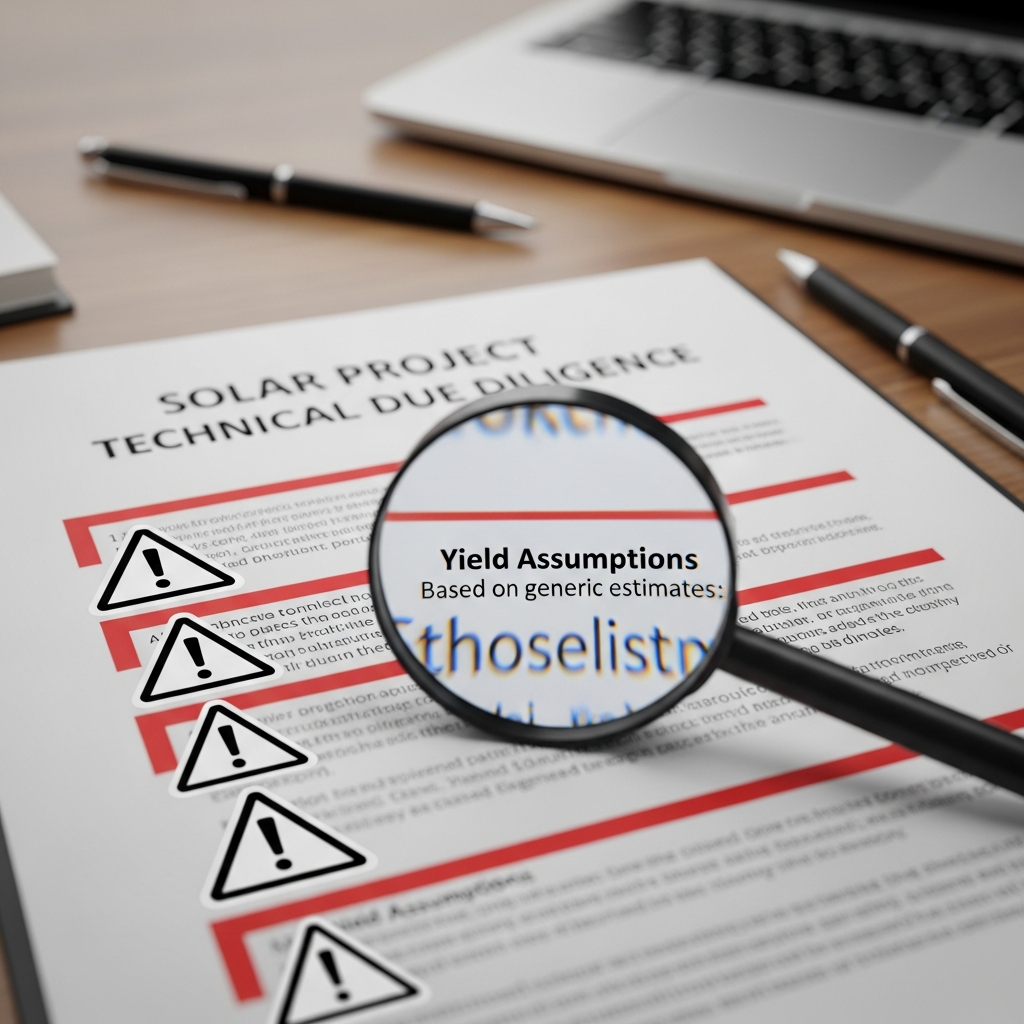
The Role of Technical Due Diligence: More Than a Box-Ticking Exercise
Technical Due Diligence is often mistaken for a mere compliance step. In reality, its purpose is to stress-test every technical assumption that underpins the project’s financial model. From the yield forecast to the lifespan of the inverters, the TDD report verifies if the engineering reality matches the financial spreadsheet. It is the primary document that determines solar project bankability.
Ensure your project is bankable. Explore our Lender’s & Owner’s Engineering services and Climate & Renewable Energy Finance support.
Red Flag #1: Overly Optimistic or Unverifiable Energy Yield Forecast (P50/P90)
The yield forecast is the cornerstone of your revenue model. A major red flag occurs when the TDD report simply accepts the developer’s yield model without independent validation.
- What to Look For: A lack of independent meteorological data sources (relying solely on one satellite database), no sensitivity analysis for inter-annual variability, or the use of inappropriate historical weather years that don’t reflect climate trends.
- The Risk: A solar P50 yield forecast that overestimates generation by even 5% can devastate equity returns and lead to debt service shortfalls. The report must rigorously question the underlying data and methodology to ensure energy yield assessment accuracy.
Red Flag #2: Inadequate Site-Specific Soiling & Degradation Analysis
In the GCC, dust (soiling) is the dominant performance loss factor. Generic assumptions here are a major risk to technical due diligence solar GCC processes.
- What to Look For: The use of a static, low soiling loss rate (e.g., “standard 3%”) without a detailed analysis of local dust composition, rainfall patterns, and the proposed cleaning strategy (manual vs. robotic).
- The Risk: Real solar panel soiling loss GCC can exceed 15% in neglected periods. If the report doesn’t model the specific cost and efficiency of the cleaning robots, the Operational Expenditure (OPEX) will be underestimated, and revenue will be crushed.
Red Flag #3: Vague or Incomplete Technology & O&M Due Diligence
This is the “black box” risk—accepting equipment and maintenance plans without looking under the hood.
- What to Look For: A missing deep-dive on inverter cooling capabilities (critical for 50°C+ desert heat), a lack of review on the functional specifications of the Battery Management System (BMS) or Energy Management System (EMS), and the acceptance of vague O&M contracts without strict Key Performance Indicators (KPIs).
- The Risk: Without rigorous solar inverter due diligence, you risk premature component failure, high unscheduled maintenance costs, and unclear accountability for performance shortfalls.
Red Flag #4: Weak Grid Connection and Power Curve Analysis
The grid connection is the project’s lifeline to revenue. A report that glosses over this puts the entire solar investment risks profile in the red.
- What to Look For: Lack of verification of the grid connection agreement’s technical clauses, no independent review of the Power Plant Controller (PPC) logic, or missing analysis of whether the transformer and cable ratings can handle peak output at high temperatures.
- The Risk: This leads to grid connection risk solar projects fear most: Curtailment (the grid turning off your plant), inability to pass commissioning tests, or costly forced upgrades to meet grid code requirements post-construction.
Red Flag #5: Superficial EPC & Contractual Review
Engineering does not exist in a vacuum. A major red flag is a TDD report that stays purely “technical” and ignores the alignment with the Engineering, Procurement, and Construction (EPC) contract.
- What to Look For: Failure to check if the EPC contractor’s proposed technology matches the lender’s technical specifications, or if liability caps and warranty pass-through provisions are inadequate to cover potential defects.
- The Risk: If the EPC contract review solar section is weak, the owner—not the contractor—bears the cost for design flaws or equipment failures due to legal loopholes.
Red Flag #6: Missing Constructability & Schedule Risk Assessment
Can the project actually be built on time and on budget? A report that doesn’t assess execution is incomplete.
- What to Look For: No review of geotechnical reports for foundation design (crucial in sandy or rocky GCC soil), no analysis of supply chain risks for critical components (like transformers), or an uncritical acceptance of an aggressive construction schedule.
- The Risk: Cost overruns, delays in reaching the Commercial Operation Date (COD), and subsequent financial penalties that eat into the project’s margin.
Red Flag #7: Lack of a Clear, Actionable Risk Mitigation Plan
This is the ultimate test of a TDD report’s value. Identifying problems is only half the job; the report must solve them.
- What to Look For: A report that lists findings but does not prioritize them by financial impact or provide clear recommendations (e.g., “Holdback X% of payment until yield is validated” or “Require extended warranty on inverters”).
- The Risk: The investor is left with a list of worries but no roadmap to resolve them. A robust risk mitigation plan solar project section is essential to de-risk the deal and allow financing to close.
Frequently Asked Questions (FAQs)
Q1: Who typically commissions a technical due diligence report?
Primarily the project’s lenders (banks) to protect their debt, and equity investors/infrastructure funds to protect their capital. However, savvy sellers (developers) also commission them (“Vendor Due Diligence”) to pre-empt issues and speed up the sale process.
Q2: When in the project lifecycle is it done?
Most commonly at financial close, before funds are released for construction. It is also critical during project acquisitions (M&A) to assess the health of an operating asset before buying it.
Q3: What’s the difference between a lender’s engineer and an owner’s engineer in this context?
A Lender’s Engineer works for the bank, focusing strictly on risks to debt repayment and downside scenarios. An Owner’s Engineer works for the project company, focusing on ensuring the project is built and operated to meet its business plan and upside potential. The TDD scope differs accordingly.
Q4: Can a project proceed if red flags are found?
Yes, but not “as-is.” Significant findings usually lead to “Conditions Precedent” (CPs) in the loan agreement or specific mitigation measures (e.g., additional insurance, escrow accounts, or revised contracts) that must be satisfied to de-risk the investment
Conclusion
A robust Technical Due Diligence report is an investor’s primary tool for converting technical uncertainty into managed risk. It should not be a static document filed away at closing, but a foundational guide for the project’s entire lifecycle.
Don’t let a substandard due diligence report put your capital at risk. Our multi-disciplinary engineering team acts as your independent technical advisor, delivering the depth of analysis required to secure financing and safeguard your investment in GCC solar projects.
Contact ElecWatts to discuss your specific due diligence needs.