

In the high-stakes execution of commercial, residential, and industrial construction projects in Abu Dhabi, time is an incredibly expensive asset. As construction draws to a close, developers, consultants, and contractors face the ultimate gatekeeper of the power grid: the Electrical Inspection Authority (EIA). Successfully navigating this final phase requires a specialized electrical engineering consulting partner who can bridge the gap between design theory and physical compliance. If the site fails its final walkthrough, the consequences are immediate and severe.
The EIA, operating in close coordination with the Abu Dhabi Distribution Company (ADDC), is tasked with protecting the integrity, safety, and stability of the Emirate’s electrical grid. Passing the ADDC electrical inspection is the definitive prerequisite for meter installation and final power-on. Too often, projects hit the “95% trap,” where construction is physically complete, but the facility sits dark for months due to recurring inspection failures. Securing your EIA approval Abu Dhabi demands an uncompromising approach to quality control, a deep understanding of local wiring regulations, and a proactive defense against the most common technical rejections.
Rejection 1: SLD vs. As-Built Discrepancies
The single most frequent reason for failing an EIA inspection is a lack of alignment between the approved design documents and the physical site installation.
During the site walkthrough, utility inspectors will carry your stamped, approved Single Line Diagram (SLD) and compare it directly to the physical switchgear, breakers, and cables. Over the course of a fast-track construction cycle, it is common for contractors to make unauthorized field changes—such as substituting a different frame-size circuit breaker due to procurement issues or rerouting a major feeder cable to avoid a mechanical duct.
These undocumented changes lead to an immediate SLD discrepancy rejection. The inspector will not accept the explanation that the modification was “technically equivalent.” To pass, the physical build must match the approved drawings to the letter, or the contractor must submit formal ADDC as-built drawings through the e-services portal and secure a revised design approval before booking the final site inspection.
Rejection 2: Non-Compliant Earthing and Bonding
An electrical system is only as safe as its connection to the earth, and in Abu Dhabi’s dry, highly resistive desert soil, grounding is heavily scrutinized.
The Regulation and Supervision Bureau (RSB) enforces some of the strictest grounding guidelines in the world. Inspectors will physically witness Abu Dhabi earth pit testing to ensure the earth loop impedance and overall grid resistance comply strictly with RSB earthing regulations (typically requiring less than 1.0 ohm for utility-connected substations and main low-voltage panels).
Beyond the earth pits themselves, a major source of failure is missing or incomplete equipotential bonding. All exposed, non-current-carrying metallic parts of the building’s infrastructure—including metallic cable trays, building structural steel, raised floor pedestals, and incoming metallic water pipes—must be continuously and visibly bonded back to the main earth bar. If the inspector finds a single segment of cable tray lacking an earth jumper braid, the entire earthing submittal is rejected.
Rejection 3: Switchgear Clearance and Room Sizing
Electrical rooms are the critical nerve centers of any facility. However, in the race to maximize leasable or usable square footage, architects often squeeze these rooms down to the absolute minimum, creating severe spatial violations.
The ADDC electrical room size and layout are governed by uncompromising safety and maintenance clearances.
- Front Clearances: Inspectors will measure the physical space in front of all Low Voltage (LV) panels. Standard regulations typically mandate a minimum of 1.2 to 1.5 meters of unhindered clearance to allow operators to safely rack breakers in and out and escape during an emergency.
- Rear and Side Clearances: For rear-access switchgear, a minimum of 1.0 meter must be maintained behind the panels.
- Common Spatial Rejections: Rejections run rampant when inspectors find that the mandatory switchgear clearance Abu Dhabi zones are blocked by structural columns, or when the electrical room is being used by the contractor as a temporary storage closet. Most critically, any “wet services” (water supply pipes, AC condensate drains, or drainage lines) routed directly above or through the electrical room are a cause for immediate, non-negotiable rejection.
Rejection 4: Failure to Use ADDC Approved Materials
One of the most rigid quality control firewalls in the GCC is the utility’s pre-qualification system. ADDC maintains a highly policed, continuously updated list of approved manufacturers and equipment.
During the procurement phase, contractors are often tempted to swap out specified, high-end components for cheaper, off-the-shelf alternatives to save on costs or bypass long manufacturing lead times.
If the site inspector identifies that the installed cables, busbars, circuit breakers, or transformers are not sourced from the ADDC approved vendor list (AVL), the inspection is failed instantly. The contractor will be forced to completely strip out the non-compliant equipment and replace it with materials sourced from the authorized AVL electrical materials UAE registry. There are no deviations or waivers granted for non-AVL materials at the final inspection stage.
Rejection 5: Improper Cable Color Coding and Labeling
A safe electrical installation must be easy to navigate, maintain, and troubleshoot. Poor, incomplete, or illegible labeling is a direct indicator of substandard workmanship and is a major trigger for compliance failures.
The RSB cable color code is absolute and must be followed across the entire low-voltage network:
- Phase L1: Red
- Phase L2: Yellow
- Phase L3: Blue
- Neutral: Black
- Protective Earth: Green/Yellow
Inspectors will inspect the internal wiring of every distribution board. If they find standard black wires used for phases without proper colored sleeving, or if the permanent, heat-shrink ferrule labels on the cables are missing or illegible, they will reject the panel. Furthermore, every distribution board must feature a permanently mounted, highly accurate, typewritten circuit directory card. Hand-written labels or empty, unlabeled breaker slots are an immediate cause for failure under electrical panel labeling UAE guidelines.
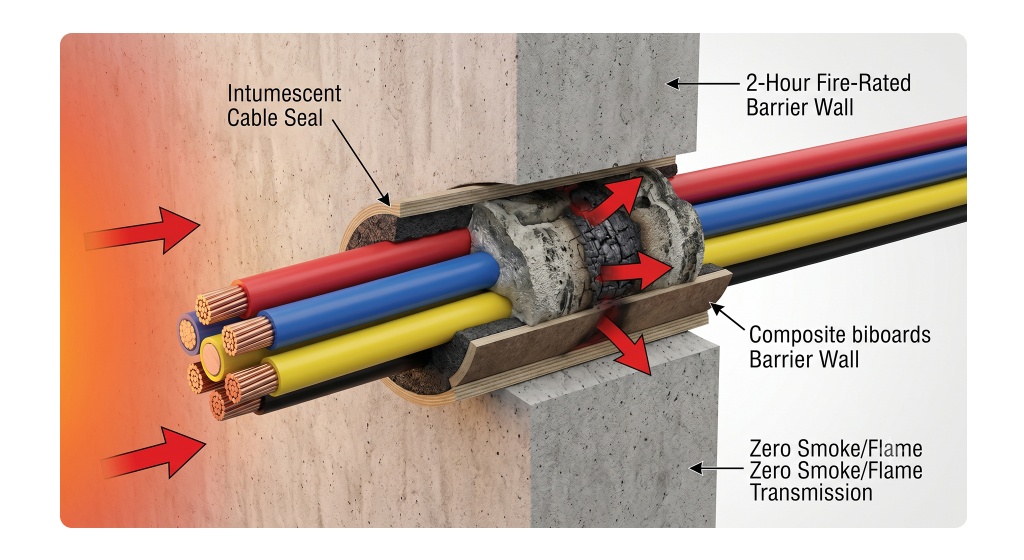
Rejection 6: Inadequate Fire Stopping and Sealing
Electrical rooms and cable risers are the primary highways through which power travels in a building. If left unsealed, they also act as perfect chimneys, allowing toxic smoke and flames to rapidly bypass fire-rated walls and spread throughout the facility.
The intersection of ADDC regulations and Abu Dhabi Civil Defense standards mandates rigorous electrical fire stopping Abu Dhabi protocols.
- The Failure: Contractors often run cables through a wall penetration and simply pack the remaining gap with cheap, non-rated expanding foam or standard cement mortar.
- The Requirement: Every single cable, conduit, or busbar transit that penetrates a fire-rated wall or floor slab must be completely sealed using a certified, multi-layer intumescent cable seal system. Under the heat of an actual fire, these specialized seals expand up to 40 times their original volume, crushing the melting plastic cables and completely blocking the passage of smoke and heat, preserving the building’s fire compartmentation. Inspectors will physically check these seals at every penetration point.

The Role of the Third-Party Inspector (TPI)
For high-capacity connections, heavy industrial facilities, and complex high-rise developments, the sheer volume of electrical testing required can overwhelm the standard utility inspection schedule. To streamline this process, ADDC has codified the integration of independent, accredited testing bodies.
The ADDC third party inspection (TPI) process acts as a highly effective pre-filter. A certified TPI agency must be engaged by the contractor to conduct comprehensive, independent testing of the entire high-voltage and low-voltage network before the official ADDC or EIA inspector is invited to the site.
The TPI team will execute rigorous TPI electrical testing—including primary and secondary injection testing of protection relays, ductor (contact resistance) testing on busbar joints, and insulation resistance testing on all main feeders. The certified TPI test reports, stamped and signed off by the independent testing engineers, form a mandatory component of your final submission package, providing the utility with empirical proof of the installation’s physical and operational integrity.
Conducting a Flawless Pre-Inspection Audit
Failing a utility inspection is not an unavoidable risk; it is the direct result of poor on-site coordination and inadequate pre-commissioning. The only way to guarantee a first-time pass rate is to implement a strict, proactive quality control program weeks before the utility is called.
Contractors must develop and execute a comprehensive electrical pre-inspection checklist. This internal audit must mimic the exact inspection paths and technical criteria utilized by the EIA. Every single cable gland, earth pit, labeling ferrule, and clearance zone must be physically inspected, verified, and signed off by the lead project engineer.
Implementing robust Electrical Construction & Commissioning Management is the defining factor in this phase. This specialized project management discipline ensures that the ADDC commissioning procedure is executed in a highly structured, documented sequence. By resolving any “snags” internally and compiling all TPI test reports into a flawless, transparent submittal package, the commissioning manager ensures that the official utility inspection is turned from a high-risk trial into a routine, successful formality.
Frequently Asked Questions (FAQ)
1. What is the difference between ADDC and the EIA?
ADDC (Abu Dhabi Distribution Company) is the government utility company that owns and operates the water and electricity network in Abu Dhabi. The EIA (Electrical Inspection Authority) is the specific regulatory inspection division tasked with physically auditing, testing, and approving new or modified consumer installations to ensure they are safe to connect to the ADDC grid.
2. Why does the EIA reject electrical rooms with wet services passing through them?
Water and high-voltage electricity are a lethal combination. If a pressurized water pipe, a sewer line, or an AC condensate drain routed above an electrical panel leaks, it can cause catastrophic short circuits, explosive arc flashes, and total equipment destruction. Under RSB regulations, routing any non-electrical wet services through or directly above an electrical room is strictly prohibited.
3. Can I use copper-clad aluminum (CCA) cables to pass an ADDC inspection?
Absolutely not. RSB and ADDC wiring regulations strictly mandate the use of high-purity, solid or stranded copper (or approved solid aluminum for specific high-voltage feeders) conductors. Copper-clad aluminum cables have inferior electrical conductivity and are highly susceptible to galvanic corrosion, making them an immediate cause for inspection rejection.
4. What is the maximum allowable resistance for a substation earth pit in Abu Dhabi?
Under strict RSB earthing regulations, the overall resistance of a primary substation or main low-voltage grounding grid must be less than 1.0 ohm. For standard distribution boards and minor installations, the earth pit resistance must typically be kept below 5.0 ohms. High-resolution testing is witnessed by the inspector to verify these values.
5. How does the ADDC e-NOC portal integrate with the physical inspection?
The e-NOC (No Objection Certificate) portal is the digital gateway where you secure design and routing approvals before construction begins. The physical site inspector will carry a copy of the approved drawings generated from this portal. If your physical site installation deviates from the approved e-NOC drawings, the inspection fails immediately.
Achieving First-Time Pass Rates
Securing utility energization in the Emirate of Abu Dhabi is a highly structured, uncompromising process that leaves absolutely no room for shortcuts, low-quality materials, or uncoordinated installations. Passing your final EIA inspection requires absolute, seamless alignment between the approved design schematics and the physical reality of the constructed site. From the precision of your as-built drawings to the exact color-coding of your cables, the depth of your earth pit testing, and the fire-integrity of your penetration seals, every element of your electrical infrastructure is a critical factor in public and grid safety.
Treating the inspection phase as a minor, administrative hurdle at the end of the project is a guaranteed path to costly rejections, project delays, and financial penalties.
Struggling with complex utility approvals or failed inspections?
Do not let regulatory bottlenecks delay your facility’s opening or compromise your asset value. Rely on a premier Abu Dhabi electrical consultant to streamline your compliance journey. Our specialized team possesses the deep regulatory fluency and technical due diligence required to navigate the EIA compliance UAE framework flawlessly. Through our comprehensive Project Lead Engineering & Management services, we audit your designs, oversee your installations, and manage your pre-commissioning audits to guarantee first-time utility pass rates.
Contact Elecwatts today to secure your EIA approvals and power up your Abu Dhabi project on schedule.