

In the rapidly expanding urban and industrial landscape of Abu Dhabi, securing a reliable power connection is a critical milestone that dictates the success of any construction project. To navigate this complex regulatory gateway efficiently, partnering with an expert electrical engineering consultancy from the very beginning is absolutely vital. The primary gatekeepers for electrical connections in the Emirate are the Abu Dhabi Distribution Company (ADDC) for the central and western regions, and the Al Ain Distribution Company (AADC) for the eastern region.
Securing your AADC electrical connection or mastering the ADDC approval process requires far more than submitting basic blueprints. The Emirate operates under the strict guidelines established by the Regulation and Supervision Bureau (RSB)—now integrated into the Department of Energy (DoE). Complying with these rigorous RSB wiring regulations is paramount; a single non-compliant cable size or mismatched load calculation can result in cascading project delays, rejected applications, and severe budget overruns. This comprehensive guide breaks down the multi-stage approval journey, providing project managers and contractors with the actionable insights needed to secure utility energization without the headache.
Pre-Requisites and Competency Requirements
Before you can even initiate an application on the utility portals, your administrative foundation must be rock solid. ADDC and AADC operate a strictly gated system to ensure only qualified professionals design and build their network connections.
The Licensing Mandate
You cannot bypass the competency requirements. Only an officially licensed and registered ADDC approved contractor or an accredited Abu Dhabi electrical consultant can submit applications and stamp drawings. If your firm does not hold the specific Department of Energy competency licenses, you must partner with an approved firm to act as your Engineer of Record.
Preliminary Documentation
The application gateway requires specific, up-to-date documentation to prove the legality and spatial boundaries of your project:
- Valid Trade Licenses: For both the owner and the executing contractors.
- Affection Plan (Site Plan): Issued by the Abu Dhabi Municipality (ADM) or the relevant free zone, detailing the exact plot coordinates.
- Building Permit: The approved ADM building permit verifying that the architectural and structural plans have been sanctioned.
The Preliminary Load Demand (PLD) Submission
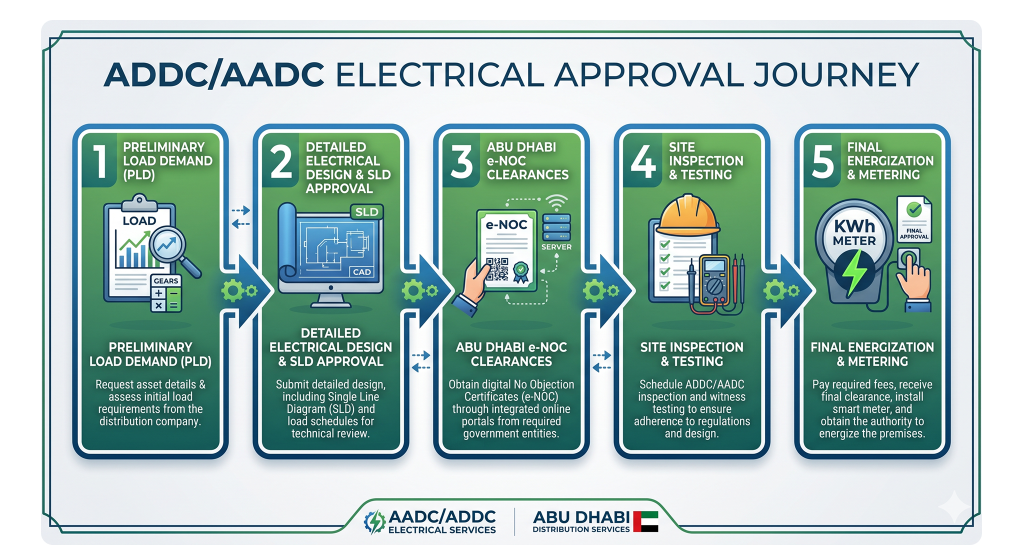
The first technical step is declaring how much power your facility will consume. The utility needs this data early to ensure their local grid network and primary substations have the capacity to host your project.
Securing Power Allocation
Submitting the ADDC preliminary load demand (PLD) establishes your power quota. This is not a rough estimate; it is a calculated projection of your facility’s total energy footprint.
- The Diversity Factor Challenge: Engineers must perform an accurate electrical load calculation Abu Dhabi style. This involves applying specific diversity factors based on the building type (e.g., residential villa, heavy industrial warehouse, or high-rise commercial tower) as dictated by RSB guidelines. Overestimating your load might force you to pay for an unnecessary, dedicated on-plot substation. Underestimating the load will result in tripping breakers and a costly redesign when the utility refuses to allocate more power later in the project.
Detailed Electrical Design and SLD Approval
Once your power quota is allocated, you must prove to the utility exactly how you intend to distribute that power safely within your building. This is the most heavily scrutinized engineering phase.
The Technical Submission
The core of this submission is the ADDC single line diagram (SLD). This comprehensive drawing must detail the main incomer, the distribution hierarchy, metering locations, and the earthing arrangement.
- Calculations: The SLD must be backed by rigorous math. You must submit precise voltage drop calculations (ensuring the drop does not exceed the allowed limits at the furthest point) and short-circuit calculations to prove your breakers can handle a fault without exploding.
- The Engineering Edge: Securing electrical drawing approval UAE from ADDC requires absolute precision. Partnering with experts in electrical system design ensures your SLDs, earthing layouts, and load schedules meet the RSB’s uncompromising technical review on the very first attempt, eliminating the dreaded “Revise and Resubmit” cycle that paralyzes construction schedules.
Switchgear and Equipment Compliance
ADDC and AADC do not allow unverified equipment to connect to their grid. Every major component specified in your approved design must meet stringent quality and safety standards.
The Approved Vendor List (AVL)
Your procurement team must select equipment strictly from the ADDC/AADC Approved Vendor List (AVL). Sourcing a cheaper transformer or main breaker from a non-approved manufacturer will result in an immediate rejection during the site inspection.
LV Panel Specifications
For LV panel approval Abu Dhabi, the switchgear must be assembled by an approved local panel builder.
- The Documentation: The documentation package must prove that the ADDC approved switchgear meets specific criteria, including Internal Arc Classification (IAC) to protect operators during a fault, and adequate Ingress Protection (IP) ratings. For outdoor installations in the UAE, panels must typically carry IP55 or higher ratings to withstand fine desert sand and coastal humidity, along with certified temperature rise tests validating performance in 50°C ambient heat.
Navigating the e-NOC Portal
In Abu Dhabi, you cannot dig a trench or lay a cable without ensuring you won’t disrupt other critical city infrastructure. The digital gateway for this coordination is the Abu Dhabi e-NOC (No Objection Certificate) system.
Unified Clearances
The ADDC portal submission process is highly integrated. Before finalizing your external cable routing from the utility connection point to your building, you must route your drawings through the e-NOC portal to secure clearances from all overlapping authorities.
- This involves coordinating with the Abu Dhabi Water Authority, Etisalat/Du (telecommunications), the Department of Transport (DoT), and Abu Dhabi Civil Defense (ADCD). The e-NOC system ensures your proposed electrical trench does not clash with a pressurized water main or a fiber-optic bundle, preventing catastrophic utility strikes during excavation.
The Crucial Site Inspection (Work Completion)
Once the physical installation is complete, the project transitions from paper compliance to physical verification. The ADDC site inspection is notoriously thorough.
The Inspector’s Checklist
The ADDC or AADC inspector arrives to verify that the reality on the ground matches the approved SLD down to the smallest detail.
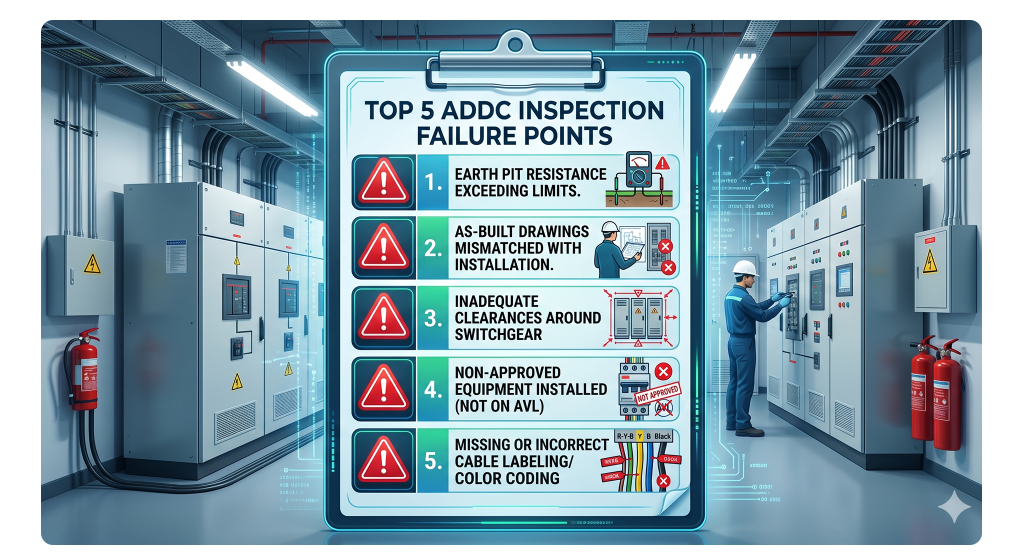
- Earthing: They will physically measure the earthing pit resistance values to ensure they fall below the required threshold (typically <1 ohm).
- Labeling and Color Coding: All cables must feature proper identification tags, and the phase color coding must strictly adhere to RSB standards.
- Clearances: The inspector will measure the operational and maintenance clearances around the main switchgear to ensure safety protocols are met.
Common Failure Points
Securing an immediate pass for electrical testing Abu Dhabi requires avoiding common pitfalls. Sites frequently fail inspections because contractors made “minor” on-site modifications to the panel boards without seeking revised approvals, or because the submitted “As-Built” drawings do not perfectly reflect the final installation.
Energization and Meter Installation
Passing the inspection triggers the final administrative sequence. You are now authorized to connect to the grid.
The Final Steps
- Certifications: You must secure the final Building Completion Certificate from Abu Dhabi Municipality (ADM) and submit it to the utility.
- Fees: The owner must settle all required connection fees and security deposits.
- The Switch-On: Once the administrative holds are cleared, you schedule the ADDC meter installation. Utility engineers will arrive to install the tariff meters and execute the final physical connection to the grid.
- Commissioning Coordination: Achieving seamless power energization Abu Dhabi requires impeccable timing. Expert Electrical Construction & Commissioning Management keeps the main contractor, the facility management team, and the ADDC field technicians perfectly synchronized for the final switch-on, ensuring a safe and controlled power-up sequence for the building.
Integrating Solar PV (Abu Dhabi Solar Policy)
Abu Dhabi is rapidly expanding its distributed renewable energy capacity. If your facility includes a rooftop solar array, you must navigate a parallel approval path.
The Renewable Gateway
Connecting solar power to the grid falls under specific Department of Energy (DoE) regulations. Securing an Abu Dhabi solar connection requires specialized engineering.
- Interface Protection: ADDC requires robust Interface Protection (IP) panels for grid-tied solar systems. These utility-grade relays ensure that if the ADDC grid fails, your solar panels instantly disconnect (anti-islanding) to protect utility workers.
- Approval Process: The ADDC renewable energy submission must include detailed harmonic studies, solar yield calculations, and proof that the selected solar inverters are fully compliant with Abu Dhabi’s specific grid codes for fault ride-through and power quality.
Frequently Asked Questions (FAQ)
1. What is the difference between ADDC and AADC?
The Abu Dhabi Distribution Company (ADDC) manages the water and electricity networks for the central and western regions of the Emirate (including Abu Dhabi city and Al Dhafra). The Al Ain Distribution Company (AADC) manages the networks exclusively for the eastern region (Al Ain city and its surrounding areas). The technical RSB standards are identical for both.
2. Can I use DEWA-approved equipment for an ADDC project?
Not automatically. While there is often overlap between high-quality manufacturers, ADDC/AADC maintains its own specific Approved Vendor List (AVL). Even if a piece of switchgear is approved in Dubai (DEWA), you must verify it is explicitly listed on the Abu Dhabi AVL before procuring it for a project in the capital.
3. What is the RSB and why is it important?
The Regulation and Supervision Bureau (RSB)—now integrated into the Abu Dhabi Department of Energy (DoE)—is the regulatory body that sets the technical rules for the water and electricity sectors in the Emirate. The “Electricity Wiring Regulations” published by the RSB is the definitive rulebook that all ADDC/AADC electrical designs and installations must follow.
4. How long does the ADDC electrical approval process take?
If the documentation is flawless, the Preliminary Load Demand (PLD) and SLD approvals can take 2 to 4 weeks. However, coordinating the e-NOC clearances across multiple government departments can add significant time. If drawings are rejected due to technical errors, the process can easily drag on for several months.
5. Do I need an ADDC approved consultant for a small villa renovation?
Yes. Any modification to the electrical load, the main distribution board, or the utility meter requires official approval. Only a licensed and registered ADDC/AADC approved electrical contractor or consultant can log into the portal to submit the required “Addition/Modification of Load” requests.
Conclusion & Next Steps: Fast-Tracking Your Power Connection
Successfully navigating the ADDC and AADC approval process is not a matter of luck; it is the result of meticulous preparation, flawless documentation, and an uncompromising adherence to the RSB wiring regulations. From the initial load demand calculations to the final e-NOC clearances and site inspections, every step represents a potential bottleneck that can derail your project schedule.
By treating the utility approval process as a critical engineering discipline rather than a mere administrative chore, developers and contractors can eliminate the cycle of rejections, streamline their procurement, and ensure a seamless path to energization.
Need to expedite your Abu Dhabi project?
Do not let regulatory hurdles delay your handover. Rely on an expert ADDC approval consultant to navigate the complexities for you. Contact Elecwatts to manage your electrical design Abu Dhabi submissions end-to-end. We provide the certified engineering rigor required to secure your ADDC/AADC approvals on the first attempt, getting your facility powered up safely and on schedule.
Contact Elecwatts today to fast-track your electrical utility connections in Abu Dhabi.