

As the major electrical markets of Riyadh and Dubai experience high developer concentration, forward-thinking engineering firms are shifting their sights toward adjacent opportunities within the Arabian Peninsula. Establishing a footprint in the Bahrain electrical market and securing licenses for Kuwait electrical engineering consultants represent highly lucrative, long-term avenues for growth. However, entering these markets requires a complete shift in administrative and technical execution.
While the fundamental laws of electrical physics remain constant across borders, the bureaucratic landscapes, grid codes, and environmental extremes are highly unique. To safely navigate these entry barriers, partnering with a registered electrical engineering consulting firm early in the market entry phase is critical to avoid immediate utility rejections. Success in these nations depends entirely on abandoning standard “copy-paste” regional designs and building localized, highly tailored engineering workflows that respect the unique mandates of local utility departments.
Kuwait MEW (Ministry of Electricity and Water) Overview
The power sector in the State of Kuwait is centralized under a single, highly structured governmental body: the Ministry of Electricity and Water Kuwait (MEW). Unlike other GCC regions where independent private entities manage different sections of the grid, Kuwait’s MEW directly owns, operates, and regulates the entire generation, transmission, and distribution network.
Operating under Kuwait MEW regulations requires designing systems capable of withstanding some of the most punishing climatic conditions on Earth. During the peak summer months, ambient air temperatures in areas like Mitribah routinely exceed $54^\circ\text{C}$, driving the national cooling load to astronomical levels.
This extreme thermal stress means that Kuwait’s electrical infrastructure must run continuously at near-maximum capacity, leaving virtually zero margin for design errors. MEW engineers enforce a highly rigid, conservative review process for all new connections, prioritizing grid safety and thermal headroom above all else.
Bahrain EWA (Electricity and Water Authority) Overview
Across the border in the Kingdom of Bahrain, the regulatory authority is the Electricity and Water Authority (EWA), which executes its distribution mandates through the Electricity Distribution Directorate (EDD). Designing for the Bahrain EWA electrical standards requires managing a completely different set of geographical and physical constraints.
As a highly dense, urbanized island nation, Bahrain faces severe physical spatial limits. The EDD regulations Bahrain enforces are heavily optimized around compact spatial planning.
- The Footprint Challenge: Developers cannot afford the luxury of sprawling outdoor switchyards or oversized utility plots.
- The Engineering Solution: Consultants must design highly compact, indoor Gas Insulated Switchgear (GIS) substations and tightly coordinated electrical rooms that integrate seamlessly into premium real estate master plans without violating strict safety, ventilation, and emergency escape codes, making spatial optimization a primary engineering gate.
Prequalification and Registration Processes
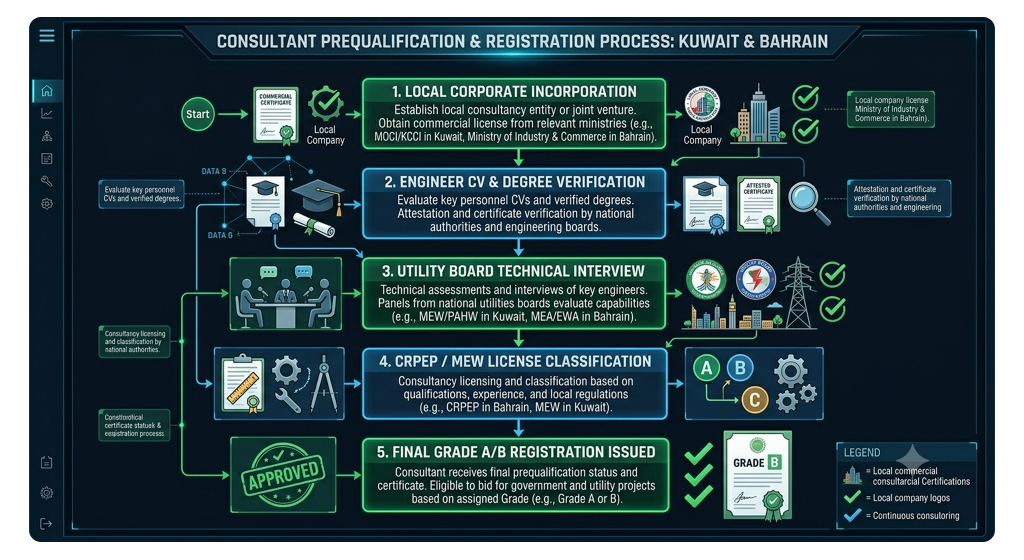
Before a foreign engineering consultancy can submit a single drawing or load calculation to the utilities, they must navigate a strict, multi-tiered licensing firewall.
The Kuwait MEW Gateway
To secure a MEW consultant registration, foreign firms must typically establish a formal joint venture or local partnership with a licensed Kuwaiti engineering office. The firm’s lead electrical engineers must submit their certified university degrees, professional CVs, and proof of chartership to the MEW technical committee. The engineers are then subjected to a rigorous, in-person technical interview conducted by senior MEW utility directors. Only after passing this interview is the firm granted a Grade A, B, or C license, defining the maximum voltage level they are legally authorized to design and sign off on.
The Bahrain EWA Gateway
The process to become an EWA approved engineering firm follows a similar, highly regulated path managed by the Council for Regulating the Practice of Engineering Professions (CRPEP) in Bahrain. The licensing board evaluates the firm’s global track record, financial stability, and the specific competency of its local resident engineers before granting the statutory licenses required to submit packages for utility approval.
Earthing Systems and Ambient Temperature Derating
While both Kuwait and Bahrain align their technical frameworks with British Standards and the IEC, they apply highly localized safety modifications to account for their environments.
Kuwait’s Thermal Derating Mandates
Because the desert sands of Kuwait absorb immense thermal energy, underground cables are subjected to extreme operating temperatures. When sizing underground feeder cables, engineers must apply the strict Kuwait cable derating factors mandated by MEW regulations. The calculations must assume a maximum soil temperature of $35^\circ\text{C}$ at a burial depth of $1.0\text{ meter}$, and an extreme ambient air temperature of $50^\circ\text{C}$ for cables installed in free air or on trays.
To calculate the derated continuous current-carrying capacity ($I_z$) of a power cable, engineers must apply localized correction factors:
$$I_z = I_k \times f_1 \times f_2 \times f_3$$
Where $I_k$ is the nominal current-carrying capacity in free air under standard IEC conditions, $f_1$ is the temperature correction factor (which drops sharply to $0.70$ or lower under Kuwait’s $50^\circ\text{C}$ air ambient), $f_2$ is the cable grouping derating factor, and $f_3$ is the soil thermal resistivity correction factor (assuming a harsh soil thermal resistivity of $2.0\text{ K}\cdot\text{m/W}$). Ignoring these factors leads to rapid thermal runaway and catastrophic cable failures.
Bahrain’s Grounding Mandates
Conversely, in Bahrain, the primary challenge is the highly saline, corrosive coastal soil. The Bahrain earthing standards strictly regulate the design of the grounding grid. Standard copper rods driven into saline coastal mud will suffer rapid galvanic corrosion, leading to a complete failure of the earthing path within years. Consultants must specify advanced, solid-core copper earth electrodes encased in specialized, non-corrosive chemical grounding backfills to maintain a stable, long-term earth loop resistance of less than $1.0\text{ ohm}$ under all conditions.
Load Schedules and Drawing Formatting
One of the most common reasons for immediate drawing rejection during utility reviews is submitting documentation formatted to the standards of neighboring countries.
Sizing the MEW Load Schedule
When compiling a MEW load schedule in Kuwait, the calculations must be presented using highly specific Excel templates mandated by the utility.
- The Diversity Penalty: The diversity factors applied to HVAC loads are far more conservative than those used in the UAE or Europe. MEW assumes that during the peak summer, all air-conditioning units will operate continuously at $100\%$ capacity, meaning you cannot apply standard diversity factors to your cooling calculations.
- kVA vs. kW Demands: Load schedules must explicitly calculate the Total Connected Load in kilowatts ($kW$) and the Total Maximum Demand in kilovolt-amperes ($kVA$), assuming a strict, minimum power factor of $0.90$ lagging.
Navigating EWA Approvals
In Bahrain, securing an EWA electrical drawing approval requires submitting a highly detailed, multi-page Single Line Diagram (SLD) package. The drawings must feature dedicated sections showing the exact metering boundaries, the physical lockable isolation switches for utility operators, and the precise wiring schematics of the under-voltage and over-current protection relays, ensuring the utility’s engineers can audit the entire system flow at a glance.
Strict Procurement: Kuwait’s KPC and MEW Vendor Lists
In both Kuwait and Bahrain, procuring materials for a utility-connected project is heavily restricted. Contractors cannot simply purchase materials from any global supplier; they must operate within a highly policed Approved Vendor List (AVL).
The AVL in Kuwait is particularly rigid. Any project interfacing with the public utility or heavy industrial zones managed by the state oil sector must source materials strictly from the MEW and Kuwait Petroleum Corporation (KPC) pre-qualified registries.
- The Material Sourcing Shield: Utilizing an expert Electrical Plant Procurement framework is vital during the early design phase. This proactive procurement strategy ensures that every transformer, high-voltage cable, and medium-voltage switchboard specified in your design is sourced from a manufacturer on the MEW approved vendor list and meets the rigid KPC electrical materials specifications.
- Bahrain’s Approach: While Bahrain’s EWA material approval process offers slightly more flexibility for specialized, custom components, they still enforce strict type-testing requirements (such as certified KEMA or ASTA test reports) for all main low-voltage distribution assets, completely eliminating the possibility of low-quality material substitutions.
Substation Dimensioning and Plot Allocation
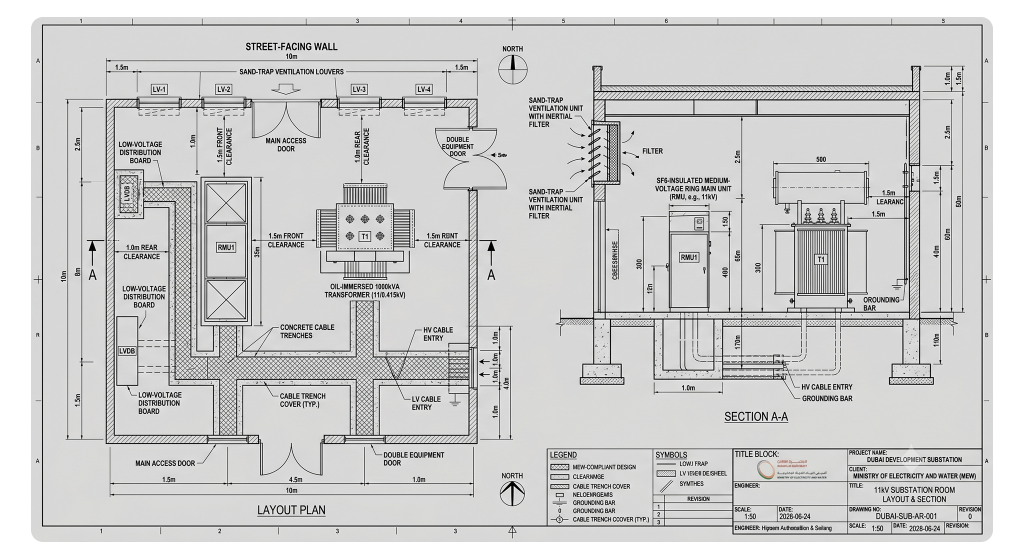
For any project requiring a power connection exceeding $100\text{ kVA}$, the developer must allocate dedicated land on their plot to build a utility substation. The design of these substation rooms is a high-stakes civil-electrical coordination effort.
Under the Kuwait MEW substation design codes, the dimensions of the substation room are absolute and non-negotiable.
- The Physical Footprint: A standard $11/0.4\text{ kV}$ indoor substation requires a highly specific, minimum footprint (typically $7.0\text{ meters}$ by $8.0\text{ meters}$ with a minimum internal clear height of $4.0\text{ meters}$).
- Ventilation and Access: The room must feature direct, unobstructed street-front access doors to allow MEW maintenance crews to drive heavy trucks directly up to the switchgear. It must also incorporate highly specific sand-trap louver dimensions to allow natural ventilation while blocking the ingress of fine, blowing desert sand.
- Trenching Depths: The cable basement or trenches beneath the substation must meet strict depth requirements (minimum $1.5\text{ meters}$) to ensure the heavy, high-voltage cables can meet their mandatory minimum bending radiuses without stress.
Failing to meet these spatial codes in your Bahrain EWA electrical room or Kuwait substation layouts will lead to an immediate rejection of your civil building permits.
Managing Regulatory and Project Risks
Expanding into new GCC territories introduces significant regulatory, legal, and operational risks that can quickly drain a consulting firm’s financial reserves.
The primary risk in these markets is the duration of the utility review cycles. Both Kuwait and Bahrain utilities are thorough, and experiencing GCC utility approval delays of several months is a common operational hurdle.
- Protecting the Firm: To insulate your engineering practice from catastrophic professional indemnity claims during these delayed approvals, implementing robust Net zero risk management solutions is a mandatory requirement.
- The Safety Shield: This specialized electrical engineering risk management framework combines comprehensive technical due diligence with strategic professional indemnity insurance. By proving that your designs are mathematically flawless, fully aligned with the latest MEW/EWA codes, and backed by certified calculations, you eliminate any legal liability if site delays or construction clashes occur.
Frequently Asked Questions (FAQ)
1. What is the minimum power factor allowed by MEW in Kuwait?
Kuwait’s MEW strictly mandates that all consumer installations maintain a minimum power factor of $0.90$ lagging under full load conditions. If a facility’s power factor falls below this threshold, the owner faces significant monthly utility penalties, and MEW reserves the right to disconnect the service until a compliant capacitor bank or active power factor correction system is installed.
2. Can I use an approved DEWA transformer in a Bahrain EWA project?
Generally, no. While both utilities operate on similar IEC principles, Bahrain’s EWA enforces its own highly specific Approved Vendor List (AVL) and localized technical standards. A transformer approved by DEWA in Dubai must still undergo the formal pre-qualification and material approval process with EWA’s technical committee before it can be legally connected to the Bahrain grid.
3. Why are Kuwait’s cable derating factors so much stricter than those in Europe?
Because of Kuwait’s extreme summer climate. High summer temperatures heat the dry, sandy soil to over $35^\circ\text{C}$ at a depth of one meter, drastically reducing the soil’s ability to dissipate heat. To prevent the cables from overheating and suffering catastrophic insulation breakdown under full load, the cables must be significantly oversized (“derated”) compared to the standards used in cooler climates.
4. What are the grading levels for registered MEW consultants in Kuwait?
MEW registers consultants under three primary classifications:
-
- Grade A: Authorized to design and supervise high-voltage and medium-voltage installations up to the highest grid limits.
-
- Grade B: Authorized for medium-voltage and low-voltage systems up to $11\text{ kV}$.
-
- Grade C: Restricted solely to standard low-voltage commercial and residential installations.
5. What are the rules regarding “wet utilities” near electrical rooms in Bahrain?
Under strict EWA and EDD regulations, routing any wet utility pipes—including domestic water supplies, sewage lines, or air-conditioning condensation drains—directly through, above, or beneath an electrical room or substation is strictly prohibited. This prevents the catastrophic short-circuits and explosive arc flashes that would occur if a pipe leaked onto live switchgear.
Establishing a Regional Foothold
Successfully executing electrical designs, securing utility connections, and managing capital assets in the State of Kuwait and the Kingdom of Bahrain require an uncompromising technical mastery of both standard international codes and highly specialized local regulations. From the extreme, high-temperature cable derating requirements of Kuwait’s MEW to the compact, spatial substation layouts of Bahrain’s EWA, every single cable, panel, and room footprint must be engineered with absolute precision.
Attempting to bypass these strict utility frameworks or ignoring the local Approved Vendor Lists is a guaranteed path to project rejection, procurement waste, and long construction delays.
Expanding your project portfolio into Kuwait or Bahrain?
Do not let complex local codes or bureaucratic delays stall your market entry. Partner with an established, regional specialist to secure your design approvals and power connections seamlessly. Contact us to schedule a certified engineering review. As a premier Bahrain electrical consultant and leading Kuwait engineering partnership facilitator, our electrical engineering consulting firm delivers the certified technical due diligence, advanced dynamic simulations, and professional utility coordination required to power your regional expansion flawlessly.
Contact Elecwatts today to secure your MEW and EWA project approvals.