

The deployment of Battery Energy Storage Systems (BESS) is accelerating across the Middle East. Whether capturing excess solar energy or shaving peak industrial demand, these massive battery banks represent highly lucrative assets. However, they are also chemically volatile investments. To navigate this volatility, engaging an expert electrical consultancy early in the development phase is absolutely critical.
Unlike a solar panel or a diesel generator, a lithium-ion battery degrades fundamentally and continuously from the very first day it is installed. The most common and fatal mistake developers make is treating a battery’s nameplate capacity as a static constant over a 15-year lifecycle. Failing to accurately execute battery degradation modeling ruins the BESS business case, rapidly turning what looked like a highly profitable asset on a spreadsheet into a catastrophic sunk cost within five years. Understanding the chemical physics of degradation and translating them into robust financial models is the ultimate key to bankable energy storage in the GCC.
Understanding the Two Villains: Calendar Fade vs. Cycle Fade
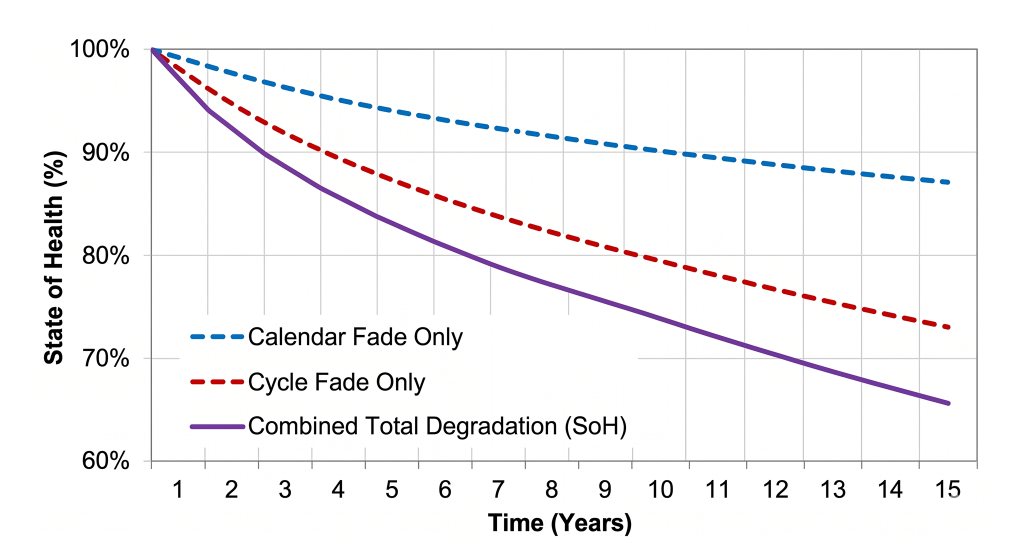
Battery degradation is not a single process; it is a combination of two distinct chemical “villains” that constantly attack the lithium-ion cells.
- Calendar Fade: This is the loss of capacity simply from time passing. Even if a battery sits completely idle, chemical side reactions inside the cell slowly consume active lithium. Over time, battery calendar fade irreversibly reduces the total amount of energy the battery can hold.
- Cycle Fade: This is the wear and tear from actual usage. Every time lithium ions physically move back and forth between the anode and cathode during charging and discharging, they cause microscopic mechanical stress. This BESS cycle fade leads to micro-cracking and loss of active material.
Combining these two degradation metrics dictates the exact State of Health (SoH) curve of the battery, which forms the baseline for all revenue projections.
The Extreme Impact of GCC Ambient Temperatures
The primary catalyst for chemical degradation is heat, governed by the Arrhenius equation. Simply put: heat violently accelerates the chemical side-reactions that cause calendar fade.
Understanding the temperature impact on lithium ion cells is crucial in the Middle East. Lithium-ion batteries prefer to operate at a comfortable 25°C. Operating a BESS in a 50°C GCC summer dramatically steepens the calendar fade curve. If a facility’s internal battery cooling system fails even briefly during a July heatwave, the BESS degradation hot climate penalty is immense. A battery exposed to 45°C for a few weeks can suffer the equivalent of years of normal calendar fade, permanently destroying a massive chunk of its revenue-generating capacity.
Depth of Discharge (DoD) and State of Charge (SoC) Optimization
How you operate the battery dictates how fast it dies. Pushing a battery to its absolute limits destroys cell chemistry.
Resting a battery fully charged at a 100% State of Charge (SoC) creates high internal voltage stress, accelerating calendar fade. Conversely, draining the battery entirely to a 100% Depth of Discharge (DoD) causes severe mechanical stress to the electrodes, accelerating cycle fade.
- The Financial Tradeoff: To preserve lifespan, the financial model must cap operations. Engineers implement strict state of charge optimization, deliberately programming the BESS to only operate between 10% and 90% SoC. This intelligent battery depth of discharge management extends the lifespan of the asset by years, but it means you must subtract that 20% “buffer” from your usable, revenue-generating capacity in your financial model from Day 1.
C-Rate: The Speed of Charge and Discharge
It is not just how deep you discharge the battery, but how fast you do it. This is measured by the C-Rate. A 1C rate means charging or discharging the entire battery in 1 hour; a 2C rate does it in 30 minutes.
High C-rates generate immense internal electrical resistance and heat. Highly lucrative applications like grid frequency regulation require lightning-fast, high C-rate bursts of power. However, this exact application causes internal micro-cracking and lithium plating, leading to severe battery frequency regulation degradation. If your business case relies on high-speed ancillary services, your model must heavily penalize the battery’s expected lifespan to account for this severe BESS C-rate impact.
HVAC and Parasitic Load Calculations
To combat the massive heat generated by high GCC ambient temperatures and aggressive C-rates, utility-scale batteries utilize aggressive, liquid-cooled HVAC systems.
These HVAC systems require a massive amount of power to run. This is known as a BESS parasitic load. It is electricity consumed by the battery itself, rather than sold to the grid. In a 50°C summer, battery HVAC energy consumption can eat up to 10% or 15% of the battery’s stored energy. If the financial spreadsheet does not subtract this massive Operational Expenditure (OPEX) load from the net exportable energy, the revenue projections will be catastrophically inflated.
Augmentation Strategies: Planning for Replacement
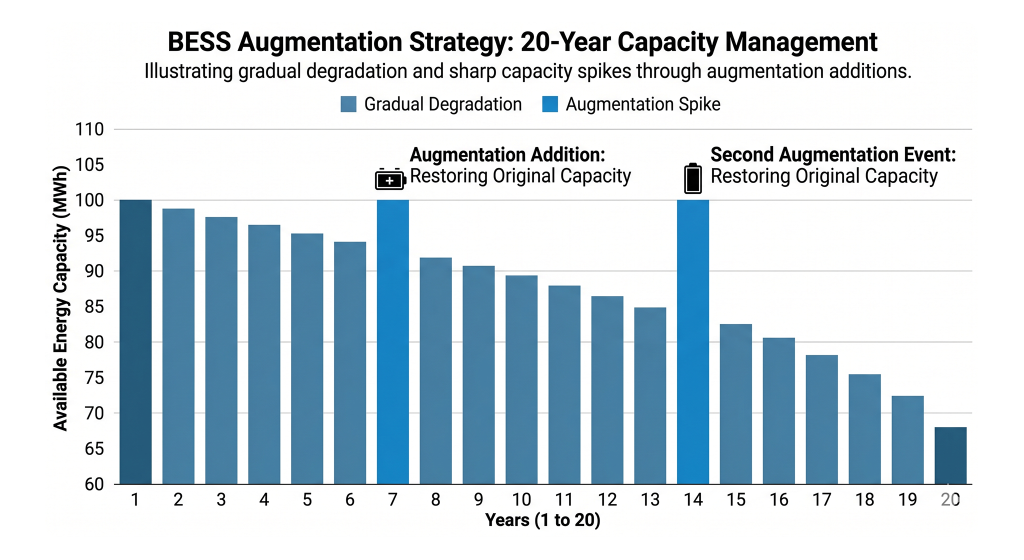
Because a battery will inevitably degrade, developers cannot simply accept a drop in revenue over 15 years. They employ a BESS augmentation strategy.
This involves physically adding new battery racks to the system in specific intervals (e.g., Year 5 and Year 10) to artificially boost the system back up to its original nameplate capacity.
- The Engineering Foresight: You cannot simply plug in new batteries years later. Strategic Project Lead Engineering & Management must be utilized on Day 1. The original site design must include empty concrete pads for future containers, and the initial inverters and switchgear must be intentionally oversized to handle the future battery capacity maintenance additions. The financial model must then account for these massive future CAPEX injections.
Navigating Manufacturer Warranties and Guarantees
Bankers and investors rely heavily on the Original Equipment Manufacturer (OEM) BESS performance warranty to secure financing. However, these warranties contain treacherous fine print.
An OEM will guarantee that a battery will maintain 70% capacity after 10 years, but only if strict operational boundaries are respected. If the site data logger proves the battery operated above 30°C for too many hours, or if the average C-rate exceeded the contractual limits, the multi-million-dirham warranty is instantly voided. Integrating comprehensive Sustainable infrastructure insurance management is the ultimate safety net. Specialized battery degradation insurance protects the investors’ revenue stream, covering the financial shortfall if the asset degrades faster than the manufacturer’s predicted curve.
Integrating Degradation into the Financial Model (IRR/NPV)
Once the engineering degradation curve is established, it must be meticulously injected into the financial spreadsheet.
Degradation directly impacts the levelized cost of storage (LCOS). In BESS financial modeling, every percentage drop in State of Health equates to a direct reduction in the MWh of energy you can sell or the peak kW you can shave. As the usable capacity drops year over year, the annual revenue drops with it. If augmentation costs and parasitic cooling loads are not accurately modeled against this declining revenue curve, the calculated Net Present Value (NPV) and Internal Rate of Return (IRR) presented to investors will be a complete fiction.
Frequently Asked Questions (FAQ)
1. What does State of Health (SoH) mean for a battery?
State of Health (SoH) is a percentage that represents the battery’s current maximum ability to hold energy compared to the day it was brand new. If a 1,000 kWh battery degrades to an 80% SoH, it can now only store and discharge 800 kWh of energy when fully charged.
2. Can I run my BESS without air conditioning to save money?
Absolutely not, especially in the GCC. Lithium-ion batteries are extremely sensitive to heat. If the internal temperature rises above 30°C to 40°C, the chemical degradation accelerates violently, cutting a 10-year lifespan down to 2 or 3 years. At higher temperatures, you risk “thermal runaway,” which results in catastrophic and unstoppable chemical fires.
3. What is the difference between CAPEX and OPEX in a BESS model?
CAPEX (Capital Expenditure) is the massive upfront cost to buy and install the batteries, inverters, and transformers on Day 1 (and the future costs of augmentation). OPEX (Operational Expenditure) is the ongoing annual cost to keep it running, which includes the electricity to power the HVAC cooling, routine maintenance, and insurance premiums.
4. Why is a battery’s C-Rate important for degradation?
The C-Rate measures how fast you force energy in or out of the cells. Discharging a battery slowly over 4 hours (0.25C) is gentle on the chemistry. Discharging that same battery violently in 30 minutes (2C) generates intense heat and mechanical stress on the cell electrodes, causing micro-cracks that permanently destroy the battery’s capacity much faster.
5. Why do OEMs void warranties based on temperature?
Manufacturers base their 10 or 15-year performance guarantees on specific laboratory-tested conditions. Because heat is the primary driver of lithium-ion degradation, if the operator allows the HVAC system to fail or deliberately runs the battery in a 45°C environment to save on cooling costs, the battery will degrade far faster than the OEM predicted. The OEM will use the battery’s internal computer logs to prove the temperature limits were breached, voiding the warranty.
Building Bankable Battery Projects
A successful BESS business case is a delicate, high-wire act of financial and chemical engineering. It requires balancing aggressive revenue generation through deep cycling and high C-rates with the careful chemical preservation required to keep the asset alive for 15 years.
Treating a battery like a static solar panel is a fatal financial error. By mathematically modeling calendar fade, limiting depth of discharge, aggressively accounting for GCC cooling loads, and planning physical augmentation strategies from Day 1, developers can present a deeply realistic and robust financial model to lenders.
Need to validate the technical and financial assumptions of your storage project?
Do not present a financial model based on best-case scenarios. Contact an expert electrical consultancy for rigorous BESS technical due diligence. As a premier energy storage consultant GCC, Elecwatts aligns the harsh realities of lithium-ion chemistry with bulletproof financial modeling, ensuring your battery asset remains highly profitable from commissioning through end-of-life.
Contact Elecwatts today to audit and optimize your BESS business case.