

The adoption of Battery Energy Storage Systems (BESS) across the GCC is accelerating at an unprecedented rate. From stabilizing renewable integration in desert solar parks to providing peak-shaving services for industrial facilities, BESS is reshaping the regional grid. However, bringing these high-energy assets online is a complex, high-stakes endeavor.
Commissioning a BESS is not merely about flipping a switch. It is a rigorous process of validation that stands between a successful asset and a potential disaster. A missed step can lead to safety hazards, catastrophic thermal runaway events, warranty voids, or rejection by utility operators like DEWA or SEC. To navigate this complexity, we have compiled the definitive BESS commissioning checklist 2026, designed to provide a proven framework for safe and compliant energization in the modern regulatory landscape.

Why a Structured Commissioning Process is Non-Negotiable
Ad-hoc approaches to commissioning are arguably the biggest risk to BESS project success. The modern BESS is a convergence of chemical, electrical, thermal, and digital systems. A structured process is non-negotiable to mitigate BESS commissioning risks such as:
- Thermal Runaway: Ensuring cooling systems function correctly under GCC peak ambient temperatures.
- Protection Failures: Verifying that the system isolates faults before they propagate to the grid.
- Regulatory Non-Compliance: Meeting evolving GCC grid code compliance 2026 requirements, such as those from Saudi Arabia’s SASO or the UAE’s Regulation & Supervision Bureau.
Need expert support? Learn about our Commissioning Management Services.
Pre-Site Delivery: The Foundation (Points 1-5)
Successful commissioning begins long before the containers arrive at the site. Quality assurance must “shift left” to the factory floor.
- Verify Factory Acceptance Test (FAT) Reports: Ensure all witness certificates are signed and that the specific units shipping to your site passed all performance metrics.
- Confirm Equipment Nameplates: Verify that the rated capacity, voltage, and short-circuit ratings on physical nameplates match the approved submittals and utility purchase orders.
- Approve Method Statements: Review and sign off on detailed method statements for installation, lifting, and High-Potential (Hi-Pot) testing procedures.
- Validate Thermal Management Systems: Ensure the liquid or air-cooling systems have been factory-tested to simulate GCC specific ambient temperatures (often requiring 50°C+ stress tests).
- Check BMS Firmware Version: Confirm the BMS firmware update is the latest stable version, with all 2026-compliant cybersecurity patches applied to prevent external vulnerabilities.
Site Pre-Energization Checks (Points 6-13)
Once the system is installed, the focus shifts to mechanical integrity, electrical safety, and BESS grounding requirements before any voltage is applied.
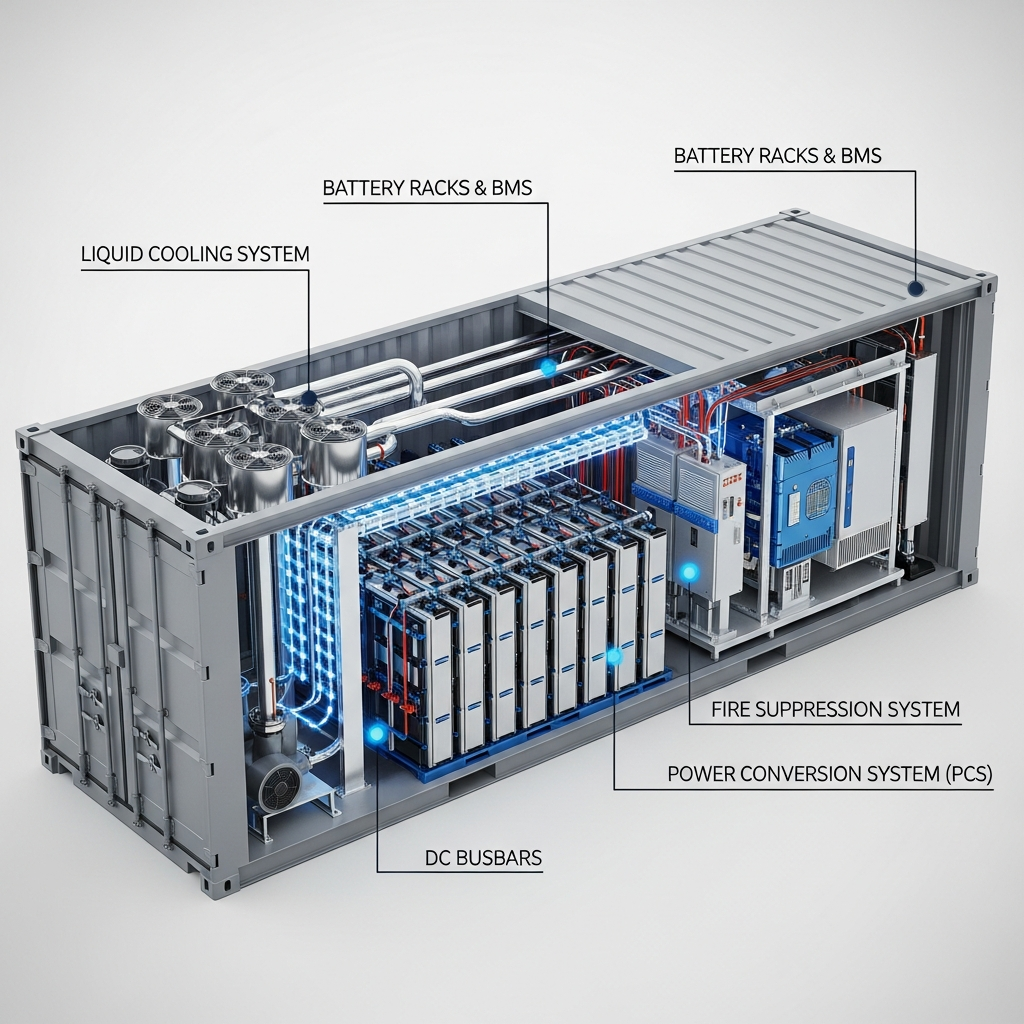
- Torque Verification: Perform and log torque checks on all DC busbars, battery rack connections, and AC cabling to prevent hotspots.
- Insulation Resistance (IR) Testing: Verify correct IR values for all battery racks and DC cabling to ensure no insulation damage occurred during transit or installation.
- Grounding Integrity: Confirm grounding and bonding meet IEEE 80 standards and local codes, ensuring equipotential bonding between racks and the container.
- Sensor Calibration: Calibrate and verify readings for all critical sensors, including current, voltage, and internal cell temperatures.
- Fire Suppression Testing: Test the functionality of the fire suppression (e.g., aerosol or gas) and combustible gas detection systems in coordination with local civil defense requirements.
- Emergency Stop (E-Stop) Validation: Physically test E-stop circuits from all designated locations to ensure they instantly isolate the DC and AC sources.
- Protection Relay Injection: Perform secondary injection tests on protection relays to ensure they coordinate perfectly with the grid-side protection.
- Communication Link Verification: Verify that the “handshake” between the Battery Management System (BMS), Power Conversion System (PCS), and Energy Management System (EMS) is operational and stable.
Functional & Performance Testing (Points 14-21)
With the system safe and energized, the grid connection testing BESS phase begins to prove operational performance.
- Controlled Cycle Testing: Execute controlled charge and discharge cycles at incremental power levels (25%, 50%, 75%, 100%) to verify thermal stability.
- SOC/SOH Algorithm Validation: Validate that the State of Charge (SOC) and State of Health (SOH) displayed on the SCADA match the physical reality of the battery voltage and specific gravity (if applicable).
- Grid Mode Testing: Test both grid-following and, if applicable, grid-forming BESS test modes to ensure stable synchronization with the network.
- State Transition Verification: Verify seamless and shock-free transitions between charging, idling, and discharging states.
- Grid Support Functions: Test the response to frequency-watt and volt-var control signals as per the specific requirements of the grid operator (e.g., primary frequency response).
- Load Rejection Test: Conduct a full load rejection test to assess system stability and ensure the PCS doesn’t trip on over-voltage during a sudden loss of load.
- Capacity & Efficiency Test: Validate cyclical performance against the warranted capacity and perform a BESS round-trip efficiency test.
- 72-Hour Continuous Run: Perform a 72-hour continuous load test at varying set points to identify any “infant mortality” issues in components.
Final Integration & Documentation (Points 22-25)
The final hurdle is the administrative and regulatory handover.
- Grid Model Validation: Obtain model validation certificates from the grid operator (often required for dynamic model compliance in the GCC).
- As-Built Documentation: Complete all red-line markups and update Single-Line Diagrams (SLDs) to reflect the final installation.
- O&M Training & Handover: Conduct comprehensive training for the Operations and Maintenance team and hand over all manuals, software licenses, and warranty documents.
- COD Approval: Secure the Certificate of Completion (CoC) and final COD approval battery storage from the offtaker or utility.
Frequently Asked Questions (FAQs)
Q1: How long does a typical BESS commissioning process take in 2026?
For a utility-scale system, a thorough commissioning typically takes 4-8 weeks. This timeline is heavily dependent on the availability of the grid operator for witness tests and the complexity of the control schemes. Rushing this process is the leading cause of post-COD operational issues.
Q2: What are the most common issues found during commissioning today?
In 2026, we most frequently see communication protocol mismatches (e.g., Modbus mapping errors) between the BMS, PCS, and EMS. We also see inadequate cooling system performance under peak desert temperatures and protection setting conflicts with existing grid infrastructure.
Q3: Are there specific GCC standards we must follow?
Absolutely. Beyond international standards (like IEEE 1547 and IEC 62933), you must comply with your local utility’s grid connection code. This includes specific Fault Ride-Through (FRT) requirements, power quality limits, and cybersecurity protocols that are continually evolving in the region.
Q4: Can you provide a downloadable version of this checklist?
Yes. Our comprehensive 2026 BESS Commissioning Protocol, which includes this checklist and detailed test procedure sheets, is available to qualified project teams.Contact us to request your copy.
Conclusion
A BESS is a complex, live asset where the quality of commissioning dictates its entire lifecycle performance, safety, and return on investment. The difference between a reliable asset and a liability often comes down to the rigor of the testing phase.
Don’t leave your project’s success to chance. Partner with specialist commissioning engineers who have a proven track record across the GCC. Contact ElecWatts to discuss your specific BESS project requirements for 2026 and beyond.