

The Middle East is undergoing a massive paradigm shift in how it generates and consumes power. With gigawatt-scale solar parks coming online and commercial facilities racing to reduce their carbon footprints, the integration of renewables has exposed a critical vulnerability: the grid needs flexibility. Enter the Battery Energy Storage System (BESS). BESS is widely recognized as the missing link for grid stability. However, the rapid adoption of battery energy storage GCC solutions has highlighted a severe challenge. A BESS is a massive capital investment. Establishing a rigorous BESS sizing methodology through expert electrical engineering work in Dubai before procurement is the only way to guarantee the asset performs as expected and maximizes ROI.
If a developer drastically over-sizes the battery, millions of dirhams are wasted in stranded capacity. Conversely, under-sizing the system means it will fail to meet operational targets, leading to blackouts or missed tariff savings. This guide breaks down the critical use cases, cooling loads, and degradation limits you must calculate to size your BESS perfectly for the harsh Middle Eastern climate.
Defining the Primary Use Case
The most common mistake in BESS design is assuming a single battery can effectively do everything at once. While a BESS is highly versatile, optimizing its size requires defining its absolute primary goal.
You must clearly define the BESS use cases: is the system acting as an energy buffer, a peak shaver, or an emergency backup? The answer to this question dictates the fundamental architecture of the system, specifically the power-to-energy ratio.
- Power (kW): Determines how much electrical “muscle” the battery can output at any given second.
- Energy (kWh): Determines how long the battery can sustain that output before running empty.
A thorough understanding of battery kW vs kWh is essential. A peak shaving battery might require massive power (high kW) for a very short duration (low kWh), whereas an energy shifting battery requires moderate power (kW) but massive storage capacity (high kWh) to last through the night.
Sizing for Energy Shifting (The Buffer Strategy)
As solar PV adoption increases, facilities face the “duck curve” dilemma: they generate massive amounts of free power at midday when facility demand might be low, but lose that generation as the sun sets and evening operational loads spike.
The strategy of solar energy shifting solves this. The BESS acts as a massive sponge, charging up on free midday solar power and discharging it during the evening peak to offset grid consumption.
- The Calculation: BESS energy buffer sizing focuses heavily on total capacity (kWh). Engineers must calculate the exact area under the load curve during the evening gap and size the battery’s kWh capacity to bridge that specific timeframe (e.g., providing 500kW of continuous power for a 4-hour duration requires a minimum 2,000kWh battery).
Sizing for Peak Shaving and Tariff Management
Industrial plants and large commercial facilities in the GCC are heavily penalized by utilities for their highest spikes in power consumption.
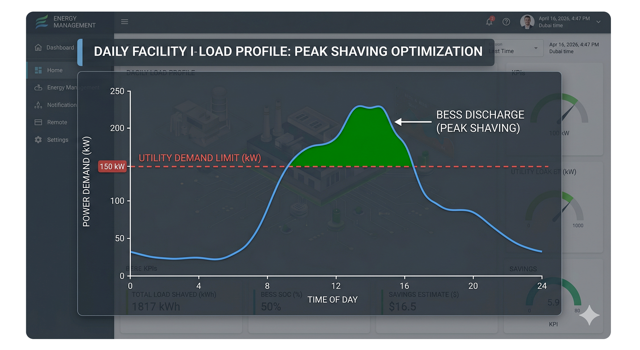
Battery peak shaving is a highly lucrative strategy where the BESS is programmed to monitor the facility’s real-time consumption. When heavy machinery starts and the load spikes toward a penalty threshold, the BESS discharges a massive, short burst of power to “chop off” the peak. The utility meter never sees the spike.
- The Benefit: This strategy guarantees demand charge reduction BESS savings by avoiding costly Time-of-Use (ToU) tariffs. Furthermore, sizing a battery for high-kW, short-duration peak shaving allows developers to specify a smaller, less expensive utility transformer connection for the facility, as the grid no longer has to support the absolute highest transient loads.
[Placement for Image 1]
Sizing for Critical Backup (UPS Replacement)
When grid reliability is a concern, or when life-safety systems mandate uninterrupted power, a BESS can be deployed to replace or supplement traditional emergency diesel generators.
When sizing for BESS emergency backup, the methodology shifts toward absolute worst-case scenario modeling. Engineers must isolate the facility’s critical load profile (fire pumps, server rooms, emergency lighting) from non-essential loads.
- The Methodology: The sizing is dictated by the required autonomy time mandated by local codes or operational needs (e.g., maintaining critical loads for 2 hours until mobile generators arrive). In the battery vs diesel generator debate, BESS provides the advantage of instant, zero-millisecond response times (acting as a massive UPS) without the noise, emissions, and fuel storage risks associated with diesel plants.
Factoring in Depth of Discharge (DoD) and Cycle Life
A critical reality of battery chemistry is that you can never use 100% of a battery’s nameplate capacity if you want it to survive long-term.
Lithium-ion cells degrade every time they are charged and discharged. To ensure the battery lasts for a commercially viable 10 to 15 years, the sizing calculation must incorporate a maximum battery depth of discharge (DoD) limit.
- The Margin: If your facility requires exactly 1,000kWh of usable energy, you cannot buy a 1,000kWh battery. If you drain it to 0% every day, it will degrade rapidly. For proper BESS cycle life optimization, engineers will size the battery at 1,250kWh and program the system to never discharge below 20% (an 80% DoD). This deliberate oversizing protects the cell chemistry and guarantees the asset meets its promised lifespan under harsh GCC operating conditions.

HVAC and Auxiliary Load Calculations
Deploying a BESS in the Middle East involves battling the region’s extreme ambient temperatures. Lithium-ion batteries must generally be kept operating between 20°C and 25°C to prevent thermal runaway and severe capacity degradation.
This requires dedicated, heavy-duty HVAC systems built directly into the battery containers. Calculating the BESS cooling load GCC is a critical step because the HVAC system is a “parasitic load”, it draws power directly from the battery itself. If the HVAC system consumes 10% of the battery’s energy just to keep the cells cool during a 50°C summer day, that is 10% less energy available for your facility. Utilizing expert electrical engineering design services accurately models these parasitic cooling loads, ensuring the gross battery capacity is upsized to accommodate strict lithium ion HVAC requirements without compromising the net usable energy promised to the client.
Inverter (PCS) Sizing and Grid Synchronization
A battery stores Direct Current (DC), but the facility and the utility grid operate on Alternating Current (AC). The bridge between the two is the Power Conversion System (PCS), essentially a massive, highly sophisticated bi-directional inverter.
Properly sizing the BESS power conversion system is entirely dependent on the maximum kW output required. A 2,000kWh battery is useless for peak shaving if it is bottlenecked by a 200kW inverter. The battery inverter sizing must match the highest transient load spike the facility expects to shave. Furthermore, advanced electrical grid studies must be performed to ensure the PCS synchronizes flawlessly with the local utility frequency and can safely execute “islanding” (disconnecting from the grid during a blackout) without causing dangerous voltage fluctuations.
Procurement Strategy and Supply Chain Realities
Determining the perfect mathematical size for your BESS is only half the battle; acquiring it in the current global market is another.
Driven by the global rush for electric vehicles and renewable grid storage, lithium cell manufacturing faces immense supply chain constraints. Extended lead times of 12 to 18 months for fully integrated, utility-scale battery containers are the industry norm. Engaging proactive Electrical Plant Procurement secures high-tier battery cells and ensures project timelines are met. Expert procurement teams lock in manufacturing slots early, navigate the volatile BESS supply chain, and ensure that the delivered chemistry perfectly matches the intense environmental demands modeled during the sizing phase. Proper utility scale battery procurement prevents costly project delays and avoids the danger of accepting lower-tier cells simply to meet a deadline.
Frequently Asked Questions (FAQ)
1. What is the difference between kW and kWh in battery sizing?
Think of kW (kilowatts) as the speed or power, it determines how many machines the battery can run at once. Think of kWh (kilowatt-hours) as the fuel tank, it determines how many hours the battery can keep those machines running before it needs to recharge.
2. Can a BESS completely replace a diesel generator?
Yes, but it depends on the duration of the outage. For short outages (1-4 hours), a BESS is vastly superior as it provides instant, silent, zero-emission power. However, for multi-day outages, sizing a battery to last that long becomes prohibitively expensive. Often, a “hybrid” approach (BESS for instant response + a smaller diesel generator for extended durations) is the most cost-effective solution.
3. Why do batteries need heavy air conditioning in the Middle East?
Lithium-ion chemistry is highly sensitive to heat. If the internal temperature of the battery container exceeds 25°C to 30°C, the cells begin to degrade rapidly, cutting a 15-year lifespan down to 5 years. Extreme heat can also trigger “thermal runaway,” a dangerous chemical fire. Robust, redundant HVAC systems are mandatory for safety and ROI in the GCC.
4. Can I use 100% of my battery’s capacity?
Technically yes, but practically no. Discharging a lithium-ion battery to 0% (a 100% Depth of Discharge) puts immense stress on the cells and severely limits the number of charge cycles it can survive. Engineers typically size the system so it only ever discharges to 20% or 10% remaining capacity, which dramatically extends the operational lifespan of the asset.
5. What is a “parasitic load” in BESS sizing?
A parasitic load is the electricity consumed by the battery system itself to stay operational. The largest parasitic load is the HVAC system cooling the container, followed by the Battery Management System (BMS) computers and fire suppression panels. This load must be calculated and subtracted from the battery’s gross capacity to determine the actual usable energy for the facility.
Engineering the Smart Grid
The integration of Battery Energy Storage Systems represents the cutting edge of modern power distribution in the GCC. However, successfully deploying these massive assets requires moving beyond simple assumptions. BESS sizing is an intricate, highly specialized balance of operational load profiling, stringent battery chemistry limits, thermal thermodynamics, and complex financial modeling.
An incorrectly sized battery is a stranded asset. A perfectly sized battery is an agile, revenue-generating powerhouse that slashes utility bills, guarantees uptime, and unlocks the full potential of renewable energy investments.
Ready to integrate battery storage into your facility?
Navigating the complexities of DoD limits, parasitic cooling loads, and peak shaving algorithms requires dedicated analytical expertise. As a premier BESS sizing consultant, Elecwatts provides the sophisticated energy storage engineering GCC solutions required to transform your facility into a resilient, smart-grid-ready operation.
Contact Elecwatts today to accurately size, procure, and integrate your next energy storage asset.