

In the design office, a cable schedule might look perfect. The voltage drop is within limits, the ampacity is sufficient, and the short-circuit rating is compliant. However, the design is only as good as the installation. A cable can be electrically perfect on paper but mechanically destroyed before it is even terminated if the physical forces of installation are ignored.
The reality of the job site, especially in complex industrial projects, is that cables are subjected to immense stress as they are dragged through long conduit runs and around tight bends. If Cable Pulling Calculations are neglected, the result is often hidden damage to the insulation or shielding. This damage may not trigger an immediate fault but creates a weak point that leads to premature failure, water ingress, or faults years down the line. To prevent this, engineers must master the mechanical physics of the pull.
Explore Cable Design Engineering Services in Dubai at Elecwattsgcc
The Two Critical Forces: Tension and Pressure
When designing a cable run, two primary mechanical limits must never be exceeded: the longitudinal tension and the radial pressure.
Maximum Pulling Tension (
TmaxT_{max}Tmax
)
This represents the absolute limit of how hard you can pull the conductor before it irreversibly stretches or snaps.
- The Conductor Limit: Copper and aluminum have specific tensile strengths. Exceeding this elongates the metal, reducing its cross-sectional area and increasing resistance (creating a hot spot).
- The Grip Matters: The allowable tension changes based on how you pull. Using a pulling eye (which attaches directly to the conductor) allows for higher tension than a basket grip (which pulls on the jacket). If using a basket grip, the limiting factor is often the shear strength of the insulation, not the conductor itself.
Sidewall Bearing Pressure (SWBP)
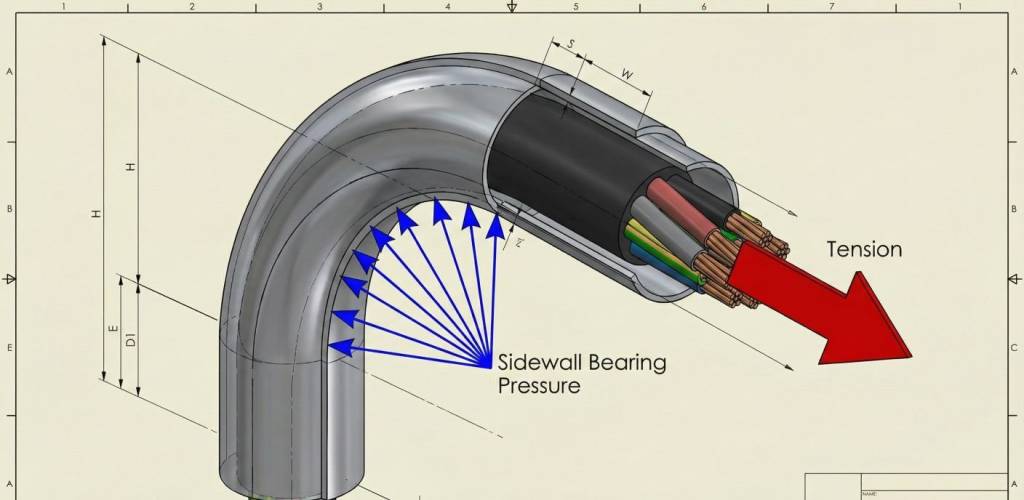
While tension is intuitive, sidewall bearing pressure is the silent killer of cables. This is the crushing radial force exerted on the cable insulation as it is pulled around a bend under tension.
Imagine a rope being pulled tight around a pole; the tighter you pull, the harder the rope is crushed against the pole. Inside a conduit bend, if this pressure exceeds the cable manufacturer’s limit (typically expressed in lbs/ft or kN/m), the insulation will be crushed, potentially exposing the conductor or damaging the internal shield. This is the most common failure point in complex duct banks.
The “Jam Ratio”: Avoiding the Trap
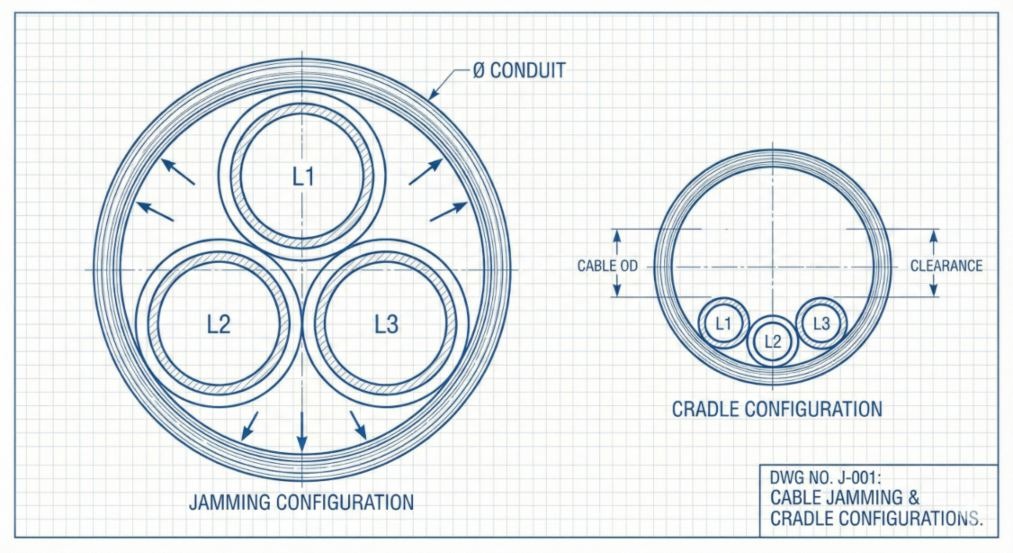
One of the most insidious risks in raceway design is the “jamming” phenomenon. This occurs when three cables are pulled into a conduit side-by-side.
- The Problem: In straight sections, the cables sit in a “cradle” formation. However, when entering a bend, the tension forces them to align. If the ratio of the conduit size to the cable size is in a critical range, the cables can align in a triangular formation and wedge against the conduit walls. This “jamming” locks the cables in place, causing tension to spike instantly and often damaging the cable jacket.
- The Calculation: The jam ratio is calculated by dividing the conduit’s inner diameter (ID) by the cable’s outer diameter (OD).
- Jamming Danger Zone: A ratio between 2.8 and 3.2 is typically considered the danger zone for three single-conductor cables.
- The Fix: The solution is preventative. You must calculate this ratio during the design phase and either resize the conduit or select cables with a different insulation thickness to avoid the critical ratio.
Optimizing the Route: Smart Design Strategies
You can often reduce pulling forces without changing the cable size simply by optimizing the route and installation method.
a. Reverse Pulling
The direction of the pull matters immensely. Tension is cumulative; it builds up as the cable passes through each bend. By reversing the pull direction, specifically, pulling from the end with the most bends towards the straight end, you keep the tension low through the difficult sections. This keeps the resulting sidewall bearing pressure within safe limits.
b. Lubrication and Friction
The coefficient of friction (
μ\muμ
) between the cable jacket and the conduit material dictates the drag.
- Pulling Lubricant: Using the correct lubricant can reduce friction by 40-60%.
- Compatibility: It is vital to match the lube to the jacket material. Some lubricants effective for PVC jackets may be chemically incompatible with Low Smoke Zero Halogen (LSZH) or XLPE jackets, potentially causing long-term degradation.
c. Bend Radius
Never confuse the conduit’s sweep radius with the cable’s minimum bending radius. While a cable might theoretically bend to a 10x diameter radius, pulling it under tension around a bend requires a much larger sweep to keep the SWBP low.
Conclusion: Engineering for the Physical World
Electrical engineering is not just about electrons; it is about the physical materials that carry them. A robust design considers the physical pathway as critically as the wire size. Advanced software tools (like ETAP or specialized pulling calculators) allow engineers to simulate the pull, predicting tension and conduit fill calculation issues before a single meter of cable is purchased.
By validating the cable tension limits and installation physics during the design phase, you ensure that the cable installed is just as healthy as the cable specified.
Frequently Asked Questions (FAQ)
1. What is the difference between pulling tension and sidewall pressure?
Pulling tension is the force stretching the cable length-wise (longitudinal). Sidewall bearing pressure (SWBP) is the force crushing the cable against the inside of a conduit bend (radial). A cable can be well within its tension limits but still fail due to excessive SWBP at a tight bend.
2. Why is the “Jam Ratio” only critical for three cables?
Jamming is a geometric phenomenon. A single cable can’t jam against itself, and two cables naturally lay flat. Three cables, however, can transition from a flat “cradle” to a “triangular” shape. If the conduit size is just right (or wrong), they get stuck in this transition, wedging against the walls like a keystone in an arch.
3. What tool is used to monitor tension during installation?
A dynamometer is used. It is a device attached to the pulling line that measures the force being applied in real-time. It often has a “break-away” feature or an alarm to stop the pull if the tension exceeds the pre-set safety limit.
4. Can I use soap or dish detergent as a pulling lubricant?
Absolutely not. Household detergents can dry out and essentially glue the cable to the conduit, making future removal impossible. More importantly, they often contain chemicals that can chemically attack and degrade the cable’s insulation over time. Always use a dedicated, compatible cable pulling lubricant.
5. How does the “pulling eye” attachment method affect the calculation?
When using a pulling eye, the force is transferred directly to the metal conductor, allowing you to pull up to the conductor’s tensile limit. If you use a “basket grip” (a wire mesh over the jacket), the force is transferred to the insulation/jacket, which is much weaker. The allowable tension is significantly lower with a basket grip.
Avoid stuck cables and hidden jacket damage. Contact ElecWatts for comprehensive cable routing studies and pulling calculations that ensure a smooth, safe installation for your project.