

For critical industrial facilities, district cooling plants, and hyperscale data centers operating across the Arabian Peninsula, operational continuity is the ultimate benchmark of engineering success. Minimizing downtime requires a highly strategic approach to supply chains, where partnering with an expert in Electrical Plant Procurement is vital to insulate your assets from unexpected grid shocks and mechanical wear. In modern operations management, relying on a “just-in-time” (JIT) parts delivery model is a recipe for physical and financial disaster.
The geographical reality of the GCC presents significant logistical hurdles. While the region boasts world-class ports and airports, the original equipment manufacturers (OEMs) of heavy, customized electrical assets—such as high-voltage gas insulated switchgear (GIS) and multi-megawatt variable frequency drives (VFDs)—are predominantly located in Europe, North America, or East Asia. When a critical component fails, waiting for international shipping and navigating complex local customs clearance procedures can turn a minor breakdown into weeks of catastrophic outage. Establishing a highly localized, robust electrical spare parts strategy is the only way to safeguard your facility, ensuring that the GCC supply chain electrical constraints do not compromise your core operational uptime.
Categorizing the Inventory: From Consumables to Capital
An efficient warehouse does not treat all spare parts equally. To prevent capital from being wastefully locked up in stagnant inventory, facility managers must categorize their electrical spares into three distinct, structured tiers:
- Tier 1: Consumables and Wear Items: This category comprises high-turnover, low-cost components that are depleted during routine maintenance. Examples include control fuses, indicator bulbs, terminal blocks, carbon brushes, and air filters.
- Tier 2: Operational Spares: These are medium-value components with moderate failure rates that are vital for restoring system functionality. This tier includes control contactors, molded case circuit breakers (MCCBs), protection relays, auxiliary power supplies, and cooling fans. Managing these operational spare parts requires maintaining a continuous safety stock on-site to facilitate rapid replacement.
- Tier 3: Capital and Insurance Spares: These are highly customized, extremely expensive, single-point-of-failure (SPOF) assets with very low probability of failure but devastating consequences if they do. This tier includes massive step-down transformers, custom generator rotors, and high-voltage circuit breakers. Investing in these capital electrical spares is a long-term risk-mitigation strategy, protecting the facility from existential operational collapse.
Performing a Criticality Analysis
Deciding what to stock on your warehouse shelves is not a guessing game; it is a rigorous, mathematical discipline. To optimize your capital allocation, engineers must perform a formal equipment criticality analysis for every electrical asset.
This analysis evaluates two primary axes: the Probability of Failure ($P$) and the Consequence of Failure ($C$). The overall Risk Score ($R$) is calculated as:
$$R = P \times C$$
To model the optimal number of spare parts ($k$) required to guarantee a specific service level over a given time horizon ($t$), reliability engineers utilize the Poisson distribution. The probability $P$ of experiencing exactly $k$ failures, given a constant failure rate $\lambda$, is expressed mathematically as:
$$P(X = k) = \frac{e^{-\lambda t} (\lambda t)^k}{k!}$$
By calculating this probability, facility managers can execute sophisticated spare parts optimization models. If a specific protection relay has a calculated failure rate of $\lambda = 0.05$ failures per year, and the cost of plant downtime is exceptionally high, the model will prove precisely whether stocking one, two, or zero spares is the most financially optimal decision.
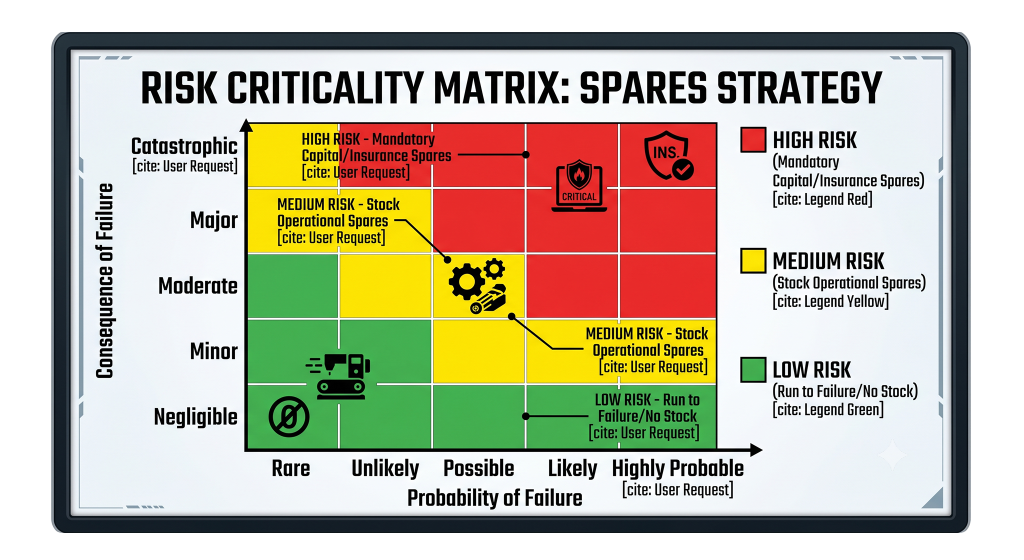
The “Insurance Spare” Dilemma
Purchasing a $\$500,000$ medium-voltage motor or transformer to sit in a warehouse, potentially forever, is one of the most painful financial decisions a facility manager faces. This represents the classic “insurance spare” dilemma—balancing the immediate pain of capital expenditure (CAPEX) against the theoretical risk of a catastrophic event.
However, when evaluated through the lens of risk, the investment becomes clear. If a critical incoming transformer fails, the lead time to design, manufacture, and ship a custom replacement can easily exceed 12 months. During this period, the facility’s productivity drops to zero, representing a staggering business interruption risk electrical networks cannot afford to bear.
To resolve this dilemma, smart developers align their procurement strategy with formal Electric Insurance management protocols. By proving to insurance underwriters that critical insurance spare parts are stocked locally, developers can negotiate significantly lower annual premiums, directly offsetting the CAPEX of the spare asset while shielding the business from existential financial ruin.
Environmental Degradation of Stored Spares
A common and highly expensive mistake in GCC operations is assuming that a spare part is safe simply because it is sitting inside a warehouse. The extreme climate of the Middle East is as hostile to stored equipment as it is to live installations.
If a high-precision circuit breaker, protection relay, or spare motor is left in an uncooled, unventilated, and humid warehouse, it will degrade rapidly. Fine desert sand will penetrate mechanical seals, high ambient heat will dry out internal lubricating greases, and coastal humidity will cause rapid galvanic corrosion on copper contacts. Under these conditions, the part will be completely useless when finally needed.
- The Preservation Mandate: Executing a strict program for electrical spares preservation is mandatory. This involves establishing a highly regulated, climate controlled switchgear storage environment where temperature and humidity are kept within strict limits (ideally $<25^\circ\text{C}$ and $<50\%$ relative humidity).
- Preventative Rotation: Furthermore, large stored rotating assets (like spare generator rotors or motor shafts) must be subjected to periodic shaft-rotation schedules to prevent shaft bowing and bearing flat-spots, ensuring they are truly plug-and-play ready during an emergency.
[Placement for Image 2]

Standardization During the Design Phase
The ultimate way to simplify spare parts management is to design the complexity out of the facility before construction even begins. This is achieved through a strict commitment to equipment standardization.
In many fast-track developments, different sub-packages (e.g., the chiller plant, the fire pumps, and the main process line) are designed by different contractors. Consequently, they often arrive on site featuring completely different brands of VFDs, protection relays, contactors, and control PLCs. This diversity forces the warehouse to stock hundreds of unique parts, driving up inventory costs.
- The Standardization Shield: Utilizing expert Project Lead Engineering & Management from day one eliminates this issue. Dedicated engineering management enforces strict technical specifications that force all package suppliers to use the exact same family and brand of control and power components. This rigorous equipment standardization engineering achieves a massive electrical inventory reduction (often exceeding $60\%$), simplifying maintenance training, optimizing warehouse space, and drastically reducing procurement costs.
Vendor Managed Inventory (VMI) and SLAs
For many facilities, holding millions of dirhams or riyals worth of spare parts on their own balance sheets is financially unviable. Fortunately, modern logistics offers highly sophisticated alternatives.
Rather than buying and storing everything in-house, facility managers can negotiate strategic Service Level Agreements (SLAs) and vendor managed inventory electrical (VMI) contracts with local GCC distributors:
- The SLA Structure: The SLA electrical maintenance contract legally binds the supplier to maintain a specific level of critical stock (such as specific breaker poles or control modules) in their local GCC warehouse, dedicated exclusively to your facility.
- The Performance Guarantee: The contract stipulates strict delivery timeframes (e.g., “Guaranteed delivery of critical parts to the plant gates within 4 hours of notification, 24/7/365”). This allows the facility manager to offload the storage and preservation costs to the vendor, while maintaining absolute confidence in their emergency recovery timelines.
Navigating Obsolescence and Upgrades
Operating an older industrial plant presents a unique, silent risk: technological obsolescence. Over a 15-to-20 year operational lifecycle, OEMs will inevitably discontinue specific product lines.
This creates the nightmare scenario of electrical parts obsolescence. You may have a warehouse stocked with spare components, but if the IT department forces you to upgrade your control networks, those legacy spares become completely useless because they cannot interface with the new digital protocols.
- The Lifecycle Handshake: Your spare parts strategy must be dynamically tied to your overall equipment lifecycle. Facility managers must track OEM obsolescence notices. As a critical relay or breaker family approaches its “End of Life” or “End of Support” milestone, you must execute a strategic transition—either purchasing a final batch of legacy equipment spares to tide you over, or planning a structured, phased retrofit to upgrade the physical switchgear before the parts supply dries up completely.
CMMS Integration for Min/Max Tracking
Relying on manual logbooks, spreadsheets, or human memory to track critical spare parts is an operational liability that eventually leads to critical stockouts.
The modern solution relies on unified software integration. The spare parts inventory must be managed dynamically within the plant’s Computerized Maintenance Management System (CMMS) or Enterprise Asset Management (EAM) platform.
- Automated Tracking: The CMMS spare parts tracking module monitors every part’s movement. When a technician checks out a contactor or relay to perform a repair, the system instantly updates the inventory.
- Automated Reordering: By establishing precise Minimum/Maximum (Min/Max) stock thresholds for every item, the system completely automates the procurement loop. The exact millisecond the stock of a critical fuse or breaker falls below the pre-set minimum threshold, the CMMS automatically generates a purchase requisition, triggering an automated electrical procurement cycle to replenish the stock before a critical emergency occurs.
Frequently Asked Questions (FAQ)
1. What is the difference between an operational spare and an insurance spare?
An operational spare is a medium-value component with a moderate failure rate (like a contactor, cooling fan, or control relay) that is consumed regularly during routine maintenance. An insurance spare is a highly expensive, low-failure-rate capital asset (like a primary power transformer or custom MV motor) that is stocked solely to mitigate the catastrophic financial impact of a long-term unplanned outage.
2. Why is a standard warehouse unsafe for storing electrical spares in the GCC?
The extreme summer heat, high coastal humidity, and pervasive desert dust in the GCC are highly destructive. Uncontrolled environments cause internal lubricating greases to dry out, accelerate galvanic corrosion on copper electrical contacts, and degrade delicate electronic components in protection relays, rendering the stored parts useless when finally needed.
3. How does equipment standardization during design reduce spare parts costs?
By forcing all equipment package suppliers (chillers, pumps, switchgear) to use the exact same manufacturer and model family for VFDs, relays, and contactors, you eliminate duplicate stock. Instead of keeping five different brands of $11\text{ kW}$ VFD spares, you only need to stock one, reducing your overall inventory costs by up to $60\%$.
4. What is a “Criticality Analysis” and how is it calculated?
Criticality analysis is a mathematical method used to determine which spare parts must be stocked. It calculates a Risk Score ($R$) by multiplying the Probability of Failure ($P$) by the Consequence of Failure ($C$). High-risk items must be stocked locally on-site, while low-risk items can be sourced on-demand or managed via vendor SLAs.
5. How can we prevent our stored spare motor shafts from bending?
Large stored motors are subject to gravitational sagging, which can permanently bend the rotor shaft and damage the bearings if left stationary. To prevent this, maintenance technicians must implement a routine preservation schedule that involves physically rotating the shaft by $90^\circ$ or $180^\circ$ at regular intervals (e.g., monthly) and verifying the shaft-locking mechanism is secure.
Engineering Resilience
Designing, managing, and preserving a robust spare parts strategy is not a mere administrative warehouse task; it is a core engineering resilience strategy. In the highly demanding, high-voltage industrial landscapes of the GCC, a single missing fuse or unpreserved relay can bring a multi-million-dollar plant to its knees, costing hundreds of thousands of dollars in halted production.
By systematically stratifying your inventory, executing rigorous Poisson-based criticality analyses, enforcing strict climate-controlled preservation protocols, and integrating your stock tracking with your CMMS, you do more than just satisfy a maintenance checklist. You build a resilient, self-healing grid infrastructure that maximizes your operational uptime and secures the financial future of your business.
Need to optimize your facility’s critical spares inventory?
Do not let supply chain disruptions or unpreserved assets compromise your facility’s safety and reliability. Partner with our specialized regional engineering team to design an ironclad spares program. Contact us to leverage our premier Electrical Plant Procurement expertise to secure critical inventory with minimal financial waste. Elecwatts serves as your strategic regional partner, delivering the certified technical due diligence, advanced system simulations, and comprehensive electrical resilience GCC solutions required to achieve flawless electrical procurement optimization across your entire portfolio.
Contact Elecwatts today to secure the operational resilience and reliability of your high-voltage infrastructure.