

In the demanding industrial environment of the Gulf Cooperation Council (GCC), designing a safe electrical network requires far more than looking up a cable’s standard ampacity in a catalog. To prevent catastrophic failure, project managers must partner with an expert electrical engineering consulting firm in Dubai to master the critical concept of electrical derating. Derating is the vital engineering process of reducing the maximum allowable current of a cable to account for severe environmental conditions that inhibit its ability to dissipate heat.
Standard international cable tables often assume benign, temperate climates. Applying these generic ratings directly to a project in Dubai or Riyadh is a guaranteed recipe for insulation breakdown, short circuits, and severe fire risks. The unique combination of searing ambient air, highly resistive dry sand, and intense solar radiation creates an incredibly hostile environment for power distribution. Understanding and applying precise cable derating factors GCC is non-negotiable. This guide serves as your definitive cheat sheet for electrical derating desert conditions, breaking down the critical variables that dictate safe cable sizing in the Middle East.
Ambient Air Temperature Derating
The most immediate and obvious stressor on a cable in the Gulf is the air temperature. Cables generate internal heat ($I^2R$ losses) when carrying current. If the surrounding air is already extremely hot, the cable cannot shed this internal heat, forcing its core temperature to rise dangerously close to the insulation’s melting point (typically 90°C for XLPE).
IEC Assumptions vs. GCC Reality
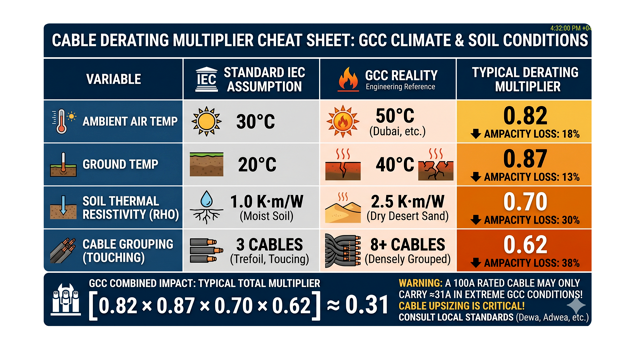
Standard IEC (International Electrotechnical Commission) ampacity tables typically assume an ambient air temperature of 30°C or 40°C.
- The Reality: In the GCC summer, outdoor shaded temperatures frequently exceed 50°C. Inside unventilated electrical rooms, plant areas, or roof-mounted trays, the stagnant air can easily breach 60°C.
- The Solution: Engineers must apply aggressive ambient temperature cable derating multipliers. A rigorous 50 degree ambient electrical design often requires reducing a cable’s allowable current by 10% to 25%, depending on the insulation type, simply to survive the midday heat.
Ground Temperature and Burial Depth Factors
For underground distribution networks, the earth acts as the primary heat sink. However, the thermal dynamics of the desert ground present a unique set of challenges.
Trapped Heat at Depth
A common misconception is that burying a cable deeper makes it cooler. While deeper burial protects the cable from mechanical damage and surface temperature swings, it also increases the distance the heat must travel to escape to the surface.
- The Multiplier: This necessitates a specific cable burial depth factor derating.
- Ground Temperature Baseline: Furthermore, the standard reference ground temperature in Europe is often 20°C. In the GCC, the baseline ground temperature at a typical burial depth of 1 meter is highly elevated, often standardized at 35°C to 40°C. This elevated baseline significantly restricts the cable’s thermal headroom, mandating strict ground temperature derating calculations.

The Hidden Enemy: High Soil Thermal Resistivity
Perhaps the most insidious and widely misunderstood derating factor in underground GCC installations is the nature of the soil itself.
The Thermal Blanket Effect
For a buried cable to cool down, the surrounding dirt must be able to conduct heat away. This property is measured as Soil Thermal Resistivity (Rho), expressed in K·m/W.
- The European Baseline: Moist, temperate European soils are highly conductive, typically boasting a low thermal resistivity of 1.0 to 1.5 K·m/W.
- The GCC Reality: The Arabian Peninsula is dominated by dry, aerated sand and crushed limestone. Dry sand acts like a thermal blanket. The soil thermal resistivity GCC average often ranges from 2.0 to 3.0 K·m/W.
- The Impact: Burying a cable in 3.0 Rho sand means the heat is trapped three times more effectively than the baseline assumption. If this desert soil cable heating effect is not identified and heavily derated for, the cable will literally bake itself to death within months of commissioning.
Grouping Factors for Cable Trays and Trenches
In massive industrial plants and commercial skyscrapers, cables do not travel alone. They are bundled together by the dozen on trays or squeezed into narrow trenches.
The Compounding Heat Effect
When multiple loaded cables are laid touching each other, they radiate heat into one another. The central cables in a bundle are effectively insulated by the outer cables, drastically reducing their ability to cool.
- The Derating Penalty: Electrical codes require the application of a cable grouping derating factor. The severity of this penalty depends heavily on the installation method.
- Installation Types: Cables laid in a single layer on a well-ventilated perforated tray require less derating than cables stacked three layers deep in a solid-bottom trunking. Similarly, electrical trench heat dissipation is notoriously poor; burying multiple circuits in a single trench requires severe derating penalties, often forcing engineers to space the cables out by at least one cable diameter to allow the surrounding earth to absorb the heat.
Solar Radiation Impacts on Exposed Routing
If a cable must be routed outdoors, above ground, it faces the full, unfiltered fury of the Middle Eastern sun.
The Black Jacket Penalty
Most heavy power cables utilize black XLPE or PVC outer sheaths to provide UV protection. However, black materials absorb maximum solar radiation. A cable sitting on a rooftop in Dubai in August is subjected to extreme solar radiation cable derating. The surface temperature of the cable jacket can easily surpass 70°C before a single Ampere of current even flows through the copper core.
- Mitigation Strategies: Rooftop cable routing UAE standards strongly recommend mechanical interventions. Installing ventilated sun shields over the cable trays or using specialized heat-reflective covers is vastly preferred to simply applying a massive, financially crippling solar derating multiplier to the cable size.
Harmonic Currents and Skin Effect Derating
The modern industrial facility is packed with high-efficiency, non-linear loads like Variable Frequency Drives (VFDs), UPS systems, and LED lighting. These devices generate significant harmonic distortion.
The High-Frequency Heat Trap
Harmonics are higher-frequency currents (e.g., 150Hz, 250Hz) that ride on top of the standard 50Hz supply.
- Skin Effect: At these higher frequencies, the current is forced to travel only along the outer “skin” of the copper conductor, effectively reducing the usable cross-sectional area of the cable. This increases the AC resistance, causing severe harmonic cable heating.
- Neutral Overloading: Furthermore, “triplen” harmonics sum together on the neutral conductor. A neutral wire that theoretically carries zero current in a perfectly balanced system can become massively overloaded, requiring its own specific skin effect derating factor. Comprehensive power system analysis and design is absolutely mandatory to mathematically calculate these harmonic heating effects and size the phase and neutral conductors safely.
Integrating Derating into Sustainable Design
There is a stark reality to applying all these necessary derating factors: safety requires significantly more copper.
If a 50°C ambient temperature, 2.5 Rho soil, and a harsh grouping factor are all applied simultaneously, a cable’s capacity might be cut in half. The immediate engineering response is to drastically upsize the cables. However, doubling the size of every cable in a facility massively increases the Capital Expenditure (CAPEX), the structural weight on the building, and the overall carbon footprint of the project.
True sustainable electrical systems design aims to balance safety with efficiency. Instead of blindly upsizing cables, brilliant engineers optimize the physical routing. By designing the facility to route major cable arteries through shaded, mechanically ventilated service corridors rather than hot roofs, or by specifying specialized low-Rho thermal backfill for trenches, engineers minimize the environmental penalties. This results in sustainable cable sizing that ensures absolute safety while maintaining a lean, CAPEX optimized electrical design.
DEWA and SEC Specific Regulatory Requirements
In the GCC, you cannot simply guess your derating factors. Utility providers have codified the baseline assumptions to protect their grids.
The Utility Baseline
Authorities like the Dubai Electricity and Water Authority (DEWA) and the Saudi Electricity Company (SEC) enforce strict mandates.
- Default Values: If an engineering firm fails to perform site-specific soil testing, DEWA cable sizing regulations dictate default worst-case scenario values (e.g., assuming a ground temperature of 40°C and a soil thermal resistivity of 2.0 K·m/W).
- Drawing Submissions: To secure an NOC (No Objection Certificate), your drawing submissions must explicitly list the derating factors applied to every single main feeder. SEC derating standards require clear, tabulated proof showing the base ampacity, the specific multipliers for grouping, depth, and temperature, and the final derated capacity, proving mathematically that the cable is safe.
Frequently Asked Questions (FAQ)
1. What is the standard ground temperature assumption in the GCC?
While European standards often assume a ground temperature of 20°C, the GCC reality is much hotter. Utilities like DEWA and SEC typically mandate a baseline ground temperature assumption of 35°C to 40°C at a standard burial depth of 1 meter for all underground cable sizing calculations.
2. How does dry sand affect cable heat dissipation?
Dry desert sand has a high “Soil Thermal Resistivity” (often measured at 2.0 to 3.0 K·m/W). This means it acts like a thermal blanket, trapping the heat generated by the loaded power cables. Moist, dark soil found in temperate climates conducts heat away much faster. Burying cables in dry sand requires significant derating to prevent them from overheating.
3. Why do grouped cables need derating?
When multiple cables are laid touching each other in a trench or on a tray, the inner cables cannot radiate their heat into the ambient air or surrounding soil because they are insulated by the hot cables surrounding them. This compounding heat effect requires a “grouping derating factor” to reduce the allowable current and prevent the central cables from melting.
4. How do harmonics affect cable sizing?
Harmonics (generated by VFDs and LEDs) are high-frequency currents. At high frequencies, electricity suffers from the “Skin Effect,” meaning it only travels along the very outer edge of the copper wire, effectively shrinking the usable cross-sectional area of the cable. This increases electrical resistance and generates excess heat, requiring the cable to be upsized.
5. Can solar radiation impact exposed cables?
Yes, severely. Black XLPE or PVC cable jackets absorb massive amounts of solar radiation. In the GCC summer, a cable lying directly in the sun on a rooftop can reach 70°C before any electricity even flows through it. If sun shields are not installed, a harsh solar derating multiplier must be applied to prevent the cable from surpassing its 90°C melting point when loaded.
Conclusion & Next Steps: Precision Over Guesswork
Designing an electrical power distribution network in the GCC is a battle against the elements. The environment actively conspires to trap heat, degrade insulation, and destroy copper.
Relying on standard generic ampacity tables without applying rigorous, localized derating multipliers is not an engineering oversight; it is a critical safety failure. Mastering the complex matrix of ambient heat, soil thermal resistivity, solar radiation, and harmonic distortion ensures that your facility is built on a foundation of absolute reliability and utility compliance. Precision must always prevail over guesswork.
Want to ensure your facility’s electrical backbone is optimally sized and safe?
Navigating the compounding penalties of GCC derating requires sophisticated modeling and localized expertise. Contact our specialized team for precise electrical sizing calculations GCC and optimized routing strategies. Elecwatts operates as a premier cable derating consultant, ensuring your infrastructure survives the harsh desert conditions while keeping your capital expenditure tightly controlled.
Contact Elecwatts today to audit and optimize your cable design strategy.