

In the relentless, fast-paced construction landscape of Dubai, time is arguably the most expensive commodity. For electrical consultants and MEP contractors, nothing drains project budgets and erodes client trust faster than regulatory bottlenecks. A rejected drawing or a failed site inspection doesn’t just mean rewriting a document; it means idle labor, delayed handovers, and compounding financial penalties.
At the heart of Dubai’s electrical infrastructure is the Dubai Electricity and Water Authority (DEWA). DEWA’s mandate is uncompromising: to maintain world-class grid stability, enforce rigorous safety standards, and ensure uninterrupted power supply across the Emirate. Handling over a hundred thousand new connection requests and technical submittals annually, DEWA operates a highly systematized, digital-first regulatory framework.
However, for contractors and consultants, especially those new to the region or dealing with complex industrial facilities, the DEWA approval process can appear as a labyrinth of shifting requirements and strict technical thresholds. Navigating Dubai electrical regulations requires more than just good engineering; it requires a masterful understanding of DEWA’s specific procedural protocols. This guide demystifies the entire journey, providing a definitive, step-by-step roadmap from initial NOC to final energization, ensuring you get it right the first time.
Pre-Requisites: The Foundation of a Successful Application
Before you even attempt to log into the DEWA smart portal, your administrative and foundational engineering house must be in perfect order. Missing pre-requisites are the most common cause of “Day Zero” rejections.
The Administrative Must-Haves
To initiate any DEWA NOC requirements, the appointed contractor or consultant must have an active, DEWA-approved portal account. The application mandates specific, up-to-date documentation:
- The Affection Plan (Site Plan): Issued by Dubai Municipality (DM) or the relevant free zone authority (like JAFZA or Trakhees), this document proves the plot’s location and boundaries.
- Trade License: The electrical contractor must hold a valid Dubai trade license with the specific electrical contracting activity codes.
- Owner’s Identification: Copies of the property owner’s Passport and Emirates ID, or the company’s Certificate of Incorporation if commercially owned.
Preliminary Load Estimation
Before formalizing the design, establishing an accurate preliminary load estimate is paramount. Getting electricity in Dubai hinges on DEWA’s ability to allocate power from its local distribution network.
- Residential vs. Commercial vs. Industrial: DEWA applies different diversity factors and infrastructure requirements based on the facility type. A massive logistics warehouse requires a different approach (and often a dedicated substation) compared to a high-rise residential tower. Underestimating your total connected load (TCL) and maximum demand (MD) at this stage can force a complete redesign later if DEWA confirms that the local network cannot support your sudden, revised power requirements.
Step 1: The Building Permit and NOC Stage
Once the foundation is set, the formal engagement begins. This stage integrates your electrical requirements with the broader architectural and structural approvals of the building.
The “Al Namoos” Fast-Track System
For projects with a load of up to 150kW, DEWA introduced the DEWA Al Namoos (an Emirati word for “winning”) service. This is a game-changer for electrical consultants, providing a fast-tracked, single-step process for getting electricity connections within days, rather than weeks, provided the documentation is flawless.
Reserving the Electrical Room
For larger projects exceeding 400kW, DEWA will require the provision of a dedicated substation or electrical room on the premises. This is where architectural coordination is critical.
- DEWA electrical room regulations are notoriously strict. The room must be located on the ground floor (or appropriately accessible basement levels with specific ramp access for DEWA vehicles).
- The dimensions must perfectly match DEWA’s standard layouts (e.g., specific clearance around RMUs, transformers, and LV distribution boards).
- Ventilation, fire-rating of doors (typically 2 hours), and specific cable trench depths must be detailed in the preliminary architectural drawings submitted for the NOC. Failure to coordinate this with the lead architect guarantees a rejection.
Step 2: Electrical Design Submission and SLD Approval
This is the engineering core of the application. DEWA’s engineers will scrutinize your submission to ensure it aligns perfectly with the DEWA Electricity Wiring Regulations.
Critical Technical Documents
Your submission package must include meticulously detailed drawings and calculations:
- Single Line Diagrams (SLD): The absolute blueprint of your system. It must show the main incomer, tariff metering locations, earth leakage protection (ELCB/RCCB ratings), and the complete distribution hierarchy.
- Electrical Load Schedule: A comprehensive electrical load schedule Dubai format detailing every circuit, connected load, applied diversity factor, and the resulting maximum demand for each Distribution Board (DB) and Sub-Main Distribution Board (SMDB).
- Voltage Drop and Short Circuit Calculations: Proving that the cables are sized correctly not just for ampacity, but to ensure the voltage drop at the furthest point does not exceed DEWA’s 4% limit, and that breakers can safely handle prospective fault currents.
The Diversity Factor Pitfall
A common pitfall is arbitrarily applying diversity factors to lower the total maximum demand and save on cable sizing. DEWA has strict guidelines on allowable diversity based on application (e.g., lighting vs. continuous AC loads). Over-diversifying will lead to immediate rejection. To avoid these technical traps, partnering with a specialized electrical engineering consultancy in dubai ensures your SLDs and load flow calculations meet DEWA’s stringent standards on the very first submission, saving weeks of redesign time.
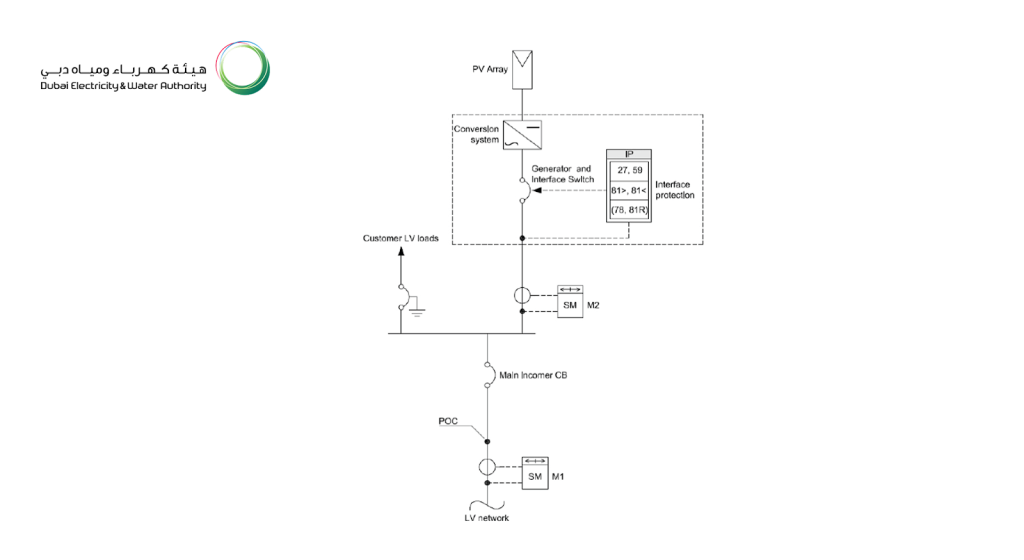
Step 3: Switchgear and Equipment Approvals
DEWA does not allow the installation of unverified electrical equipment on its network. Every major component must be vetted to ensure safety, reliability, and grid compatibility.
The Approved Vendor List (AVL)
When submitting your designs, you must specify equipment from the DEWA approved switchgear and materials list. Using a non-approved manufacturer for your main cables, transformers, or Ring Main Units (RMUs) will halt the project.
LV Panel Approval and FAT
For LV panel approval Dubai, the panel builder must be DEWA-certified.
- Once the panel design is approved, DEWA engineers may require a Factory Acceptance Test (FAT) for large Main Low Tension (MLT) panels before they are shipped to the site.
- You must submit detailed equipment layout drawings showing the precise physical arrangement of the panels within the approved electrical room, ensuring all operational and maintenance clearances (typically 1.2 to 1.5 meters front clearance) are strictly maintained.
Earthing System Mandates
Dubai predominantly uses the TT earthing system for the LV network, though TN-S is used within DEWA’s own substations. The design submission must clearly detail the earthing arrangements, including the sizing of the Earth Continuity Conductor (ECC) and the configuration of the earth pits, ensuring they are designed to achieve the required resistance in Dubai’s dry, sandy soil.
Step 4: The Crucial Site Inspection Phase
Once the installation is complete, the project moves from paper to reality. The DEWA site inspection is notoriously rigorous. A single loose wire or missing label can result in a failed inspection.
What the Inspectors Scrutinize
The DEWA site inspection checklist is comprehensive. The inspector will verify that the physical installation matches the approved SLD exactly.
- Cable Routing and Color Coding: Ensuring all cables are properly contained (in trays or trunking), securely glanded, and adhere to DEWA’s strict color-coding standards (Red, Yellow, Blue for phases; Black for Neutral; Green/Yellow for Earth).
- Earthing Pit Values: The inspector will physically measure the earth resistance. For a general building, it must typically be less than 1 ohm. If the desert soil is too dry, chemical earth pits may have been required during design to pass this test.
- Panel Board Wiring: Checking for proper ferruling (wire identification), shrouded busbars to prevent accidental contact, and ensuring the tariff meter provisions (space and CTs) match DEWA specifications.
The Mini-Checklist for Contractors
Before booking the electrical inspection Dubai, contractors must pre-inspect:
- Are all DBs perfectly labeled matching the approved load schedule?
- Is the electrical room completely clean, painted, and free of non-electrical storage?
- Are rubber mats placed in front of all main panels?
- Are the required fire extinguishers and shock treatment charts mounted?
Step 5: Final Connection and Energization (Getting the Meter)
Passing the inspection is a cause for celebration, but the administrative journey has one final leg. This is the transition to an active, billed utility customer.
Administrative Hurdles
To initiate DEWA meter installation, the contractor or owner must complete the final paperwork:
- Security Deposits: The owner must pay the required innovation fees and security deposits, which vary based on the connected load and property type.
- Connection Fees: Paying the final connection charges for DEWA to physically pull the cables from the network to your main incomer.
- Clearance Certificates: Providing final completion certificates from Dubai Municipality or the relevant Free Zone authority.
The Switch-On Coordination
The DEWA energization process requires precise choreography. DEWA’s field teams will arrive to install the smart meter and make the final network connection. The main contractor, the electrical subcontractor, and the facility manager must be present. Having robust electrical construction and commissioning management on your side significantly smooths out this high-pressure phase, ensuring that the transition from a dead building to a live, energized facility happens safely and without administrative delays.
The Digital Shift: Leveraging DEWA’s Smart Services
DEWA is a pioneer in digital government. Gone are the days of carrying massive rolls of A0 printed drawings to DEWA offices. The entire process is now managed online.
Mastering the e-Services Portal
Using DEWA e-services effectively requires administrative discipline.
- Dubai BPS Integration: The Dubai Building Permit System (BPS) integrates DM, DEWA, Civil Defense, and RTA into a single window. Your electrical submissions are often routed through this unified portal.
- Document Management: System rejections often happen for non-technical reasons. Uploading a 50MB PDF when the limit is 10MB, using incorrect file formats, or poor naming conventions (e.g., “Drawing_Final_v2.pdf” instead of “SLD_GroundFloor_Rev0”) will cause the automated system or the reviewing engineer to kick the application back.
- Ensure all drawings are uploaded in standard DWG and high-resolution PDF formats, properly scaled and digitally signed by the certified consulting engineer.
Top 5 Reasons for DEWA Submission Rejections
Understanding why applications fail is the best way to ensure yours succeeds. Here are the most common DEWA rejection reasons during the electrical drawing approval Dubai phase:
- Mismatched Load Schedules and SLDs: The total load on the excel schedule says 250kW, but the breakers on the SLD add up to 300kW. Fix: Implement strict QA/QC checks to ensure all documents cross-reference perfectly.
- Undersized Main Incomer Cables: Failing to account for the proper voltage drop or grouping factors in Dubai’s high ambient temperature (often calculated at 50°C ground temp). Fix: Always include detailed, software-backed voltage drop calculations with your submission.
- Incorrect Tariff Meter Placement: Placing the utility meter in an inaccessible location or failing to provide the specific dimensions required for DEWA’s smart meter cabinets. Fix: Strictly follow the DEWA meter cabinet spatial guidelines detailed in the wiring manual.
- Inadequate Electrical Room Sizing: The architectural layout doesn’t provide the mandatory clearances for DEWA personnel to safely maintain or replace the equipment. Fix: Engage the electrical consultant during the concept architecture phase, not after the concrete is poured.
- Non-Compliant Earthing Design: Failing to specify the correct earthing system or inadequate earth pit distribution. Fix: Clearly detail the ECC sizing and earth pit locations on a dedicated earthing layout drawing.
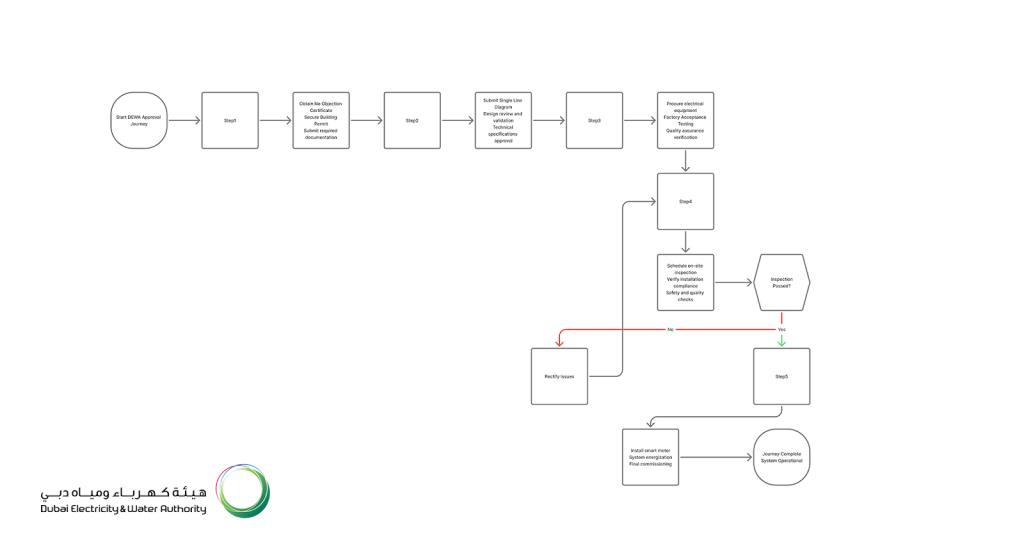
Frequently Asked Questions (FAQ)
1. How long does the DEWA approval process typically take?
If the submission is flawless, the initial SLD and design approval can take between 3 to 7 working days. The Al Namoos fast-track service (for loads up to 150kW) can provide connections in just 5 days. However, complex industrial projects or submissions with multiple rejections can drag the process out for weeks or months.
2. Can any electrical contractor submit drawings to DEWA?
No. Only electrical contractors and consultants who are officially enrolled and licensed by DEWA can submit designs and execute work. The company must have DEWA-approved electrical engineers on their permanent visa to stamp and authorize the technical submissions.
3. What happens if I fail the DEWA site inspection?
If you fail the physical inspection, the inspector will issue a snag list detailing the non-compliance issues. You must rectify all issues and apply for a re-inspection through the portal. Note that DEWA will charge a re-inspection fee, and this will inevitably delay your project’s energization date.
4. Is the DEWA NOC valid forever?
No. DEWA NOCs generally have a validity period (often 6 months to 1 year, depending on the type of NOC). If construction is delayed and the NOC expires, you must revalidate it. If DEWA’s network infrastructure has changed in the meantime, you may be required to alter your design.
5. What is the difference between an LV and MV inspection?
An LV (Low Voltage – 400V/230V) inspection generally focuses on the main distribution boards, sub-mains, and final circuits within a building. An MV (Medium Voltage – 11kV or 33kV) inspection is far more complex, involving DEWA’s transmission engineers, and covers high-voltage switchgear, transformers, and complex protection relay testing before connecting to the main grid.
Conclusion & Next Steps: Streamlining Your Future Approvals
Successfully navigating the DEWA approval process is not an administrative afterthought; it is a critical project management milestone. The overarching theme for success in Dubai is uncompromising preparation and strict, almost dogmatic adherence to the latest DEWA Electricity Wiring Regulations.
Treat the DEWA manual not as a guideline, but as absolute law. Furthermore, regulations evolve. DEWA regularly updates its smart services, equipment vendor lists, and technical thresholds to align with Dubai’s transition toward smart cities and renewable energy integration. Contractors and consultants must maintain an updated library of these regulations to avoid being caught off-guard.
If your projects are suffering from persistent regulatory bottlenecks, rejected SLDs, or failed inspections, the cost of delays far outweighs the cost of expert intervention. If you need Dubai electrical contractor help or comprehensive DEWA compliance solutions, consider partnering with a specialized engineering firm that lives and breathes these regulations daily.Contact Elecwatts today to audit your designs, streamline your DEWA submissions, and ensure your next project is energized on schedule and on budget.