

Dubai’s ambitious transition toward clean energy is anchored by the Shams Dubai initiative. This landmark program encourages residential and commercial building owners to install distributed solar photovoltaic (PV) systems, connecting them directly to the emirate’s grid. However, navigating the bureaucratic and technical landscape to achieve this connection is notoriously complex. For developers and contractors, engaging a specialized electrical engineering services in dubai early in the design phase is absolutely critical. The reality is that a significant percentage of initial solar grid-tie applications face technical rejection by the Dubai Electricity and Water Authority (DEWA).
These rejections are not arbitrary. As distributed solar generation scales up, the utility must protect its network from destabilizing voltage fluctuations, dangerous reverse power flows, and compromised power quality. DEWA’s strict Standards for Distributed Renewable Resources Generation (DRRG) form the backbone of these protections. When consultants and EPC (Engineering, Procurement, and Construction) contractors submit designs that misinterpret or overlook the nuances of the DRRG manual, the Shams Dubai solar connection application stalls.
This creates a frustrating cycle of resubmissions, driving up engineering man-hours, delaying project commissioning, and eroding the financial return on investment (ROI) of the solar asset. To successfully navigate DEWA grid tie requirements, project managers must proactively understand the most common technical pitfalls. This comprehensive guide details the top rejection reasons encountered during the DEWA solar approval process and provides actionable engineering strategies to secure first-time approvals.
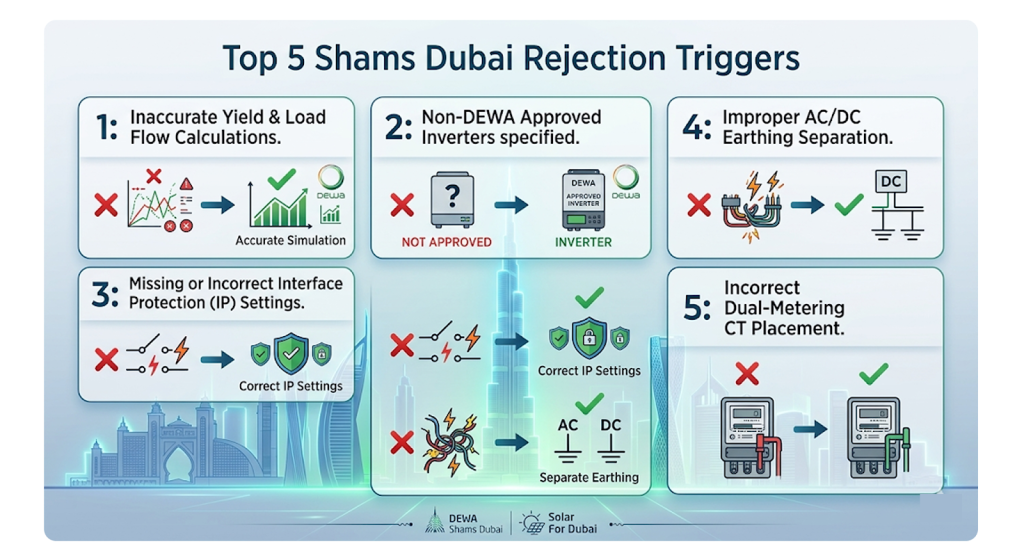
Rejection Reason 1: Inaccurate Load Flow and Yield Calculations
The foundational step of any grid-tied solar application is proving that the proposed PV plant is appropriately sized for the facility and the local utility network. DEWA meticulously reviews the projected energy yield and the building’s historical or calculated base load.
The Oversizing Trap
One of the most frequent reasons for rejection is designing a system that excessively over-generates power. While net metering allows for exporting excess energy back to the grid, DEWA limits the maximum allowable exported capacity based on the facility’s sanctioned load and the local network’s hosting capacity. If the PV yield calculation Dubai shows that the solar plant will consistently push massive amounts of power backwards into a constrained local feeder, the application will be flagged.
Load Flow Precision
To avoid this, engineers must perform highly accurate solar load flow analysis.
- The Solution: This involves using advanced power systems software to simulate the electrical network under various conditions (e.g., peak solar generation with minimum building load, and zero solar generation with peak building load). By utilizing precise load flow analysis, you mathematically prove to DEWA that your PV generation matches their intake thresholds and will not cause voltage violations at the Point of Common Coupling (PCC). Furthermore, yield calculations must accurately account for Dubai’s specific environmental factors, including heavy soiling losses from desert dust and the severe thermal derating of panels during the 50°C summer months.
Rejection Reason 2: Non-Compliant Inverter Specifications
The inverter is the brain of the solar PV system. It is the active bridge between the DC solar array and DEWA’s AC grid. Because of its critical role, DEWA enforces a strict “Equipment Eligibility Standard.”
The Approved Vendor List
A remarkably common and easily avoidable mistake is specifying inverters that are not on the official list of DEWA approved inverters. Even if an inverter is from a Tier-1 global manufacturer and holds European CE or American UL certifications, it cannot be installed in Dubai unless it has been specifically tested, vetted, and listed by DEWA for Shams Dubai compliance.
Anti-Islanding and Power Quality Parameters
Beyond simply choosing an approved brand, the inverter’s specific settings must align with local grid codes.
- Anti-Islanding Protection: This is a non-negotiable safety feature. If the main DEWA grid loses power (a blackout), the grid-tied inverter must detect the loss of utility voltage and shut down in milliseconds. This prevents the solar plant from continuing to energize the “dead” lines, which could electrocute utility line workers attempting repairs. If the design documentation fails to explicitly detail how the inverter achieves this (e.g., via voltage and frequency shift detection), the submission is rejected.
- Harmonic Limits: Inverters must not inject excessive “dirty power” into the network. Total Harmonic Distortion (THD) limits must be strictly adhered to and proven via factory test certificates attached to the submittal.
Rejection Reason 3: Improper Interface Protection (IP) Design
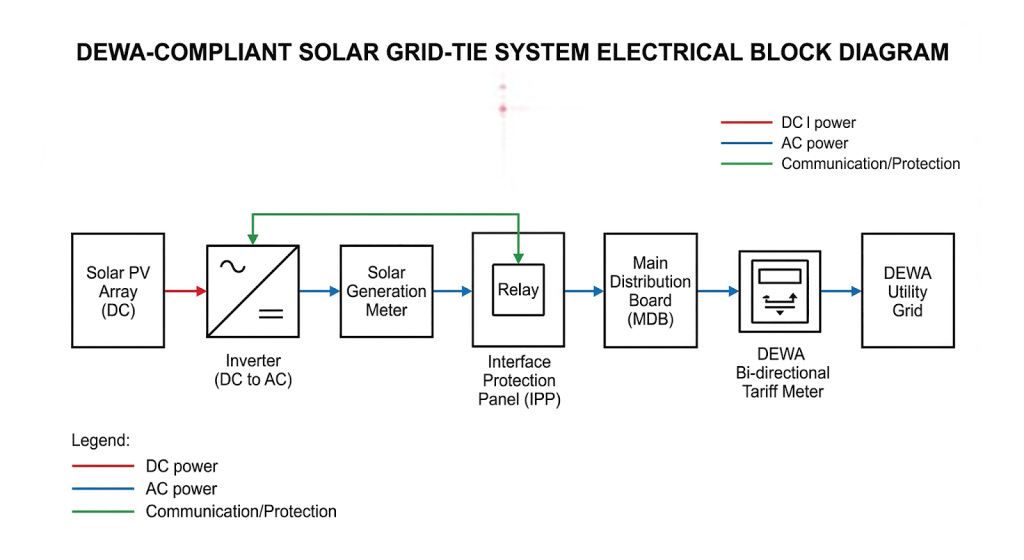
For larger commercial and industrial solar installations, the built-in protection of the inverter is not enough. DEWA mandates a dedicated, physical Interface Protection (IP) panel installed between the solar plant and the main low-voltage distribution board.
The Role of the IP Panel
The DEWA interface protection panel acts as the ultimate fail-safe. It contains utility-grade protection relays that constantly monitor the grid’s health. If the grid becomes unstable, the IP relay trips a motorized breaker, instantly physically decoupling the solar plant from the DEWA network.
Strict Relay Settings
Rejections frequently occur because the consulting engineer fails to program or specify the exact solar relay settings mandated by the DRRG manual. DEWA scrutinizes the following parameters:
- Over/Under Voltage (O/V, U/V): Strict trip thresholds and time delays.
- Over/Under Frequency (O/F, U/F): To protect against grid instability.
- Loss of Mains (LoM): Often requiring sophisticated Rate of Change of Frequency (ROCOF) or Vector Shift protection algorithms.
If the single-line diagram (SLD) and the protection schedule do not explicitly list these exact DEWA-mandated setpoints, the drawing is immediately stamped “Rejected/Revise and Resubmit.”
Rejection Reason 4: Earthing and Bonding Discrepancies
Solar PV systems introduce complex grounding challenges. You are dealing with extensive metallic structures (the panel mounting frames) located on exposed rooftops, high-voltage DC circuits, and standard AC distribution, all of which must be safely grounded to prevent electrocution and lightning damage.
The Equipotential Bonding Mandate
A frequent trigger for DEWA rejection is a lack of clarity regarding PV panel bonding. Every single solar panel frame, mounting rail, and metallic cable tray must be continuously bonded and connected to the building’s main earth terminal.
- The Error: Contractors often try to create a separate, independent earth pit just for the solar array on the roof. This creates dangerous ground loops and potential differences during a fault. DEWA insists on an equipotential bonding zone where all earths are tied together at the main incoming earth bar.
Mixing AC and DC Earthing
Stringent solar earthing requirements dictate how DC and AC faults are handled. In transformerless inverters (which are the most common), a ground fault on the DC side can inject dangerous DC currents into the AC network, which can blind standard AC Earth Leakage Circuit Breakers (ELCBs) or RCDs, rendering them useless. The design must explicitly show the use of Type-B RCDs (which can detect DC residual currents) or prove that the inverter has built-in, DEWA-approved residual current monitoring units (RCMU).
Rejection Reason 5: Metering Configuration Errors
Under the Shams Dubai initiative, DEWA uses a Net Metering scheme to calculate the customer’s utility bill. This financial calculation relies entirely on precise physical metering architecture.
The Dual-Metering Requirement
Unlike off-grid systems, a grid-tied system requires two distinct meters:
- The DEWA Tariff Meter (Bi-directional): Measures power imported from the grid and power exported to the grid.
- The Solar Generation Meter: Measures the total gross energy produced by the solar inverters before it is consumed by the building.
Schematic Placement Errors
Rejections run rampant when the SLD shows incorrect meter placement or incorrect Current Transformer (CT) configurations.
- The Fatal Flaw: If the solar generation meter Dubai is placed after a local building load, it will not measure the gross generation correctly. It must be placed directly on the output of the inverters, before any other connections.
- Furthermore, the metering cabinet dimensions, CT class, and testing blocks must adhere exactly to DEWA’s standard drawings. A non-compliant metering schematic will halt the entire DEWA net metering application.
Navigating the NOCs: Roof Structural & Dubai Municipality
While DEWA handles the electrical integration, they will not process an application if the physical safety of the building is in question. A solar PV project is not just an electrical installation; it is a major structural addition.
The Structural Imperative
Solar panels, mounting structures, and concrete ballast blocks add significant dead weight to a roof. More importantly, they act as massive sails, creating severe wind uplift forces during desert storms.
- The Requirement: DEWA mandates that the solar application package includes a No Objection Certificate (NOC) from the Dubai Municipality (DM) or the relevant Free Zone authority (like JAFZA or Trakhees) confirming the structural integrity of the roof.
- The Coordination Gap: Many electrical consultants submit the DEWA application before securing the Dubai Municipality solar NOC. This results in an immediate administrative rejection. Success requires seamless coordination between the electrical design team and a licensed structural engineer who must calculate the wind loads and provide the stamped PV structural approval drawings concurrently.
The Importance of Power Quality Studies for Large Solar Plants
As the size of the commercial solar installation grows (typically crossing the 1MW threshold), DEWA’s scrutiny intensifies. Large inverter banks act as massive power electronics hubs that can distort the fundamental waveform of the utility grid.
Harmonic and Flicker Studies
For these large-scale projects, simple SLDs and load schedules are insufficient. The consultant must submit a comprehensive solar power quality study.
- Harmonic Distortion: Inverters generate harmonics. If the cumulative PV harmonic distortion at the Point of Common Coupling exceeds the limits set by IEEE 519 (which DEWA enforces), it can overheat neighboring utility transformers. The study must mathematically prove compliance.
- Flicker: Rapid changes in solar irradiance (e.g., fast-moving clouds) cause rapid fluctuations in power output, which can cause perceptible “flicker” in lighting on the local grid. Advanced modeling is required to prove these fluctuations remain within allowable limits.
Best Practices for the Site Inspection and Testing Phase
Assuming your design navigates the paperwork maze and gets approved, the final hurdle is the physical installation and the DEWA site inspection.
The Ultimate Reality Check
The DEWA inspector will arrive with the approved drawings in hand. If the physical reality of the site deviates from the stamped SLD by even a minor degree, a different brand of isolator, a slightly different cable route, or an incorrectly labeled warning sign, the inspection is failed.
The Commissioning Strategy
- Pre-Inspection Checklist: The contractor must perform a rigorous internal audit using the official Shams Dubai inspection checklist before inviting DEWA. This includes verifying all warning labels (which must be in both English and Arabic), checking that the anti-islanding test protocol functions perfectly, and ensuring the interface protection relays are calibrated and password-locked.
- Expert Electrical Construction & Commissioning Management is vital here. A dedicated commissioning manager ensures that the solar PV commissioning sequence is executed flawlessly, bridging the gap between the theoretical design and the physical hardware, guaranteeing that when the DEWA inspector arrives, the system operates exactly as promised.
Frequently Asked Questions (FAQ)
1. What is the Shams Dubai initiative?
Shams Dubai is a regulatory framework introduced by DEWA to encourage residents and businesses to install solar panels on their properties. It allows customers to generate their own electricity, use it to offset their consumption, and export any surplus to the DEWA grid via a net metering scheme.
2. Can I install batteries with my Shams Dubai solar system?
Currently, DEWA’s Shams Dubai framework is primarily designed for grid-tied systems without battery storage. The grid acts as your “virtual battery.” If you wish to install physical Battery Energy Storage Systems (BESS), it requires highly specialized approvals and complex protection designs to ensure batteries do not discharge into the utility grid during a blackout.
3. Why does DEWA care about the structural integrity of my roof?
DEWA is responsible for overall safety. If a poorly designed solar array is ripped off a roof during a storm, it could damage DEWA’s overhead lines, transformers, or cause public harm. Therefore, they require a structural NOC from Dubai Municipality to certify that the roof can handle the dead weight and wind uplift forces of the PV system.
4. How long does the DEWA solar approval process take?
If the submission is technically flawless and all structural NOCs are ready, the initial design approval can take 2 to 4 weeks. However, if the design is rejected due to the technical errors outlined in this article, the revise-and-resubmit cycle can easily drag the process out for 3 to 6 months.
5. What happens to the excess solar power I generate?
Under the Net Metering scheme, if your solar panels generate more electricity than your building consumes during the day, the excess is exported to the DEWA grid. Your bi-directional smart meter records this. DEWA then credits your account with this exported energy, which offsets your consumption during the night or in subsequent billing cycles.
Conclusion & Next Steps: Securing First-Time Approvals
The transition to solar energy is a brilliant financial and environmental strategy for any building owner in Dubai. However, the path to connecting that solar asset to the grid is fraught with complex, uncompromising engineering standards. The high rejection rates experienced by many contractors are not due to an inherently flawed grid, but rather a failure to meticulously align the system design with DEWA’s DRRG manual.
By proactively addressing the nuances of load flow analysis, specifying strictly compliant inverters, mastering the interface protection settings, and ensuring flawless metering and earthing configurations, project managers can bypass the cycle of rejection and redesign.
Don’t let regulatory rejections delay your solar ROI.
Securing a first-time approval requires a partner who speaks DEWA’s technical language fluently. Ensure your next renewable energy project is designed flawlessly from day one. Engage our specialized electrical engineering consulting team to guarantee your design meets absolute DEWA DRRG compliance, accelerating your path from concept to connection.Contact Elecwatts today to fast-track your Shams Dubai solar grid-tie approval.