

In the glittering skyline of Dubai, the towering high-rises, sprawling data centers, and advanced medical cities represent the pinnacle of modern architecture. Yet, beneath the aesthetic brilliance lies a stark reality: in these structures, a loss of power during an emergency equates to a catastrophic life safety failure. Designing the lifeblood of these buildings requires partnering with an expert electrical engineering consultancy in dubai that intimately understands local mandates. At the heart of this regulatory landscape is the Dubai Civil Defense (DCD) overarching 3 hour emergency power survival mandate.
When a severe fire breaks out and the municipal utility grid fails or is intentionally severed to protect firefighters, the building must essentially become a self-sustaining survival pod. The DCD mandates that specific, life-saving essential services must remain fully operational for a continuous duration of 180 minutes under extreme conditions. For engineers tasked with critical facility electrical design, this is the ultimate test. It is not merely about providing backup power; it is about engineering an indestructible electrical ecosystem capable of withstanding intense heat, water sprays, and mechanical impacts to ensure occupants can evacuate safely and first responders have the tools they need to save the building.
Defining the “Essential” Electrical Load
The first step in designing a compliant emergency system is ruthlessly categorizing the building’s electrical loads. Not all loads are created equal, and in an emergency, power is a finite, precious resource.
What Constitutes an Essential Load?
The DCD strictly defines what must be connected to the life safety power supply. These are the systems that directly contribute to evacuation and fire suppression:
- Smoke Management Systems: Massive smoke extraction fans and staircase pressurization fans that keep escape routes clear of toxic fumes.
- Firefighting Elevators: Specially designed lifts used exclusively by civil defense personnel to rapidly ascend the tower.
- Fire Pumps: The electric pumps driving the sprinkler systems and fire hose reels.
- Emergency Lighting and Voice Evacuation: Systems guiding occupants to safety in total darkness.
The Principle of Isolation
These critical systems cannot be mixed with standard commercial loads. Precise electrical system design in dubai isolates these essential electrical load circuits onto dedicated, strictly segregated, fire-protected distribution boards. If a short circuit occurs in a tenant’s office on the 40th floor during a fire, the protective isolation ensures that the fault does not cascade and trip the main life safety breaker, leaving the entire building defenseless.
Fire-Rated Cabling: The Lifeline of the Building
A perfectly sized emergency generator is useless if the cables delivering the power melt within the first five minutes of a fire. The physical transmission network is the most vulnerable component of the emergency system.
The FP400 and CWZ Standard
Standard PVC cables act as fuel during a fire, releasing lethal, acidic smoke. Life safety circuits mandate the use of heavy-duty, FP400 fire rated cable specifications or their equivalent.
- The CWZ Test: To meet DCD approvals, these cables must typically pass the grueling BS 6387 CWZ test. This proves the cable can maintain electrical continuity for 3 hours while being blasted by a 950°C flame (C), sprayed with water to simulate sprinkler activation (W), and repeatedly struck by a steel bar to simulate falling structural debris (Z).
Systemic Survival
A critical, often overlooked engineering requirement is that it is not just the cable that must survive; the entire routing infrastructure must match the cable’s fire rating. A fire-resistant cable will fail if the standard aluminum tray holding it melts and collapses. Engineers must specify certified fire survival cable tray systems, heavy-duty copper saddles, and specialized steel fixings that ensure the cable remains physically supported in the ceiling void, even as the surrounding room is consumed by a 900°C inferno.
Emergency Generator Autonomy and Fuel Storage
When the main DEWA (Dubai Electricity and Water Authority) grid fails, the building’s emergency diesel generators must roar to life. Sizing these massive machines for critical facilities is far more complex than simple addition.
Managing the Inrush Chaos
During a fire alarm, multiple massive induction motors, like the 200kW smoke extraction fans on the roof and the main fire pumps in the basement, will attempt to start almost simultaneously.
- The Sizing Challenge: Emergency generator sizing must account for “Locked Rotor Amps” (LRA). The inrush current of these fans can be 6 to 8 times their normal running current. If the generator’s alternator is not oversized to handle this sudden, massive reactive load, the voltage will crash, the generator will stall, and the smoke fans will fail to spin up. Engineers must program careful “step-loading” sequences into the building automation system to start these heavy loads one by one over a 60-second window.
Autonomy and Fuel Storage
The 3-hour rule dictates the minimum running time, but DCD fuel storage rules vary based on the criticality of the building.
- A standard high-rise may require fuel for 4 to 8 hours of full-load operation.
- A critical hospital or major data center may require 24 to 72 hours of on-site fuel.
Storing thousands of liters of highly combustible diesel fuel within the footprint of a skyscraper requires complex bulk fuel tanks, 2-hour fire-rated containment rooms, and specialized transfer pumping systems equipped with fusible-link safety shutoff valves to prevent the generator fuel system from fueling the fire.
Automatic Transfer Switches (ATS) and Bypass Architecture
The Automatic Transfer Switch (ATS) is the critical brain of the power transition. It is the device that physically disconnects the building from the dead DEWA grid and connects it to the live generator grid.
The 15-Second Mandate
For life safety systems, time is measured in seconds. Generator automatic transfer must occur rapidly. DCD and international NFPA codes mandate that life safety power must be restored within a maximum of 10 to 15 seconds after the primary power fails. The ATS switchgear design must feature utility-grade contactors and highly reliable motorized mechanisms capable of executing this violent switch safely.
The Bypass-Isolation Imperative
An ATS is a mechanical device, and all mechanical devices require maintenance. However, you cannot simply shut down the life safety network of a 60-story occupied tower to clean the ATS contacts.
- The Solution: Critical facilities mandate the use of “Bypass-Isolation” ATS units. This dual-mechanism architecture allows a facility manager to physically bypass the automatic switch, routing utility power directly to the load through a secondary path, and then completely isolate and slide out the main ATS mechanism for safe maintenance, all without dropping power to the fire pumps or elevators for a single millisecond.
Uninterruptible Power Supplies (UPS) for Zero-Interruption Zones
While a 15-second generator startup delay is acceptable for a smoke exhaust fan, it is a catastrophic eternity for other critical zones within a facility.
The Zero-Tolerance Loads
In a hospital, a 10-second blackout during a delicate neurosurgery procedure or a reboot of the life-support ventilators is fatal. In a data center, a momentary voltage sag crashes servers, corrupting millions of financial transactions. These zones require an impenetrable bridge of power.
Online Double-Conversion Topologies
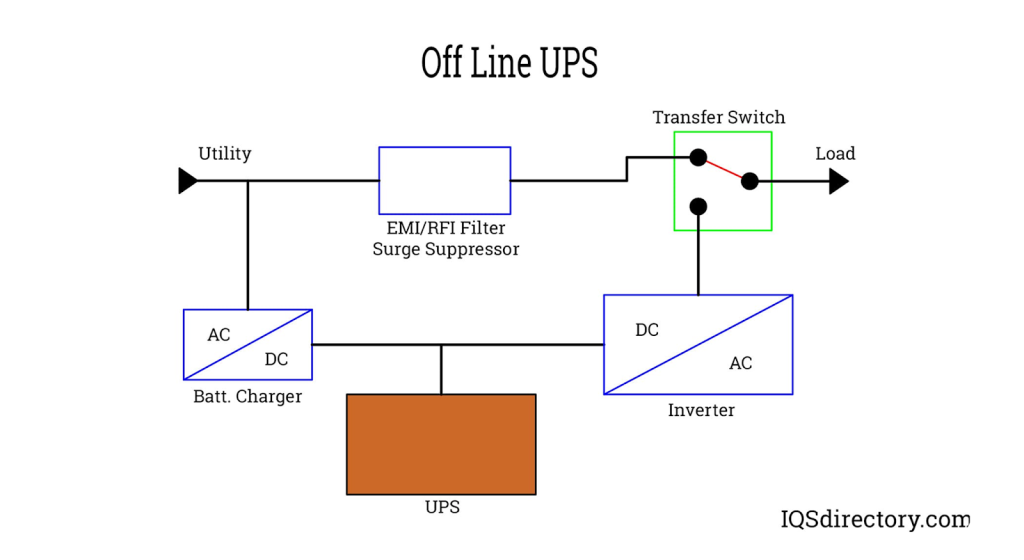
To bridge this gap, engineers deploy heavy-duty Uninterruptible Power Supplies (UPS) systems. Hospital UPS design relies on “Online Double-Conversion” topologies. The incoming AC power is converted to DC to charge the batteries, and then immediately inverted back to perfectly clean AC power for the critical load.
- The Result: When the DEWA grid fails, there is literally a zero-millisecond transfer time. The batteries instantly take the load until the heavy diesel generators spin up and take over.
- Medical IT Systems: In operating theaters, the medical IT power supply utilizes specialized isolation transformers connected downstream of the UPS. This ungrounded system ensures that a single electrical fault on a piece of surgical equipment will not trip the breaker or shock the patient, maintaining critical uptime while alerting the staff via a line isolation monitor.
Safe Routing Through Fire Compartments
The architecture of a modern building is divided into “Fire Compartments”, zones designed to contain a fire for 2 to 3 hours, preventing it from spreading to the rest of the building. The electrical design must respect and navigate these physical boundaries.
The Prohibition of Cross-Routing
A fundamental rule of fire compartmentation electrical design is ensuring survivability through spatial separation.
- The Rule: You absolutely cannot route the primary safe cable routing supply for Life Safety Zone A through the high-fire-risk area of Zone B. If a fire starts in the main kitchen (Zone B), it should never be able to burn through the cables powering the staircase pressurization fans serving the hotel rooms (Zone A).
- Segregation: Engineers must coordinate deeply with architects to design dedicated, fire-rated electrical riser shafts. Primary and secondary (redundant) feeder cables must be routed through completely distinct paths, ensuring a single localized fire cannot sever both power supplies to the critical equipment simultaneously.
Fire Stopping and Penetration Seals
Every time a cable, conduit, or cable tray passes through a fire-rated wall or floor slab, it destroys the integrity of that 2-hour fire compartment, creating a hole for smoke, toxic gas, and flames to travel through.
Sealing the Breaches
Electrical fire stopping is a highly scrutinized step during the DCD site inspection. Standard construction foam or cement is strictly illegal for this purpose.
- Intumescent Technology: Engineers must specify the use of an intumescent cable seal, fire-rated mortars, and specialized fire collars. Intumescent materials have a unique chemical property: when exposed to the extreme heat of a fire, they rapidly expand (intumesce) up to 40 times their original volume.
- The Action: As the plastic insulation on the cables melts away during a fire, the intumescent sealant expands to crush the cables and completely seal the hole, re-establishing the 2-hour fire barrier and preventing the building’s electrical shafts from acting like massive, deadly chimneys.
Rigorous Commissioning and Integrated Testing
A critical electrical system is only a theory until it is proven under stress. The final hurdle before securing the building’s occupancy certificate is the ultimate stress test.
The Black Building Test
You cannot test a life safety system by pressing a test button on a single smoke detector. DCD requires a full black building test. This involves coordinating with the utility to actually trip the main DEWA incoming breakers, plunging the entire fully-loaded facility into darkness.
- The Sequence: The engineering team must prove that the ATS senses the loss of power, the generators start, the UPS systems hold the critical loads without a flicker, and the smoke fans and fire pumps step-load onto the generator seamlessly within 15 seconds.
- Project Leadership: Executing integrated systems testing on this scale is inherently dangerous. It requires dedicated Electrical Project Management in dubai to orchestrate the mechanical, electrical, elevator, and fire alarm contractors. Every system must interact flawlessly based on the Cause-and-Effect matrix. A failure here requires weeks of reprogramming and re-testing.
Frequently Asked Questions (FAQ)
1. Does the 3-hour emergency rule apply to residential villas?
No. The strict 3-hour (180-minute) survival mandate and centralized emergency generator requirements are typically reserved for critical facilities, high-rise buildings (usually over 23 meters), malls, hospitals, and large industrial facilities. Standalone residential villas have different, less stringent fire safety requirements focused on localized smoke detection and rapid egress.
2. Can solar panels be used as an emergency power source instead of a diesel generator?
Currently, under DCD and DEWA regulations, standard grid-tied solar panels cannot replace the primary life-safety diesel generator. Solar generation is variable and unpredictable (e.g., during a nighttime fire). However, massive Battery Energy Storage Systems (BESS) are slowly being integrated into hybrid emergency power designs, though diesel remains the mandatory, proven backbone for the guaranteed 3-hour high-load runtime.
3. What is the difference between FP200 and FP400 fire-rated cables?
Both are fire-resistant, but they are designed for different severity levels. FP200 (or equivalent “standard” fire-resistant cable) is typically used for smaller circuits like fire alarm loops and emergency lighting, offering 30 to 120 minutes of resistance. FP400 (or “enhanced” armored fire-resistant cable) is much heavier, heavily armored, and designed to meet the rigorous CWZ standard (3 hours at 950°C with water and impact). FP400 is mandatory for the heavy power feeders to the main fire pumps and massive smoke fans.
4. Why do fire pumps start directly across the line (DOL) instead of using soft starters?
While soft starters or VFDs protect the electrical grid from massive inrush currents, they contain sensitive power electronics that can fail under extreme heat or fault conditions. In a raging fire, protecting the grid is secondary to pumping water. Therefore, DCD regulations often mandate that electric fire pumps use robust, simple contactors (Star-Delta or Direct-On-Line) to guarantee the pump starts, sacrificing electrical finesse for absolute mechanical reliability.
5. If the generator runs out of fuel after 4 hours, what happens?
The primary goal of the 3-hour rule is to guarantee enough time to fully evacuate a massive skyscraper and allow the Dubai Civil Defense heavy firefighting units to arrive, set up, and take control of the situation. After the mandated 3 to 8 hours (depending on the facility type), it is assumed that the building is either saved, safely evacuated, or that emergency services have deployed external mobile generators and high-capacity fire trucks to take over the life safety load.
Conclusion & Next Steps: Designing for the Worst-Case Scenario
Designing an electrical system to meet Dubai’s 3-hour emergency response requirement is the ultimate exercise in risk mitigation. It forces engineers to assume that the absolute worst-case scenario will occur, total grid failure combined with a massive, uncontrolled thermal event. In this environment, every component, from the massive ATS switchgear down to the intumescent putty sealing a cable hole, plays a vital role in preserving human life.
For developers and facility owners, this is not an area for cost-cutting or minimum compliance. A robust, heavily redundant life safety electrical architecture protects your occupants, safeguards your asset from total destruction, and ensures seamless compliance with DCD’s uncompromising standards.
Are your facility’s life safety designs fully compliant and resilient?
Do not wait for an inspection failure or a catastrophic event to uncover the weak links in your emergency power systems. If you are developing a high-rise, healthcare facility, or data center, you need a specialized critical power consultant by your side. Contact our Dubai life safety engineering team today for a rigorous DCD compliance audit and ensure your critical facility is truly designed to survive.
Contact Elecwatts today to secure your emergency power infrastructure.