

In the high-stakes landscape of Dubai’s construction sector, securing regulatory permits is a complex undertaking, but no hurdle is more heavily scrutinized than the Dubai Civil Defense approval. Protecting the lives of thousands of occupants in supertall skyscrapers, sprawling malls, and heavy industrial zones is a mandate that admits zero margin for error. Navigating these uncompromising life safety regulations requires partnering with an expert electrical engineering consultancy in dubai early in the concept phase. If a project fails to align its electrical architecture with the UAE Fire and Life Safety Code of Practice, the result is not just a delayed schedule; it is a total blockade of the Building Completion Certificate (BCC).
The fundamental challenge for project managers and consultants lies in the intricate integration between general electrical design and active fire protection systems. Life safety infrastructure, from emergency lighting and smoke extraction fans to the main fire pumps, cannot be treated as a separate, isolated discipline. These systems are parasitic; they rely entirely on the building’s electrical backbone for their survival during a catastrophic event.
When a fire breaks out and the main power grid is compromised, the electrical design must seamlessly cascade into a predefined emergency mode, ensuring that every pump runs, every alarm sounds, and every evacuation route remains illuminated. For DCD electrical safety approvals, intention is not enough. You must provide an exhaustive, mathematically proven, and flawlessly coordinated documentation package. This guide serves as the definitive checklist for the electrical safety documentation required to secure your DCD approvals without crippling delays.
The Initial NOC and Drawing Requirements
Before a single trench is dug or cable tray installed, the theoretical framework of your life safety system must be approved. The initial No Objection Certificate (NOC) phase sets the baseline for all subsequent electrical designs.
Establishing the Baseline
To initiate the DCD NOC requirements, the submission package must be built upon a foundation of DCD-stamped architectural plans. The electrical engineer cannot design the alarm zones until the fire and life safety strategist has clearly demarcated the building’s fire compartments, evacuation routes, and hazard classifications.
- The Load Schedule Interface: Your initial electrical load schedule must explicitly isolate the life safety equipment. Elevators designated for firefighting, smoke management Air Handling Units (AHUs), and staircase pressurization fans must be clearly identified and their loads calculated with absolute precision to size the life safety emergency generators correctly.
The Mandate for Approved Professionals
DCD does not accept fire life safety drawings Dubai from generic contractors. The design, installation, and certification must be executed by companies that hold valid, specific DCD “House of Expertise” or approved fire contractor licenses. Attempting to submit electrical life safety drawings stamped by an unapproved entity will result in an immediate, unceremonious rejection at the very first gateway.
Fire Alarm and Detection Systems (FACP) Documentation
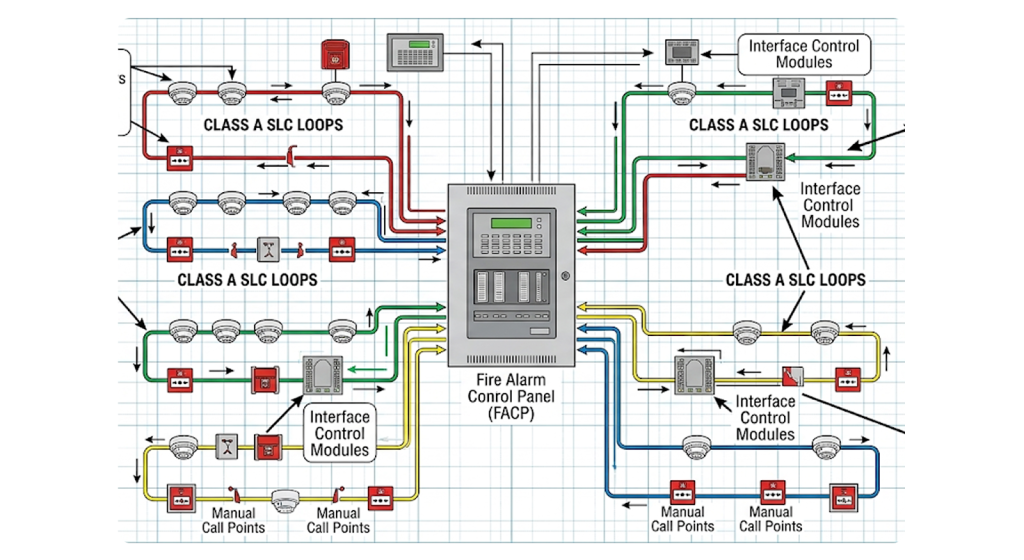
The Fire Alarm Control Panel (FACP) is the sensory nervous system of the building. DCD requires absolute clarity on how this network is wired, zoned, and powered.
Schematic Rigor
The FACP schematic drawing must be a masterpiece of clarity. It cannot be a generic block diagram.
- Loop Capacities: The documentation must detail every addressable loop, explicitly showing that the number of devices (smoke detectors, heat detectors, manual call points) does not exceed the manufacturer’s maximum capacity or the DCD-mandated 20% spare capacity rule for future expansion.
- Zoning: The electrical fire zones must perfectly overlay the architectural fire compartments. A single alarm zone cannot cross a fire-rated wall, ensuring that emergency responders can instantly pinpoint the exact compartment in distress.
Interfacing on the SLD
The FACP does not just ring bells; it commands the building. The Single Line Diagram (SLD) must clearly illustrate the interface units (control relays). DCD fire alarm regulations require documented proof of how the FACP interfaces with other disciplines. For instance, the schematic must show the exact control wiring that shuts down the fresh air handling units (to prevent feeding oxygen to the fire) and automatically recalls all passenger elevators to the ground floor upon alarm activation.
Emergency Lighting and Central Battery Systems (CBS)
When the primary power fails and the corridors fill with smoke, emergency lighting is the only thing preventing a panicked stampede. DCD’s scrutiny of this system is notoriously intense.
The 3-Hour Autonomy Rule
Whether utilizing self-contained luminaires (with internal battery packs) or a Central Battery System, the mathematical core of your submission is the emergency lighting calculation.
- The Requirement: You must submit comprehensive battery sizing calculations proving that the system can maintain the mandated lux levels (typically 1 lux along the center line of the escape route and 10.8 lux at high-hazard task areas like stairwells and fire alarm panels) for a continuous duration of 3 hours after a total power failure.
Central Battery System (CBS) Documentation
For large commercial and high-rise residential projects, a central battery system DCD submission is standard.
- Fire-Rated Integrity: Because a centralized system relies on cables to distribute DC power to the luminaires, the documentation must explicitly prove that the distribution circuits are wired using fire-resistant cables.
- Sub-Circuit Monitoring: The schematics must detail how the CBS monitors the local lighting sub-circuits. If the normal lighting in a specific corridor fails (even if the main building power is still on), the emergency lights in that specific zone must activate automatically.
Fire Pump Electrical Feeder Calculations
The fire pumps are the beating heart of the active suppression system. If the electrical supply to the electric fire pump fails, the sprinkler network is rendered useless.
The “Direct Feed” Mandate
DCD pump room regulations dictate that the power supply to the electric fire pump must be as indestructible as possible.
- Routing: The fire pump electrical feed must be tapped ahead of the building’s main isolating breaker. This ensures that if the civil defense team or the building management trips the main power to the building to fight the fire safely, the fire pump remains fully energized.
- Generator Backup: In facilities requiring secondary power, the fire pump must be supported by the life safety generator via a dedicated, fire-rated Automatic Transfer Switch (ATS) located inside the pump room.
Starting Current and Voltage Drop
Fire pumps utilize massive induction motors. When they start, they pull immense inrush currents (Locked Rotor Amps).
- The Calculation: The electrical submission must include highly specific voltage drop calculations for the fire pump feeder during the starting phase. If the cable is undersized, the massive current draw will cause a severe voltage dip, potentially causing the pump’s magnetic contactor to chatter and fail, preventing the pump from starting when it is needed most. DCD engineers will check this calculation line by line.
Fire-Resistant Cabling (FP200/FP400) Specifications
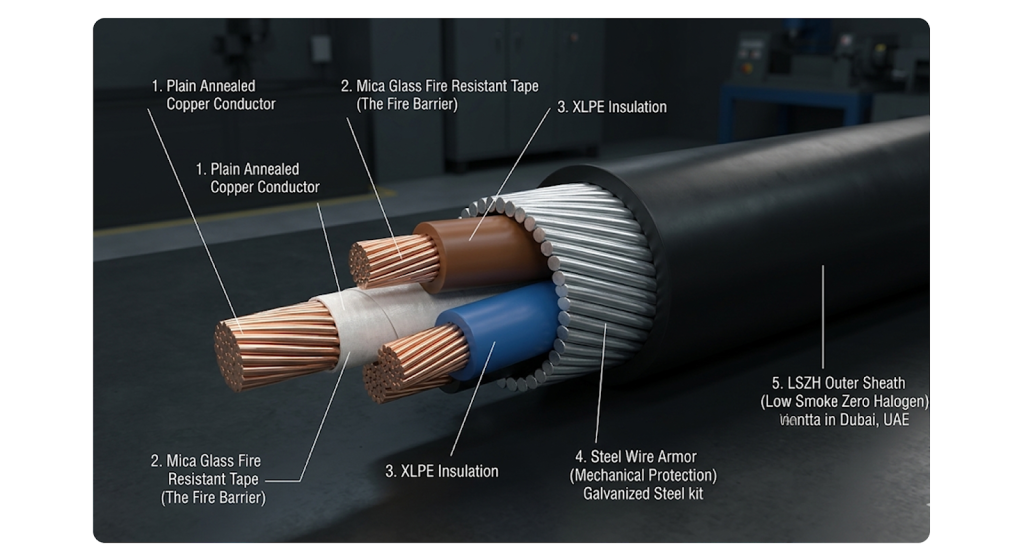
Standard PVC electrical cables melt, short circuit, and release lethal, blinding toxic smoke within minutes of a fire. The lifeline of the building’s safety systems relies entirely on the specification of specialized fire-resistant cables.
The Cable Checklist
Your documentation must explicitly specify cables that meet stringent British Standards (BS 6387 or BS EN 50200).
- CWZ Category: The cables must achieve the ‘CWZ’ rating, proving they can maintain circuit integrity for 3 hours at 950°C (C), withstand water sprays from sprinklers (W), and endure physical mechanical shocks from falling debris (Z).
- Sheathing: The specification must mandate Low Smoke Zero Halogen (LSZH or LSF) sheathing to ensure that the cables do not contribute to the smoke density or release acidic hydrochloric gas that damages the lungs of evacuees.
Routing and Segregation
Specifying the correct FP400 cable specification is only half the battle. The layout drawings must prove physical segregation. Fire rated cables Dubai routing must be completely physically separated from normal building power cables. If routed on a shared tray, a physical metallic divider must be documented. Furthermore, the drawings must prove that life safety cable routes consciously avoid high-hazard zones (like chemical storage or main kitchen exhaust hoods).
Cause and Effect Matrix (The Brain of the System)
If the cables are the nervous system and the FACP is the brain, the Cause and Effect Matrix is the underlying logic programmed into that brain. This is the single most heavily audited document during a DCD review.
Defining the Sequence of Operations
The DCD life safety matrix is a comprehensive spreadsheet that cross-references every single input (Cause) against every single required output (Effect).
- The Logic: If Smoke Detector 14 in the Basement Parking is activated (Cause), what happens? The matrix must definitively state the Effects: The alarm bells ring on the ground floor and basement, the parking exhaust fans switch to high-speed smoke extract mode, the make-up air fans activate, the access control doors unlock, and the elevators return to the ground floor and open their doors.
Why DCD Relies on It
The fire alarm cause and effect matrix proves that the electrical engineer, the mechanical engineer, and the fire strategist have actually communicated. Without this matrix, a building is just a collection of disjointed systems. DCD inspectors will use this exact matrix during the final site inspection to test the building’s automated response to simulated disasters.
Managing Liability and Risk Documentation
Life safety systems carry immense legal and financial weight. If a commercial lighting circuit fails, it is an inconvenience. If a smoke extraction fan fails to start during a fire because of an undersized cable or a flawed relay, it is a criminal liability.
The Burden on the Consultant and Contractor
In the UAE, the liability for a catastrophic failure of a life safety system rests heavily on the engineers who stamped the drawings and the contractors who executed the work. Documenting your compliance is your primary legal defense.
- Strategic Risk Mitigation: Every calculation, every cable schedule, and every manufacturer’s data sheet submitted to DCD forms a permanent legal record. Engaging net zero risk management solutions in dubai ensures your project is comprehensively covered against compliance failures. By deploying third-party peer reviews of your life safety schematics before DCD submission, you insulate your firm against catastrophic liability and prevent the project from becoming an uninsurable asset.
The Pre-Inspection Commissioning Checklist
The DCD site inspection is notoriously unforgiving. The inspector does not arrive to help you troubleshoot; they arrive to witness a flawless performance. If a system fails, the inspection is aborted, and a costly, time-consuming re-inspection must be booked.
The 100% Pre-Test Mandate
Before officially inviting the DCD inspector, the main contractor must execute a ruthless internal pre-inspection. This is not a random sampling exercise.
- The Requirement: 100% of the devices on the FACP loop must be physically tested. Every single line item on the Cause and Effect Matrix must be simulated and verified. The central battery system must be subjected to a full 3-hour discharge test, and the lux levels recorded.
- Commissioning Leadership: This is where projects succeed or fail. Expert Electrical Construction & Commissioning Management in dubai is vital here to ensure the physical installation perfectly matches the approved Cause and Effect Matrix. A dedicated commissioning manager orchestrates the complex interplay between the fire alarm programmers, the BMS technicians, and the mechanical contractors, ensuring that the “dry runs” expose and resolve any interface failures weeks before the official DCD inspector sets foot on the site.
Frequently Asked Questions (FAQ)
1. Do we need DCD approval for a simple office fit-out?
Yes. Even if you are just moving partition walls, you are altering the fire zones and sprinkler coverage. Any modification to the existing Fire Alarm Control Panel (adding or moving smoke detectors) requires a dedicated fit-out drawing submission and a subsequent DCD inspection to ensure the life safety integrity of the base building hasn’t been compromised.
2. Can we use the same generator for life safety and normal standby power?
Yes, but with strict conditions. DCD allows a shared generator only if the life safety loads are prioritized. The generator must feed a dedicated life safety distribution board via its own ATS. If the generator is nearing its maximum capacity during an outage, the electrical design must include automated load-shedding contactors that instantly disconnect the non-essential commercial loads (like general AC) to ensure the fire pumps and smoke extraction fans never lack power.
3. What happens if our emergency lighting calculation fails the 3-hour test on site?
If the battery banks drain before the 3-hour mark, the DCD inspection fails. You will be forced to either drastically increase the battery capacity of your Central Battery System or retrofit additional standalone emergency luminaires. This highlights why precise, conservative voltage drop and battery sizing calculations are critical during the initial drawing submission phase.
4. Are standard PVC conduits allowed for routing fire alarm cables?
Generally, no. For critical life safety circuits, DCD and the UAE Fire Code strongly prefer heavy-duty, galvanized rigid steel conduits or specialized fire-rated trunking, especially when routed through exposed areas like basement car parks or mechanical plant rooms, to provide maximum mechanical protection to the FP200/FP400 cables within.
5. Why did DCD reject our Cause and Effect matrix?
The most common reason for rejection is a “conflict of logic.” For example, if the matrix states that upon detecting smoke in an office, the fresh air handling unit (AHU) should continue running while the smoke extraction fan turns on, this is a fatal flaw. The fresh air unit would feed oxygen to the fire. The matrix must demonstrate a flawless, code-compliant logic that prioritizes containment and extraction.
Conclusion & Next Steps: Securing Your Occupancy Certificate
Navigating the Dubai Civil Defense approval process is the ultimate test of an electrical engineering team’s rigor. The documentation required, from the initial load schedules to the final, exhaustively detailed Cause and Effect Matrix, leaves absolutely no room for ambiguity, assumptions, or “rule-of-thumb” engineering.
A flawless DCD electrical submission is the master key to unlocking the final Building Completion Certificate (BCC). It is the definitive proof that the building is not just functional, but inherently safe for the public. Failing to respect the depth of documentation required by DCD will trap your project in an endless loop of rejections, bleeding budget and delaying handover indefinitely.
Don’t let life safety compliance jeopardize your project timeline.
If you are struggling with a DCD rejection, facing a complex heritage retrofit, or starting a massive new high-rise, you need a partner whose expertise is recognized by the authorities. Contact our electrical engineering consulting firm to audit, optimize, and rectify your life safety drawings. We serve as your dedicated DCD approval consultant, translating complex Dubai occupancy certificate requirements into flawless, approved electrical designs that guarantee compliance and protect your liability.Contact Elecwatts today to secure your DCD approvals and bring your project safely across the finish line.