

Dubai South represents one of the most ambitious urban and industrial master developments in the world. Spanning 145 square kilometers, it is designed to be a self-sustained ecosystem anchoring the Al Maktoum International Airport, the sprawling Logistics City, and dynamic commercial mega-zones. For developers and contractors venturing into this high-stakes arena, partnering with a specialized electrical engineering consulting in dubai firm early in the conceptual phase is critical to project viability. The margin for error in these sectors is non-existent.
In the fast-paced realms of global logistics and aviation, power outages do not just turn off the lights; they halt international supply chains, ground aircraft, and cause millions of dollars in cascading operational losses. A cold-chain storage facility handling pharmaceuticals or a robotic sorting hub processing e-commerce freight requires an electrical backbone that guarantees absolute, uninterrupted resilience. Designing for Dubai South means engineering for scale, speed, and extreme reliability under the relentless GCC climate. This comprehensive guide explores the unique Dubai South electrical design considerations and the uncompromising Logistics City power requirements that define this global commerce hub.
Understanding the Master Plan’s Power Distribution Network
Dubai South is not a patchwork of isolated buildings; it is a meticulously planned mega-grid. Understanding how power is routed from the utility to your specific plot is the first step in successful facility design.
The 132/11kV Substation Backbone
The Dubai Electricity and Water Authority (DEWA) has deployed a robust network of primary 132/11kV substations strategically located throughout the Dubai South master plan. These substations form the backbone of the Dubai South substation network, stepping down transmission-level voltages to the 11kV distribution Dubai standard used for localized industrial routing.
- The Developer’s Interface: When a developer acquires a plot in Logistics City, DEWA allocates a specific power quota based on the plot size and intended use. The developer must then design an internal 11kV/400V network, often requiring dedicated on-plot ring main units (RMUs) and step-down transformers, to safely distribute this power.
Navigating Plot-Limit Power Allocations
A common trap for developers in Dubai South is designing a hyper-automated facility whose Total Connected Load (TCL) exceeds the pre-allocated DEWA quota for the plot.
- The Engineering Solution: If the facility’s demand outstrips the allocation, the developer cannot simply “request more power” without severe cost and schedule implications. Engineers must meticulously calculate diversity factors, implement peak-shaving strategies, and utilize ultra-high-efficiency equipment to keep the Maximum Demand (MD) safely within the plot limit. If the load is unavoidably massive, the developer may be forced to carve out valuable real estate to build a dedicated DEWA 11kV substation on their own land.
Redundancy Requirements for Automated Logistics Hubs
Modern logistics facilities in Dubai South are vastly different from traditional storage sheds. They are highly complex, automated machines.
The Rise of Automation and Cold-Chain
Facilities are increasingly relying on Automated Storage and Retrieval Systems (ASRS), miles of conveyor belts, robotic sorting arms, and massive, temperature-controlled cold-chain zones for food and pharmaceuticals.
- The Risk: A momentary voltage sag can confuse a robotic sorting algorithm, requiring a manual system reboot that delays thousands of shipments. A complete power failure in a cold-chain facility during a 50°C summer day can spoil millions of dollars of inventory in mere hours.
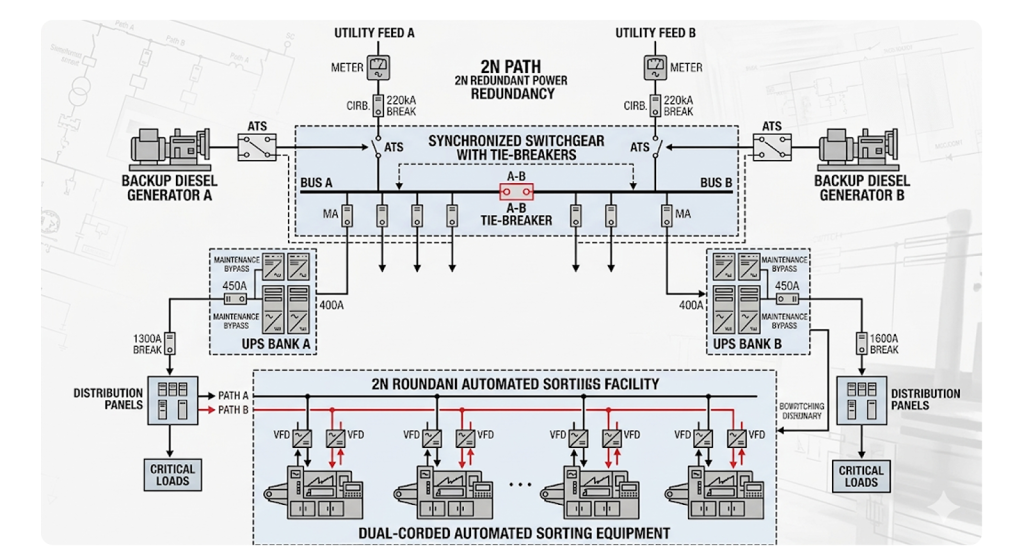
N+1 and 2N Power Architectures
To achieve zero downtime, logistics electrical redundancy must be engineered into the core of the automated warehouse power supply.
- N+1 Architecture: Ensures that if one component (like a transformer or backup generator) fails, there is one independent backup ready to take the load.
- 2N Architecture (Dual Path): For highly critical ASRS or data-heavy sorting centers, a 2N design is deployed. This means the facility is fed by two completely independent power paths (e.g., two different DEWA feeders, backed up by two different generator sets) running simultaneously through sophisticated Automatic Transfer Switches (ATS) or Static Transfer Switches (STS). If one entire path is lost, the second path seamlessly assumes 100% of the critical load without a millisecond of interruption.
Specialized Cable Routing in High-Traffic Industrial Zones
Logistics City is defined by the relentless movement of heavy machinery, 18-wheeler trucks, heavy-duty forklifts, and container reach stackers. Routing power across a massive 100,000-square-meter plot without exposing the electrical lifelines to mechanical damage requires extreme engineering foresight.
The Danger of Shallow Trenching
Standard commercial cable trenching is insufficient for Dubai South. If an 11kV feeder cable is buried too shallowly or without proper mechanical protection, the continuous dynamic weight of heavy trucks turning above will compress the soil, eventually crushing the cable ducts and causing a catastrophic underground short circuit.
Heavy-Duty Infrastructure
Effective industrial cable routing mandates robust civil-electrical coordination.
- Concrete-Encased Duct Banks: All critical high-voltage and low-voltage main feeders crossing vehicular paths must be routed through concrete-encased duct banks.
- Load-Rated Manholes: Access chambers must be fitted with Class D400 or even F900 cast-iron covers, specifically rated to withstand the axle loads of aviation and port-grade transport vehicles.
- Thermal Considerations: Precision cable design engineering is required to calculate the optimal depth. Cables buried too deep in Dubai’s thermally resistive dry sand cannot dissipate heat, leading to severe thermal derating. Engineers must balance the need for mechanical protection against the need for thermal heat dissipation, often utilizing specialized thermal backfill materials in the heavy duty cable trenches.
Aviation District Specifics: Airport Lighting and Radar Systems
The Aviation District surrounding Al Maktoum International Airport operates under a completely different set of rules. Here, electrical failure does not just cost money; it compromises human safety in the airspace.
Strict Regulatory Compliance
Electrical designs within this zone must comply not only with DEWA regulations but also with the stringent mandates of the General Civil Aviation Authority (GCAA) and the International Civil Aviation Organization (ICAO).
- The Interface: Aviation District electrical infrastructure often interfaces directly with the airport’s secure networks. This includes providing reliable power to Airfield Ground Lighting (AGL), navigational aids (NavAids), and weather monitoring radars.
Specialized Aviation Power Systems
Standard 50Hz utility power is often insufficient or incompatible with specialized aviation equipment.
- Constant Current Regulators (CCRs): For airport lighting power supply, engineers must design networks utilizing CCRs. Unlike standard circuits that provide constant voltage, CCRs provide constant current in a series loop, ensuring that every runway light shines with the exact same intensity, regardless of its distance from the substation.
- Aviation UPS and Frequency Converters: Critical radar and air traffic control communication equipment requires military-grade Uninterruptible Power Supplies (UPS). Furthermore, aircraft ground support equipment often operates on 400Hz power, requiring the installation of heavy-duty solid-state frequency converters at the apron stands.
Managing Massive Cooling Loads for Mega-Warehouses
Cooling a 50,000-square-meter warehouse in the GCC summer is an electrical challenge of monumental proportions. The sheer volume of uninsulated air space requires massive cooling capacity.
The Dominance of HVAC
In Logistics City, the warehouse cooling electrical load can account for 70% to 80% of the facility’s total power consumption.
- The Equipment: This requires arrays of massive air-cooled chillers or connections to District Cooling (DC) plants, supported by dozens of high-capacity Air Handling Units (AHUs) moving millions of cubic feet of air per minute.
Motor Control Centers (MCC) and Power Quality
Managing these massive motors requires sophisticated MCC design for logistics.
- Variable Frequency Drives (VFDs): To optimize energy consumption, nearly all large HVAC motors are controlled by VFDs. However, VFDs are non-linear loads that inject severe harmonic distortion into the electrical grid.
- Harmonic Mitigation: Electrical engineers must perform comprehensive harmonic studies and integrate Active Harmonic Filters (AHF) directly into the MCC design. Failure to do so will result in overheated transformers, tripped breakers, and severe penalties from DEWA for violating power quality standards.
High-Mast Lighting and Yard Power Distribution
Logistics operations in Dubai South run 24 hours a day, 7 days a week. The exterior marshalling yards, truck queuing zones, and container storage areas require daylight-level visibility during the darkest hours.
Precision High-Mast Illumination
Standard streetlights are inadequate for logistics yards because they create harsh shadows between stacked containers.
- The Solution: High mast lighting design utilizes 20-meter to 30-meter tall poles equipped with high-output LED floodlight arrays.
- Lux Level Calculations: Engineers use advanced photometric software (like DIALux) to calculate the exact placement and aiming angles of these masts. The goal is to achieve uniform, shadow-free illumination (typically 30 to 50 lux for general yards, and higher for specific loading bays) to ensure worker safety and prevent accidents involving heavy machinery.
Remote Yard Power
Providing logistics yard power involves running extensive LV distribution networks across vast plots to power reefer (refrigerated) container plug-in points, security gatehouses, and perimeter surveillance networks. Voltage drop calculations over these long distances (often exceeding 500 meters) are critical, usually requiring significantly oversized cables to ensure adequate voltage reaches the furthest endpoints.
Integration of On-Site Renewable Energy
Sustainability is a core mandate of the Dubai South master plan. The massive, flat, unshaded roofs of logistics mega-warehouses present the perfect canvas for large-scale solar power generation.
Turning Warehouses into Power Plants
Driven by DEWA’s Shams Dubai initiative, developers are increasingly integrating warehouse solar PV UAE systems into their base designs.
- The Scale: A typical logistics facility in Dubai South can easily host a 2MW to 5MW rooftop solar array.
- The Grid-Tie Challenge: Commercial solar integration at this scale drastically alters the electrical design. The main distribution boards must be engineered to handle massive, bidirectional power flows. The design must include dedicated Interface Protection (IP) panels equipped with sophisticated utility-grade relays (G99/DEWA DRRG compliant) to monitor grid stability and prevent dangerous anti-islanding scenarios.
- Structural Coordination: Electrical engineers must coordinate heavily with structural teams to ensure the vast network of DC cables, heavy inverters, and panel ballasts do not exceed the structural load limits of the wide-span warehouse roofs.
Fast-Track Project Execution in Dubai South
The commercial realities of the logistics sector dictate aggressive timelines. Developers securing contracts with major e-commerce or shipping giants must often transition from bare sand to an operational, automated hub within 12 to 18 months.
The Need for Agile Engineering
Traditional, sequential construction (where electrical design waits for architectural finalization) is too slow for fast track electrical projects.
- Parallel Processing: Dedicated project lead engineering and management is required to keep electrical procurement and installation perfectly aligned with structural fast-tracking.
- Long-Lead Procurement: Critical electrical equipment, such as customized 11kV GIS switchgear, cast-resin transformers, and massive UPS systems, can have manufacturing lead times of 6 to 9 months. Dubai South engineering management requires identifying and ordering these long-lead items based on preliminary design loads, long before the final building permits are fully stamped, managing the calculated risk through robust engineering experience.
Frequently Asked Questions (FAQ)
1. What is the maximum power DEWA will provide to a single plot in Dubai South?
There is no universal “maximum,” as DEWA allocates power based on a specific kW/sqm allowance depending on the plot’s zoning (e.g., light industrial, cold storage, aviation support). However, if your calculated load significantly exceeds the standard allocation, you must undergo a special technical review and may be required to allocate land for a dedicated 11kV or 132kV DEWA substation on your plot.
2. Do we need specialized contractors for projects in the Aviation District?
Yes. Electrical contractors working within the secure zones (airside) of the Aviation District must hold specific security clearances and have proven experience in adhering to GCAA and ICAO standards. General commercial electrical contractors are often not qualified for airfield ground lighting or NavAid power installations.
3. How do we protect electrical panels from the intense dust in Logistics City?
Given the continuous movement of heavy trucks and the open desert environment, dust ingress is a major threat to switchgear. Electrical rooms should be designed with positive-pressure HVAC systems to keep dust out. Exterior panels must be specified with a minimum IP65 rating and equipped with specialized inertial sand-trap louvers for ventilation.
4. Can we use the solar panels on the warehouse roof as backup power during a grid outage?
Standard grid-tied solar inverters under the Shams Dubai scheme are designed to shut down immediately during a grid outage (anti-islanding protection) for safety reasons. To use solar as backup power, you must design a complex, highly regulated “microgrid” system incorporating large-scale battery storage and specialized grid-forming inverters, which requires customized DEWA approvals.
5. Why is a short-circuit study critical for a warehouse project?
In a large logistics facility with a massive DEWA power connection and potentially megawatts of rooftop solar power, the available “fault current” (the massive surge of energy released during a short circuit) can be incredibly high. A short-circuit study ensures that all circuit breakers and switchboards are physically capable of interrupting this explosive energy without catching fire or melting.
Conclusion & Next Steps: Designing for Scale and Speed
Dubai South is not merely an industrial park; it is the physical manifestation of global trade. The facilities built here, whether automated e-commerce fulfillment centers in Logistics City or critical support hubs in the Aviation District, must operate with the precision and reliability of a Swiss watch, despite being subjected to the harsh extremes of the GCC climate.
Achieving this level of resilience requires an electrical infrastructure that is heavily redundant, highly automated, and engineered for massive scale. From the 11kV primary substations down to the VFDs controlling the cooling plants, every component must be designed with total cost of ownership, operational continuity, and fast-track constructability in mind.
Is your Dubai South project engineered for uninterrupted performance?
Navigating the complex intersection of heavy industrial power demands, aviation regulations, and aggressive construction schedules requires specialized expertise. As a leading logistics facility electrical design consultancy, Elecwatts provides the deep engineering rigor required for Dubai South consultants. We help developers and EPC contractors design, procure, and commission robust electrical architectures that keep global supply chains moving without a second of downtime.Contact Elecwatts today to discuss the electrical strategy for your upcoming Dubai South mega-project.