

Powering the Future of Dubai
The Dubai 2040 Urban Master Plan is not merely a roadmap for architectural expansion; it is a blueprint for a demographic and infrastructural revolution. Designed to accommodate a projected population of 5.8 million residents, the plan focuses on sustainable, interconnected urban development. However, realizing this vision requires a radical rethink of how we design and deploy power networks. For developers, partnering with an expert electrical engineering consulting in dubai firm is no longer optional, it’s a prerequisite to navigate this new era. The expansion demands an electrical infrastructure in Dubai that can handle unprecedented density, seamlessly integrate renewable energy, and operate flawlessly under extreme climatic conditions.
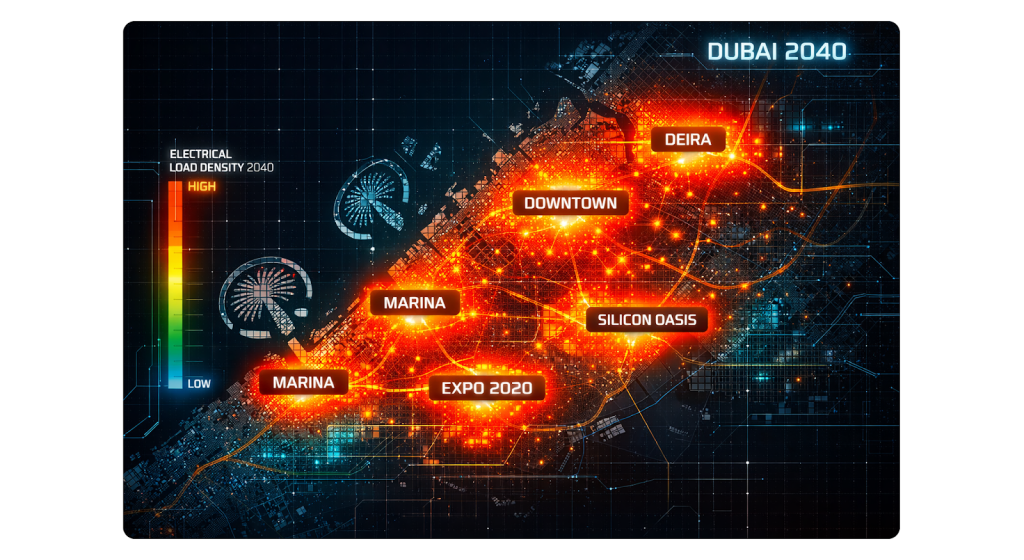
The master plan focuses on developing and enhancing five main urban centers: the historical hubs of Deira and Bur Dubai, the financial heartbeat of Downtown and Business Bay, the hospitality and leisure center of Dubai Marina and JBR, and two crucial expansion zones, the Expo 2020 Centre and Dubai Silicon Oasis Centre. This targeted densification shifts the city away from unchecked urban sprawl and towards concentrated, hyper-efficient hubs of activity. For electrical design engineers and project managers, this means the old rules of thumb for load estimation, power distribution, and grid resilience are obsolete. This guide delves into the profound technical implications the Dubai 2040 Urban Master Plan brings to electrical infrastructure in these new development zones.
The Shift to High-Density Load Profiles
The most immediate engineering challenge posed by the 2040 plan is the dramatic shift in power density. Historically, much of Dubai’s expansion was horizontal, sprawling villa communities and expansive, low-rise industrial zones. The new master plan pivots aggressively toward vertical, mixed-use densification, particularly in the Expo 2020 and Dubai Silicon Oasis (DSO) corridors.
Vertical Density and the Cooling Challenge
When you stack commercial, residential, and retail spaces into a single high-rise footprint, the high-density electrical loads skyrocket. In the GCC, HVAC systems routinely account for 60% to 70% of a building’s peak electrical demand. In a densely packed mixed-use development, managing these cooling loads becomes a monumental task.
- The Engineering Shift: Instead of relying on decentralized, roof-mounted chillers for individual buildings, new zones will increasingly rely on massive District Cooling (DC) plants. These plants present concentrated, multi-megawatt electrical loads that require dedicated primary substations (132/11kV), rigorous harmonic mitigation (due to massive Variable Frequency Drives), and advanced protection coordination.
Dynamic Load Profiles
A traditional residential neighborhood has a predictable load curve (peaking in the evening). A modern, 2040-compliant mixed-use development has a complex, overlapping load profile. Offices peak at noon, retail peaks in the late afternoon, and residential peaks at night. Dubai urban development power demand calculations must now utilize highly sophisticated diversity factors. Overestimating leads to stranded CAPEX in oversized transformers; underestimating leads to localized brownouts and melted switchgear.
Integrating Green Corridors and Sustainability Targets
A cornerstone of the 2040 master plan is the mandate that 60% of Dubai’s total area will be dedicated to nature reserves and natural rural areas, with the length of public beaches increasing by 400%. Furthermore, green and recreational spaces will double in size. This has profound implications for how and where electrical infrastructure is deployed.
Minimizing the Infrastructural Footprint
You cannot have sprawling, open-air electrical switchyards cutting through newly mandated green corridors.
- Compact Substations: There will be a strict regulatory push toward highly compact, aesthetically integrated substations. Gas Insulated Switchgear (GIS) will become mandatory even at lower distribution voltages to minimize the physical footprint of electrical buildings.
- Underground Routing and Thermal Challenges: To preserve green aesthetics, almost all new green energy distribution networks must be underground. However, burying heavily loaded high-voltage cables in Dubai’s dry, sandy soil (which has poor thermal conductivity) presents severe overheating risks. Achieving sustainable infrastructure Dubai targets requires advanced soil thermal resistivity testing and the use of specialized thermal backfill materials to ensure cables don’t derate and fail prematurely beneath parks and pedestrian walkways.
Decentralized Power and Microgrids in New Zones
The traditional model of relying entirely on massive, centralized power plants (like the Jebel Ali power and desalination complex) is shifting. To meet the resilience and sustainability goals of 2040, new development zones are being conceptualized as interconnected nodes of generation and consumption.
The Rise of Distributed Energy Resources (DERs)
New zones will mandate the heavy integration of solar PV on every available roof and parking canopy, building upon the success of the Shams Dubai initiative. However, injecting gigawatts of variable solar power into the grid requires localized management.
- Microgrid Architecture: We are seeing a shift toward Dubai microgrid design. Massive developments will operate as semi-autonomous grids. By pairing rooftop solar with localized Battery Energy Storage Systems (BESS), a development can store excess midday solar and discharge it during the evening peak.
- Resilience: If the main utility grid suffers a disturbance, these microgrids can “island” themselves, ensuring that critical loads within the community, such as district cooling pumps, emergency lighting, and data centers, remain operational. This transition to distributed energy resources GCC requires highly complex synchronization controls, bidirectional protection relays, and advanced active harmonic filters to maintain power quality.
Designing for Advanced Public Transit Networks
A primary objective of the Dubai 2040 Urban Master Plan is mobility. The plan aims for 55% of the population to live within 800 meters of a main public transit station. This means a massive expansion of the Dubai Metro, new tram lines, fleets of electric buses, and future readiness for autonomous pods.
The Impact of Transit on the Grid
Electrifying a city’s transport network is the single most disruptive event for a local power grid.
- Traction Power Substations: The Dubai Metro power supply requires dedicated 132kV or 33kV traction substations that convert AC power to the DC power used by the trains. These substations draw massive, instantaneous surges of power as trains accelerate, and they inject power back into the grid via regenerative braking as trains stop.
- Power Quality Challenges: The rectifiers used in traction power are massive non-linear loads. They inject severe harmonic distortion into the surrounding grid, which can overheat nearby commercial transformers and disrupt sensitive data centers. Transit electrical infrastructure design for 2040 zones mandates rigorous harmonic analysis and the installation of heavy-duty active harmonic filters at the point of common coupling (PCC) to protect the integrity of the broader distribution network.
Future-Proofing with Smart Grid Technologies
The developments born out of the 2040 plan will not be passive consumers of electricity; they will be active, intelligent participants in a digital energy ecosystem. Smart grid technology is transitioning from a “nice-to-have” feature to a strict regulatory requirement.
The Digital Nervous System
Every new building, substation, and distribution panel will be nodes on an Industrial Internet of Things (IIoT) network.
- Advanced Metering Infrastructure (AMI): Smart grid integration Dubai means bidirectional smart meters are standard, enabling Net Metering for solar prosumers and paving the way for dynamic Time-of-Use (TOU) tariffs.
- Automated Fault Detection: The days of waiting for a customer to call in an outage are over. New zones will feature Fault Location, Isolation, and Service Restoration (FLISR) technology. If a cable faults in Silicon Oasis, intelligent switches on the ring main unit (RMU) will detect it, communicate via fiber optics or 5G, isolate the damaged section, and reroute power from an alternative feeder in milliseconds. This IoT electrical monitoring ensures that grid reliability metrics (SAIDI and SAIFI) meet world-class standards.
Navigating Upgraded DEWA Regulations for 2040
As the city’s vision evolves, so do the regulations enforcing it. The Dubai Electricity and Water Authority (DEWA) is continuously tightening its technical frameworks to ensure that new developments align with the 2040 sustainability mandates.
Al Safat and Green Building Compliance
The Dubai Green Building Regulations, now integrated into the “Al Safat” rating system, dictate the energy performance of all new structures.
- Energy Use Intensity (EUI): Electrical engineers must now design systems that meet strict EUI benchmarks (kWh/m²/year). This impacts everything from transformer selection to lighting control.
- Equipment Efficiency: DEWA green building regulations mandate the use of ultra-premium efficiency motors (IE3/IE4) for HVAC systems and highly stringent “no-load loss” limits for distribution transformers.
- Smart Lighting and Automation: Al Safat electrical compliance requires comprehensive deployment of DALI (Digital Addressable Lighting Interface) systems integrated with daylight harvesting sensors, ensuring that artificial lighting is only used when and where absolutely necessary. Non-compliance with these evolving DEWA regulations will result in immediate rejection during the building permit phase.
The Role of Predictive Modeling in Long-Term Reliability
Designing a facility that will remain operational and efficient up to the year 2040 and beyond requires a departure from traditional engineering methods. You can no longer rely on static spreadsheet calculations and conservative rules of thumb.
Dynamic Load Forecasting
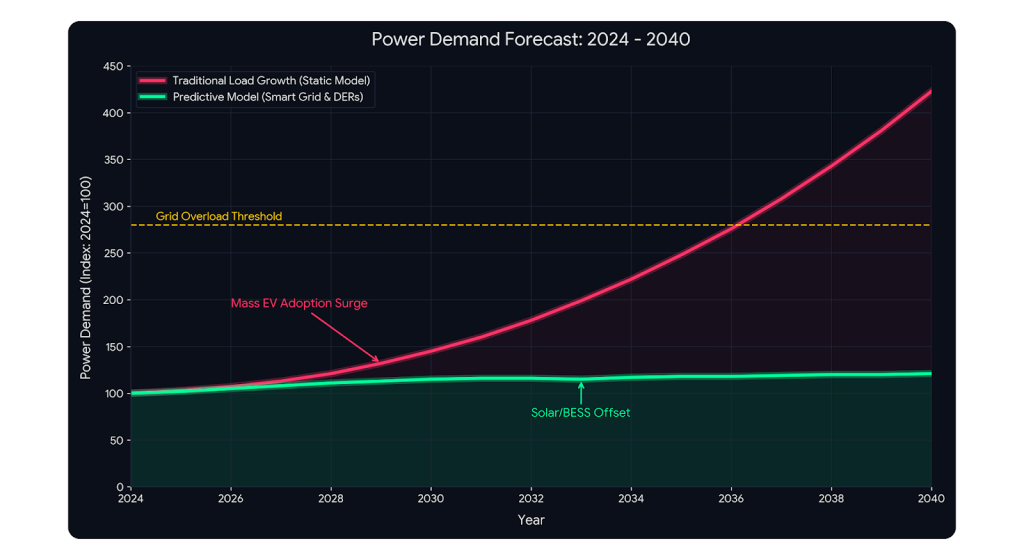
The electrical load profile of a building in 2030 will look vastly different than it does today. The massive, impending adoption of Electric Vehicles (EVs) means that basement parking lots will become multi-megawatt power sinks. If you size a residential tower’s main incomer based on 2024 appliance loads without predicting 2035 EV charging demand, the building will require a catastrophic and expensive electrical retrofit within a decade.
Advanced System Simulation
Predictive power modeling is essential. Engineers must use advanced software (like ETAP or DigSILENT) to simulate the grid 10, 15, and 20 years into the future. This involves modeling solar panel degradation over time, the shifting of peak cooling hours due to climate change, and the step-load impact of mass EV charging. Only through dynamic, long-term simulation can developers guarantee long-term electrical reliability and avoid stranded assets.
Financial Implications: CAPEX vs. OPEX in New Zones
The sophisticated technologies required to align with the Dubai 2040 Urban Master Plan, microgrids, active harmonic filters, premium efficiency transformers, and IoT sensors, inevitably drive up the initial Capital Expenditure (CAPEX) of electrical construction. Developers often face “sticker shock” during the design phase.
The Total Cost of Ownership (TCO) Shift
However, evaluating these projects purely on CAPEX is a flawed financial model. The high-density, smart-grid nature of these new zones drastically shifts the financial equation toward Operational Expenditure (OPEX) savings.
- Energy Savings: An CAPEX OPEX electrical design analysis will show that premium transformers and smart lighting controls pay for their premium within 3 to 5 years through reduced energy consumption. Over a 25-year asset lifespan, this translates to millions of dirhams in savings.
- Avoided Penalties: DEWA imposes strict penalties for poor power factor. Investing upfront in advanced reactive power compensation prevents these monthly recurring fines.
- Asset Value: Buildings and developments that are certified under Al Safat and are demonstrably “future-proofed” for EV charging and solar integration command higher rental yields and greater overall electrical infrastructure ROI from environmentally conscious multinational corporate tenants.
Frequently Asked Questions (FAQ)
1. What are the 5 main urban centers targeted in the Dubai 2040 Urban Master Plan?
The plan focuses on developing and enhancing five distinct hubs: 1) The historical Deira and Bur Dubai area, 2) The financial and commercial Downtown and Business Bay area, 3) The tourism and entertainment hub of Dubai Marina and JBR, 4) The Expo 2020 Centre (focused on exhibitions, events, and logistics), and 5) The Dubai Silicon Oasis Centre (focused on science, technology, and knowledge).
2. How does the 2040 Master Plan affect DEWA NOC approvals for new projects?
DEWA is increasingly scrutinizing NOC applications for adherence to long-term sustainability and efficiency goals. Submissions in new development zones must rigorously detail their green building compliance (Al Safat), provisions for EV charging infrastructure, and solar PV readiness. Projects failing to demonstrate these future-ready elements face delays or rejections.
3. What is Al Safat and how does it relate to electrical design?
Al Safat is Dubai’s Green Building Evaluation System. For electrical design, it enforces strict mandates on Energy Use Intensity (EUI), requiring highly efficient lighting (LEDs with smart controls), premium-efficiency HVAC motors, the installation of smart meters for energy tracking, and the minimization of electrical losses throughout the distribution network.
4. Why are microgrids important for new Dubai developments?
As developments become larger and denser, relying solely on the central utility grid poses a resilience risk. Microgrids, combining local solar generation, battery storage, and smart controls, allow a development to generate its own clean power, manage its peak demand to lower utility bills, and potentially operate independently during major grid disturbances, ensuring critical systems stay online.
5. How will EV charging be integrated into the new master plan’s infrastructure?
EV charging is shifting from an “amenity” to a core infrastructural requirement. New developments must have significant electrical capacity reserved specifically for Level 2 and DC Fast Charging networks. This requires upsized primary transformers, dynamic load management software (to prevent all chargers from spiking demand simultaneously), and heavy-duty cabling routed throughout massive parking structures.
Conclusion & Next Steps: Aligning Your Projects with 2040
The Dubai 2040 Urban Master Plan is a bold declaration of the city’s future, a future that is dense, green, highly mobile, and intensely digital. For developers, architects, and contractors, the electrical infrastructure designed today must be capable of supporting this vibrant reality for decades to come.
Relying on outdated engineering practices, sizing equipment for minimum initial cost, and ignoring the impending surge of EVs and distributed renewables will result in buildings that are obsolete before the paint dries. Success in these new development zones requires visionary engineering, predictive modeling, and a deep understanding of evolving DEWA and Al Safat regulations.
Are your upcoming developments ready for 2040?
Aligning your project with the ambitious goals of the Dubai 2040 master plan requires specialized expertise in future proof electrical systems and smart grid integration. As a leading engineering firm in the region, Elecwatts provides the strategic Dubai 2040 electrical planning and design services necessary to navigate this new era. From microgrid feasibility studies to deep predictive power modeling, we ensure your infrastructure is resilient, compliant, and optimized for the future.
Contact Elecwatts today to future-proof your next major development in Dubai.