

The massive wave of urban and industrial development that swept across the United Arab Emirates during the early 2000s real estate boom is now hitting an inevitable operational milestone: the 20-year mark. To protect these capital-intensive builds, partnering with an expert electrical engineering consulting firm is critical to pivot from reactive crisis management to structured, data-driven modernization. The electrical systems that were energized in the mid-2000s to power glittering high-rises, sprawling malls, and massive industrial zones are quietly entering their twilight years.
Managing this aging electrical infrastructure UAE developers rely upon is a high-stakes challenge. Operating high-voltage and low-voltage networks beyond their design lifecycles without a rigorous verification framework is an invitation to disaster. Facility managers can no longer afford to rely on superficial visual inspections or basic thermography alone to determine the safety, compliance, and reliability of their networks. Achieving a safe, reliable, and compliant electrical asset end of life transition requires a deep, molecular-level diagnostic approach to uncover the invisible degradation hidden within your switchgear, transformers, and cabling systems.
The Difference Between Chronological and Health Age
A common and highly expensive mistake in property management is assuming that two identical pieces of equipment installed in the same year will degrade at the exact same rate. In reality, chronological age is a highly deceptive metric.
A 15-year-old power transformer operating continuously in a clean, dust-free, and meticulously air-conditioned Dubai basement might display excellent insulation health. Conversely, a 7-year-old unit sitting in an unshaded, highly saline coastal yard in Abu Dhabi, subjected to sandstorms and peak summer loads, may be bordering on immediate catastrophic failure.
- The Diagnostic Shift: To manage this variance, asset managers utilize a sophisticated electrical asset health index (AHI) scoring system. This indexing framework aggregates thermal history, chemical analysis, electrical test reports, and operational criticality to mathematically calculate the “health age” of each asset. Understanding this localized equipment degradation GCC profile allows developers to identify which legacy assets are truly at risk, rather than executing wastefully premature wholesale replacements based strictly on calendar years.
Assessing Low and Medium Voltage Cables
Cables represent the invisible, highly expensive energy highways of your facility. Because they are buried deep in concrete trenches or sealed within vertical building risers, their degradation is completely hidden from the naked eye.
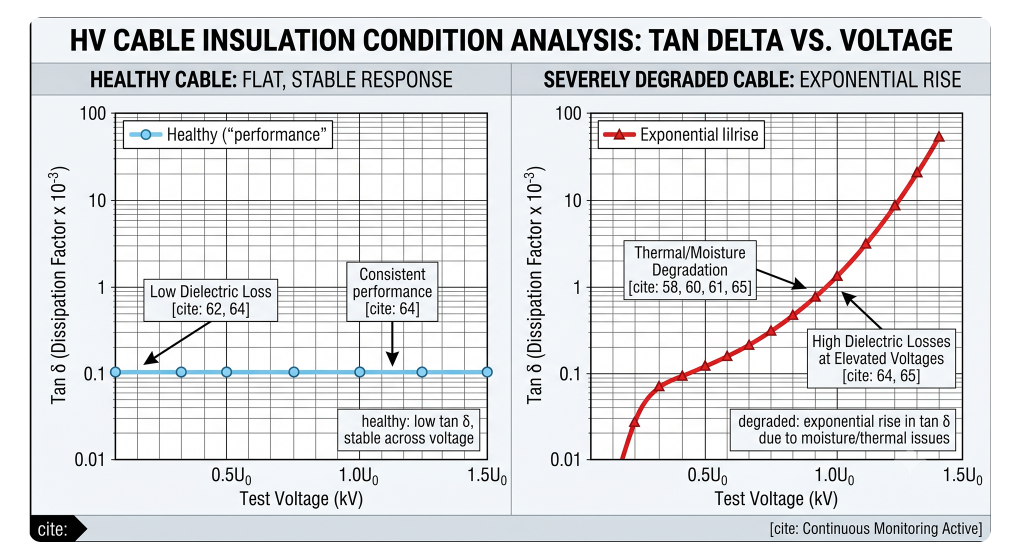
The combination of high GCC ambient heat and continuous over-loading is a lethal mix for cross-linked polyethylene (XLPE) and polyvinyl chloride (PVC) cable insulations. Over years of service, the thermal stress causes the polymer chains to break down, leading to rapid cable insulation degradation and the formation of “water trees” within the dielectric layer.
- Predictive Diagnostics: To locate these invisible defects before they trigger a devastating short circuit, advanced Cable engineering diagnostics are mandatory. Field engineers execute high-frequency partial discharge testing cable diagnostics alongside Tan Delta (dissipation factor) testing. By measuring the minute, high-frequency electrical discharges occurring within the degraded insulation layers, chemists and engineers can map the exact physical coordinate of the insulation defect, allowing for target-focused repairs before a catastrophic blowout occurs.
Evaluating Transformer Core and Coil Health
Transformers are the heaviest, most expensive Single-Points-of-Failure (SPOFs) in your power grid. Evaluating their health requires extracting molecular diagnostic data from their physical cores and liquid insulation systems.
For oil-filled power transformers, chemists execute a comprehensive battery of tests:
- The Dissipation Factor: The transformer power factor test (also known as the dissipation factor or $\tan\delta$ test) measures the electrical losses within the winding insulation. It is calculated as the ratio of resistive current ($I_R$) to capacitive current ($I_C$):
- $$\tan\delta = \frac{I_R}{I_C}$$
- An elevated dissipation factor indicates high moisture levels or severe aging of the insulating mineral oil.
- Winding Integrity: Simultaneously, executing a high-accuracy transformer winding resistance test identifies localized hotspot corrosion, winding deformation, or loose internal connections.
- Paper Insulation Health: Because you cannot physically touch the solid paper wrapping the copper windings, furan analysis is executed on the oil. High concentrations of furanic compounds prove that the paper has suffered severe mechanical degradation, rendering the transformer highly fragile and at risk of mechanical collapse during a standard grid short circuit.
Switchgear Mechanical Wear and Arc Chutes
While cables and transformers are static assets, circuit breakers are dynamic, mechanical safety systems that must physically move to clear a fault within milliseconds. If they fail to operate when commanded, the resulting arc flash will instantly destroy the entire switchboard.
Over a 20-year operational lifecycle, circuit breakers suffer severe circuit breaker mechanical wear:
- Lubrication Breakdown: The specialized grease inside the breaker’s spring-charging mechanisms dries out, becomes gummy, and attracts fine desert dust. This increases the mechanical trip time, causing the breaker to operate too slowly during a fault.
- Contact Degradation: Repeated operations pit and erode the copper contacts, leading to high switchgear contact resistance and intense localized heating.
- Arc Chute Erosion: The ceramic arc chutes, designed to safely absorb and extinguish the intense plasma arc during a breaker opening, suffer thermal erosion over time. If the arc chutes are cracked or compromised, the arc can bridge the phase gaps, causing a catastrophic phase-to-phase short circuit inside the switchboard.
The Threat of Technological Obsolescence
In many cases, an aging electrical asset may be physically healthy on paper, but it presents a massive operational risk due to technological obsolescence.
Over a 20-year lifecycle, manufacturers inevitably discontinue specific product lines.
- The Spare Parts Nightmare: If your facility relies on discontinued, legacy circuit breakers, sourcing matching spare parts during an emergency breakdown is a logistical nightmare.
- The Protection Gap: This electrical equipment obsolescence is highly critical for legacy protection relays. Modern smart grids rely on continuous, real-time data communication. Legacy solid-state or electromechanical relays cannot be integrated into modern Building Management Systems (BMS) or central SCADA networks, leaving your facility blind to real-time power quality issues and preventing automated, fast-clearing fault isolation schemes.
Retrofitting vs. Complete Replacement Strategy
When an end-of-life assessment identifies critical vulnerabilities in your switchgear, the facility manager faces a major financial and engineering decision: Should we replace the entire switchboard, or execute a targeted retrofit?
- The Replacement Path: Demolishing an active, main low-voltage switchboard and installing a new one requires weeks of site-wide blackouts, massive civil modifications, and a staggering capital layout.
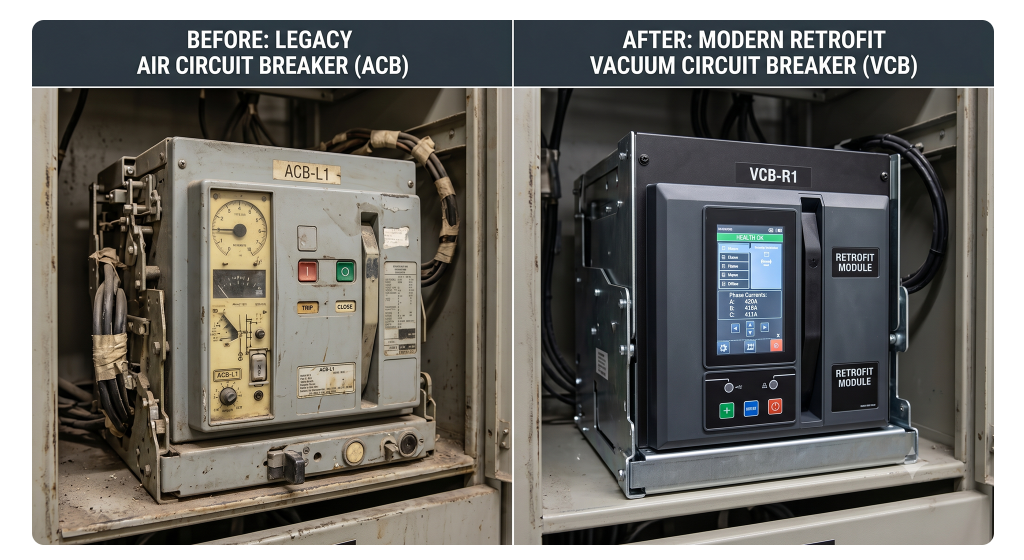
- The Retrofit Path: Switchgear retrofitting is often the most cost-effective and least disruptive strategy. Instead of replacing the entire metallic cubicle, specialized engineers execute a targeted circuit breaker upgrade. They slide out the legacy, obsolete air circuit breakers (ACBs) and install modern, direct-replacement vacuum circuit breakers into the existing busbar cradles. This restores the mechanical and electrical reliability of the switchboard, integrates modern digital protection relays, and minimizes building downtime to a few planned hours rather than weeks of chaotic outages.
Navigating Modern Regulatory Compliance
A massive risk that often catches facility managers off guard during a modernization project is the regulatory “compliance trap.” You cannot simply swap out old equipment for new like-for-like units without interfacing with modern laws.
An electrical installation approved under the regulations of 2005 is protected under grandfather clauses. However, the moment you execute a major electrical compliance upgrade or replace a main switchboard, you trigger modern utility standards.
- Upgrading to Modern Codes: The newly installed system must comply with the current DEWA modernization rules, ADDC codes, and Abu Dhabi Civil Defense standards. This means you may be legally required to upgrade your entire building’s earthing grid, install low-smoke zero-halogen (LSZH) cabling in public risers, and install mandatory, highly expensive interface protection relays for net-metering.
- The Engineering Handshake: Partnering with a specialist in electrical plant engineering uae during the feasibility stage is the only way to ensure that your brownfield replacement designs are fully compliant with current municipal regulations, preventing immediate rejection at the utility inspection gate.
Building a CAPEX Replacement Roadmap
Executing an end-of-life assessment is not a exercise in identifying defects; it is a critical financial planning tool designed to eliminate unbudgeted emergency expenditures.
The ultimate deliverable of a comprehensive assessment is a structured, 5-to-10 year electrical CAPEX planning roadmap.
- Staggering the Investment: By utilizing the calculated health index scores of your assets, engineers can rank and prioritize replacements based on risk and criticality.
- The Roadmap: A high-risk, obsolete Tier 1 asset is scheduled for a circuit breaker upgrade in Year 1. A moderately degraded, redundant Tier 2 transformer is scheduled for filtration in Year 3 and complete replacement in Year 7. This structured asset replacement roadmap allows the finance department to allocate capital smoothly years in advance, schedule outages during low-load winter periods, and ensure absolute operational continuity without draining emergency cash reserves.
Frequently Asked Questions (FAQ)
1. What is the average lifespan of a power transformer in the UAE?
In a mild, controlled indoor climate, a high-quality power transformer can easily operate reliably for 25 to 30 years. However, in the harsh GCC climate, a transformer installed outdoors without adequate shading and subjected to high ambient temperatures, saline humidity, and sandstorms can reach its physical end of life in as little as 12 to 15 years due to accelerated oil and winding insulation decay.
2. What is “Furan Analysis” and why is it important for old transformers?
Furan analysis is a laboratory test performed on transformer oil that measures the concentration of unique oil-soluble furanic compounds released as the transformer’s solid paper insulation decomposes. Because you cannot physically touch the solid paper wrapped around the copper windings, measuring furans is the only non-destructive way to calculate the paper’s remaining mechanical strength (Degree of Polymerization), accurately predicting when the transformer is reaching its end of life.
3. Why are legacy protection relays considered an operational risk?
Legacy electromagnetic or solid-state relays are considered a high risk because they are prone to “drift”—meaning their calibrated trip times shift over years of service, leading to slow fault clearing. Furthermore, they lack communication capabilities, meaning they cannot connect to modern BMS or SCADA networks for real-time monitoring, and finding exact replacement parts during an emergency is highly difficult due to manufacturer obsolescence.
4. What is the difference between retrofitting and replacing switchgear?
Replacing switchgear involves completely demolishing the existing metallic enclosures and busbars, pouring new concrete bases, and installing a brand-new switchboard—a process that is highly expensive and requires long site blackouts. Retrofitting involves keeping the existing metallic switchboard frame and busbars, but extracting the obsolete circuit breakers and installing modern, digitally integrated breakers into the same cradles, saving massive CAPEX and minimizing downtime.
5. Does executing a major equipment replacement trigger new DEWA regulations?
Yes, in many cases. While your legacy building operates under the standards of the year it was constructed, executing a major electrical modification or switchboard replacement will require the new installation to comply with the latest utility regulations, such as DEWA’s current power quality, earthing, harmonic limit, and life-safety wiring standards.
Preventing Catastrophic Failure
Executing a systematic end-of-life assessment is the defining factor that separates a highly resilient, cost-effective, and safe facility from an operational disaster zone characterized by sudden blackouts, expensive emergency repairs, and catastrophic liabilities. Electrical equipment does not fail without warning; it signals its distress through insulation decay, mechanical wear, and chemical side-reactions years in advance.
By moving away from a reactive “wait until it blows” mindset and adopting a proactive, data-driven health indexing framework, facility managers protect their multi-million-dirham power grids, maximize the lifecycle of their assets, and secure the business continuity of their organizations.
Managing an aging property portfolio?
Do not gamble your facility’s safety or risk massive insurance rejections on unverified legacy connections. Partner with an independent specialist to evaluate your asset health and secure your operational future. Contact us to schedule a comprehensive, certified electrical asset audit UAE across your portfolio. Elecwatts serves as your strategic regional partner, delivering the certified technical due diligence, advanced dynamic simulations, and professional facility electrical upgrade solutions required to keep your high-voltage and low-voltage infrastructure safe, compliant, and fully energized.
Contact Elecwatts today to secure your aging electrical infrastructure.