

In the high-stakes world of Middle Eastern real estate, heavy industrial development, and utility infrastructure, executing projects on time is a monumentally complex task. To secure the financial viability of these capital-intensive builds, engaging expert electrical engineering consultancy services during the conceptual design phase is a fundamental requirement. Among the many elements that can derail a master schedule, none are more treacherous than the management of high-value, highly customized electrical equipment.
In the terminology of project management, these assets are classified as long lead items electrical (LLIs)—equipment that can take anywhere from 6 to 18 months to design, manufacture, test, ship, and physically install on-site. In the context of fast-tracked GCC mega project management, where construction cycles are aggressively compressed, failing to order LLIs on time is the single greatest cause of missed energization dates, costly contractual penalties, and delayed commercial handovers. Mastering this critical path is the defining factor between a project that powers up on schedule and one that sits in the dark.
Identifying the Usual Suspects: Transformers and Switchgear
You cannot buy utility-grade high-voltage equipment off a warehouse shelf. The equipment that typically falls into the LLI category represents the heavily customized, primary muscle of your electrical distribution network.
The typical list of long-lead assets includes:
- Power Transformers: Massive 132kV, 33kV, or 220kV step-up and step-down units.
- Gas Insulated Switchgear (GIS): Compact, high-performance medium and high-voltage switchboard arrays.
- Specialized Variable Frequency Drives (VFDs): Multi-megawatt motor controllers utilized in industrial pumping or HVAC district cooling plants.
Each custom power transformer and GIS array must be individually engineered. It must be designed to match the specific short-circuit fault levels, protection schemes, and grid synchronization parameters of the host utility. Furthermore, they must be physically engineered to survive the brutal GCC climate—requiring custom cooling radiators, specialized anti-condensation internal heaters, and structural steel designed to withstand extreme ambient temperatures and corrosive, saline desert air. Consequently, standardizing GIS switchgear procurement is impossible; every unit must be custom-made to order.
Procurement During the FEED Stage
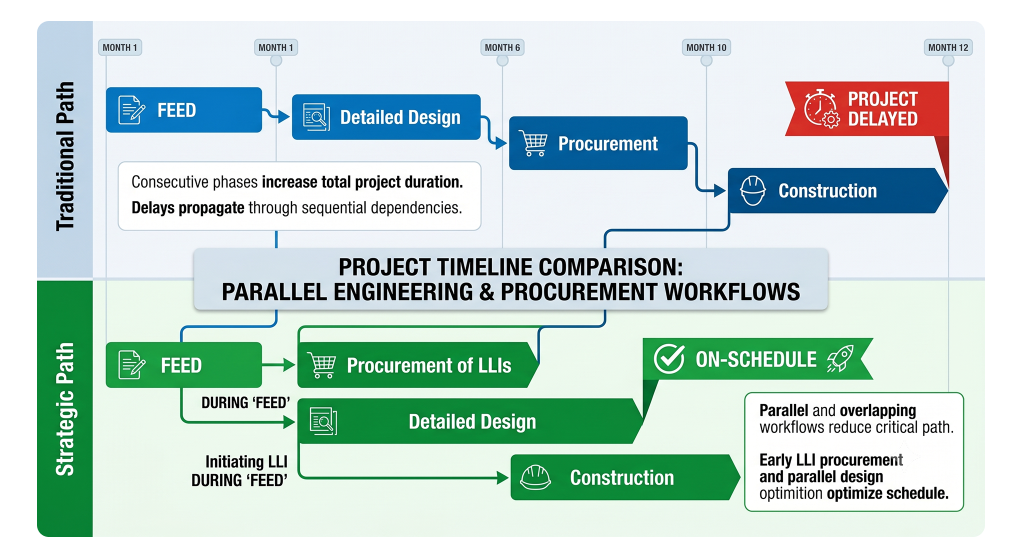
To keep a compressed construction schedule on track, developers cannot afford the traditional linear approach of waiting until the detailed engineering design is $100\%$ complete before issuing purchase orders.
The most effective strategy to compress the critical path is executing FEED stage procurement.
- The Strategy: Front-End Engineering Design (FEED) freezes the technical parameters, system fault levels, and overall dimensions of your primary equipment. It does not define where the individual light switches or conduit paths will sit, but it tells you exactly what size transformers and switchgear you require.
- Locking in the Slot: By leveraging this early data, procurement teams execute early equipment ordering. This involves issuing conditional purchase orders to lock in the manufacturer’s physical casting and assembly slots, while reserving the final, auxiliary wiring and control schematic details for later refinement during the detailed design phase.
Navigating Utility Approved Vendor Lists (AVLs)
A common and highly expensive error in GCC megaprojects is procuring equipment from unapproved manufacturers. The power grids in the Gulf are heavily policed monopolies, and they enforce strict boundaries on who can connect to their networks.
Achieving utility AVL compliance is a non-negotiable rule. Utilities like DEWA (Dubai), SEC (Saudi Arabia), and KAHRAMAA (Qatar) maintain highly structured, pre-qualified lists of approved manufacturers.
- The Risk of Shortcuts: If a contractor attempts to bypass a long lead time by procuring a transformer from an unapproved, non-AVL factory in Europe or Asia, the utility will flatly refuse to inspect, meter, or energize the facility.
- Securing the Supply Chain: Implementing a robust Electrical Plant Procurement strategy from day one ensures that you only source a DEWA approved transformer or SEC-compliant switchgear, saving you from wasting 10 months waiting for an asset that the utility will ultimately reject.
Factory Acceptance Testing (FAT) Logistics
Before a multi-million-dollar power transformer or GIS panel board is cleared to ship from its manufacturing facility—whether located in Germany, South Korea, or Japan—it must be physically and electrically proven to perform.
Electrical FAT logistics are a critical, high-pressure milestone in the procurement cycle.
- The Witness Protocol: Developers are contractually and regulatory obligated to coordinate a formal Factory Acceptance Test (FAT). This requires sending your lead electrical engineers, and frequently the host utility’s official inspectors, to the manufacturer’s facility to witness high-voltage dielectric testing, lightning impulse withstand tests, and mechanical operations.
- Managing the Remediation Schedule: If an asset fails its transformer factory testing, the manufacturer must execute immediate repairs. Re-testing and remediation can add weeks or months to the delivery timeline, meaning that the FAT must be scheduled with a built-in “float” to absorb potential testing failures without impacting the master construction timeline.
Global Supply Chain Disruptions and Copper Pricing
The global supply chain for heavy electrical equipment is subject to extreme market volatility.
- Material Indices: Transformers and switchboards are highly dependent on raw materials like copper, aluminum, and electrical-grade silicon steel. Fluctuations in global metals indices can dramatically impact the final price of the equipment, requiring procurement managers to negotiate robust price-hedging or variation clauses in LLI contracts.
- Component Shortages: Furthermore, modern smart grid technology has introduced semiconductor-based protection relays and electronic components into switchgear panels. A global switchgear component shortage can completely halt the assembly of a $132\text{ kV}$ substation, making a highly diversified, resilient electrical supply chain GCC strategy essential for any mega-developer.
Shipping and Port Customs in the Middle East
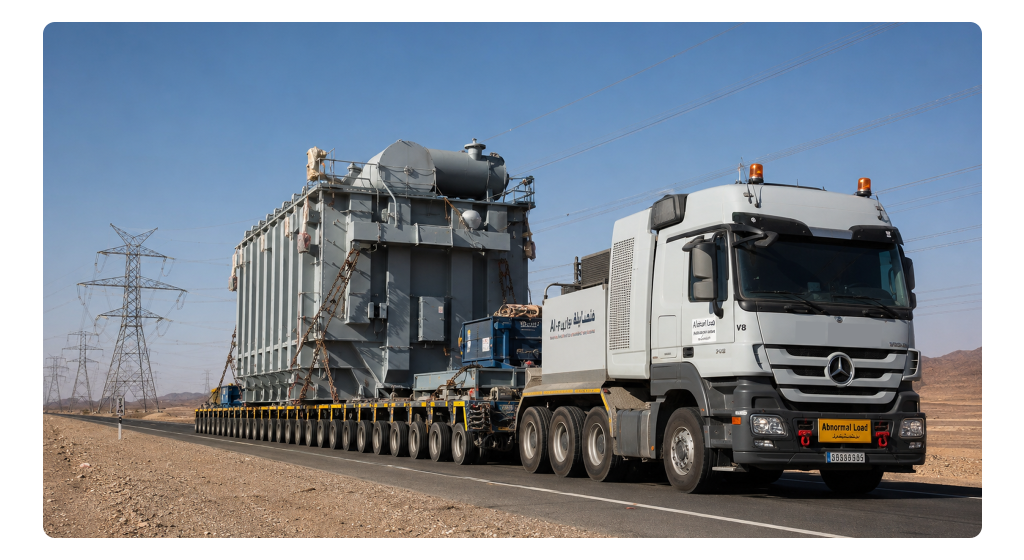
The physical delivery of a 50-ton power transformer from a seaport to a remote desert construction site is a monumental logistical challenge.
Securing heavy lift electrical transport is a highly specialized engineering field:
- The Route Survey: Long before the ship arrives, logistics teams must conduct exhaustive route surveys. They must mathematically verify that the bridge capacities, overhead power lines, and turning radiuses along the transport route can safely support the massive weight and physical footprint of the transport trailers.
- Clearing the Gateways: Navigating GCC port customs electrical clearances efficiently is equally critical. Bureaucratic delays at the port can result in massive demurrage fees and leave sensitive high-voltage assets sitting exposed in salty, humid port yards, highlighting the need for proactive customs documentation preparation.
Site Storage and Preservation in Harsh Climates
In many cases, due to mismatched schedules or accelerated manufacturing, long-lead electrical items will arrive at the construction site before the permanent substation building or electrical rooms are physically complete.
Leaving sensitive electrical assets exposed on an active construction site is highly dangerous. Meticulous electrical equipment preservation is a non-negotiable requirement during switchgear site storage.
- Dust Protection: The fine, blowing desert sand will easily penetrate unsealed panels, jamming delicate mechanical breaker springs and contaminating electrical contacts.
- Climate Control: Extreme desert heat coupled with high coastal humidity causes rapid internal condensation. If the switchgear’s internal anti-condensation space heaters are not hooked up to a temporary, continuous power supply, the copper busbars and steel frames will suffer severe rust and dielectric degradation before the panel is ever energized.
Integrating Procurement with Civil Works
An electrical substation is not a standalone asset; it is deeply integrated with the building’s structural and civil engineering.
Failing to coordinate these two disciplines is a primary cause of physical clashes on-site. Civil engineers require the exact, final dimensions, weight, and cable-conduit entry configurations of the switchgear and transformers early in the design cycle. This data is the foundation of substation foundation planning.
- The Engineering Handshake: If the civil team pours the concrete foundation slab or builds the cable trenches based on preliminary drawings, and the procured transformer arrives with a slightly different footprint, the equipment physically will not fit. Proactive Project Lead Engineering & Management manages this crucial civil electrical coordination, ensuring that the concrete structural foundations, crane access loading paths, and cable basement transits are engineered to match the exact dimensions of the long-lead electrical assets.
Frequently Asked Questions (FAQ)
1. What are the most common long-lead electrical items in a GCC project?
The most common long-lead items are utility-grade step-up and step-down power transformers ($33\text{ kV}$, $132\text{ kV}$, etc.), Gas Insulated Switchgear (GIS), medium-voltage Motor Control Centers (MCCs), and massive variable frequency drives (VFDs). These items typically require custom engineering and have manufacturing lead times ranging from 8 to 18 months.
2. Why is the utility’s Approved Vendor List (AVL) so critical?
Utilities like DEWA and SEC strictly regulate what equipment connects to their grid to protect their networks from substandard materials. If your consultant specifies and your contractor procures switchgear from a manufacturer that is not pre-qualified on the utility’s AVL, the utility will refuse to inspect or energize the facility, requiring you to replace the equipment at your own expense.
3. How does FEED-stage procurement protect the project schedule?
By initiating procurement during the Front-End Engineering Design (FEED) stage, developers can place early, conditional orders for primary electrical equipment before detailed design drawings are finished. This locks in the manufacturer’s production slot, allowing the manufacturing process to run in parallel with the detailed engineering phase, saving months of time.
4. What are the risks of storing electrical equipment on-site before installation?
Extreme GCC heat, high coastal humidity, and fine desert sand are highly destructive. If uninstalled equipment is stored on-site without continuous climate control (such as anti-condensation heaters hooked up to temporary power) and dust seals, the internal insulation can degrade, copper busbars can corrode, and fine sand can jam delicate mechanical breaker linkages.
5. Why is a route survey necessary for heavy-lift electrical transport?
A massive power transformer can weigh over 50 tons. Moving this load from the seaport to the site requires specialized heavy-haul trailers. A route survey physically and mathematically verifies that all bridges along the route can support the weight, that overhead power lines are high enough, and that the physical road turns are wide enough to accommodate the transport.
Mastering the Schedule
Managing the procurement, testing, and delivery of electrical long-lead items is one of the most critical and complex tasks in modern GCC mega-project development. A successful energization is not the result of a last-minute rush; it is the physical manifestation of rigorous planning, early engineering decisions, and strategic vendor relationships established on day one.
By identifying your critical path assets early, initiating procurement during the FEED stage, strictly enforcing utility AVL compliance, and managing civil-electrical integration with extreme precision, you protect your project from the cascading delays and financial penalties that plague uncoordinated builds.
Struggling to secure your project’s critical path electrical assets?
Do not let supply chain volatility or regulatory hurdles derail your handover. Contact our specialized engineering team to secure your supply chain and keep your project on schedule. As a leading electrical procurement consultant, we provide the comprehensive electrical engineering consultancy services and rigorous Project Lead Engineering & Management required to design, procure, and commission your infrastructure flawlessly.
Contact Elecwatts today to secure the technical and logistical success of your next GCC mega-project.