

In the high-stakes operational landscape of the Gulf region’s heavy industries—spanning massive petrochemical complexes, desalination plants, and gigawatt-scale utilities—electrical infrastructure represents both the lifeblood of production and a severe potential hazard. To manage these complex systems safely, engaging an expert electrical engineering consulting partner is critical. Far too often, facility operators mistake safety management for a passive compliance checklist or a box of safety glasses and flame-resistant arc-flash suits.
In reality, mitigating electrical hazards requires a comprehensive, top-down cultural framework: an Electrical Safety Management System (ESMS). A robust ESMS integrates administrative controls, physical safeguards, engineering calculations, and human competency. In the GCC, where operations are run by incredibly diverse, multi-national workforces speaking different primary languages, relying on assumptions is a fatal mistake. Building a highly standardized, language-independent, and ironclad GCC electrical safety culture is the only way to insulate your personnel from catastrophic accidents and protect your multi-million-dirham capital assets.
Regional Regulatory Frameworks (OSHAD & ISO)
Implementing an ESMS is not an optional exercise in best practices; it is a strict statutory requirement across the Middle East.
National and municipal authorities have codified electrical safety into clear, enforceable legal frameworks.
- Abu Dhabi OSHAD: In the capital, the Abu Dhabi Occupational Safety and Health Center (OSHAD) enforces a rigorous system. Under the OSHAD electrical safety mandates, facilities must prove they have structured risk management, documented training registries, and formal incident investigation protocols tailored specifically to electrical hazards.
- Dubai and Regional Standards: Dubai Municipality guidelines and regional civil defense codes enforce similar, highly structured safety baselines.
- The Global Standard: To synchronize these regional requirements, facilities align their ESMS with the global occupational health and safety standard, ISO 45001. Achieving integrated ISO 45001 facility management ensures that electrical safety is not treated as an isolated technical issue, but as a core component of the corporate risk registry, subjected to regular internal audits and continuous executive reviews.
Hazard Identification and Risk Assessment (HIRA)
The foundation of any safety system is visibility: you cannot protect workers from a danger you haven’t identified. The starting point of your ESMS is the Hazard Identification and Risk Assessment (HIRA).
An electrical HIRA must systematically audit every room, panel, transformer, and cable run in the facility. Engineers utilize a quantitative risk scoring matrix to evaluate hazards:
$$R = S \times L$$
Where $R$ represents the overall Risk Score, $S$ represents the Severity of the prospective accident (from minor injury to fatal shock or explosive arc flash), and $L$ represents the Likelihood of occurrence based on equipment age, maintenance history, and operator exposure.
Applying the Hierarchy of Controls
Once hazards are identified and scored, the team must apply the strict hierarchy of controls electrical guidelines to mitigate risks:
- Elimination: Completely removing the hazard (e.g., de-energizing a panel before work begins).
- Substitution: Replacing high-risk processes with safer alternatives.
- Engineering Controls: Installing physical barriers, retrofitting arc-resistant switchgear, or deploying remote racking devices.
- Administrative Controls: Implementing warning signs, safety boundaries, and mandatory permit-to-work systems.
- PPE: Utilizing personal protective equipment (flame-resistant suits, insulated gloves) as the final, least-effective line of defense.
Implementing Ironclad LOTO Procedures
The golden rule of electrical safety is that no equipment is safe to touch until it is physically proven to be dead. Achieving this state of safety requires a rigid Lockout/Tagout (LOTO) protocol.
A compliant LOTO electrical procedure mandates that any circuit being serviced must be physically isolated from all power sources.
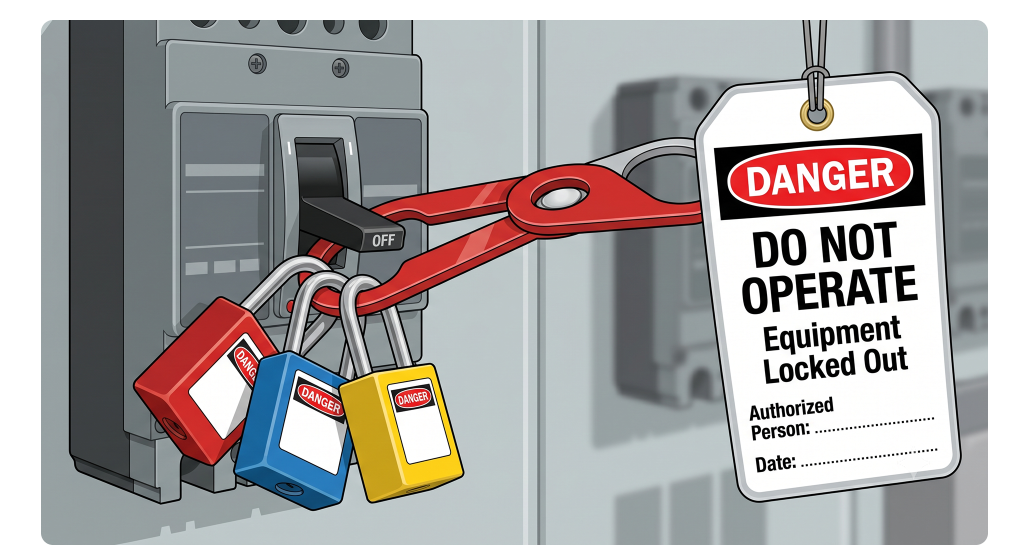
- Physical Isolation: The circuit breaker must be racked out or switched off, and the isolation point must be locked using a physical padlock.
- Zero-Energy Verification: The most critical and frequently missed step is zero energy verification. Technicians must use calibrated, rated voltage testers to physically prove there is no residual electrical or electrostatic charge remaining on the busbars before they place a single finger inside the panel.
- Standardized Safety Hasps: When multiple teams (such as mechanical, electrical, and control contractors) are working on a massive chiller or compressor, they must use a multi-hole safety hasp. Each team leader places their own personal lock on the hasp, ensuring the circuit breaker cannot be accidentally re-energized until every single team has safely completed their work and removed their padlock.
Managing Arc Flash Boundaries and Studies
While electrical shock is a well-known danger, the most violent and destructive electrical event is an Arc Flash. This occurs when a short circuit fault ionizes the air, creating a plasma explosion that can reach temperatures exceeding $19,000^\circ\text{C}$ (hotter than the surface of the sun).
Managing this hazard requires advanced mathematical modeling. To secure your facility, executing a formal electric power system analysis is a mandatory phase of the ESMS implementation. Using specialized software like ETAP, engineers calculate the exact prospective short-circuit current and breaker tripping times.
This study yields the calculated incident energy ($E_i$), typically expressed in calories per square centimeter ($\text{cal/cm}^2$), using the IEEE 1584 standard:
$$E_i = 4.184 \times C_f \times E_n \times \left(\frac{t}{0.2}\right) \times \left(\frac{610^x}{D^x}\right)$$
Where $C_f$ is the calculation factor, $E_n$ is normalized incident energy, $t$ is arcing time (seconds), $D$ is working distance (mm), and $x$ is the distance exponent.
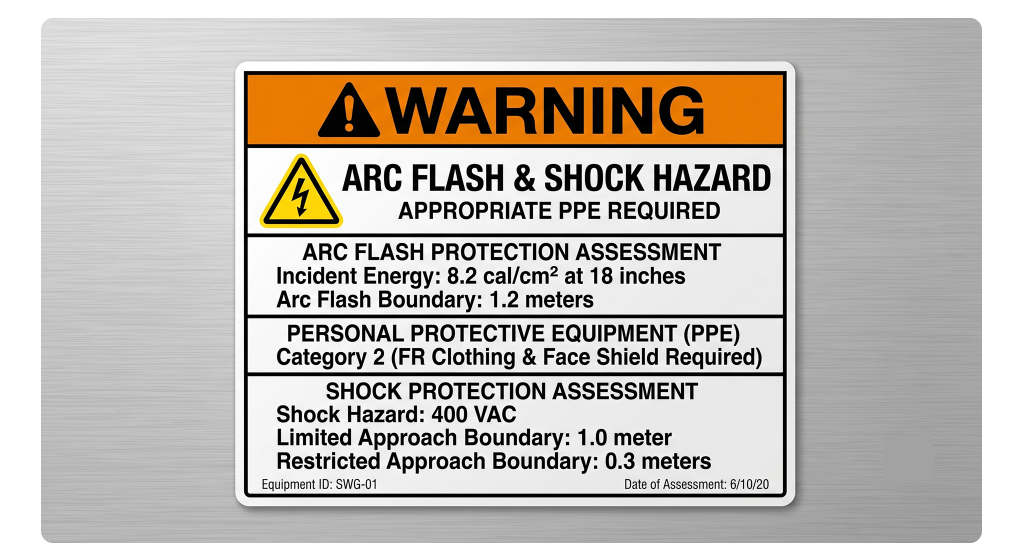
- Establishing Boundaries: The calculated incident energy determines the arc flash boundary—the physical distance from the panel within which an unprotected person could suffer second-degree burns.
- PPE Mapping: The study dictates the exact personal protective equipment category required (e.g., Category 2 or Category 4 flash suits) and the safe boundary lines that must be physically painted on the electrical room floors.
The Permit to Work (PTW) System
No switch should ever be operated, no panel opened, and no cable cut without formal, written authorization. The administrative backbone of the ESMS is the Permit to Work (PTW) system.
The electrical permit to work acts as a strict bureaucratic shield, preventing unauthorized personnel from accessing hazardous areas.
- The Workflow: A technician requesting to perform maintenance must submit a detailed method statement. The designated safety manager reviews the isolations, verifies the LOTO plan, and issues the permit.
- High-Voltage Rigor: For switching operations on the $11\text{ kV}$ or $33\text{ kV}$ networks, the facility must enforce a specialized high voltage PTW system. This requires a formal, step-by-step switching program written, reviewed, and signed off by senior engineers before a single breaker is racked out, eliminating the risk of human switching errors.
Competency, Training, and Authorization
A safety management system is only as effective as the human beings executing it. In the GCC, where the industrial workforce is highly transient and consists of various contracting agencies, assessing technical competency is a major challenge.
To mitigate this risk, the ESMS must establish a strict hierarchy of personnel competency, defined by clear electrical authorized person roles:
- Competent Person (CP): An individual trained to perform basic electrical tasks under direct supervision.
- Authorized Person (AP): An engineer licensed to execute isolations, perform testing, and issue standard permits to work.
- Senior Authorized Person (SAP): A highly experienced specialist who owns the high-voltage switching programs and holds the legal authority to authorize main utility grid synchronization.
Supporting this hierarchy requires continuous, mandatory electrical safety training GCC modules. This training must be translated into multiple languages and incorporate hands-on practical testing on actual de-energized training boards to ensure that safety protocols are understood across all cultural boundaries.
Audits, Near Misses, and Incident Reporting
A healthy safety culture is not one that claims “zero accidents” on paper; it is one that actively hunts for systemic weaknesses before they can cause a tragedy.
- Reporting Near Misses: A critical pillar of your ESMS is the electrical near miss reporting program. If a technician finds a damaged cable insulation or a panel door that won’t lock, they must be encouraged to report it instantly through an anonymous, blame-free portal. Analyzing these near-misses allows safety managers to identify trends (e.g., “The humidity in Substation 3 is causing gasket degradation”) and fix them before a catastrophic arc flash occurs.
- Safety Auditing: This proactive approach is backed by a structured safety audit GCC schedule. Safety managers must conduct quarterly internal safety audits and commission independent, third-party engineering verifications annually to guarantee that all LOTO logs, PTW records, and calibration certificates are fully up-to-date and compliant.
Managing Contractor and Third-Party Risk
Industrial facilities regularly shut down for planned maintenance, bringing hundreds of external contractors and vendor technicians onto the site. This sudden influx of external personnel represents a massive safety risk.
The ESMS must mandate strict contractor safety management protocols:
- Pre-Qualification: Before any contracting firm can bid on an electrical shutdown, they must submit their own ESMS manuals, safety statistics, and proof of DCRP or local utility pre-qualifications.
- Induction: Every external worker must undergo a mandatory, site-specific electrical safety induction before entering the switchgear rooms.
- Financial Protection: Enforcing these strict contractor standards is closely tied to Sustainable infrastructure insurance management protocols. By proving that all external contractors operate strictly under your facility’s ESMS and that their tools are certified and calibrated, you insulate the facility owner from massive electrical liability risk if an uncoordinated action by a contractor triggers an accident or cause a site-wide blackout.
Frequently Asked Questions (FAQ)
1. What is an Electrical Safety Management System (ESMS)?
An ESMS is a comprehensive, top-down organizational framework designed to manage electrical risks. It goes beyond basic safety rules by integrating Hazard Identification (HIRA), standard operating procedures (LOTO), Permit to Work systems, personnel competency hierarchies, regular safety audits, and continuous training to build a zero-harm safety culture.
2. What is OSHAD and does it apply outside of Abu Dhabi?
OSHAD is the Abu Dhabi Occupational Safety and Health Center, which enforces strict safety regulations in Abu Dhabi. While its legal mandates are specific to Abu Dhabi, its comprehensive framework is widely recognized as a regional best practice. Facilities in Dubai, Qatar, and Saudi Arabia frequently model their safety systems on OSHAD guidelines to ensure alignment with international standards like ISO 45001.
3. What is the difference between an Authorized Person (AP) and a Competent Person (CP)?
A Competent Person (CP) is trained to work safely within an electrical area and identify basic hazards, but they must work under supervision. An Authorized Person (AP) is a qualified engineer who has been formally assessed and authorized in writing to execute complex isolations, perform voltage testing, and issue Permits to Work (PTW).
4. Why is “zero-energy verification” the most critical step in LOTO?
Simply switching off a breaker does not guarantee safety. A circuit breaker’s mechanical linkage can fail, leaving the internal contacts closed even if the handle is in the “OFF” position. Furthermore, cables can hold a dangerous capacitive charge. Zero-energy verification forces the technician to physically test the conductors with a rated, calibrated voltage tester to prove there is no voltage before touching the busbars.
5. How often should an Arc Flash study be updated?
Under international safety standards like NFPA 70E and IEEE 1584, an Arc Flash study must be updated at least once every five years. It must also be updated immediately if any significant modification is made to the electrical network—such as adding a new generator, expanding a motor control center, or changing a main transformer—as these changes alter the prospective short-circuit fault levels and incident energy.
Safety as an Investment
Implementing a robust Electrical Safety Management System is not an administrative burden or an unnecessary expense. In the high-voltage industrial environments of the Gulf, an ESMS is a critical investment that yields massive returns. It is the defining line between a highly efficient, resilient, and safe facility and an operational disaster zone characterized by tragic loss of life, catastrophic equipment destruction, and devastating financial downtime.
By systematically mapping regulatory compliance, enforcing zero-energy LOTO verifications, defining clear competency hierarchies, and conducting rigorous arc flash simulations, you protect your personnel and maximize the lifecycle of your power assets.
Need to overhaul your facility’s safety protocols?
Do not gamble your personnel’s lives or risk catastrophic liability on unverified safety plans. Partner with a premier electrical safety consultant to engineer a safer working environment. Contact us to engage our Project Lead Engineering & Management experts to design, build, and implement a customized facility ESMS implementation plan tailored specifically to your complex industrial assets.
Contact Elecwatts today to secure your facility’s safety, compliance, and operational future.