

The Gulf Cooperation Council (GCC) is defined by its pursuit of two critical resources: energy and fresh water. As the region aggressively scales up its renewable targets, developers are encountering land constraints and the harsh realities of desert climates. This has birthed an innovative solution at the water-energy nexus: Floating Photovoltaics (FPV). By installing FPV on the region’s extensive network of artificial lakes, finding success in this niche requires highly specialized electrical engineering services to overcome unique marine challenges.
The massive potential of floating solar GCC projects lies in utilizing the vast, open surfaces of water treatment basins and desalination storage facilities. Combining clean energy generation with vital water conservation represents a paradigm shift. However, executing a floating PV desalination integration is far more complex than a standard ground-mounted system. It demands a rigorous feasibility study bridging structural mooring, marine-grade electrical design, and environmental chemistry. This guide explores the engineering intricacies of deploying floating solar on critical water assets in the Middle East.
The Dual Benefit: Yield Boost and Evaporation Reduction
The primary driver for FPV is the extraordinary symbiotic relationship between the solar panels and the water beneath them.
Standard solar panels suffer significant voltage drops and efficiency losses in the blistering GCC heat. However, water acts as a natural heat sink. The cooling effect of the reservoir on the underside of the panels creates a substantial floating solar yield boost, frequently increasing PV panel efficiency by up to 10% compared to a traditional hot desert ground mount.
Simultaneously, the panels benefit the reservoir. By shading the water’s surface from direct sunlight and buffering the wind, the array drastically limits thermal evaporation. This reservoir evaporation reduction is a critical metric for GCC water security, saving millions of gallons of painstakingly desalinated water from being lost to the atmosphere every year.
Floater Technology and Structural Mooring
You cannot bolt a solar panel to water; the foundation of an FPV system relies entirely on buoyancy and structural tethering.
The standard industry approach utilizes blow-molded High-Density Polyethylene (HDPE) floating solar pontoons. These UV-resistant plastic floats lock together to form a massive, flexible raft that supports the aluminum panel racks.
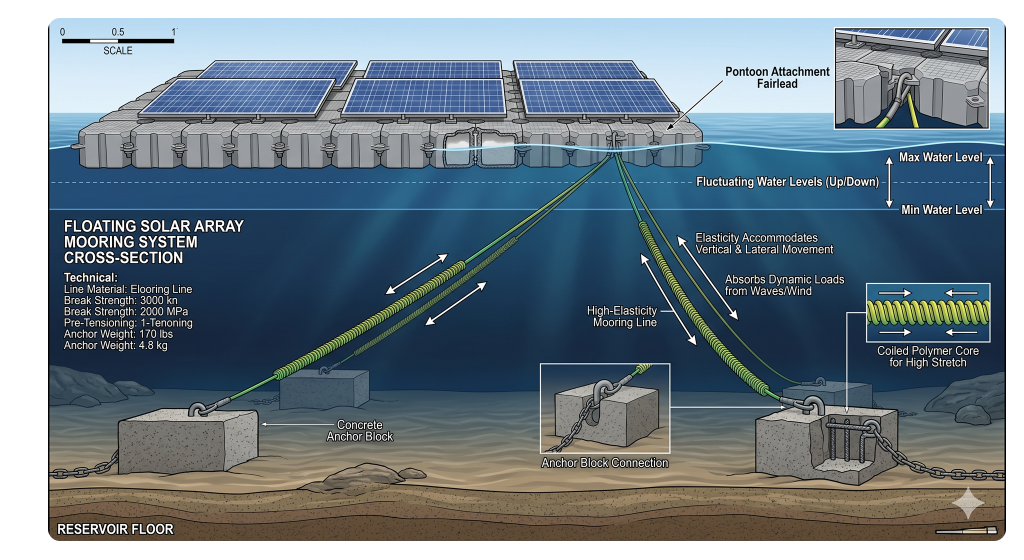
The true engineering challenge lies below the surface. The array must be secured with a highly complex FPV mooring system. Structural marine engineers must calculate extreme wind loads (which turn tilted panels into sails), wave action, and, most importantly, fluctuating reservoir water levels. The anchoring system—often utilizing concrete blocks on the reservoir floor or helical anchors drilled into the banks—must employ elastic mooring lines that allow the massive solar island to rise and fall seamlessly with the water without drifting or breaking apart.
Specialized Marine-Grade Electrical Equipment
Electricity and water are a notoriously dangerous combination. When coupled with the intense coastal humidity and salinity of the GCC, standard solar equipment will rapidly disintegrate.
Designing an FPV system requires an uncompromising specification of marine grade solar equipment. Every bolt, frame, and combiner box must possess extreme anti-corrosion properties (such as anodized aluminum or marine-grade SS316L stainless steel). Furthermore, the core electrical components must be hermetically sealed.
Proactive Electrical Plant Procurement is absolutely mandatory to source an IP67 solar inverter or IP68 rated connectors. If an inverter or combiner box is mounted on the floating pontoon, it must be certified to withstand intense salt-mist environments and potential temporary submersion from wave splashing without compromising its electrical integrity.
Dynamic Cable Routing on Water
Transporting high-voltage Direct Current (DC) from a continuously moving floating island to a stationary shore connection is one of the most difficult challenges in FPV design.
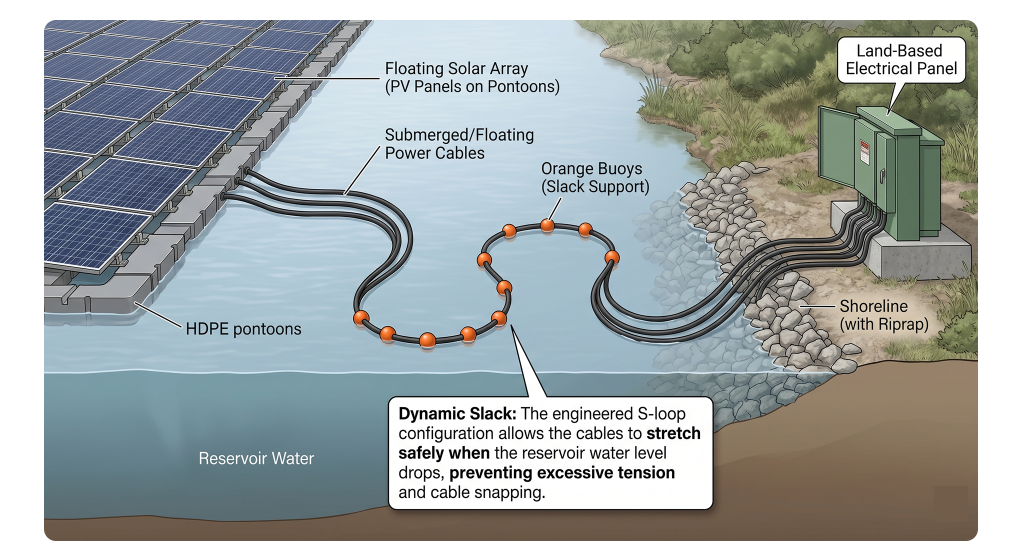
Floating solar cable routing cannot rely on rigid trays. The cables must bridge the gap between the pontoons and the bank while accommodating the relentless kinetic motion of the water. This is where specialized Cable engineering becomes critical. Engineers must calculate the exact required slack and design specific “flexibility loops” into the cabling. Often, a dynamic submarine cable with heavy-duty, UV-resistant, and completely waterproof XLPE/EPR jacketing is utilized. These cables are either floated on the surface using dedicated buoy-trays or submerged securely to the reservoir floor to prevent them from snapping as the water level rises and falls.
Earthing and Electrical Safety in Wet Environments
Introducing hundreds of volts of DC electricity onto a massive conductive body of water presents a severe life-safety risk for maintenance personnel.
Rigorous floating solar earthing protocols are non-negotiable. Standard grounding rods cannot simply be driven into a plastic pontoon. The design must incorporate robust equipotential bonding, ensuring every single metallic frame and panel chassis across the entire floating array is electrically connected. This massive bonding network is then tethered via specialized earth cables back to deep, shore-based grounding pits. This guarantees that in the event of an insulation failure, wet environment electrical safety is maintained, and fault currents are safely and instantly dissipated away from the water and into the earth, tripping the protective breakers.
Integrating Power into Desalination Operations
The energy generated by the FPV array is exceptionally valuable because desalination plants are incredibly energy-intensive, relying on massive high-pressure pumps for Reverse Osmosis (RO).
Effective FPV grid integration involves synchronizing this new clean power directly with the heavy, fluctuating motor loads of the desalination facility. The design dictates a sophisticated shore-based substation, equipped with step-up transformers and smart switchgear. This substation manages the desalination plant power supply, ensuring the solar power offsets the plant’s grid consumption seamlessly, without introducing voltage spikes or harmonic distortion that could damage the sensitive variable frequency drives (VFDs) running the massive water pumps.
Environmental Impact and Water Quality
When deploying technology on a critical drinking water or treated water reservoir, preserving the ecological and chemical integrity of the water is paramount.
Utility authorities require extensive studies regarding floating solar water quality. The HDPE pontoons must be certified food-grade, ensuring zero leaching of toxic plastics, heavy metals, or chemical plasticizers into the water supply over their 25-year lifespan.
Furthermore, the FPV environmental impact on the reservoir ecosystem must be modeled. While shading the water reduces evaporation, it also limits the sunlight penetrating the water. This can be highly beneficial by suppressing unwanted algae blooms in treated water reservoirs, but the precise impact on the biological oxygen levels must be balanced to maintain overall ecological equilibrium.
Operations, Maintenance, and Cleaning on Water
Once commissioned, maintaining an FPV plant requires a completely different logistical approach compared to a walk-in ground-mounted facility.
Floating solar O&M (Operations and Maintenance) introduces unique hurdles. Inspecting under-panel wiring, combiner boxes, and the structural integrity of the pontoons requires technicians operating from small, non-motorized boats or utilizing aquatic drones.
More importantly, FPV panel cleaning requires extreme care. In the dusty GCC, panels must be washed frequently. However, chemical detergents cannot be used, as the runoff drops directly into the pristine desalination reservoir. Maintenance strategies often involve specialized automated wet-cleaning robots that use the reservoir water itself to clean the glass, or manual boat access crews trained in environmentally neutral dry-brushing techniques.
Frequently Asked Questions (FAQ)
1. Does floating solar generate more electricity than rooftop solar?
Yes, typically. The water beneath a floating solar array acts as a natural cooling system. Because solar panels lose efficiency as they heat up, the cooling effect of the water keeps the panels operating at a lower temperature, yielding an efficiency boost of 5% to 10% compared to panels baking on a hot commercial roof or desert sand.
2. Can floating solar withstand strong winds and storms?
Yes, if engineered correctly. The pontoons are heavily tethered using complex mooring systems anchored to the shore or the reservoir bed. The aerodynamic profile of the panels is kept very low to the water to reduce wind drag (uplift). During severe storms, the flexibility of the interlocking pontoons allows the array to ride the waves dynamically rather than resisting them rigidly and breaking.
3. What happens if an electrical cable falls into the water?
Marine-grade FPV systems are designed with this specific risk in mind. All cables used in floating solar are highly specialized, double-insulated, and completely waterproof (often rated for continuous submersion). Furthermore, the entire system is protected by rapid ground-fault detection relays that will instantly cut the power if any electrical leakage into the water is detected.
4. Will the plastic pontoons contaminate drinking water reservoirs?
No. Reputable floating solar pontoons are manufactured using High-Density Polyethylene (HDPE) that is specifically certified for drinking water contact. They are chemically inert, UV-stabilized, and tested to ensure they do not leach microplastics, toxins, or chemicals into the water over their multi-decade lifespan.
5. How are the panels cleaned without polluting the water?
Cleaning FPV panels on fresh water or desalination reservoirs strictly forbids the use of soaps or chemical detergents. Operators use automated, water-based robotic cleaners that draw water directly from the reservoir, clean the glass, and let the clean water runoff back into the basin, ensuring zero chemical contamination.
Assessing Your Water Assets
Floating solar offers incredible, synergistic benefits for the GCC, turning passive bodies of water into active clean energy generators while preserving the very water they float upon. However, deploying high-voltage infrastructure on a moving, wet surface is unforgiving. It requires highly specialized structural mooring analysis, marine electrical engineering, and meticulous environmental foresight.
Looking to monetize your water reservoirs and reduce pumping costs?
Do not proceed without rigorous technical validation. Leverage our expertise to conduct a comprehensive floating solar feasibility study. As a premier FPV engineering consultant, Elecwatts provides the critical floating solar feasibility GCC assessments, cable routing strategies, and marine-grade procurement required to ensure your aquatic solar asset is safe, resilient, and highly profitable.
Contact Elecwatts today to evaluate the hidden energy potential of your water infrastructure.