

The industrial sector in the GCC is evolving at a breakneck pace. Driven by national mandates like Saudi Vision 2030 and the UAE Net Zero 2050 strategy, factories are shifting toward AI-driven operations, mandatory decarbonization, and increasingly volatile energy markets. In this environment, the electrical infrastructure built today faces a critical test: it must be resilient enough to power a future that is radically different from the present.
For plant owners and engineering directors, the central question is stark: Will your facility’s electrical system be a strategic asset that enables growth, or a costly constraint that bottlenecks production by 2030? The answer lies in the design decisions made today. We have identified five industrial electrical design trends and pillars that separate a future-ready facility from one destined for obsolescence.
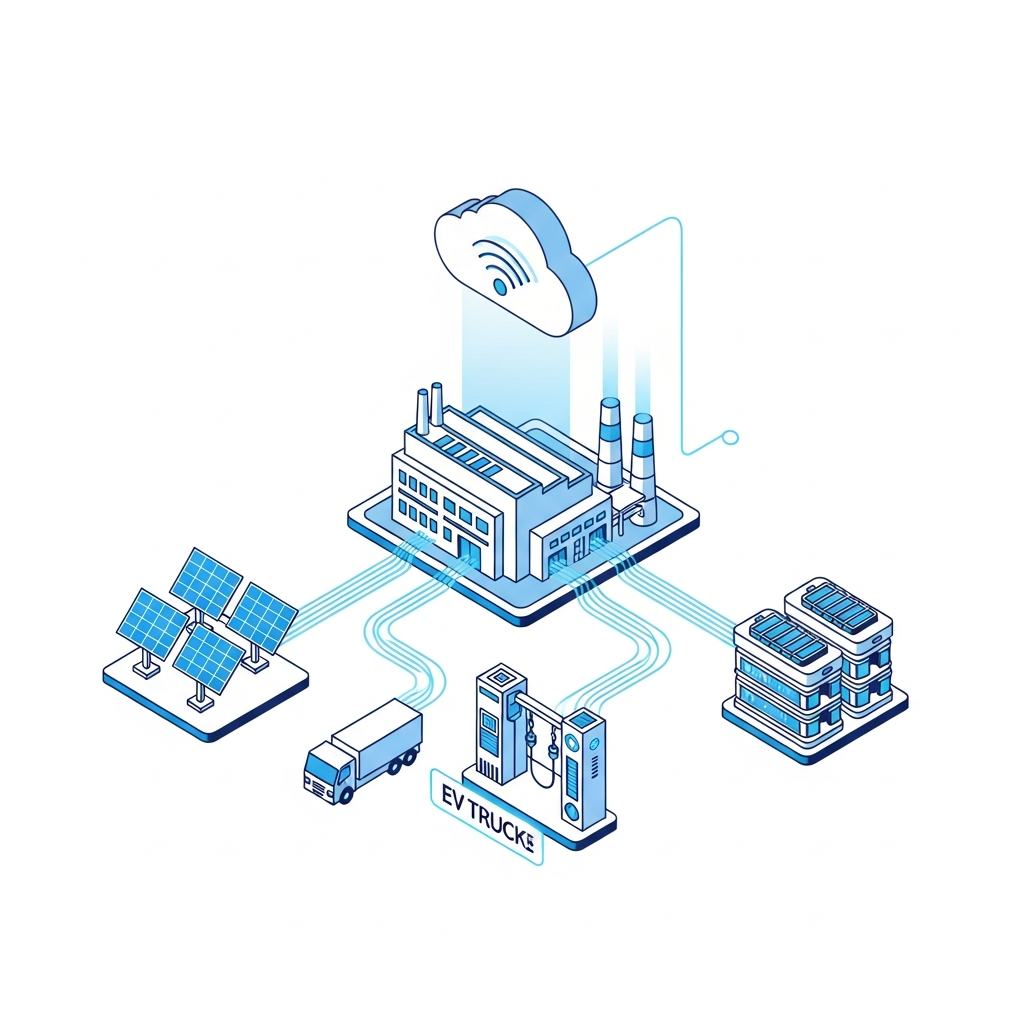
Alt Text for SEO: “Diagram of a future-proof industrial plant with smart grid, solar, and IIoT infrastructure.”
Why “Future-Proofing” is an Economic Imperative, Not a Luxury
There is a misconception that designing for the future is an unnecessary expense. However, the financial reality is quite the opposite. The cost of a “retrofit”—tearing up concrete to lay new conduits, replacing undersized switchgear during a shutdown, or re-engineering protection schemes—is exponentially higher than the marginal incremental cost of designing for flexibility upfront.
Future-proof electrical design for industrial plant 2030 strategies are about preserving long-term asset value. A flexible plant adapts to market shifts faster, integrates new technology cheaper, and maintains higher operational uptime, delivering a superior Return on Investment (ROI) over its lifecycle.
Building a new facility? Start right with our Electrical Plant Design Engineering services.
Must-Have #1: Design for Digital from the Ground Up (The IIoT Spine)
Future smart factories run on data as much as they run on electricity. The electrical design must provide the physical backbone for the Industrial Internet of Things (IIoT). It is no longer sufficient to run power cables; you must run the nervous system of the plant.
Key Design Actions:
- Fiber-Optic Backbones: Install dedicated, redundant fiber-optic conduits to every major substation, Motor Control Center (MCC), and process area, separate from power interference.
- Smart Switchgear: Specify IoT-enabled switchgear and protection relays with built-in communication ports (IEC 61850) ready to transmit health data.
- Universal Metering: Plan for high-resolution power quality metering at all distribution levels, not just the incomer, to feed digital twin data collection models.
The 2030 Benefit: This enables predictive maintenance (catching failures before they happen), real-time energy optimization, and the seamless integration of advanced process control systems without laying a single new cable.
Must-Have #2: Build in Inherent Scalability & Flexibility
The rigid design philosophy of “building for today’s maximum load plus 10%” is obsolete. The smart factory electrical infrastructure of 2030 requires a modular, scalable grid that can breathe and grow with the business.
Key Design Actions:
- Modular Substations: Utilize modular substation designs (e.g., skid-mounted or containerized) that can be replicated and dropped in as the plant expands.
- Oversized Pathways: Oversize cable trays, conduits, and trench spaces by 40-50%. The cost of air and steel is low compared to the cost of digging new trenches later.
- Spare Capacity: Design main distribution boards with 20-30% spare breaker capacity and provisions for easy busbar extension.
The 2030 Benefit: This approach accommodates unplanned production line expansions, technology shifts, or the addition of new heavy machinery with minimal downtime, rework, or scalable electrical distribution headaches.
Must-Have #3: Plan for Electrification & On-Site Generation
The path to net-zero runs through the electrification of heat (electric boilers replacing gas) and transport. By 2030, the industrial plant must be both a consumer and a producer of clean energy (“Prosumer”).
Key Design Actions:
- Renewable Ready: Reserve physical space and grid connection capacity (switchgear cubicles) for future solar PV carports and rooftop arrays.
- Storage Integration: Design main switchgear with dedicated incomers sized for large Battery Energy Storage Systems (BESS) for industrial microgrid design.
- EV Infrastructure: Provide high-power (MW-scale) EV charging infrastructure for plant logistics fleets, including heavy electric trucks and forklifts.
The 2030 Benefit: A drastic reduction in Scope 1 & 2 emissions, protection from grid price volatility, and seamless compliance with evolving GCC sustainability mandates.
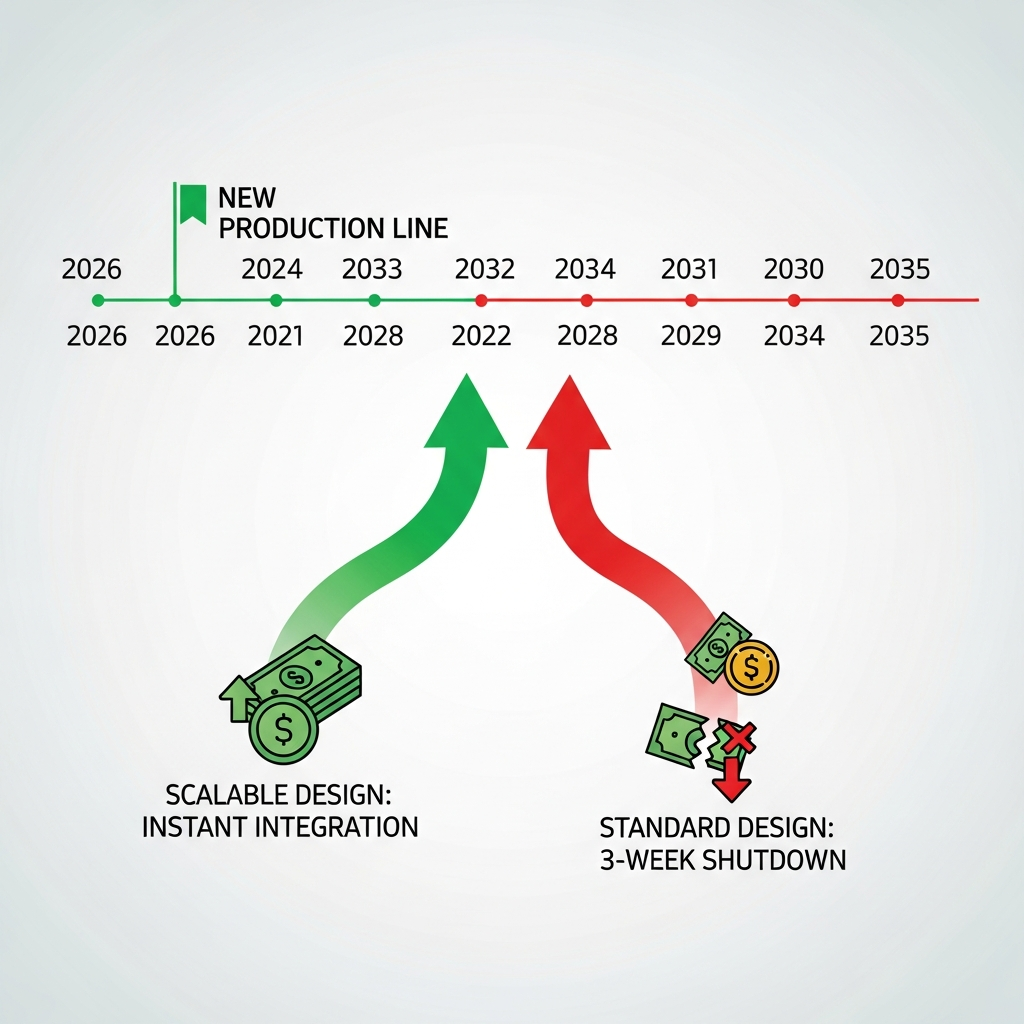
Alt Text for SEO: “Timeline showing the ROI benefits of scalable electrical design versus traditional design over 10 years.”
Must-Have #4: Integrate Cybersecurity at the Hardware Level
As industrial systems become connected, cyber-physical risk becomes a core safety issue. OT cybersecurity electrical design can no longer be a software-only afterthought; it must be baked into the hardware.
Key Design Actions:
- Secure Hardware: Specify “secure by design” hardware components that feature physical security switches and hardware-based authentication.
- Network Segmentation: Design the network architecture with physically separate layers for Operational Technology (OT) and Information Technology (IT) to prevent cross-contamination.
- Future-Proofing Controls: Include provisions and space for future Hardware Security Modules (HSMs) or firewalls in critical control panels.
The 2030 Benefit: This protects against operational shutdowns, safety system compromises, and intellectual property theft, ensuring the plant meets stringent future insurance and regulatory requirements for secure industrial control systems.
Must-Have #5: Embrace Adaptive Protection & Dynamic Energy Management
A static protection system cannot manage a dynamic, bi-directional power flow derived from on-site renewables and battery storage. The grid of 2030 must be intelligent and self-optimizing.
Key Design Actions:
- Adaptive Relays: Specify numerical protection relays with adaptive protection schemes (multiple setting groups) that can automatically switch based on the grid configuration (e.g., islanded vs. grid-connected).
- The “Brain”: Design for a central Microgrid Energy Management System (MEMS) to act as the brain of the plant’s power system.
- Automated Transfer: Implement fast, automated transfer schemes to seamlessly island critical processes during grid disturbances.
The 2030 Benefit: This maximizes uptime, optimizes energy cost in real-time (arbitrage), and safely manages the complexity of a decarbonized, resilient power system.
Frequently Asked Questions (FAQs)
Q1: Won’t future-proofing our electrical design significantly increase the initial CAPEX?
It involves a marginal increase in strategic CAPEX (typically 5-10%), focused on enabling infrastructure like conduits, space, and communication layers. This is vastly cheaper than the 10X+ cost of retrofitting or facing production constraints later. It is an investment in optionality and risk reduction.
Q2: How can we design for technologies that don’t exist yet?
You design for uncertainty, not for specific gadgets. The goal is to create a flexible, well-instrumented, and scalable platform. By providing ample space, cooling, data bandwidth, and connection points, you ensure you can integrate new technologies as they emerge without rebuilding your core grid.
Q3: Is this relevant for a brownfield (existing) plant retrofit?
Absolutely. While more challenging, the same principles guide a prioritized modernization roadmap. It starts with a deep audit to identify the biggest constraints (often data connectivity or switchgear capacity) and then phases investments to systematically build in the five must-haves over time.
Q4: Who is responsible for driving this holistic design approach?
It requires early collaboration between the plant owner (who sets the vision), the EPC contractor (who executes), and a specialist electrical design consultant who acts as the owner’s engineer. The consultant ensures these long-term principles are embedded in the technical specifications and construction drawings.
Conclusion
The electrical system is the central nervous system of the modern industrial plant. Designing it based on the standards of the past guarantees obsolescence, but designing it for 2030 ensures resilience and value.
Transform your electrical infrastructure from a fixed cost into a strategic, future-ready asset. Our electrical plant design engineering team specializes in creating the adaptable, digital, and decarbonized power systems that GCC industries need to thrive.
Contact us today to begin a feasibility study for your new project or modernization plan.