

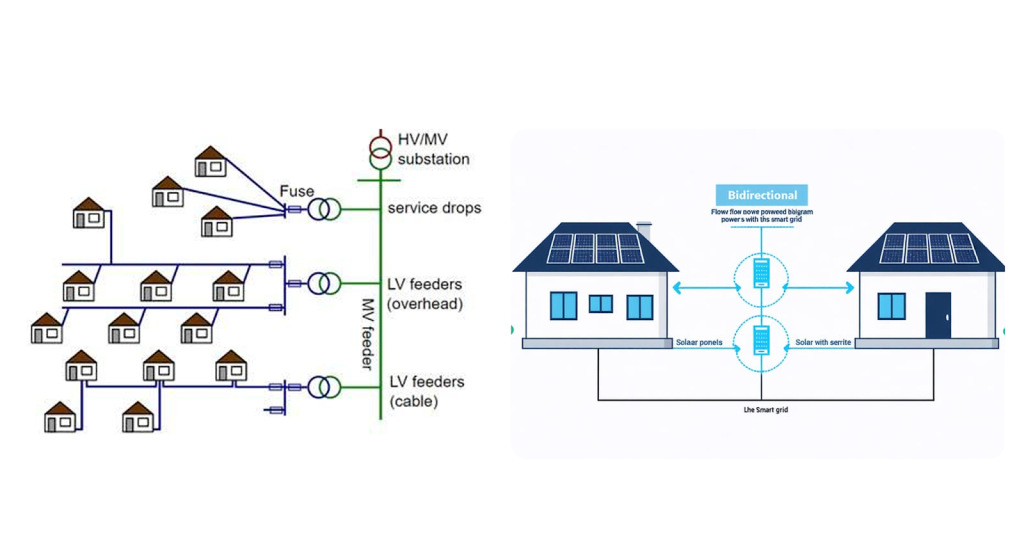
For over a century, the electrical distribution grid in the Gulf Cooperation Council (GCC) was designed based on a simple, immutable law of physics: power flows from the central generator to the consumer. It was a one-way street. Massive gas turbines in Jebel Ali or Ras Al Khair generated electricity, which was stepped up, transmitted, stepped down, and finally consumed by villas and skyscrapers.
Today, that fundamental law has been broken.
Driven by aggressive renewable energy targets and the plummeting cost of photovoltaics (PV), cities like Dubai and Riyadh are witnessing a surge in Distributed Energy Resources (DERs). Rooftop solar panels are turning consumers into “prosumers” who generate their own electricity and export the excess back to the grid.
While this is a triumph for sustainability, it is a headache for distribution network operators. Traditional grids were not designed for bidirectional power flow GCC. When power flows “backwards” from the grid edge, it disrupts voltage regulation, blinds protection relays, and can overload transformers designed for unidirectional loading.
As the penetration of rooftop solar grows, Dubai aims for 75% clean energy by 2050, the grid must evolve. It requires a fundamental electrical system design overhaul of the distribution network, moving from passive copper wires to active grid-edge intelligence Middle East.
The GCC Smart Grid Vision: From Centralized Generation to Distributed Energy Resources
The transition is not accidental; it is policy-driven.
- Dubai (DEWA): The “Shams Dubai” initiative has already connected thousands of buildings to the grid, necessitating a robust Smart Grid Strategy.
- Saudi Arabia (SEC): The Saudi National Smart Grid Program (SASG) is a core pillar of Vision 2030, aiming to modernize the Kingdom’s vast distribution network to handle the target of 58.7 GW of renewable energy by 2030.
The Evolution of the Grid
To accommodate GCC smart grid evolution, utilities are shifting from a rigid, centralized architecture to a flexible, decentralized one. This requires distributed energy resources integration at a granular level. The grid must now act less like a pipeline and more like a cloud network, managing thousands of micro-generators in real-time. This shift demands a completely new layer of technology at the “Grid Edge”, the point where the utility meets the customer.
Technology Component 1: Advanced Metering Infrastructure (AMI) with Two-Way Communication
The first step in managing bidirectional flow is seeing it. Old electromechanical meters simply spun backwards, providing no data on when or how power was being exported.
The Role of AMI
Advanced metering infrastructure UAE and KSA programs are replacing millions of legacy meters with Smart Meters. These devices are the sensory nerves of the smart grid.
- Bidirectional Measurement: They separately record import (consumption) and export (generation) kWh, allowing for accurate “Net Metering” billing.
- Power Quality Monitoring: They detect voltage swells caused by high solar generation at noon, alerting the utility to potential local over-voltage issues.
Communication Protocols for the Desert
Getting data from the meter to the utility (Head End System) in the GCC presents unique challenges.
- RF Mesh: Common in dense urban areas like Dubai Marina, where meters “hop” signals to a collector.
- Cellular (4G/5G/NB-IoT): Preferred for sprawling, low-density suburbs in Riyadh or remote industrial zones where RF mesh is unreliable.
- Cybersecurity: As critical infrastructure, GCC utilities impose strict cybersecurity protocols (like NESAS in UAE) to prevent state-sponsored actors from hacking smart meter communications to disrupt the grid.
Technology Component 2: Adaptive Protection Schemes for Variable Power Flows
Traditional protection schemes rely on a simple assumption: high current flows downstream to a fault.
The Solar Blind Spot
In a bidirectional network, a fault on the feeder can be fed by both the utility substation and the customer’s solar panels (Reverse Feeding).
- Blinding: The fault current is split between sources, potentially tricking the substation relay into thinking the current is lower than the trip threshold. The fault persists, risking fire and equipment damage.
- Sympathetic Tripping: A fault on Feeder A might cause solar inverters on Feeder B to feed into it, causing Feeder B’s breaker to trip unnecessarily.
The Solution: Adaptive Protection
Modern distribution automation GCC designs utilize adaptive protection systems.
- Directional Relays: These intelligent devices distinguish between “forward” load current and “reverse” fault current.
- Dynamic Settings: Using high-speed communication, the relays can automatically adjust their trip settings based on the current level of solar generation in the loop.
[Placement for Image 1]
Technology Component 3: Volt-VAR Optimization at the Grid Edge
One of the biggest impacts of solar integration is voltage rise. As solar panels push power into the grid during midday, the voltage at the end of the line can rise above statutory limits (e.g., >240V).
The Inverter as a Grid Asset
Traditionally, voltage was managed by tap changers at the substation. In a smart grid, the solar inverters themselves become active grid agents.
- Volt-VAR Control: Modern smart inverters (compliant with IEEE 1547-2018 and GCC grid codes) can be programmed to absorb reactive power (VARs) when they generate active power (Watts).
- The Effect: Absorbing VARs pulls the voltage down, counteracting the rise caused by solar generation.
- Optimization: Volt-VAR optimization strategies allow the utility to command thousands of inverters to stabilize voltage autonomously, saving the life of expensive substation tap changers.
The Infrastructure Challenge: Transformer Loading and Reverse Power Flow
Distribution transformers are the workhorses of the grid, but they are vulnerable in a high-solar environment.
The Reverse Power Stress
During a cool, sunny winter day in the GCC, a residential neighborhood might generate far more solar power than it consumes (ACs are off).
- Reverse Flow: This excess power flows backwards through the distribution transformer, stepping up from 400V to 11kV.
- Impact: While transformers work both ways, the older units were not sized for this “peak generation” load. Furthermore, frequent reversals of power flow can cause mechanical stress on the windings.
- Monitoring: Distribution transformer monitoring units (DTMs) are essential to track the “Net Load.” Without them, a transformer could be severely overloaded by solar export without the utility knowing, leading to premature failure.
The Consumer Perspective: Prosumer Management and Grid Services Participation
For the grid to function, the relationship with the consumer must change. The passive bill-payer becomes an active “Prosumer.”
The Economic Model
- Net Metering: The current standard in Dubai and elsewhere. Consumers bank excess kWh to offset future consumption.
- Grid Services: The future of prosumer management GCC lies in flexibility markets. Utilities may pay prosumers to curtail their solar generation during grid congestion or to use their batteries to support peak demand.
- Equipment: To participate, prosumers need smart inverters and potentially Battery Energy Storage Systems (BESS) integrated with the utility’s demand response platform.
The Utility Perspective: Visibility, Control, and Predictive Analytics
To manage this chaos, utilities need a “Brain.” The traditional SCADA system, which only sees high-voltage substations, is no longer enough.
Advanced Distribution Management Systems (ADMS)
An ADMS integrates SCADA, Outage Management, and Meter Data. It provides visibility all the way down to the low-voltage (LV) network.
- State Estimation: Using data from smart meters, the ADMS creates a real-time model of power flow on every street.
- Forecasting: Predictive grid analytics use weather data to predict solar generation minute-by-minute. “A cloud is moving over Riyadh; solar output will drop by 30% in 10 minutes.” The ADMS automatically prepares backup generation to fill the gap.
This level of sophisticated GCC smart grid advisory and Project Lead Engineering & Management is where specialized engineering firms add immense value, bridging the gap between legacy infrastructure and digital future.
Implementation Roadmap: Phased Approach for GCC Municipalities
Modernizing a city’s grid is not a “big bang” event; it is a decade-long journey.
- Phase 1: Visibility (Years 1-2)
- Roll out Smart Meters (AMI).
- Install monitoring on critical distribution transformers.
- Establish the telecommunications backbone (Fiber/4G).
- Phase 2: Automation (Years 3-5)
- Deploy automated reclosers and switches for self-healing networks.
- Implement ADMS software.
- Mandate smart inverter standards for new solar installations.
- Phase 3: Optimization (Years 5+)
- Activate Volt-VAR optimization.
- Launch prosumer flexibility markets.
- Integrate large-scale community battery storage.
The Economic Case: Calculating the Grid Modernization ROI
Smart grids are expensive. Justifying the billions in CAPEX requires a robust business case based on smart grid ROI calculation.
The Benefits Stack
- Operational Savings: Reduced truck rolls (remote meter reading), lower non-technical losses (theft detection), and deferred capital upgrades (using Volt-VAR instead of reconductoring lines).
- Reliability Value: Reduced SAIDI/SAIFI (outage duration/frequency) creates economic value for the city.
- Sustainability: Enabling higher renewable penetration directly supports national decarbonization goals, which has an intrinsic sovereign value.
[Placement for Image 2]

Frequently Asked Questions (FAQ)
1. What happens if my solar panels generate more power than my house uses?
In a bidirectional grid with Net Metering (like DEWA’s Shams Dubai), the excess power flows back into the utility grid. Your smart meter records this export, and the utility credits your account, offsetting your future bills.
2. Can the existing grid handle everyone installing solar panels?
No. There is a “Hosting Capacity” limit. If too many neighbors install solar, the local transformer may overload or the voltage may rise too high. Utilities perform a “Connection Impact Study” for large installations to check this. If the limit is reached, the grid must be reinforced before more solar can be added.
3. What is “Islanding” and why is it dangerous?
Islanding occurs when the utility grid goes down (blackout), but your solar panels keep powering your house and feeding back into the lines. This is dangerous for line workers repairing the “dead” lines. Smart inverters must have “Anti-Islanding” protection to instantly shut off solar generation during a grid outage.
4. How does the extreme GCC heat affect smart meters?
Standard smart meters can fail in 50°C heat (LCD screens black out, electronics overheat). GCC utilities specify “Tropicalized” meters designed to withstand temperatures up to 70°C inside the meter box, often with special UV-resistant casings and potted electronics.
5. Will a smart grid lower my electricity bill?
Indirectly, yes. While the rate per kWh might stay the same, smart grids enable “Time of Use” tariffs (cheaper power at off-peak times) and provide you with detailed data to help you reduce waste. For the utility, it reduces operational costs, which helps keep tariffs stable in the long run.
Conclusion: The Grid of the Future is Here
The transition from a passive, one-way distribution system to an active, bidirectional smart grid is the defining infrastructure challenge of this decade for GCC cities. It is a transformation that touches every asset, from the high-voltage substation to the meter on the wall of a villa.
Designing for Grid-Edge Intelligence requires a holistic approach that combines power systems analysis with telecommunications and data science. It requires moving beyond “fit-and-forget” design to creating adaptive, resilient networks capable of handling the dynamic energy flows of a renewable-powered future.
Ready to modernize your distribution network?
Navigating the complexities of smart grid integration requires specialized expertise. Elecwatts is a leading smart grid technical advisory firm in the region. We support municipalities, industrial cities, and master developers in designing future-ready distribution networks, conducting solar hosting capacity studies, and implementing advanced protection schemes compliant with regional grid codes.
Contact Elecwatts today to engineer the intelligent grid your city deserves.