

The Middle East is undergoing an unprecedented infrastructure and industrial boom. However, as smart cities and massive manufacturing complexes rise from the desert, they bring an invisible but highly destructive threat to the electrical grid: harmonic distortion. For developers and facility managers aiming for seamless operations, consulting a specialized electrical engineering firm in Dubai early in the design phase is no longer optional, it is a critical prerequisite. The massive influx of modern, high-efficiency equipment across the GCC is polluting the grid with “dirty power.”
To protect the integrity of national infrastructure, utility providers like the Dubai Electricity and Water Authority (DEWA) and the Saudi Electricity Company (SEC) are actively enforcing strict regulations to curb this pollution. They have instituted rigid Total Harmonic Distortion (THD) limits that all new and upgraded facilities must meet before they are allowed to connect to the grid. Understanding harmonic analysis GCC protocols and ensuring strict THD limits utility compliance is the ultimate gateway to getting your facility energized, avoiding crippling fines, and ensuring your equipment survives the brutal GCC climate.
Understanding Non-Linear Loads in Middle East Industries
To understand harmonics, we must look at how modern industrial and commercial facilities consume power. The electrical loads of the past, like incandescent light bulbs or simple induction motors, were “linear.” When you applied a smooth, sinusoidal AC voltage to them, they drew a smooth, sinusoidal AC current.
Today’s facilities operate almost entirely on non-linear loads electrical systems.
- The Culprits: The primary generators of harmonics in the GCC include the thousands of Variable Frequency Drives (VFDs) powering massive district cooling plant chillers, LED lighting drivers in commercial skyscrapers, heavy industrial rectifiers in aluminum smelting, and Uninterruptible Power Supplies (UPS) in hyper-scale data centers.
- The Pulse Effect: These devices utilize power electronics (diodes, thyristors, and IGBTs) to convert and manipulate electricity. Instead of drawing current in a smooth continuous wave, they draw current in abrupt, high-frequency pulses. These rapid pulses distort the fundamental 50Hz or 60Hz sine wave, superimposing higher-frequency waves (harmonics) on top of it. This VFD harmonic distortion acts as electrical friction, injecting chaotic noise back into the facility’s power grid and ultimately into the public utility network.
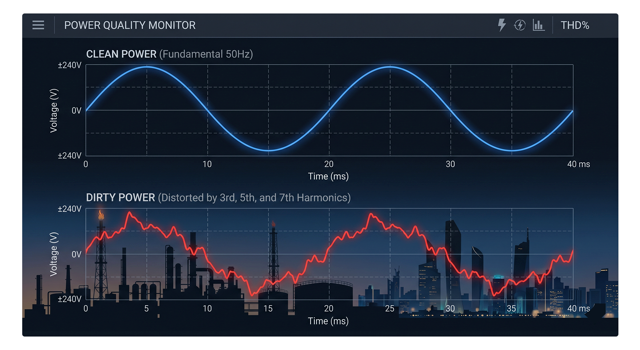
The Devastating Effects of High THD on Equipment
Harmonic distortion is not merely a theoretical grid compliance issue; it is a physical, destructive force. In the GCC, where ambient summer temperatures routinely exceed 50°C, the margin for error regarding equipment heat dissipation is essentially zero.
The Thermal Multiplier
The most immediate and dangerous consequence of high Total Harmonic Distortion (THD) is severe overheating.
- Transformers: Harmonic currents cause extreme “eddy current” and “skin effect” losses inside transformer cores and copper windings. A transformer loaded to only 60% of its nameplate capacity can literally cook itself from the inside out if the THD is too high, leading to catastrophic transformer overheating harmonics and premature dielectric failure.
- Neutral Conductors: In three-phase systems, certain harmonics (specifically “triplens” like the 3rd, 9th, and 15th) do not cancel each other out. Instead, they add together and return on the neutral wire. This can cause the neutral conductor to carry dangerously high currents, creating a massive fire hazard inside electrical shafts.
- Nuisance Tripping: THD equipment damage extends to operational downtime. The distorted, jagged waveforms can confuse the sensitive microprocessors inside protective relays and circuit breakers, causing them to trip randomly even when no actual short circuit exists, bringing critical manufacturing processes to a halt.
IEEE 519 vs. Regional Utility Standards (DEWA/SEC)
To combat this invisible pollution, international bodies and regional utilities have established strict limits on how much distortion a single facility is allowed to inject into the grid.
The Global Benchmark
The internationally recognized gold standard is IEEE 519 (“Recommended Practice and Requirements for Harmonic Control in Electric Power Systems”). It sets limits based on the ratio of the facility’s maximum demand current to the utility’s short-circuit capacity.
GCC Utility Nuances
While IEEE 519 THD limits serve as the foundation, GCC utilities have adapted these rules to protect their specific networks.
- DEWA (Dubai): For commercial and solar-integrated projects, DEWA harmonic compliance is heavily regulated under the Distributed Renewable Resources Generation (DRRG) manual and general connection guidelines. DEWA strictly monitors the Point of Common Coupling (PCC), the exact physical point where your facility connects to the DEWA grid. DEWA generally restricts Voltage THD (THDv) to less than 5% and enforces strict, tiered limits on Current THD (THDi) depending on the grid’s stiffness.
- SEC (Saudi Arabia): The Saudi Arabian Grid Code (SAGC) has equally rigorous stipulations for facilities connecting to the SEC network. Large industrial plants in Jubail or Yanbu undergo immense scrutiny to ensure their high-capacity rectifiers and arc furnaces do not destabilize the national frequency or distort the voltage profile for neighboring facilities.
The Harmonic Analysis Study Process
Proving compliance to a utility requires submitting a comprehensive, mathematically rigorous Harmonic Analysis Study before the facility is built or major equipment is procured.
The Methodology
- Data Collection: The engineering team compiles a comprehensive “Non-Linear Load Schedule,” detailing the size, type, and harmonic spectrum of every VFD, UPS, and LED driver planned for the facility.
- Electrical Network Modeling: Engaging experts in power systems analysis ensures your facility model accurately reflects real-world harmonic resonances before equipment is procured. The engineers build a “digital twin” of your facility using advanced software like ETAP or DigSILENT, mapping every cable, transformer, and utility connection point.
- Frequency Scan and Simulation: The software injects the specific harmonic currents generated by the facility’s equipment into the digital model. The harmonic study methodology includes a “Frequency Scan” to detect dangerous resonance points where the facility’s capacitance (like power factor correction banks) might inadvertently amplify the harmonic distortion to explosive levels.
- Compliance Check: The software calculates the THDv and THDi at the PCC and compares it directly against DEWA, SEC, or IEEE 519 limits.
Active vs. Passive Harmonic Filters
If the harmonic analysis reveals that the facility will exceed utility limits, mitigation equipment must be engineered into the design. The choice generally comes down to two technologies.
Passive Harmonic Filters
Passive filters are constructed using traditional capacitors and inductors tuned to “trap” a specific harmonic frequency (e.g., the 5th or 7th harmonic).
- Pros: They are relatively simple, robust, and cost-effective for stable, predictable loads.
- Cons: They only filter the specific frequency they are tuned for. If the facility’s load profile changes, the passive filter can become ineffective or, worse, create a destructive resonance condition with the grid.
Active Harmonic Filters (AHF)
In modern GCC facilities, loads are highly dynamic. District cooling chillers ramp up and down based on the desert heat; automated logistics hubs fluctuate wildly.
- The Smart Solution: This environment demands sophisticated active harmonic filter design. An AHF is essentially a heavy-duty power electronics computer. It uses Current Transformers (CTs) to monitor the distorted waveform in real-time. It then generates and injects an exact, inverted “anti-harmonic” current back into the line. The two waveforms cancel each other out, leaving a perfectly clean sine wave.
- While the passive filter vs AHF debate usually centers on the higher initial CAPEX of the AHF, the Active Filter is overwhelmingly preferred in the GCC today due to its adaptability, superior filtering performance, and absolute guarantee of utility compliance regardless of future facility modifications.
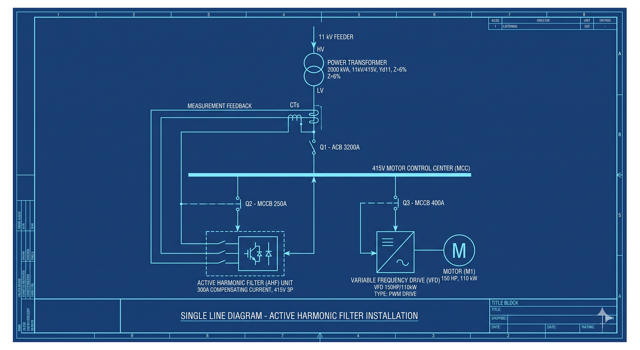
Alt Text for SEO: “Single Line Diagram illustrating the parallel installation of an Active Harmonic Filter to mitigate VFD distortion.”
Compliance at 11kV vs. LV Levels
The stringency of utility harmonic limits changes drastically depending on the voltage level at which your facility connects to the grid.
Low Voltage (LV) Connections
For standard commercial buildings connecting at 400V, the utility’s primary concern is local overheating and interference with adjacent buildings sharing the same local substation. The limits are strict, but the mitigation (like installing AHFs at individual distribution boards) is straightforward.
Medium Voltage (11kV / 33kV) Connections
For heavy industrial plants, massive data centers, and gigawatt-scale district cooling plants, the connection is typically made directly to the medium voltage THD network (11kV or 33kV).
- The Complexity: At this level, 11kV harmonic limits are exceptionally unforgiving. Because injecting distortion at the medium voltage level pollutes a much larger segment of the national grid (affecting regional substations and transmission networks), utilities like DEWA and SEC will scrutinize the harmonic study with microscopic precision. Mitigating THD at 11kV requires either massive, custom-engineered medium-voltage passive filter banks or highly complex step-up transformer arrangements for low-voltage active filters.
Continuous Power Quality Monitoring Requirements
Utilities no longer rely solely on theoretical engineering studies submitted during the design phase. They demand empirical, ongoing proof that your facility remains clean once it is operational.
The Rise of the Smart Meter
As part of their smart grid initiatives, DEWA and SEC frequently mandate the power quality analyzer installation at the Point of Common Coupling (the main incomer) for large facilities.
- Class A Certification: These are not standard utility billing meters. They are highly advanced, Class A certified Power Quality Analyzers capable of measuring harmonic spectrums up to the 50th or 63rd harmonic.
- The Watchdog: These meters provide continuous THD monitoring, logging every voltage sag, swell, and harmonic distortion event, 24/7/365. This data is often transmitted securely back to the utility’s control center. If a facility’s VFDs begin to age and produce more distortion, or if a tenant installs unfiltered equipment that pushes the facility over the IEEE 519 limits, the utility will know immediately.
Financial Penalties and Disconnection Risks
The consequences of failing to respect harmonic limits in the GCC are severe, reflecting the millions of dollars in damage dirty power can inflict on public utility infrastructure.
The Cost of Non-Compliance
- Refusal to Energize: The most immediate risk occurs during the NOC and final inspection phase. If the required harmonic studies and mitigation designs are not present or approved, DEWA or SEC will simply refuse to energize the facility, causing devastating delays to project handover.
- Financial Fines: For operational facilities flagged by continuous monitoring, utilities have the authority to levy massive monthly DEWA harmonic penalty charges on the utility bill until the “pollution” is rectified.
- Disconnection: In extreme cases where severe THD is actively destabilizing the local grid or overheating utility transformers, the utility disconnection THD protocol allows the provider to physically cut power to the offending facility to protect the wider network.
- The ROI Perspective: Viewed through this lens, investing in a robust harmonic analysis and high-quality Active Harmonic Filters is not a sunk cost; it is a highly ROI-positive insurance policy that guarantees continuous operation and prevents astronomical regulatory fines.
Frequently Asked Questions (FAQ)
1. What generates the most harmonic distortion in a typical GCC commercial building?
In modern commercial skyscrapers in Dubai or Riyadh, the vast majority of harmonic distortion is generated by the Variable Frequency Drives (VFDs) used to control the massive chilled water pumps and Air Handling Units (AHUs) for the central air conditioning system. LED lighting networks and large IT server rooms also contribute significantly.
2. Can I just rely on the built-in filters inside my VFDs?
Most industrial VFDs come with basic built-in DC chokes or AC line reactors. While these reduce the distortion generated by that specific drive (often bringing it down to 35-45% THDi), this is rarely enough to meet the strict 5% or 8% THDi limits required by IEEE 519 at the main utility connection point, especially when multiple VFDs are running simultaneously. External active or passive filters are almost always required for full compliance.
3. How does DEWA or SEC know if my facility is producing too many harmonics?
For large connections, utilities mandate the installation of Class A Power Quality Analyzers at your main intake room. These meters continuously analyze the waveform and report back to the utility. If your Total Harmonic Distortion (THD) exceeds the contracted limits, it triggers an alarm in their system.
4. What happens if a harmonic analysis is done incorrectly?
An incorrect study will lead to the wrong filters being purchased. If a passive filter is incorrectly sized, it can create a “harmonic resonance” with the utility grid. Instead of eliminating the distortion, the filter will actually amplify it, which can cause the filter’s capacitors to violently explode and cause a total facility blackout.
5. Are Active Harmonic Filters difficult to maintain in the dusty Gulf climate?
Active Harmonic Filters are sophisticated electronic devices that require clean, cool environments. To ensure longevity in the GCC, AHFs must be installed inside properly air-conditioned electrical rooms. If installed in harsher industrial environments, they must be specified with IP54 or IP55 enclosures, specialized conformal coating on their circuit boards, and advanced air filtration to protect them from corrosive humidity and desert dust.
Conclusion & Next Steps: Ensuring First-Time Approval
In the rapidly modernizing landscape of the GCC, electrical power is no longer just about quantity; it is intrinsically about quality. Harmonic distortion is a pervasive, destructive force that accelerates equipment degradation, threatens facility safety, and violates strict national grid codes.
For developers and project managers, treating power quality as an afterthought is a catastrophic financial risk. Proactive harmonic modeling and precise filter design are vastly cheaper, safer, and more effective than attempting to retrofit solutions after a utility rejection or an operational equipment failure. Achieving utility compliance is a highly specialized engineering discipline that requires deep knowledge of local codes, advanced software modeling, and strategic mitigation planning.
Don’t let dirty power derail your project’s energization.
Looking to secure your utility NOC without costly delays or redesigns? Partner with our specialized electrical system design team. As an expert harmonic compliance consultant, Elecwatts provides comprehensive, DEWA and SEC-approved power quality modeling and Active Harmonic Filter engineering that guarantees your facility meets every grid requirement on the very first submission, securing your GCC electrical NOC seamlessly.
Contact Elecwatts today to safeguard your electrical network and ensure absolute utility compliance.