

Dubai’s skyline is a global testament to architectural ambition. From the unrivaled height of the Burj Khalifa to the dense, soaring canopy of Dubai Marina and Sheikh Zayed Road, the Emirate dominates the world of supertall skyscrapers. However, behind the glittering glass facades lies a monumental, often invisible engineering challenge. Designing these vertical cities requires an expert electrical engineering consultancy in dubai to overcome a singular, massive physical hurdle: pumping gigawatts of power 300+ meters straight up into the sky.
In a sprawling horizontal development, power distribution is relatively straightforward. In a skyscraper, gravity, space constraints, and stringent fire safety regulations fundamentally rewrite the rules of electrical engineering. High rise electrical design cannot rely on standard commercial practices. Delivering reliable power to a luxury penthouse on the 80th floor requires moving high voltage deep into the building’s core, managing the massive weight of electrical equipment, and mitigating the hum of transformers mere meters away from million-dollar living spaces. This guide explores the extreme complexities of skyscraper power distribution Dubai, detailing the specialized transformer placement, vertical routing, and life-safety systems required to power the world’s tallest buildings.
The Physics of Vertical Voltage Drop
The most fundamental challenge of high-rise electrical design is overcoming the physics of electrical resistance over extreme distances. You cannot simply place a massive transformer on the ground floor and run low voltage (LV) cables 80 floors up to the top.
The Limits of Low Voltage
When electricity travels through a copper or aluminum conductor, a portion of that energy is lost as heat due to the inherent resistance of the metal ($I^2R$ losses). This results in a “voltage drop.”
- Regulatory Constraints: Both international standards (like the IET Wiring Regulations) and local authorities (DEWA) impose strict limits on this phenomenon. A vertical voltage drop calculation must prove that the voltage at the furthest socket outlet does not drop by more than 4% from the source.
- The Copper Trap: If you attempt to route 400V power from the ground floor to the 80th floor, you would need cables of such absurdly massive cross-sectional area to stay within the 4% limit that they would physically not fit inside the building’s service shafts. Furthermore, the cost of that much copper would bankrupt the project, pushing high rise electrical limits to the breaking point.
Bringing Medium Voltage (11kV) up the Tower
The only scientifically and economically viable solution to the voltage drop problem is to transmit power vertically at high voltage, where the current (and therefore the voltage drop and cable size) is significantly lower.
Vertical High Voltage Distribution
In Dubai’s supertalls, DEWA brings the primary 11kV (Medium Voltage) feed into a ground-level or basement intake room. From there, the building’s internal 11kV vertical distribution network takes over, routing the high voltage up through dedicated structural shafts to specialized mechanical equipment floors located periodically throughout the tower (e.g., every 15 to 20 floors).
Defying Gravity: Cable Support
Running 11kV heavily armored cables hundreds of meters vertically is a mechanical nightmare. If these cables are not supported correctly, their immense dead weight will cause them to stretch, snap, or pull completely out of their high-voltage terminations, causing catastrophic failure.
- The Engineering Solution: This requires precise cable engineering. The design must incorporate heavy-duty high voltage cable support systems, utilizing specialized non-magnetic wooden or polymeric cleats spaced at calculated intervals to grip the cable tightly. In ultra-tall towers, the cables are often installed in “staggered” shafts or with intentional expansion loops to absorb the sheer gravitational tension and structural sway of the building.
The Role of Cast-Resin Dry-Type Transformers
Once the 11kV lines reach the upper mechanical floors, the power must be stepped down to the usable 400V/230V standard. This is where transformer selection becomes a matter of life and death.
The Ban on Oil-Filled Transformers
Standard distribution transformers are filled with hundreds of liters of mineral oil for cooling and insulation. If a catastrophic internal fault occurs, this oil can ignite or explode. Because of this extreme fire hazard, Dubai Civil Defense (DCD) and DEWA strictly ban oil-filled transformers on the upper floors of high-rise buildings.
Dry-Type Transformers
The mandatory solution is the use of dry type transformer high rise units, specifically cast-resin transformers. Here, the high-voltage and low-voltage windings are completely encapsulated in solid epoxy resin under a vacuum. They contain no flammable liquids, making them inherently fire-safe and self-extinguishing.
- The Cooling Challenge: Because they lack oil to transfer heat, cast resin transformer cooling relies entirely on air. When confined inside a small mechanical room on the 40th floor, these transformers generate massive amounts of ambient heat. The HVAC design for these electrical rooms is highly critical; it must feature robust forced-ventilation systems (often with N+1 redundancy) to ensure the room temperature never exceeds the transformer’s operating limit, preventing thermal trip-outs that would black out dozens of floors.
Busbar Trunking Systems: The Artery of the Skyscraper
Once the power is stepped down to 400V at the mechanical floor, it must be distributed locally to the residential or commercial floors immediately above and below it. For this vertical LV distribution, massive bundles of cables are obsolete.
The Busbar Advantage
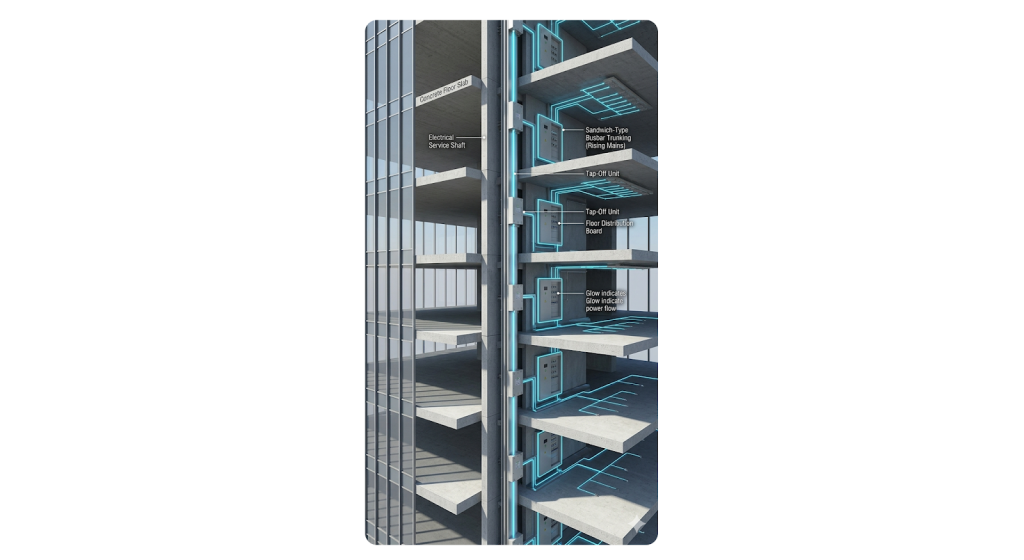
Modern skyscrapers rely almost exclusively on busbar trunking high rise systems. A busbar is a prefabricated system of solid copper or aluminum bars enclosed in a protective metal housing.
- Space Efficiency: A single, compact busbar riser can carry thousands of amps, replacing dozens of thick, cumbersome cables. This saves highly valuable real estate in the building’s vertical service shafts.
- Tap-Off Flexibility: Vertical busbar installation allows for “plug-and-play” tap-off units at every floor. If a specific floor requires more power in the future, a larger tap-off box can be safely inserted without needing to pull a new cable all the way from the mechanical room.
- Fire Safety: High-quality “sandwich-type” busbars have no air gaps, meaning they do not create a chimney effect for fire to travel between floors, satisfying strict DCD compartmentation rules.
Structural and Acoustic Challenges of Transformer Placement
Placing heavy electrical infrastructure high in the sky creates a unique intersection between electrical and structural engineering.
The Weight of Power
A standard 1500kVA cast-resin transformer can weigh upwards of 4 to 5 tons. When you place multiple transformers on a mid-level mechanical floor, the transformer structural load is immense. The structural engineers must design heavily reinforced concrete slabs specifically for these zones to handle both the dead weight and the dynamic load (vibrations) of the equipment.
Acoustic Shielding
Transformers emit a constant, low-frequency 50Hz hum. In a high-rise, the mechanical floor housing this equipment is often situated immediately above or below premium, multi-million-dollar residential apartments or penthouses.
- The Mitigation Strategy: If the transformer is bolted directly to the concrete floor, that 50Hz vibration will travel through the building’s skeleton, creating an unbearable drone in the luxury apartments below. Engineers must deploy rigorous electrical room acoustic shielding. This involves mounting the transformers on specialized heavy-duty spring vibration isolators, utilizing flexible braided copper links for all busbar connections, and often constructing “floating floors” or acoustically treated walls within the transformer room to ensure absolute silence in the adjacent living spaces.
Life Safety and Emergency Power Cascading
In a skyscraper, evacuation during a fire is not a matter of simply walking out the front door. It requires a highly coordinated, phased evacuation utilizing pressurized stairwells and dedicated firefighters’ elevators. The electrical system powering these life safety assets cannot fail under any circumstances.
DCD Emergency Power Mandates
Dubai Civil Defense enforces some of the strictest high-rise fire codes in the world. High rise emergency power systems require complex, multi-tiered generator backups.
- Rooftop Generators: While primary generators are often in the basement, supertalls frequently require secondary emergency generators located on the roof or upper mechanical floors to ensure that if the basement floods or suffers a catastrophic fire, the upper zones still have life-saving power.
- Fuel Logistics: Running a diesel generator on the 80th floor requires a gravity-fed or highly pressurized double-walled fuel piping system from the basement tanks, complete with automated leak detection and dump valves.
Fire-Rated Cabling
Standard cables will melt in minutes during a severe fire. To ensure fire pumps, smoke extraction fans, and emergency lighting continue to operate, the entire life-safety distribution network must be wired using specialized DCD fire rated cables (such as FP200, FP400, or mineral-insulated copper-clad cables). These cables are rigorously tested to maintain electrical continuity for up to 2 hours while directly exposed to flames and water sprays.
Taming Elevator Regeneration Loads
In a building exceeding 300 meters, vertical transportation is a massive energy consumer. The ultra-fast elevators used in Dubai’s supertalls drop at terrifying speeds and require immense braking power.
The Regenerative Braking Phenomenon
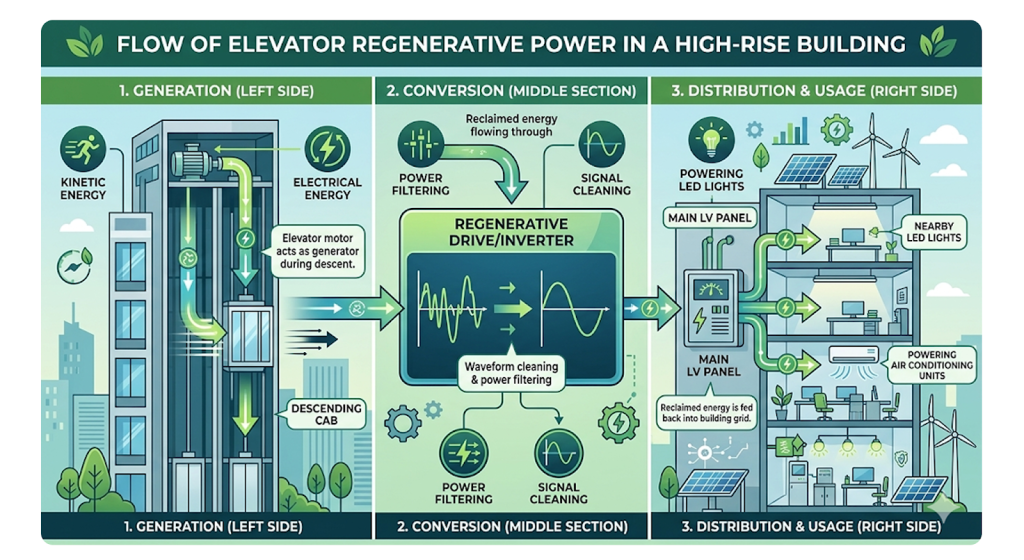
Modern high-speed elevators do not just use mechanical brakes; they use their electric motors to slow down the cab. When a fully loaded elevator descends, gravity does the work. The motor acts as a generator, converting the kinetic energy of the falling cab back into electrical energy, a process known as regenerative braking.
Capturing the Power
If this elevator regenerative power is not managed, it will flow backwards into the building’s electrical system, causing severe voltage spikes that can destroy sensitive electronics.
- The Engineering Solution: The high speed lift electrical design must incorporate regenerative drives. These complex power electronic devices capture the generated AC power, “clean” it, and synchronize it perfectly with the building’s 400V grid. This free, reclaimed energy is then instantly fed back into the local distribution board to power the corridor lighting, HVAC, or even the neighboring elevator that happens to be traveling upwards.
Procurement and Logistics for Plant Replacement
Engineers must look beyond the ribbon-cutting ceremony. A high-rise is built to last 100 years; however, a dry-type transformer or a switchgear panel has a functional lifecycle of 20 to 25 years.
The 20-Year Trap
During construction, massive 5-ton transformers are easily hoisted to the 60th floor using the external tower cranes. Fast forward 20 years: the transformer fails. The tower crane has been gone for two decades. The glass facade is sealed shut. How do you execute a high rise transformer replacement?
Designing for Replacement
Forward-thinking electrical plant logistics must dictate the design from Day One.
- Service Elevators: The building’s heavy-goods service elevator must be structurally rated and physically dimensioned to carry the heaviest single electrical component in the building.
- Modular Equipment: Engineers must procure modular, breakdown-capable switchgear that can be dismantled into smaller sections, moved through standard double doors, transported up the service lift, and reassembled in the upper mechanical room without requiring structural demolition. Failure to plan these logistical pathways results in multi-million-dirham replacement costs requiring helicopters or facade removal.
Frequently Asked Questions (FAQ)
1. Why can’t we just put all the transformers in the basement of a skyscraper?
Putting all transformers in the basement means you have to transmit low voltage (400V) all the way to the top floors. Due to the physics of electrical resistance, this would cause an unacceptable voltage drop, meaning appliances on the top floors wouldn’t work properly. It would also require impossibly thick, expensive copper cables. We must transmit high voltage (11kV) up the tower and step it down locally.
2. What happens if a fire breaks out in an upper-floor electrical room?
Because high-rises use cast-resin dry-type transformers instead of oil-filled ones, the primary fuel source for an explosive electrical fire is eliminated. Additionally, these rooms are built as strict fire compartments (typically with 2-hour fire-rated walls and doors) and are protected by clean-agent gas suppression systems (like FM200 or Novec 1230) that extinguish fires instantly without damaging the equipment.
3. How does DEWA read the meters for hundreds of apartments in a high-rise?
Modern high-rises use smart metering infrastructure. Instead of DEWA personnel walking floor to floor, the individual smart meters in the electrical closets of every floor are connected via a digital communication network (often using RS485 or fiber optics) to a central data concentrator panel in the basement. DEWA reads this central panel remotely to bill all tenants.
4. What is the “stack effect” and how does it affect high-rise electrical shafts?
The stack effect is the natural movement of air in and out of buildings due to temperature differences. In a tall skyscraper, this creates a massive upward draft inside vertical service shafts. Electrical engineers and architects must install strict “fire stopping” seals at every single floor penetration where busbars or cables pass through. If omitted, the shaft acts as a massive chimney, pulling smoke and fire rapidly to the top of the building.
5. Can a skyscraper generate its own power with wind turbines?
While some iconic buildings (like the Bahrain WTC) feature integrated wind turbines, they are generally not a primary power source for supertalls. The turbulent, unpredictable wind sheer around skyscrapers makes large-scale turbine integration structurally and electrically highly complex. Currently, skyscrapers rely primarily on the highly redundant DEWA 132/11kV grid for reliable baseline power.
Conclusion & Next Steps: Engineering to New Heights
Powering a supertall skyscraper in Dubai is an engineering ballet that defies gravity. It is a discipline where the lines between electrical, structural, and mechanical engineering completely blur. Every decision, from specifying dry-type transformers to designing acoustic vibration mounts and managing the explosive regenerative energy of high-speed elevators, must be calculated with absolute precision.
In a high-rise, there is no room for standard commercial practices. A miscalculation in voltage drop, a failure to support a vertical high-voltage cable, or poor logistical planning for future asset replacement will plague the building for its entire lifespan, driving up operational costs and compromising the safety of its occupants.
Are you designing the next addition to the Dubai skyline?
Executing a flawless vertical distribution strategy requires a partner who understands the extreme physical and regulatory demands of supertall architecture. Engage our specialized supertall electrical engineering team early in your design phase. As premier Dubai high rise consultants, we provide the rigorous predictive modeling, DCD-compliant life safety designs, and robust logistical planning required to power your skyscraper safely and efficiently for the next century.
Contact Elecwatts today to elevate your high-rise electrical design.