

As we face the summer of 2026, the reality of the GCC climate is starker than ever. With ambient temperatures in Dubai and Doha consistently exceeding 45°C and soil temperatures retaining heat well into the night, electrical infrastructure faces a grueling test. For engineers and facility owners, a critical question arises: Is your cable system designed for this thermal reality, or is it silently overheating beneath the surface?
Elevated temperature is not just a weather statistic; it is the primary enemy of electrical reliability. In these conditions, cable ampacity extreme heat Dubai calculations are no longer just about meeting a standard—they are about survival. The link between high ambient heat and reduced current-carrying capacity (ampacity) is direct and unforgiving. Ignoring this thermal relationship is a major safety risk that can lead to cable overheating risk GCC projects cannot afford.
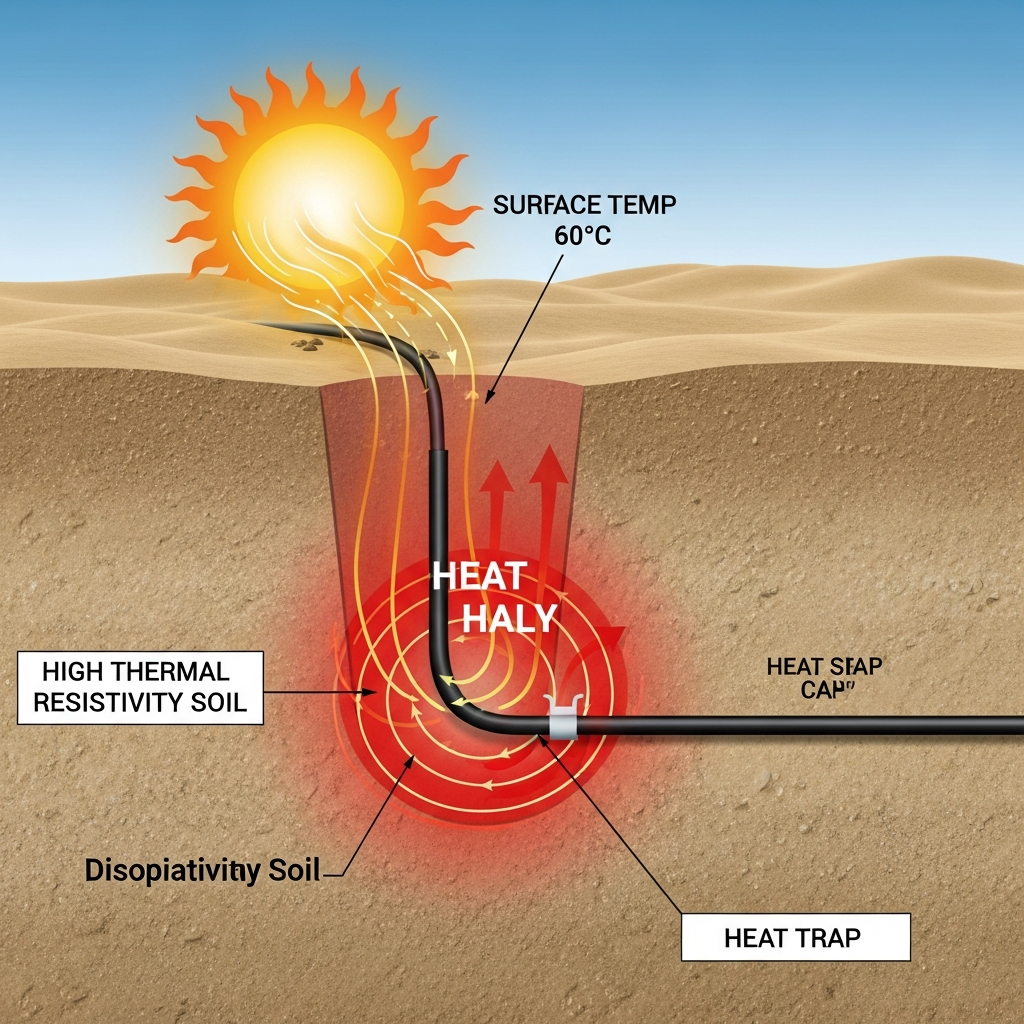
Alt Text for SEO: “Diagram showing how desert soil heat affects underground cable ampacity.”
Ampacity 101: Why Heat is the Primary Limiting Factor
To understand the risk, we must go back to physics. Ampacity is defined as the maximum current a cable can carry continuously without exceeding the temperature rating of its insulation (e.g., 90°C for XLPE).
Every amp of current flowing through a conductor generates heat due to electrical resistance (
I2RI^2RI2R
losses). For the cable to operate safely, this heat must dissipate into the surrounding environment. However, heat transfer depends on a temperature difference (
ΔT\Delta TΔT
). When the surrounding soil or air is already 40°C or 50°C, the temperature difference shrinks, and the cable’s ability to shed heat creates a bottleneck. This is the core challenge of high temperature cable design.
Need a thermal analysis for your project? Explore our Cable Design Engineering services.
The GCC Multiplier: Environmental Factors Exacerbating Heat
Standard catalog ratings for cables are often based on temperate climates (e.g., 20°C ambient). Using these figures in the Gulf without adjustment is a calculation error. Here are the local factors that standard models underestimate.
1. High Ambient Air & Soil Temperature
In 2026, data shows that underground cable temperature UAE measurements at standard burial depths (0.8m – 1.2m) can remain above 35°C for months. In open air (troughs or trays), ambient temperatures frequently spike above 50°C. If your baseline calculation assumes 25°C soil, you have already eaten into your safety margin before the cable carries a single amp.
2. Soil Thermal Resistivity (Rho)
This is the silent killer of cables in the region. Dry, sandy desert soil has high thermal resistivity (Rho)—meaning it acts as a thermal insulator. Unlike moist clay which conducts heat away, dry sand traps heat around the cable. Soil thermal resistivity desert conditions create a “thermal bottleneck” that causes the cable core temperature to rise significantly higher than predicted by standard models.
3. Solar Loading & Proximity to Other Heat Sources
Direct solar radiation on surface conduits adds a massive heat load. Furthermore, the cable grouping factor is critical; when multiple cables are bundled in a trench, they heat each other up (mutual heating), further reducing the capacity of every circuit in the group.
The Consequences of Ignoring Derating: A Real-World Risk Analysis
Failing to account for these factors leads to cable derating consequences that range from efficiency losses to catastrophe.
| Design Error | Short-Term Consequence | Long-Term Consequence |
| Using standard IEC ampacity tables without locale-specific derating. | Immediate overheating during peak summer load, tripping breakers or causing voltage dips. | Accelerated insulation aging, leading to breakdown and premature cable failure in 5-7 years instead of the expected 25+. |
| Underestimating soil thermal resistivity (Rho). | Cables operate 10-20°C hotter than designed, even at “normal” loads. | Thermal runaway in adjacent circuits, potentially causing widespread failures in a duct bank. |
| Not accounting for climate warming trends. | System operates at margin today but fails in a hotter future summer. | Catastrophic failure during a critical peak demand period, causing extended downtime and replacement costs. |
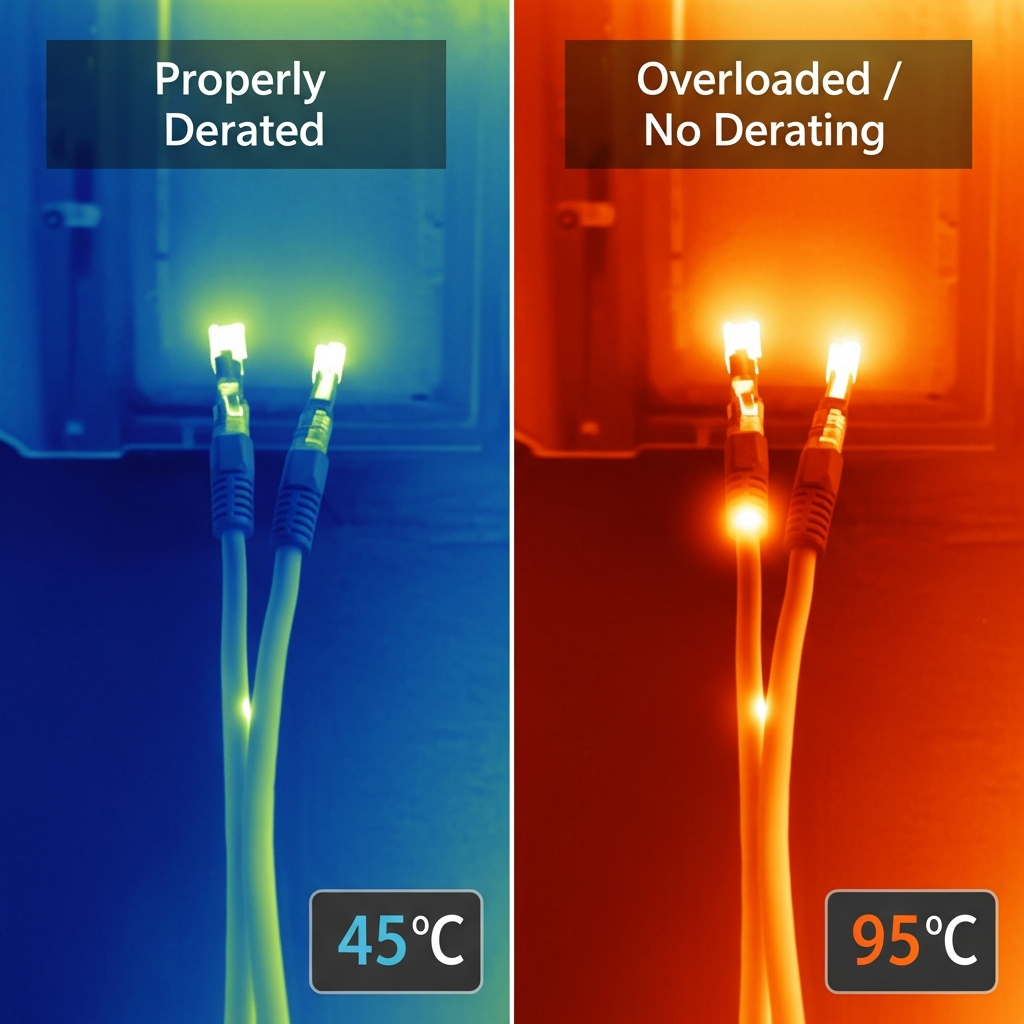
Alt Text for SEO: “Thermal imaging comparison of safe vs overheated cables due to lack of derating.”
2026 Design Guidelines for Resilient Cable Systems
To ensure reliability in the GCC, engineers must adopt a “Climate-First” approach to cable derating Qatar summer strategies.
1. Conservative Baseline Data & Dynamic Modelling
Stop using textbook defaults. We advocate for using site-measured soil thermal resistivity values. Furthermore, static spreadsheets are no longer sufficient. Engineers should use dynamic thermal analysis software (like CYME or ETAP) to model IEC 60287 desert conditions accurately.
2. Strategic Derating & Cable Selection
A derating factor is not a penalty; it is a safety feature. For buried circuits in summer, a derating factor of 0.85 or lower is often required. Additionally, always specify cables with high-grade insulation like XLPE (rated for 90°C continuous) rather than PVC (70°C), which offers zero resilience in this climate.
3. Active Cooling & Installation Mitigations
When derating makes the cable size prohibitively large, change the environment.
- Thermal Backfill: Use engineered cable thermal backfill (fluidized thermal backfill) with guaranteed low Rho to conduct heat away from the cable.
- Ventilation: For surface cables, use sun-shields and ventilated trays.
- Depth: Where the water table permits, deeper burial can access cooler soil strata.
4. Monitoring and Load Management
For mission-critical HV feeders, installing DTS cable monitoring (Distributed Temperature Sensing) is a best practice for 2026. This fiber-optic technology provides real-time thermal data along the entire cable length, allowing operators to dynamically manage loads based on actual temperature rather than theoretical limits.
Frequently Asked Questions (FAQs)
Q1: What is the typical ampacity derating for a cable buried in Dubai sand during July?
Compared to standard IEC conditions (20°C ambient, low Rho), the required derating can be 20-30% or more. For example, a cable rated for 300A in a European catalog might only safely carry 210A-240A under peak Dubai summer conditions. A project-specific calculation is non-negotiable.
Q2: Can we just use a larger cable size to solve the problem?
This is a common “brute force” fix. Upsizing the conductor reduces resistance and heat generation, which helps. However, it significantly increases CAPEX. It is often more economical to engineer the thermal environment (e.g., improve soil Rho) to allow a standard cable to perform, which is why expert design is crucial.
Q3: How do local utility regulations (DEWA, Kahramaa) address this?
GCC utilities are becoming increasingly stringent. They often require ampacity calculations based on specific regional weather data (often stipulating 50°C ambient for outdoor equipment) and may mandate the demonstration of thermal stability in designs for new connections.
Q4: Does this affect both LV and HV cables equally?
The physics are the same, but the financial risk is higher for High Voltage (HV) systems. An HV cable failure is dangerous, causes significant facility downtime, and is extremely expensive to repair. The investment in precise thermal design is highest for HV and mission-critical circuits.
Conclusion
In the GCC, cable engineering is fundamentally thermal engineering. The difference between a robust grid and a failing one lies in how well the design accounts for the extreme environment. Getting it wrong is a direct risk to your capital investment and operational continuity.
Don’t let your project’s reliability melt away this summer. Our cable design engineering team specializes in creating thermally resilient cable systems for the most demanding GCC environments, using advanced modelling and proven mitigation strategies.
Contact us for a detailed assessment of your project’s cable ampacity requirements.