

When launching high-stakes industrial, infrastructure, or commercial projects in the Gulf Cooperation Council (GCC), selecting the correct technical framework is a fundamental requirement. Developers and engineering teams frequently engage expert electrical engineering services to navigate the complex divide between the world’s two dominant electrical standards. The Gulf region—acting as a massive hub for international megaprojects, mega-cities, and heavy industrial plants—features a complex mix of both the International Electrotechnical Commission (IEC/British Standards) and the National Electrical Code (NEC/NFPA 70).
This co-existence of two fundamentally different design philosophies frequently confuses international contractors. An EPC contractor accustomed to North American practices may assume they can deploy their standard designs in Dubai, only to face immediate rejection from local utility inspectors. Conversely, European-trained engineers may struggle when designing heavy petrochemical infrastructure in Saudi Arabia, where American-style specifications are deeply entrenched. Understanding the IEC vs NEC GCC landscape is not merely an academic exercise; it is an absolute commercial and engineering necessity to ensure your project receives utility connection approval. Navigating these Middle East electrical standards requires deep technical knowledge of how each country and industrial sector regulates its power networks.
Understanding the IEC Philosophy
The International Electrotechnical Commission (IEC) standard is the dominant framework across Europe, Asia, and much of the developing world. The core philosophy of IEC electrical standards is performance-based, prioritizing flexible engineering solutions designed around strict mathematical performance limits.
The standard IEC grid is built around a standard 50Hz power system, typically distributing low voltage at $230/400\text{ V}$ or $240/415\text{ V}$.
- Hazardous Areas: IEC utilizes a highly logical, three-tier “Zone” system (Zone 0, Zone 1, and Zone 2) to classify explosive gas atmospheres based on the continuous, occasional, or rare presence of flammable vapors.
- Earthing Schemes: Safety grounding is categorized into very specific, defined topologies—such as TN-S, TN-C, TT, and IT earthing.
- Equipment Sizing: Circuit breakers and switchgear are rated based on their continuous thermal limits and maximum short-circuit interrupting capacity, allowing engineers to specify highly optimized, compact equipment tailored exactly to the modeled loads.
Understanding the NEC Philosophy
The National Electrical Code (NEC), published by the National Fire Protection Association (NFPA) as NFPA 70, is the undisputed law of electrical installation in North America. The core philosophy of the NEC electrical code is highly prescriptive, designed to act as a rigorous, literal installer’s handbook to eliminate fire and safety hazards.
An NEC-compliant system is fundamentally built around a 60Hz power system, traditionally distributing low voltage at $120/208\text{ V}$, $277/480\text{ V}$, or $600\text{ V}$.
- Hazardous Areas: The NFPA 70 standards historically classify explosive atmospheres using a Class, Division, and Group system (e.g., Class I, Division 1 or Division 2), which focuses heavily on the probability of a flammable concentration being present under normal versus abnormal operating conditions.
- Wiring Methods: NEC relies heavily on heavy-duty, rigid metallic conduit (RMC) or intermediate metal conduit (IMC) systems to physically protect conductors, creating robust, heavily armored installations.
- Overcurrent Protection: Breakers are heavily standardized, featuring fixed thermal-magnetic trip curves with less room for localized customization compared to their IEC counterparts.
UAE, Qatar, Oman, and Bahrain: The IEC Strongholds
Due to deep historical ties and British engineering influence during the mid-20th century, the national utility grids of the UAE, Qatar, Oman, and Bahrain are uncompromising strongholds of the IEC/BS framework.
If you are submitting an electrical package to the Dubai Electricity and Water Authority (DEWA), Abu Dhabi Distribution Company (ADDC), Qatar General Electricity & Water Corporation (KAHRAMAA), or Oman’s Nama Group, you must design strictly to IEC principles.
- The Voltage and Frequency Mandate: The UAE electrical code and the Qatar Kahramaa IEC standard exclusively permit a $50\text{ Hz}$ system frequency operating at nominal voltages of $230/400\text{ V}$.
- Conductor and Equipment Specifications: There is an absolute, non-negotiable requirement to specify cables using the metric cross-sectional area system (measured in $\text{mm}^2$) rather than American wire sizes. Furthermore, all main low-voltage distribution boards, ring main units (RMUs), and step-down transformers must be sourced from manufacturers possessing IEC type-test certifications from accredited independent laboratories like KEMA or ASTA.
Saudi Arabia (SEC/SASO): The Great Transition
The Kingdom of Saudi Arabia presents the most fascinating and complex standards landscape in the GCC. Historically, due to the massive involvement of American engineering firms during the early developmental boom of the 1970s and 1980s, the Kingdom adopted a US-style $60\text{ Hz}$ frequency, distributing low voltage at a non-standard split-phase system of $127\text{V}/220\text{V}$.
However, to align with the rest of the GCC and improve national energy efficiency, the Saudi Standards, Metrology and Quality Organization (SASO) alongside the Saudi Electricity Company (SEC) has executed a massive, decades-long transition.
- The Current State: The Saudi Arabia electrical standards currently mandate a complete transition to the IEC-compliant, unified $230/400\text{ V}$ distribution standard.
- The Hybrid Reality: This SASO IEC transition has created a unique hybrid electrical landscape. While all new commercial and residential developments must be designed strictly to the $230/400\text{ V}$, $60\text{ Hz}$ standard using IEC-style material specifications, legacy parts of the grid still operate at $127\text{V}/220\text{V}$, forcing engineers to design dual-voltage configurations and carefully specify transformers to bridge the transition.
The Oil & Gas Exception: Aramco and ADNOC
While the national municipal grids in the GCC are overwhelmingly aligned with IEC standards, the region’s economic engines—the massive oil, gas, and petrochemical giants—operate under a completely different set of rules.
Super-majors like Saudi Aramco in Saudi Arabia and the Abu Dhabi National Oil Company (ADNOC) in the UAE frequently bypass local municipal guidelines. Due to the historical dominance of North American petroleum engineering, the Aramco electrical standards and ADNOC NEC compliance protocols rely heavily on American Petroleum Institute (API), NEMA, and NEC standards.
- The Integration Challenge: This creates an intense engineering challenge. A designer must build a petrochemical refinery where the internal process areas are designed strictly to the NEC (utilizing Class/Division hazardous ratings, rigid steel conduits, and AWG cabling), but the plant’s main substation must step up and interface with a local $50\text{ Hz}$ IEC utility grid (such as SEC or ADDC), requiring highly specialized frequency converters, step-up transformers, and dual-standard switchgear configurations.
Key Technical Difference 1: Wire Sizing (AWG vs. mm²)
The physical physical properties of the electrical conductors represent the most immediate practical difference between the two design frameworks.
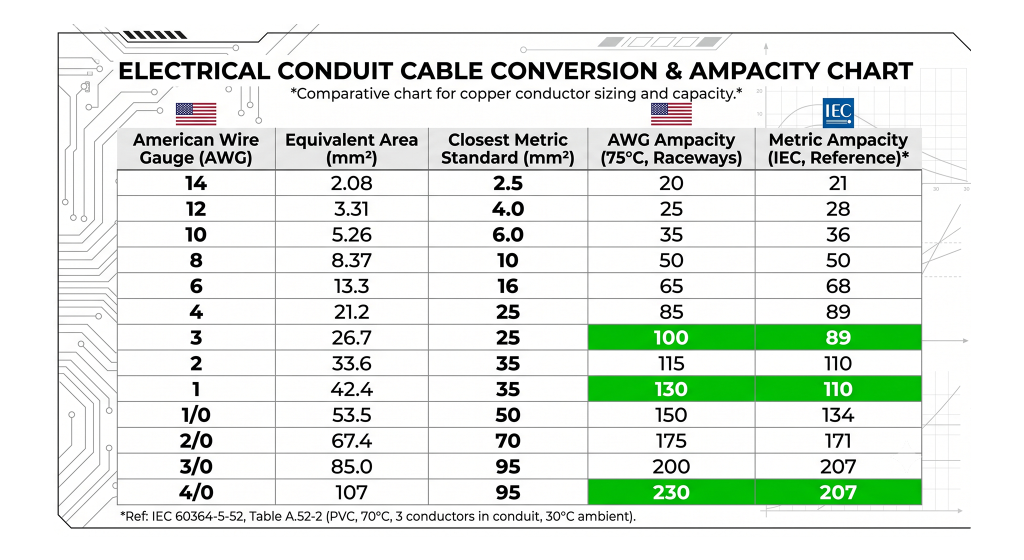
The NEC measures wire sizes using the American Wire Gauge (AWG) or Circular Mil (kcmil) systems. IEC, conversely, measures cables strictly by the physical cross-sectional area of the copper or aluminum core in square millimeters ($\text{mm}^2$).
- The Direct Translation Trap: You cannot simply cross-reference an AWG cable to its closest metric size. An $12\text{ AWG}$ solid copper conductor is physically close to a $3.31\text{ mm}^2$ wire. However, the standard metric sizes available in the GCC are $2.5\text{ mm}^2$ and $4\text{ mm}^2$.
- Ampacity Tradeoffs: If a designer “rounds down” to $2.5\text{ mm}^2$, the cable may overheat and fail. If they “round up” to $4\text{ mm}^2$, they massively inflate the material costs and weight of the project. Meticulous Cable Design Engineering is mandatory to perform precise thermal derating calculations, ensuring the AWG vs mm2 GCC conversion preserves safety margins while avoiding over-specification during metric cable sizing.
Key Technical Difference 2: Earthing and Grounding
The safety grounding philosophy is one of the most stark areas of divergence between the two standards, and a common source of inspection failure during grid connection approvals.
- NEC Solid Grounding: The NEC relies heavily on the “solidly grounded” system. The neutral of the transformer is connected directly to the earth at the service entrance, and a low-impedance Equipment Grounding Conductor (EGC) is run alongside all phase conductors to provide a direct path for fault current to instantly trip the overcurrent device.
- IEC Earthing Arrangements: IEC utilizes the highly structured TN, TT, and IT earthing schemes. In Dubai, DEWA requires a TN-S system (where the utility provides a separate protective earth conductor). In Qatar, KAHRAMAA strictly mandates a TT system (where the building has its own isolated earth pits).
Attempting to import an American-style, solidly grounded design directly into a Qatar TT network without installing highly sensitive Earth Leakage Circuit Breakers (ELCBs) will fail the inspection. The differences in IEC vs NEC earthing and TN-S vs solid grounding philosophies represent a vital life-safety compliance gate.
Key Technical Difference 3: Enclosure Ratings (NEMA vs. IP)
Protecting sensitive electrical components from the brutal, fine desert sand and extreme coastal humidity of the GCC is a critical design priority. The standards categorize this protection using completely different scales.
- NEMA Ratings: The National Electrical Manufacturers Association (NEMA) uses a descriptive scale (e.g., NEMA 3R, NEMA 4, NEMA 4X) that evaluates an enclosure’s ability to protect against dust, water, oil, corrosion, and even internal ice formation.
- IP Ratings: The IEC Ingress Protection (IP) rating system uses a precise, two-digit code (e.g., IP65, IP66). The first digit ($0$ to $6$) rates protection against solid objects (dust), while the second digit ($0$ to $9$) rates protection against liquids (water).
While a NEMA 4X enclosure provides excellent corrosion and dust protection, you cannot simply write “NEMA 4X” on a municipal drawing in Abu Dhabi. To pass local utility reviews, engineers must accurately map and specify the correct NEMA vs IP rating equivalent. For a harsh desert electrical enclosure in the Gulf, verifying an IP65 or IP66 rating (which guarantees complete protection against dust and high-pressure water jets) is the mandatory benchmark to prevent premature equipment destruction.

Frequently Asked Questions (FAQ)
1. Can I use a $60 motor on a $50 grid in Dubai?
No, not directly. Running a $60$ motor on a $50 supply will cause the motor to spin 17% slower, reducing its cooling fan speed and causing it to draw higher current. This leads to severe overheating, winding insulation failure, and eventual motor burnout. You must either utilize a Variable Frequency Drive (VFD) to regulate the frequency or procure a motor specifically wound for $50\text{ Hz}$ operations.
2. Why is Saudi Arabia transitioning from $127/220 to $230/400?
The old $127/220$ split-phase system, originally adopted from historical US practices, was highly inefficient for modern loads. Higher voltages ($230/400$) allow the same amount of electrical power to be delivered at a much lower current. Lower current means thinner cables can be used (saving massive copper costs) and dramatically reduces power losses ($I^2R$ losses) across the national grid, aligning with SASO’s energy conservation goals.
3. What is the equivalent of a NEMA 4X enclosure in the IP rating system?
The closest equivalent to a NEMA 4X enclosure is an IP66 rating. Both ratings guarantee that the enclosure is completely dust-tight and can withstand high-pressure water jets. However, NEMA 4X also certifies that the enclosure material is highly resistant to corrosion (often utilizing SS316L stainless steel), a metric that the standard IP rating system does not explicitly cover on its own.
4. Why does KAHRAMAA reject solidly grounded NEC designs?
KAHRAMAA strictly mandates the TT earthing system for most low-voltage consumer connections. In a TT system, the building is grounded to its own local earth pits, and there is no low-impedance metal conductor returning to the utility transformer. If a fault occurs, the fault current is too low to trip a standard NEC overcurrent breaker. KAHRAMAA requires highly sensitive Residual Current Devices (RCDs) to detect this low-level fault and isolate the circuit instantly.
5. Do oil and gas projects in the UAE use the local IEC utility codes?
Within the process areas of major petrochemical refineries and offshore platforms, ADNOC and Saudi Aramco frequently utilize North American NEC, NEMA, and API standards due to the historical design of petroleum equipment. However, the substation connecting the refinery to the main municipal grid (e.g., ADDC or SEC) must be designed strictly to the local utility’s IEC-based grid codes, creating a hybrid engineering interface.
Localizing Your Global Designs
Operating across the GCC requires an uncompromising approach to design standards. Assuming that a single, standardized global drawing package can be deployed universally across borders is a direct path to project failure. The technical, spatial, and mechanical differences between the IEC performance-based philosophy and the NEC prescriptive code dictate almost every single element of your electrical infrastructure—from the physical thickness of your copper conductors to the safety of your grounding systems and the durability of your environmental enclosures.
Attempting to force-fit a non-compliant standard into a local utility network leads directly to rejected submittals, long procurement delays, and millions of dirhams in scrapped materials that utilities will refuse to energize.
Need to localize a foreign design for the Middle East?
Do not gamble your project timeline on uncoordinated drawings or non-compliant equipment specifications. Partner with an expert team to audit, translate, and secure approvals for your designs. Our electrical engineering services provide the certified technical due diligence and expert electrical system design required to ensure your global assets comply flawlessly with every local GCC grid code, achieving GCC utility compliance on your very first attempt.
Contact Elecwatts today to secure your regional utility approvals and master your GCC infrastructure deployment.