

The Jebel Ali Free Zone (JAFZA) is the undisputed powerhouse of global logistics and heavy manufacturing in the Middle East. Hosting thousands of multinational corporations, this massive industrial ecosystem demands continuous, high-capacity, and flawless electrical infrastructure. To navigate the complex regulatory and technical demands of establishing a facility here, engaging a specialized industrial electrical engineering consultancy in dubai from day one is an absolute necessity. Attempting to apply standard commercial electrical design principles to a heavy industrial plot in JAFZA will invariably lead to severe project delays, failed inspections, and critical operational bottlenecks.
A major source of confusion for new developers and international contractors entering JAFZA is the dual-jurisdiction regulatory landscape. Unlike standard commercial plots in mainland Dubai where you deal primarily with the Dubai Municipality (DM) and the Dubai Electricity and Water Authority (DEWA), a factory in JAFZA operates under a different authority. While DEWA remains the ultimate provider of electrical power and governs the grid connection standards, the building permits, safety compliance, and final operational approvals are tightly controlled by Trakhees, specifically its Civil Engineering Department (CED) and Environment, Health, and Safety (EHS) divisions.
Mastering JAFZA electrical standards requires fluent coordination between DEWA’s stringent grid-tie requirements and Trakhees’ uncompromising focus on industrial safety. This guide breaks down the critical engineering parameters, from heavy load profiling to hazardous area classifications, ensuring your manufacturing facility achieves seamless Trakhees electrical compliance and long-term operational resilience.
Navigating the Trakhees CED Approval Process
The path to breaking ground and energizing a factory in JAFZA goes through Trakhees. Understanding their specific procedural and technical demands is the foundation of a successful project.
The CED and EHS Mandate
The Trakhees Civil Engineering Department (CED) is responsible for issuing the Building Permit and the final Building Completion Certificate (BCC). However, their review process is distinctly different from standard municipal bodies.
- Industrial Focus: Trakhees evaluates submissions with a hyper-focus on heavy industrial realities. They scrutinize electrical designs not just for basic code compliance, but for occupational safety, environmental impact, and emergency response capabilities.
- The Dual Approval: Securing a JAFZA electrical NOC (No Objection Certificate) often requires parallel submissions. The electrical single line diagrams (SLDs) and load schedules must be approved by DEWA for network capacity, while the physical routing, hazardous area compliance, and fire-life safety integration must be approved by Trakhees CED and EHS.
The Submission Rigor
A successful Trakhees CED approval requires highly detailed documentation. General, uncoordinated MEP drawings will be rejected. Submissions must include precise equipment layout drawings proving adequate operational clearances, detailed cable routing plans that avoid chemical or high-heat zones, and comprehensive earthing and lightning protection layouts tailored to the specific industrial processes occurring within the facility.
Heavy Industrial Load Profiling and Motor Starting
Commercial buildings are dominated by predictable HVAC and lighting loads. A manufacturing plant in JAFZA is dominated by massive, dynamic, and often violent electrical loads.
The Challenge of Dynamic Loads
Industrial facilities rely on heavy extruders, massive conveyor networks, industrial crushers, and large-scale process chillers. These machines do not draw power smoothly.
- Inrush Currents: When a massive induction motor starts Direct-On-Line (DOL), it can pull 6 to 8 times its full load current for several seconds. If multiple large motors start simultaneously, the resulting massive current draw can cause severe voltage sags across the entire facility.
- The Consequence: These voltage sags can cause sensitive programmable logic controllers (PLCs) to reboot, robotic arms to drop their payloads, and high-intensity discharge (HID) lighting to extinguish.
Advanced Motor Starting Analysis
To prevent facility-wide disruption, rigorous industrial load profiling is mandatory. Expert electrical plant engineering in the UAE manages these massive inrush currents by conducting detailed motor starting current analysis during the design phase. Engineers must specify the correct starting methodologies, such as Star-Delta starters, Soft Starters, or Variable Frequency Drives (VFDs), to electronically throttle the inrush current. By strategically staggering motor start-up sequences through the Building Management System (BMS), engineers ensure the facility’s voltage profile remains stable and within DEWA’s strict tolerance limits.
Power Factor Correction: Avoiding Heavy DEWA Penalties
Efficiency is not just an environmental goal in JAFZA; it is a strict financial mandate enforced by the utility provider.
The Inductive Load Problem
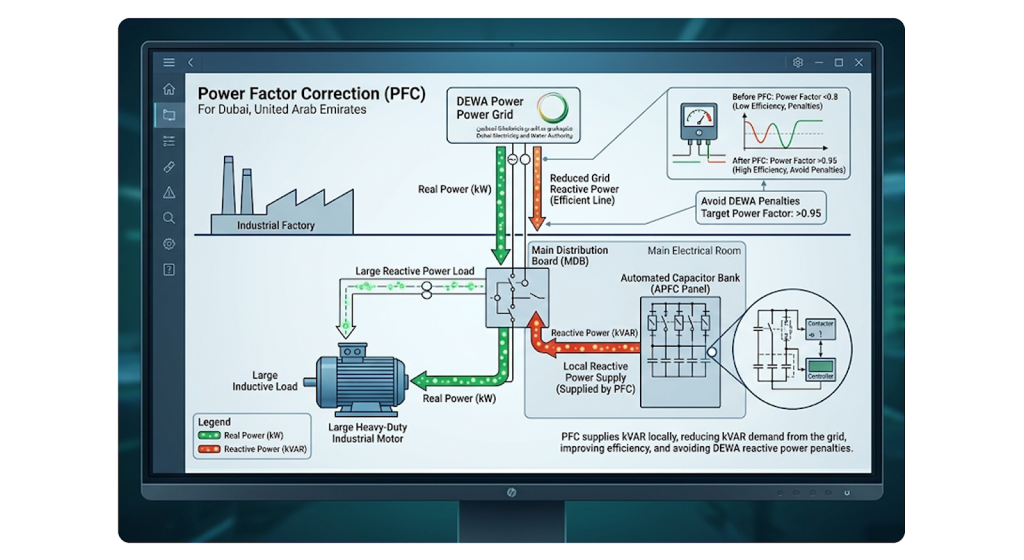
Heavy manufacturing relies almost entirely on inductive loads, specifically, induction motors and transformers. These devices require “reactive power” (kVAR) to generate the magnetic fields necessary for their operation. While reactive power does no actual “work,” it takes up valuable capacity on the electrical grid.
- Power Factor (PF): This is the ratio of working power (kW) to apparent power (kVA). A perfect PF is 1.0. Heavy motor loads drag this number down (e.g., to 0.75).
The Financial Penalty
DEWA imposes strict penalties for poor power factor. If your facility’s PF drops below 0.95, you will be hit with a severe DEWA power factor penalty on your monthly utility bill. Over a year, for a large factory, these penalties can amount to hundreds of thousands of dirhams.
- The Engineering Solution: Power factor correction JAFZA compliance is achieved by designing and installing automated Capacitor Banks at the main distribution boards. These intelligent banks automatically switch capacitors in and out of the circuit to locally supply the reactive power the motors need, ensuring the facility draws only “clean,” efficient working power from the DEWA grid, keeping the PF firmly at 0.95 or higher.
Harmonic Mitigation for Manufacturing Plants
While VFDs are excellent for controlling motor starting currents and saving energy, they introduce a sinister problem into the electrical network: Harmonics.
The Dirty Power of VFDs
VFDs, large rectifiers, and industrial welding machines are “non-linear” loads. They chop up the smooth, 50Hz AC sine wave provided by DEWA, injecting “harmonic distortion” back into the electrical system.
- The Impact: VFD harmonic distortion acts like electrical friction. It causes cables to overheat, circuit breakers to trip randomly, and distribution transformers to literally cook themselves from the inside out, drastically reducing their lifespan.
IEEE 519 Compliance
To protect the wider grid, DEWA enforces IEEE 519 standards, which limit the allowable Total Harmonic Distortion (THD) a facility can inject back into the utility network.
- Industrial Harmonic Mitigation: For heavy JAFZA plants, passive filters (simple inductors) are rarely sufficient. Engineers must deploy Active Harmonic Filters (AHF). These sophisticated devices act like noise-canceling headphones for the electrical grid; they monitor the distorted waveform in real-time and inject an inverse “anti-harmonic” current to cancel out the distortion, ensuring the power remains clean, safe, and fully compliant with utility regulations.
Hazardous Area Classifications (ATEX/IECEx)
JAFZA is home to major chemical processing plants, oil and gas logistics hubs, and food processing facilities (like flour mills). In these environments, electricity is a potential ignition source for a catastrophic explosion.
Understanding the Zones
Standard electrical design is illegal and highly dangerous in these environments. Facilities dealing with flammable gases, vapors, or combustible dusts must undergo strict hazardous area electrical classification according to ATEX or IECEx standards.
- Zone 0 (Gas) / Zone 20 (Dust): An area where an explosive atmosphere is present continuously or for long periods (e.g., inside a fuel storage tank). Electrical equipment is generally avoided here entirely.
- Zone 1 (Gas) / Zone 21 (Dust): An area where an explosive atmosphere is likely to occur in normal operation (e.g., near a chemical mixing vat).
- Zone 2 (Gas) / Zone 22 (Dust): An area where an explosive atmosphere is not likely to occur, but if it does, it will only persist for a short period (e.g., a chemical storage warehouse).
Explosion-Proof Engineering
Achieving ATEX compliance JAFZA requires specialized engineering. Every single electrical component, from the massive motor driving a pump to the simple light switch on the wall, must be specifically certified for the designated zone. This involves specifying “Ex d” (Flameproof enclosures that contain an internal explosion without igniting the outside atmosphere) or “Ex e” (Increased safety components that prevent sparks from occurring). Trakhees EHS inspectors are highly trained in ATEX compliance; a single non-certified cable gland in a Zone 1 area will result in an immediate operational shutdown.
Alt Text for SEO: “Diagram illustrating ATEX hazardous area zones (Zone 0, 1, and 2) for electrical compliance in chemical processing facilities.”
Primary Substation Design (11kV/33kV) for Mega-Facilities
For many massive manufacturing plants in JAFZA, such as steel fabricators or large-scale food processors, the standard Low Voltage (400V) DEWA connection is vastly insufficient to meet their power demands.
The Dedicated Substation
When a facility’s Total Connected Load (TCL) exceeds standard plot allocations (often entering the multi-megawatt range), DEWA requires the developer to design and build a dedicated primary substation (11kV or even 33kV) entirely within their own plot boundaries.
- Industrial High Voltage Design: This is a major civil and electrical undertaking. The JAFZA 11kV substation must be designed to exacting DEWA standards, incorporating high-voltage Ring Main Units (RMUs), specialized protection relays, and massive cast-resin or oil-filled transformers.
- Trakhees Clearances: Trakhees CED imposes strict spatial requirements for these substations. They must be easily accessible by heavy DEWA maintenance vehicles, feature 2-hour fire-rated walls, and incorporate advanced fire suppression (like FM200 or Inergen gas) and blast-containment architecture if located near critical manufacturing zones.
Specialized Industrial Earthing and Lightning Protection
In a commercial building, earthing is primarily about life safety, ensuring a tripped breaker if a person touches a live wire. In a JAFZA manufacturing plant, earthing is the foundation of operational stability and explosion prevention.
The “Clean Earth” for Automation
Modern factories rely heavily on PLCs, sensitive robotics, and CNC machinery. These digital systems operate on very low voltages (e.g., 24V DC). If the main building’s electrical earth is “noisy” (polluted with harmonics or stray currents from heavy motors), it will corrupt the data signals, causing the robotics to malfunction.
- The Solution: An industrial earthing system must incorporate a dedicated “Clean Earth” network. This involves driving separate, deep earth pits specifically for the IT and automation racks, achieving a resistance of less than 0.5 ohms, completely isolated from the “Dirty Earth” used by the heavy machinery.
Static Discharge Grounding
In ATEX environments (such as a paint manufacturing facility or a fuel transfer depot), the friction of liquids moving through pipes generates massive amounts of static electricity.
- The Hazard: If this static is allowed to arc, it will ignite the chemical vapors, causing an explosion.
- Static Grounding: The design must include rigorous static discharge grounding. Every pipe flange, storage tank, and loading gantry must be physically bonded together with heavy copper tape and tied to a dedicated static earth grid to safely dissipate the charge deep into the Dubai subsoil before a spark can occur.
Mitigating Financial and Operational Risk
The ultimate goal of adhering to these rigorous JAFZA standards is risk mitigation. In a 24/7 manufacturing environment, the manufacturing downtime cost is astronomical. An unplanned electrical failure in a continuous-process plant (like a plastics extruder) doesn’t just halt production; it can ruin hundreds of thousands of dirhams worth of raw materials caught in the machines when the power dies.
Engineering for Insurability
Industrial electrical risk extends to liability and property damage. International insurance underwriters heavily penalize facilities with poor electrical design.
- The Strategic Advantage: By integrating electric insurance management protocols into the electrical design phase, such as deploying comprehensive arc-flash mitigation, robust harmonic filtering, and certified ATEX compliance, developers do more than satisfy Trakhees and DEWA. They present a “Highly Protected Risk” (HPR) profile to global insurers, which can slash annual industrial insurance premiums by hundreds of thousands of dirhams, offering a massive long-term return on the initial engineering investment.
Frequently Asked Questions (FAQ)
1. Do I submit my electrical drawings to DEWA or Trakhees first?
You must proceed in parallel, but the initial technical load approval comes from DEWA. You submit your preliminary load schedule and SLD to DEWA to secure the power allocation. Once DEWA approves the electrical design, you submit that stamped design along with your architectural and hazardous area layouts to Trakhees CED to obtain the final Building Permit (NOC).
2. Can I use standard commercial switchgear in a JAFZA warehouse?
If the warehouse is purely for ambient storage of non-hazardous, non-combustible goods, standard commercial switchgear (with appropriate DEWA approvals and IP ratings for dust) may suffice. However, if any manufacturing, chemical storage, or cold-chain operations occur, Trakhees will demand heavy-duty industrial switchgear, often requiring higher IP ratings (IP55/IP65) and specific motor control center (MCC) designs.
3. How does DEWA calculate the Power Factor penalty?
DEWA requires a minimum power factor of 0.95. If your facility’s power factor drops below this threshold (e.g., to 0.85), DEWA applies a multiplier to your total kW demand charge on your monthly utility bill. In heavy industrial facilities with large motors, this penalty can easily amount to tens of thousands of dirhams every single month if automatic capacitor banks are not installed.
4. What is a “Clean Earth” and why do my CNC machines need it?
A Clean Earth is a dedicated grounding system isolated from the main building’s electrical earth. Heavy machinery (like compressors and HVAC chillers) dumps electrical “noise” (transients and harmonics) into the main earth line. Sensitive computerized machinery (like CNC mills or PLCs) uses the earth line as a reference point for digital data. If the earth is “noisy,” the data gets corrupted, causing the machines to crash or manufacture defective parts.
5. Are ATEX certifications recognized by Trakhees?
Yes. Trakhees EHS strictly enforces international hazardous area standards. ATEX (European) and IECEx (International) certifications are the standard benchmarks used to prove that a piece of electrical equipment (like a motor, light fitting, or junction box) is safe to operate in an explosive gas or dust atmosphere.
Conclusion & Next Steps: Streamlining Your Factory Setup
Establishing a heavy manufacturing or logistics facility in the Jebel Ali Free Zone is a massive capital undertaking. Success in this jurisdiction requires an acknowledgment that industrial electrical engineering is a vastly different discipline from commercial building design.
From managing the violent inrush currents of massive induction motors to navigating the life-or-death compliance requirements of ATEX hazardous zones, the electrical backbone of your facility must be engineered for extreme resilience. A failure to proactively address Trakhees CED regulations, DEWA power factor mandates, and complex harmonic mitigation will lead to gridlock in the approval process and devastating operational downtime once energized.
Are you ready to build a compliant, high-performance manufacturing facility?
Navigating the dual-jurisdiction complexities of DEWA and Trakhees requires a partner with deep, localized industrial expertise. As a premier JAFZA electrical consultant, Elecwatts specializes in Dubai industrial engineering. We help multinational corporations and local developers design, certify, and commission heavy-duty electrical architectures that sail through Trakhees approvals and guarantee relentless operational uptime.
Contact Elecwatts today to secure the electrical integrity of your JAFZA industrial project.