

For developers, EPC contractors, and multi-national corporations managing projects across the Arabian Peninsula, navigating the regulatory landscape is a complex challenge. Achieving regional synchronization is impossible if an engineering team treats all Gulf utilities as a single, uniform entity. Operating as a pan-GCC net zero electrical engineering consultancy requires deep fluency in local standards. While the laws of physics remain constant, the local rules, clearances, and procedures change the moment you cross a border.
A project designed to the technical standards of Dubai’s utility will face immediate rejection if “copy-pasted” into a submittal for Saudi Arabia or Qatar. Each jurisdiction has optimized its electrical grid to handle localized geographic, environmental, and demographic demands. To prevent costly design rework, procurement errors, and catastrophic delays, engineers must understand the specific technical divergences between Qatar (KAHRAMAA), Dubai (DEWA), and Saudi Arabia (SEC). This comparative guide provides a deep-dive, side-by-side GCC utility compliance comparison, detailing the grid codes, earthing philosophies, and digital workflows that govern Middle Eastern energy infrastructure.
Base Grid Codes and Voltage Standards
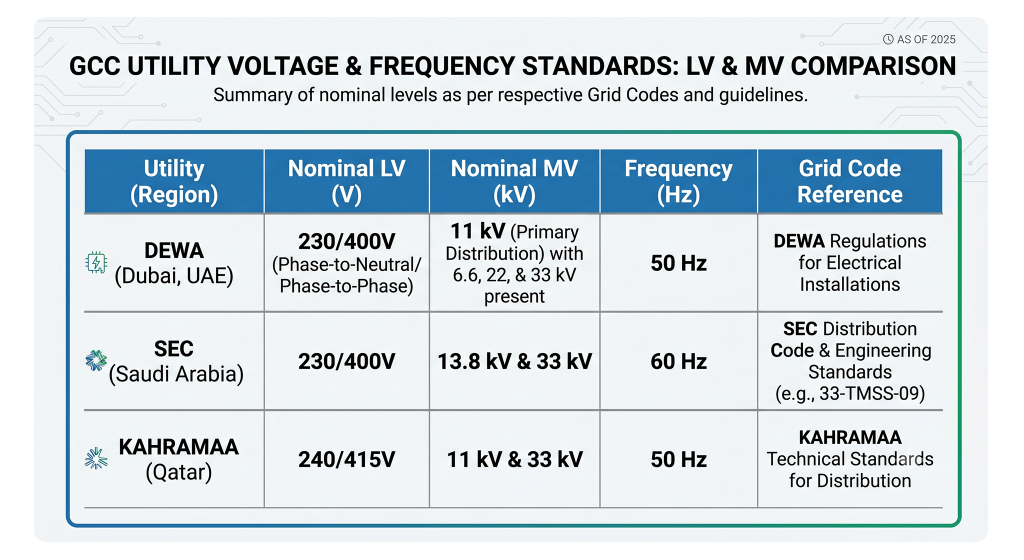
The fundamental layer of any electrical design is the voltage and frequency of the grid. While the GCC Interconnection Authority (GCCIA) has physically linked the national networks to share power during emergencies, the localized distribution networks still feature critical variations.
Low Voltage (LV) Frameworks
- DEWA (Dubai): Operates on a standard three-phase $400\text{V}/230\text{V}$ system at a frequency of $50\text{Hz}$.
- KAHRAMAA (Qatar): Utilizes a slightly different low-voltage standard of $415\text{V}/240\text{V}$ at $50\text{Hz}$. This difference in GCC distribution voltage means that equipment specified for Qatar must be rated for slightly higher voltage thresholds to prevent insulation stress.
- SEC (Saudi Arabia): Historically, Saudi Arabia operated on a highly non-standard dual-voltage system ($127\text{V}/220\text{V}$). However, SEC has executed a massive transition, mandating the international standard of $400\text{V}/230\text{V}$ for all new connections. Critically, Saudi Arabia operates at a frequency of $60\text{Hz}$, unlike its neighbors. This frequency difference affects the rotational speed of motors, the impedance calculations of cables, and the core saturation of transformers.
Medium Voltage (MV) Frameworks
The differences are even more pronounced at the medium voltage level.
- DEWA and KAHRAMAA utilize $11\text{kV}$ as their primary distribution standard.
- SEC predominantly utilizes $13.8\text{kV}$ and $33\text{kV}$ networks. This means that ring main units (RMUs), transformers, and high-voltage cable insulation ratings must be selected specifically for the host utility, making the SEC vs DEWA grid code alignment a vital task during early procurement phases.
Submission Portals and Digital Workflows
The administrative journey to securing power in the GCC has transitioned entirely to digital-first systems, but the user experience and integration pathways vary significantly between jurisdictions.
The Dubai Fast-Track
DEWA is widely considered the pioneer of digital utility integration in the region. Through the unified Dubai Building Permit System (BPS) and DEWA’s smart e-Services, the submittal workflow is highly streamlined. Under the DEWA Al Namoos initiative, connections for loads up to $150\text{kW}$ are fast-tracked, enabling NOC approvals and physical connection within days of construction completion.
The Saudi Portal
SEC operates the centralized SEC Alkahraba portal (also known as the Kahraba portal). The submission workflow is deeply integrated with the Ministry of Municipal and Rural Affairs (MOMRA) building permits and the SABER portal (for material certifications). Because SEC serves a vast geographical territory, applications are routed through regional divisions (Western, Eastern, Central, Southern), which can introduce slight variations in localized processing times.
The Qatari Integration
KAHRAMAA’s approval process is managed through a single-window portal connected to the Ministry of Municipality and Environment (MME). Designs must pass through KAHRAMAA’s Distribution Control Unit (DCU), where reviews are exceptionally rigorous. The DCU enforces a strict sequential approval gate—you cannot book a site inspection until every single technical drawing, including the cable routing and earthing, has been stamped and signed off in the digital portal.
Earthing Systems: Safety Philosophies Compared
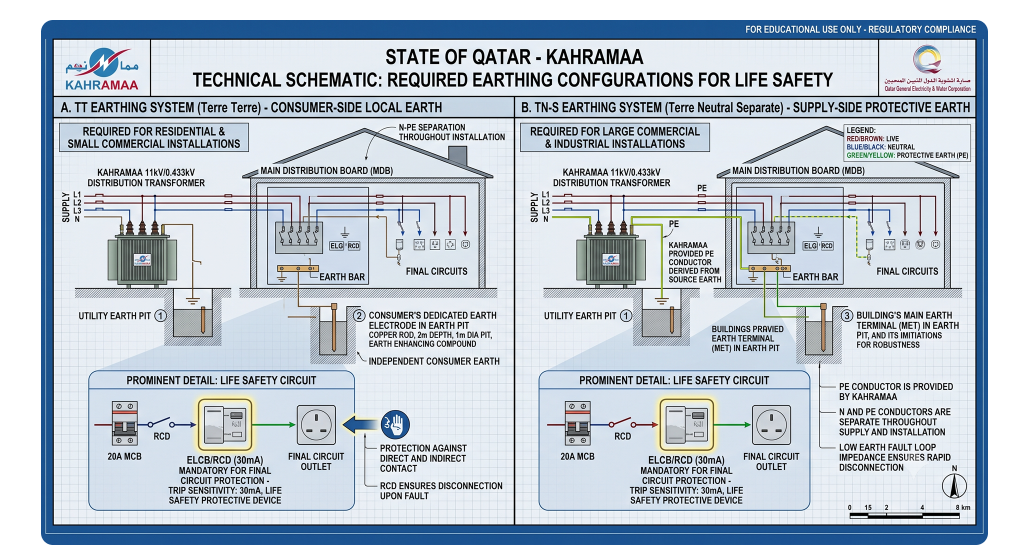
The grounding design of a facility represents its primary defense against electric shock, equipment damage, and lightning strikes. The three utilities enforce completely different earthing system topologies.
The TN-S Mandate in Dubai
DEWA relies heavily on the TN-S earthing system for the vast majority of commercial and residential distribution. In this configuration, the utility provides a dedicated physical Earth conductor (the sheath of the incoming service cable) all the way from their substation to the consumer’s Main Distribution Board (MDB). This provides a reliable, low-impedance path for fault currents to return to the source and trip the protective breakers.
The TT Mandate in Qatar
In stark contrast, KAHRAMAA mandates the TT earthing system for most low-voltage consumer installations. Here, the utility does not provide an earth connection.
- The Engineering Consequence: The consumer must establish their own independent earth electrode system (earth pits) to achieve a low resistance to the remote earth. Because the soil in Qatar can be highly resistive, achieving a safe ground path is challenging. Consequently, KAHRAMAA enforces exceptionally strict rules regarding the installation of Earth Leakage Circuit Breakers (ELCBs) or Residual Current Devices (RCDs) on almost all final circuits. If the earth resistance is slightly elevated, the sensitive RCD ensures the circuit trips instantly during a fault, protecting human life.
SEC’s Rocky Soil Challenge
SEC permits both TT and TN-S configurations depending on the transformer ownership and facility type. However, the defining element of the DEWA earthing vs Kahramaa and SEC comparison is geology. Saudi Arabia’s dry, rocky terrain presents extreme soil resistivity. SEC’s grounding standards require extensive civil-electrical coordination, frequently mandating deep-drilled earth electrodes (exceeding $20\text{m}$) and chemical soil enhancement compounds to achieve the mandatory $<1\text{ ohm}$ substation ground loop resistance. These safety protocols are heavily policed under GCC electrical safety standards.
Handling Heavy Industrial Loads and Motor Starting
As massive manufacturing plants, district cooling networks, and data centers expand across the GCC, managing the power grid during heavy motor starts is a critical priority for all three utilities.
Suppressing the Shockwave
When a multi-megawatt motor starts, it draws an immense surge of current. This inrush current causes localized voltage drops that can destabilize the surrounding utility network.
- DEWA Limits: DEWA is exceptionally strict regarding voltage flicker. The utility voltage flicker standards in Dubai limit the allowable voltage dip at the Point of Common Coupling (PCC) to a maximum of $3\%$ to $5\%$ depending on the frequency of the starts.
- SEC and KAHRAMAA Limits: Both SEC and KAHRAMAA enforce similar, rigorous limits under their respective grid codes. If a facility’s motor starting event threatens to violate these thresholds, the utility will flatly refuse connection.
The Role of Software Modeling
To secure utility approvals, developers must submit advanced dynamic simulations. Performing a comprehensive modern power system analysis is a mandatory requirement across all three jurisdictions. This modeling simulates the speed-torque curves of the motor against the stiffness of the local utility connection, proving mathematically that the specified starting method (e.g., Variable Frequency Drives or Soft Starters) will keep the GCC motor starting limits well within compliant boundaries.
Substation Space and Access Requirements
When a project’s electrical demand exceeds standard low-voltage thresholds, the developer must allocate valuable physical plot space to house the utility’s high-voltage equipment. The architectural constraints of this allocation vary significantly.
DEWA’s Indoor Philosophy
DEWA has developed highly standardized, exceptionally strict rules for indoor substations. The DEWA electrical room size is a rigid, non-negotiable metric. Rooms must be located on the ground floor, feature direct 24/7 access from the public road for heavy utility vehicles, and incorporate 2-hour fire-rated concrete construction. No wet services (water pipes, drainage) are permitted to pass above or through these rooms.
SEC’s Outdoor Package Substations
Because Saudi Arabia has vast open spaces, SEC frequently permits and prioritizes the use of outdoor “package substations” or ring main unit (RMU) enclosures placed directly in the yard, provided they meet strict clearance distances from building structures. However, for massive megaprojects, the SEC substation requirements dictate concrete-enclosed, blast-resistant structures with custom-engineered mechanical ventilation to withstand the extreme interior heat of a Riyadh summer.
KAHRAMAA’s Clearances
KAHRAMAA’s substation guidelines are incredibly protective of their assets. They enforce strict location restrictions, completely banning the placement of utility substations in basements for new developments to prevent flooding risks. The room must be a standalone structure or completely isolated at the ground floor with dedicated cable trenches engineered to KAHRAMAA’s standard drawings.
Material Sourcing: SASO vs. Approved Vendor Lists
An electrical design is only as compliant as the equipment purchased to build it. Sourcing materials in the GCC requires navigating two different compliance philosophies.
The AVL System (DEWA & KAHRAMAA)
Both DEWA and KAHRAMAA operate on a highly strict Approved Vendor List (AVL) system.
- The Process: Every major piece of equipment—from the high-voltage cables and transformers to the final low-voltage distribution boards—must be sourced from a manufacturer that is pre-qualified and registered on the DEWA approved vendor list or KAHRAMAA equivalent. If a contractor procures a transformer from a non-AVL supplier, even if it has certified test reports, the site inspector will immediately reject the installation.
The SASO/SABER Mandate (Saudi Arabia)
While SEC also maintains an approved vendor list for major high-voltage assets, Saudi Arabia adds a massive, national layer of compliance through the Saudi Standards, Metrology and Quality Organization (SASO).
- The SABER Portal: All imported electrical equipment entering Saudi Arabia must secure a SASO electrical certification via the digital SABER platform. This requires manufacturers to undergo rigorous independent audits and type-testing to prove their equipment can withstand the extreme environmental stresses of the Kingdom. Sourcing for SEC projects requires managing both the SEC utility approval and the SABER customs clearance concurrently.
Renewable Energy and Solar PV Integration
The approach to distributed renewable energy, particularly solar PV, represents one of the most divergent areas of engineering across the three utilities.
Shams Dubai: The Net-Metering Pioneer
DEWA’s Shams Dubai program is the most mature and successful distributed solar framework in the region. It operates on a clean, simple Net-Metering model.
- How it works: Excess solar power generated during the day is exported to the grid, the smart meter records the export, and the customer receives credits to offset their nighttime consumption.
SEC’s Evolving Framework
Saudi Arabia has transitioned to a distributed solar framework regulated by the Water and Electricity Regulatory Authority (WERA). The Shams Dubai vs SEC solar comparison reveals a different economic model. SEC utilizes a Net-Billing system for distributed solar, where exported power is credited at a wholesale tariff rate rather than a 1:1 retail rate, requiring engineers to design highly optimized self-consumption systems to maximize ROI.
KAHRAMAA’s Utility Focus
KAHRAMAA has historically focused primarily on utility-scale solar megaprojects (like the 800MW Al Kharsaah plant). Distributed solar on private commercial roofs is heavily regulated, often requiring specialized, custom approvals from the distribution department to ensure the local grid has the capacity to absorb the reverse power flow, making GCC renewable energy grid tie studies a highly specialized undertaking.
Penalties, Insurance, and Risk Management
To protect their distribution networks from being overloaded by inefficient consumers, GCC utilities police power factor and harmonic distortion with heavy financial penalties.
Power Factor Thresholds
- DEWA: Enforces a strict minimum Power Factor (PF) of 0.95. If your facility operates below this, you face immediate, heavy monthly penalties.
- SEC and KAHRAMAA: Enforce a minimum PF of 0.90. While slightly more lenient than DEWA, the scale of industrial facilities in Saudi Arabia means an uncorrected power factor results in massive financial penalties.
Quantifying the Compliance Risk
Failing to meet these power quality and harmonic limits represents a significant electrical compliance risk. If your facility injects severe harmonic noise back into the grid, the utility has the authority to disconnect your power supply. Navigating these differing regulatory landscapes requires robust Sustainable infrastructure insurance management to protect the developer. By conducting independent power quality audits and ensuring your system design includes detuned capacitor banks and active filters, you eliminate the risk of catastrophic utility power factor penalty GCC charges and secure a highly insurable, risk-mitigated asset.
Frequently Asked Questions (FAQ)
1. Which utility has the strictest earthing regulations?
KAHRAMAA is widely considered to have the most unique and strictly policed earthing regulations due to its mandatory use of the TT earthing system for low-voltage consumers. This requires the installer to build an independent earth pit network with extremely low resistance ($<1\text{ ohm}$) and install highly sensitive Earth Leakage Circuit Breakers (ELCBs) on almost all final circuits to guarantee safety.
2. Can I use the same electrical drawings for a project in Dubai and Riyadh?
No. Even if the building layouts are identical, the electrical designs must be heavily modified. Saudi Arabia operates at a frequency of $60\text{Hz}$ and a primary medium voltage of $13.8\text{kV}$, while Dubai operates at $50\text{Hz}$ and $11\text{kV}$. Cable sizing, transformer specifications, protection relay settings, and municipal submittal formats are completely different.
3. What is the SABER system in Saudi Arabia and does it apply to DEWA projects?
SABER is an online portal mandated by Saudi Arabia’s SASO to certify that imported products comply with Saudi national safety and quality standards. It is a national customs clearance requirement for KSA. It does not apply to DEWA (Dubai) or KAHRAMAA (Qatar) projects, which rely on their own specific utility Approved Vendor Lists (AVLs).
4. Why does DEWA require a higher Power Factor (0.95) than SEC and KAHRAMAA (0.90)?
DEWA’s $0.95$ power factor requirement is designed to maximize the efficiency of its highly dense urban grid. By forcing consumers to maintain a near-perfect power factor, DEWA reduces reactive power flow, minimizes heat losses in their distribution cables, and frees up vital grid capacity to support Dubai’s rapid vertical expansion.
5. What happens if our facility fails a utility harmonic inspection?
If your facility is found to be injecting harmonic distortion that exceeds utility limits (typically based on IEEE 519), the utility (DEWA, SEC, or KAHRAMAA) will issue a warning. If not rectified within a specified timeframe by installing active or passive harmonic filters, they will apply heavy monthly penalties to your bill or physically disconnect your grid connection to protect their transformers.
Localization is Key
Operating across multiple GCC borders is an engineering challenge that requires deep regional fluency. Attempting to “copy-paste” electrical designs, standard specifications, or material lists across national boundaries is a guaranteed recipe for utility rejection, budget inflation, and catastrophic schedule delays. Each utility—DEWA, SEC, and KAHRAMAA—has built an intricate regulatory framework tailored to the specific environmental, geological, and economic demands of its territory.
Achieving first-time approvals and ensuring long-term asset reliability requires an engineering partner with a pan-GCC footprint and a deep, localized mastery of these utility nuances.
Are you managing a multi-national project portfolio in the Gulf?
Do not let regulatory hurdles or generic designs stall your project execution. Leverage our pan-GCC engineering team to harmonize your electrical infrastructure. As a premier GCC electrical consultant, Elecwatts provides the certified technical due diligence, advanced system simulations, and localized regulatory compliance required to secure flawless approvals and ensure outstanding Middle East utility compliance across every border.
Contact Elecwatts today to secure your utility approvals across the GCC.