

As Qatar rapidly expands its infrastructure, securing reliable utility power is the ultimate project milestone. Navigating this landscape requires engaging an expert electrical engineering consulting firm early in the design phase to avoid catastrophic delays. The sole transmission and distribution system owner and operator in the State of Qatar is the Qatar General Electricity & Water Corporation, universally known as KAHRAMAA. For any developer or consultant entering the Qatari market, understanding the rigid frameworks established by this authority is non-negotiable.
The foundation of every successful electrical design in the country is the strict adherence to the KAHRAMAA “Regulations for the Installation of Electrical Wiring.” This document serves as the absolute bible for consultants. It dictates everything from minor residential circuit sizing to massive high-voltage industrial connections. Treating KAHRAMAA electrical standards as generic guidelines rather than absolute law will result in rejected drawings and blocked energization. Mastering the Qatar electrical wiring regulations is the primary gateway to ensuring your project transitions smoothly from a theoretical blueprint into a fully energized, operational reality.
The KAHRAMAA Building Permit and DCU Submission
Securing electrical approval in Qatar is a multi-layered administrative and technical journey that begins long before construction starts.
To initiate the Qatar building permit electrical process, developers must submit their initial designs through the Ministry of Municipality and Environment (MME) centralized portal. However, the true technical scrutiny happens when the file is routed to KAHRAMAA’s Distribution Control Unit (DCU).
- The Submission: Achieving KAHRAMAA DCU approval requires a comprehensive submission package. Consultants must provide detailed preliminary design loads, meticulously calculated diversity factors, and precise plot demarcation plans showing exactly where the utility network will interface with the private property. If the projected load is deemed excessively high for the existing street network, KAHRAMAA will mandate that the developer carve out space for a dedicated utility substation on their own land.
Distinctive KAHRAMAA Earthing Regulations
An electrical system is only as safe as its connection to the ground. KAHRAMAA enforces some of the most rigorous earthing regulations in the Middle East to protect human life and property.
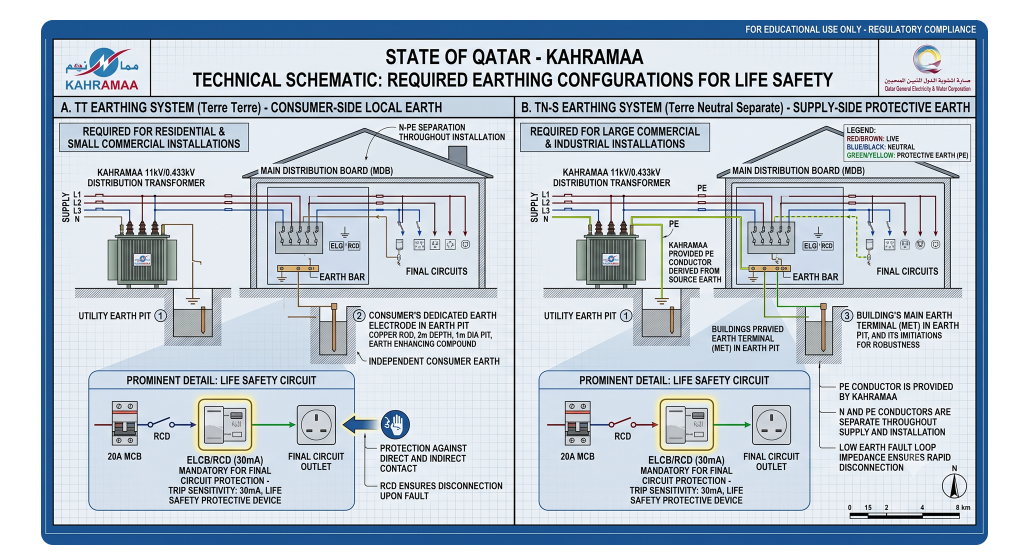
The primary earthing schemes permitted in Qatar are TT and TN-S systems, strictly depending on the type of installation and transformer ownership.
- Life Safety Mandates: To complement these earthing configurations, KAHRAMAA earthing standards mandate the aggressive use of Earth Leakage Circuit Breakers (ELCBs) or Residual Current Devices (RCDs). Unlike some regions where RCDs are only required for wet areas, Qatar ELCB requirements dictate that virtually all final circuits (lighting, power sockets, and water heaters) must be protected by highly sensitive earth leakage devices (typically 30mA for sockets). This ensures instantaneous disconnection in the event of an electrical fault, drastically reducing the risk of fatal electrocution.
Dealing with Extreme Ambient Temperatures in Design
Qatar experiences some of the highest summer temperatures on the planet. Standard international electrical equipment ratings, often based on European climates, are dangerously inadequate here.
KAHRAMAA mandates aggressive ambient temperature assumptions—frequently enforcing an ambient air temperature base of 50°C for outdoor equipment and highly restrictive ground temperatures for buried cables.
- The Thermal Penalty: This extreme heat directly degrades a cable’s ability to carry current. Expert Cable Design Engineering is required to prevent costly rejections. Consultants must strictly apply the exact Qatar electrical derating factors demanded by KAHRAMAA based on installation depth, soil thermal resistivity, and cable grouping. Failing to perform precise KAHRAMAA cable sizing will lead to undersized cables that overheat, leading to rejected designs or catastrophic insulation failure in the field.
Substation Sizing and Location Restrictions
When a project’s power demand exceeds standard low-voltage thresholds, KAHRAMAA shifts the infrastructure burden to the developer, requiring a dedicated utility substation inside the property boundary.
Navigating Qatar utility room regulations is a severe architectural constraint. KAHRAMAA does not compromise on spatial and access requirements.
- The Constraints: The KAHRAMAA substation dimensions must precisely match their standardized layouts to allow for the safe maneuvering of heavy 11kV switchgear and transformers. The room must be located on the ground floor with direct, unhindered 24/7 vehicle access from the public street for utility maintenance crews. Furthermore, KAHRAMAA strictly prohibits the routing of any “wet services” (water pipes, drainage, chilled water lines) directly above the electrical substation to eliminate the catastrophic risk of water leaking onto high-voltage equipment.
District Cooling Plant Electrical Integration
Qatar is a global leader in utilizing district cooling networks (such as Qatar Cool) to efficiently air-condition entire neighborhoods, massive malls, and stadiums. These massive chiller plants are enormous power consumers.
Powering a district cooling plant requires specialized Qatar district cooling electrical design. Due to the critical nature of these facilities, they cannot rely on a single power feed.
- Heavy Load Redundancy: KAHRAMAA heavy load integration protocols require dual-feed redundancy (typically via an 11kV or 33kV dedicated primary substation). The electrical design must incorporate complex dual-busbar switchgear, allowing the plant to seamlessly switch to a secondary high-voltage utility feed if the primary grid connection fails, ensuring uninterrupted cooling for thousands of residents and businesses.
Power Factor Penalties and Capacitor Bank Sizing
Energy efficiency is rigorously enforced at the meter. KAHRAMAA closely monitors the efficiency of large industrial and commercial consumers via their Power Factor (PF).
Heavy machinery, HVAC chillers, and transformers draw “reactive power” which strains the grid without doing useful work. KAHRAMAA establishes a strict threshold for power factor, typically enforcing a minimum of 0.90 or 0.95 depending on the tariff category and connected load size.
- The Penalty: If a facility operates below this threshold, the owner is subjected to severe Qatar electrical penalties on their monthly utility bill. To ensure KAHRAMAA power factor correction compliance, electrical engineers must design and specify precisely sized, automated capacitor banks at the main distribution boards. These intelligent banks dynamically inject reactive power locally, keeping the facility’s power factor above the penalty threshold and easing the burden on Qatar’s national grid.
Smart Metering and Tarsheed Compliance
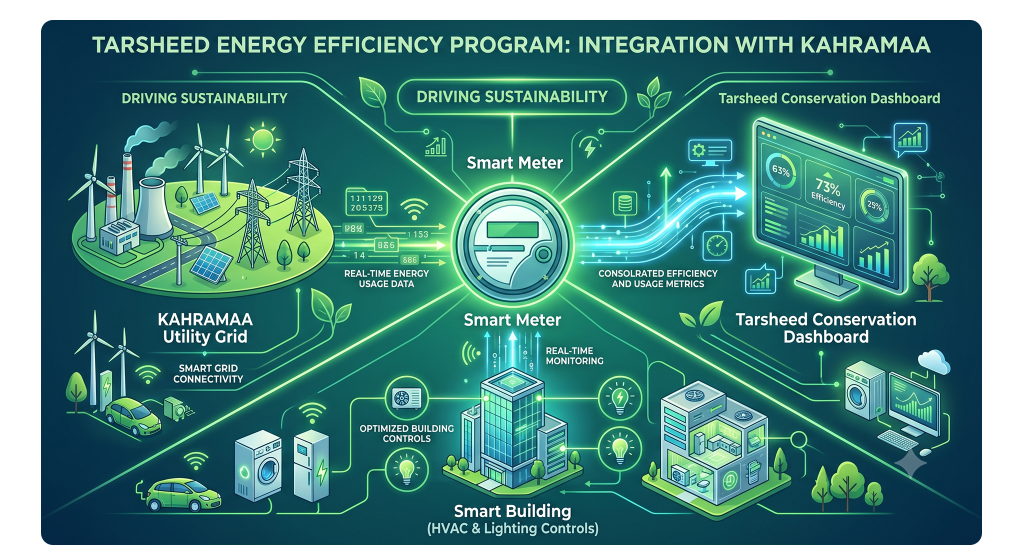
Qatar’s vision for the future is deeply intertwined with energy conservation, spearheaded by the National Program for Conservation and Energy Efficiency, known as “Tarsheed.”
To gain KAHRAMAA approval, new building designs must fundamentally prove their commitment to Tarsheed energy efficiency. This goes beyond simply using LED light bulbs.
- The Smart Grid Connection: The mandate requires the integration of advanced KAHRAMAA smart meter technology. These intelligent meters provide two-way communication, allowing the utility to monitor real-time consumption and implement sophisticated demand-side management. Furthermore, building designs must comply with Tarsheed’s stringent Energy Use Intensity (EUI) benchmarks, optimizing HVAC performance, improving building envelope insulation, and deploying advanced lighting control systems to drastically reduce overall energy waste.
The Site Inspection and “Turning On” the Power
The final, high-pressure hurdle before a building can open its doors is the physical site inspection. Designing a compliant system on paper means nothing if the execution on site falls short.
The KAHRAMAA site inspection is meticulous. Utility engineers conduct rigorous visual and technical checks. They examine the exact sizing and color-coding of earth continuity conductors, the routing of cable trays, and the physical clearances around the main switchgear. Most importantly, they witness the physical testing of the earth pits to ensure the resistance values match the approved design.
Project Leadership: Utilizing expert Project Lead Engineering & Management is the only way to survive this phase. Dedicated project management ensures that all contractor “snags” are identified and cleared before the KAHRAMAA inspector ever arrives, preventing humiliating failures, costly re-inspection fees, and delays to the critical Qatar electrical energization date.
Frequently Asked Questions (FAQ)
1. What is the difference between a KAHRAMAA DCU approval and a standard building permit?
The general building permit (issued by the MME) approves the architectural and structural viability of the project. The KAHRAMAA DCU (Distribution Control Unit) approval is a separate, highly technical review specifically focused on your electrical load, cable sizing, earthing, and grid connection strategy. You cannot get final energization without a passed DCU design and inspection.
2. Why does KAHRAMAA require ELCBs on almost all lighting and power circuits?
KAHRAMAA prioritizes extreme life safety. Earth Leakage Circuit Breakers (ELCBs/RCDs) detect tiny imbalances in current that indicate electricity is leaking to the ground (potentially through a human body). By mandating 30mA ELCBs on final circuits, KAHRAMAA ensures the power trips in milliseconds during a fault, practically eliminating the risk of fatal electrocution in homes and offices.
3. Will KAHRAMAA allow me to place my main electrical room in the basement?
Generally, no. KAHRAMAA strongly prefers and often mandates that utility substations and main electrical rooms containing utility metering and switchgear be located on the ground floor. This ensures 24/7, direct, unhindered access from the public street for utility maintenance trucks and emergency personnel, mitigating the risks of basement flooding and difficult equipment replacement.
4. What is the “Tarsheed” program and how does it affect my electrical design?
Tarsheed is Qatar’s National Program for Conservation and Energy Efficiency. It affects electrical design by enforcing strict energy efficiency regulations. To comply, consultants must specify premium-efficiency motors for HVAC, comprehensive smart lighting controls (like daylight harvesting), and deploy smart meters to ensure the building consumes significantly less power than older, legacy structures.
5. How are power factor penalties calculated in Qatar?
If your facility is an industrial or large commercial user, KAHRAMAA monitors the ratio of working power (kW) to total apparent power (kVA)—your Power Factor. If it drops below their stipulated limit (e.g., 0.90), KAHRAMAA adds a financial penalty multiplier to your monthly utility bill based on how far below the threshold your facility operates. Automated capacitor banks are used to correct this and avoid the fines.
Conclusion & Next Steps: Flawless Execution in Qatar
Securing utility power in the State of Qatar is a demanding, highly regulated process that brooks no compromises. KAHRAMAA’s electrical standards are designed to build a grid that is relentlessly safe, highly efficient, and capable of enduring one of the harshest climates on earth.
Passing KAHRAMAA reviews requires a profound understanding of these unique engineering constraints—from executing severe thermal derating calculations to ensuring absolute adherence to Tarsheed sustainability mandates and rigorous earthing protocols. For developers and contractors, relying on generalized engineering practices is a direct path to rejection and delay.
Need expert guidance to navigate Qatar’s electrical codes?
Do not risk your project schedule on non-compliant designs or failed inspections. Partner with a premier KAHRAMAA approval consultant to streamline your entire utility connection process. Elecwatts delivers specialized Qatar electrical design services, ensuring your drawings, calculations, and final site installations meet every KAHRAMAA standard flawlessly.
Contact Elecwatts today to secure your power connection in Qatar efficiently and confidently.