

In the complex landscape of GCC construction and industrial development, the margin for electrical design errors is virtually zero. Before a single cable is laid or a transformer is ordered, developers and project managers must answer fundamental questions about the viability and safety of their power network. This is where engaging a top-tier electrical consultancy in Dubai firm in the first days of conceptualization becomes the most critical decision a developer will make. The foundation of any safe, compliant, and efficient electrical network rests entirely on the execution of sophisticated simulation models.
A frequent source of confusion among developers, architects, and even some MEP contractors is the distinction between the two most fundamental simulations: the Load Flow Study and the Short Circuit Study. Often, the question is posed, “Which one do we actually need?”
The definitive answer is that you never choose between them; they are the twin pillars of the power system studies basis. Understanding load flow vs short circuit is understanding the difference between the “everyday” health of your facility and its ability to survive a catastrophic worst-case scenario. GCC utilities like DEWA, SEC, and KAHRAMAA do not view these studies as optional academic exercises; they are absolute regulatory mandates. This comprehensive guide dismantles the confusion, detailing exactly what these studies achieve, how they interact, and why both are non-negotiable for project success in the Middle East.
What is a Load Flow Study? (The “Normal” State)
To understand your electrical network, you must first understand how it operates on a standard Tuesday afternoon when the facility is running at peak capacity. This is the domain of the Load Flow Study.
Defining the Steady State
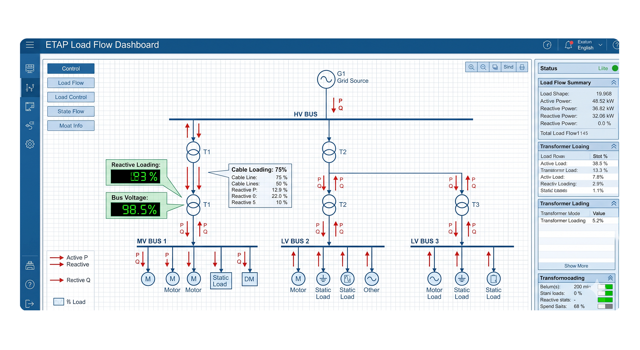
Load flow analysis explained simply: it is a mathematical simulation of the electrical network under normal, steady-state operating conditions. Using advanced software like ETAP or SKM, engineers build a “digital twin” of the facility. They input the utility source voltage, the impedance of every planned cable, and the active (kW) and reactive (kVAR) power drawn by every motor, chiller, and lighting panel.
The Purpose of the Simulation
The software then utilizes complex algorithms (like the Newton-Raphson method) to calculate the flow of power throughout the entire network. This steady state electrical analysis is designed to verify three critical operational metrics:
- Equipment Capacity: It proves that transformers, generators, and main busbars are operating within their continuous thermal capacity and are not being overloaded.
- Cable Ampacity: It confirms that the current flowing through every cable does not exceed its safe carrying capacity, preventing gradual overheating and insulation failure.
- Bus Voltages: It maps the voltage level at every single distribution board (bus) in the facility, ensuring that the voltage drop remains within the strict 4% or 5% limits mandated by local utility codes, guaranteeing that end-point equipment receives the healthy voltage required to function.
What is a Short Circuit Study? (The “Worst-Case” State)
If the Load Flow study simulates a normal working day, the Short Circuit study simulates the single worst millisecond in the facility’s lifespan.
Defining the Catastrophe
A short circuit study defined is the calculation of the absolute maximum massive fault currents that will flow through the electrical network if a catastrophic failure occurs. This is typically modeled as a “bolted 3-phase fault”, a scenario where all three phases of the electrical supply are violently shorted together with zero impedance, directly at the terminals of a critical switchboard.
The Purpose of the Simulation
In this fraction of a second, the network is no longer drawing normal running current; it is drawing thousands, sometimes tens of thousands, of Amperes directly from the utility grid and any spinning motors on-site. The purpose of this electrical fault current calculation is purely about safety and physical survival.
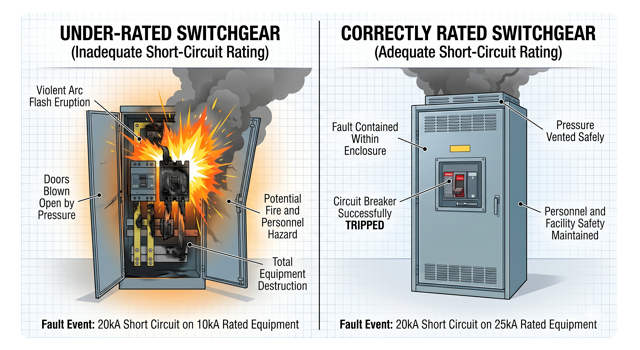
- Explosion Prevention: When massive fault currents flow through switchgear, they generate extreme electromagnetic forces and explosive thermal heat. If the switchgear is not physically rated to handle and interrupt this explosive energy, the entire panel will detonate in a deadly arc flash explosion. The short circuit study mathematically determines exactly how violent that explosion could be, allowing engineers to specify equipment strong enough to contain and safely interrupt it.
Timing: Design Phase vs. Facility Expansion
A critical aspect of power system analysis is understanding when these simulations must be executed. They are not one-time exercises; they are living documents that must reflect the current physical reality of the site.
The Initial Greenfield Design
For a new construction project, these studies must be performed during the detailed engineering design phase, long before the Bill of Quantities (BOQ) is finalized. The results of the electrical design studies dictate the physical size, rating, and cost of almost every major electrical component. Procuring a 2,500kVA transformer before running a load flow study is a multi-million-dirham gamble.
The Danger of Unstudied Expansions
The most dangerous scenario occurs during brownfield upgrades. If an existing industrial plant decides to add a new 500kW chiller line, many facility managers simply check if the main transformer has “spare capacity” and proceed to connect the load.
- The Hidden Risk: Adding new motors fundamentally alters the short circuit dynamics of the entire plant (because spinning motors contribute to fault currents). Adding new loads without conducting a comprehensive facility expansion power analysis can inadvertently push the fault current levels beyond the interrupt rating of the existing legacy switchgear, turning previously safe electrical panels into ticking time bombs. Both studies must be re-run whenever significant loads or new distribution paths are added.
Load Flow for Equipment Sizing and Optimization
The practical application of the Load Flow study directly impacts the capital expenditure (CAPEX) and the operational efficiency of the facility.
The Reality of GCC Cable Runs
In massive industrial zones like JAFZA or KIZAD, cable runs between the main substation and remote pump houses can stretch for hundreds of meters.
- Cable Sizing: Cable sizing load flow calculations are critical here. A cable might be thick enough to handle the amperage (current) safely, but over a 400-meter run, the natural impedance of the copper will cause the voltage to drop below acceptable limits. The load flow study will definitively prove if the engineer needs to upsize the cable purely to combat this voltage drop, preventing the installation of cables that would ultimately fail to run the remote equipment.
Transformer Optimization
The study is also vital for transformer tap optimization. In areas where the utility grid voltage fluctuates, the load flow simulation allows engineers to adjust the hypothetical “tap settings” on the digital transformer model. This ensures that even if the utility grid voltage dips slightly during peak summer hours, the internal facility voltage is artificially boosted at the transformer to maintain optimal, steady-state power for all sensitive equipment.
Short Circuit for Switchgear Rating Validation
While load flow optimizes efficiency, the short circuit study guarantees survival. This simulation produces a single, highly critical number for every busbar in the facility: the prospective short circuit current, measured in kilo-Amperes (kA).
The Interrupt Capacity
This kA value dictates the switchgear kA rating. Every circuit breaker and distribution board has a maximum “interrupt capacity.”
- The Deadly Mistake: Imagine a scenario where a facility manager installs standard commercial 25kA-rated switchgear in a main electrical room. However, due to the close proximity of a massive DEWA substation, the short circuit study reveals that the network is capable of delivering a 50kA fault current.
- If a fault occurs, the 25kA breaker will attempt to open, but the immense 50kA electromagnetic force will overpower the mechanism, welding the contacts shut or blowing the breaker apart.
- The Engineering Solution: Relying on expert electric power system analysis guarantees that the circuit breaker interrupt capacity is rigorously matched against the modeled short circuit levels. This ensures that the specified switchgear is physically robust enough to detect the fault, break the massive current, and safely extinguish the resulting electrical arc without harming personnel or destroying the facility.
Regulatory Requirements (DEWA/SEC/KAHRAMAA)
In the Middle East, power system studies are not just best practices; they are heavily policed regulatory gateways. Utilities must protect their macro-grid from poorly designed micro-grids.
The Gateway to Energization
Whether you are building a commercial high-rise in Dubai or a petrochemical plant in Jubail, the submission of these studies is mandatory.
- DEWA Submissions: For the DEWA power study submission, especially under the Distributed Renewable Resources Generation (DRRG) program for solar integration, the load flow and short circuit studies must be submitted in specific formats, often requiring native ETAP files. DEWA engineers will review the models to ensure your facility will not pull down the local street voltage or inject dangerous fault currents back into their substations.
- SEC Approvals: Securing an SEC electrical NOC in Saudi Arabia for heavy industrial loads requires proving that your facility’s internal faults will be cleared locally by your own correctly rated switchgear, rather than relying on SEC’s upstream breakers to trip and cause regional outages. A facility cannot be energized without utility-approved, stamped reports for both studies.
The Interdependence of the Two Studies
A common misconception is that Load Flow and Short Circuit studies are isolated tasks. In reality, they are deeply intertwined, forming an iterative loop of engineering design.
The Iterative Engineering Loop
You cannot perform an accurate short circuit study without first executing a load flow study, and the results of the short circuit study often force changes that require re-running the load flow.
- The Connection: The load flow study determines the required electrical impedance calculation by sizing the cables based on running current and voltage drop.
- Once those cable sizes (and their specific impedances) are locked in, they form the physical pathway for the fault current. Thicker cables (chosen in the load flow to reduce voltage drop) have lower impedance. Lower impedance allows higher massive fault currents to flow during a short circuit.
- This power study interdependence means that if you upsize a cable to fix a load flow voltage drop issue, you might inadvertently increase the short circuit fault level beyond the rating of your switchgear, forcing you to reconsider the entire distribution strategy.
Ensuring Field Installation Matches the Model
The most sophisticated ETAP simulation in the world is utterly worthless if the physical installation on the construction site deviates from the modeled parameters.
The Danger of On-Site Alterations
During construction, it is common for contractors to reroute cable trays to avoid mechanical ducts, thereby increasing a cable run from 50 meters to 80 meters. Or, a procurement manager might swap a specified transformer with 5% impedance for a cheaper one with 4% impedance.
- Invalidating the Safety Case: These seemingly minor electrical design vs installation discrepancies completely invalidate the mathematical models. The longer cable might now fail the load flow voltage drop test. The new transformer’s lower impedance will allow drastically higher short circuit currents to flow, potentially rendering the installed switchgear unsafe.
Rigorous Alignment
To prevent this, the engineering firm must enforce strict oversight. Highlight that strict Electrical Construction & Commissioning Management guarantees the physical build perfectly matches the modeled parameters. Power study commissioning involves verifying that the exact cable lengths, cross-sections, and transformer impedances installed on-site match the ETAP model down to the decimal point before the main breakers are ever closed.
Frequently Asked Questions (FAQ)
1. Can I use manual calculations instead of software for these studies?
For very simple, small residential distribution, manual calculations are sometimes sufficient. However, for any commercial, industrial, or multi-level facility in the GCC, manual calculations are mathematically impossible to execute accurately due to the complex interaction of multiple motor contributions, parallel paths, and dynamic impedances. DEWA and SEC strictly require software-based modeling (like ETAP) for all major submissions.
2. How often should a Load Flow and Short Circuit study be updated?
The studies form the “electrical baseline” of your facility. They must be updated absolutely any time a significant new load (like a new chiller or heavy motor) is added, when the utility changes the upstream supply characteristics, or when existing heavy switchgear or transformers are replaced. In heavy industry, it is best practice to review the model every 3 to 5 years.
3. What is a “Motor Contribution” in a Short Circuit study?
When a massive short circuit occurs, the voltage drops to zero. Induction motors that were previously spinning and consuming power suddenly become generators. Powered by the kinetic inertia of their spinning mechanical loads, they inject massive amounts of electrical current backwards into the fault for a few cycles. A Short Circuit study must accurately model this “motor contribution,” as it drastically increases the total explosive fault current the switchgear must handle.
4. Do solar panels affect the Short Circuit study?
Yes. Grid-tied solar inverters contribute to short circuit fault currents, although their contribution is different and usually smaller (limited by power electronics) compared to traditional rotating generators. However, in large commercial solar installations, the cumulative fault contribution of hundreds of inverters must be mathematically modeled and added to the Short Circuit study for DEWA Shams Dubai compliance.
5. If my Load Flow study shows a voltage drop failure, what are the solutions?
If the voltage at the end of a long cable run drops below the 4% limit, engineers have several options: 1) Increase the cross-sectional area of the cable (thicker copper has less resistance). 2) Run multiple cables in parallel. 3) Adjust the tap changer on the upstream transformer to artificially boost the starting voltage. 4) Install localized capacitor banks to improve the power factor and reduce the reactive current dragging the voltage down.
Conclusion & Next Steps: The Blueprint for Safety
Load Flow and Short Circuit studies are not merely bureaucratic checkboxes to satisfy utility regulators; they are the definitive blueprints for the operational efficiency and physical survival of your electrical infrastructure. The Load Flow study ensures that your facility operates efficiently, without overheating cables or starving critical equipment of voltage. The Short Circuit study ensures that when the absolute worst-case scenario occurs, your protective equipment will contain the explosive energy, protecting your personnel and preventing a localized fault from burning the facility to the ground.
In the complex ecosystem of electrical design, you never choose between the two. They operate in a continuous, interdependent loop, defining the exact parameters required for safe, reliable power. Treating these studies as an afterthought or allowing construction deviations to invalidate their mathematics is a risk no developer can afford.
Are your facility’s electrical studies accurate, compliant, and up-to-date?
Navigating the strict electrical system modeling UAE requirements of regional utilities demands specialized expertise and cutting-edge software analysis. Do not leave the safety and efficiency of your multi-million-dirham infrastructure to guesswork. As a premier power flow consultant GCC, Elecwatts provides rigorous, ETAP-driven Load Flow and Short Circuit analyses that guarantee safety, optimize CAPEX, and secure flawless utility approvals.
Contact Elecwatts today to commission the definitive electrical studies your project requires.