

In the towering skyscrapers and sprawling commercial hubs of the Gulf, electrical infrastructure serves a dual purpose: powering daily life and, crucially, ensuring survival during an emergency. When a fire breaks out, the ability of occupants to safely evacuate and first responders to effectively fight the blaze relies entirely on the resilience of the building’s wiring. Navigating these stringent life safety requirements mandates partnering with an expert electrical engineering consultancy in Dubai from the earliest conceptual design stages.
Mastering fire performance cables GCC standards and adhering to the uncompromising Dubai Civil Defense electrical codes is the difference between a safely managed evacuation and a catastrophic loss of life. A common and potentially fatal point of confusion among contractors and developers is the distinction between a cable’s “reaction to fire” and its “resistance to fire.” This guide demystifies the critical differences between LSZH and FP200 cables, detailing their specific applications, rigorous testing standards, and the strict installation protocols required to safeguard your facility.
Decoding LSZH (Low Smoke Zero Halogen)
To understand modern fire safety cables, we must first look at the danger they are designed to eliminate. Historically, electrical cables were insulated and sheathed in Polyvinyl Chloride (PVC).
While PVC is cheap, flexible, and an excellent electrical insulator, it becomes a deadly hazard during a fire. When standard PVC burns, it releases thick, blinding, black smoke. More dangerously, it emits hydrogen chloride gas. When this gas mixes with moisture in the air (or in a victim’s lungs), it forms toxic, highly corrosive hydrochloric acid. In a high-rise fire, more casualties are caused by smoke inhalation and toxic gas than by the flames themselves.
This is where the LSZH cable specification becomes mandatory. LSZH stands for Low Smoke Zero Halogen. These cables are manufactured using thermoplastic or thermoset compounds that contain absolutely no halogens (like chlorine, fluorine, or bromine).
- The Safety Benefit: When a zero halogen electrical cable is exposed to fire, it burns very cleanly. It emits a faint, thin white smoke that does not obscure exit signs or evacuation routes, and it releases zero toxic acidic gases, drastically increasing the survivability window for occupants.
Decoding Fire Resistant Cables (FP200 / FP400)
A critical engineering distinction must be made: while an LSZH cable will not poison you with smoke, it will not continue to conduct electricity when it burns. The insulation will melt away, the copper conductors will touch, and the circuit will short out and die.
For true life-safety systems, minimizing smoke is not enough; the equipment must remain powered and operational while actively engulfed in flames. This requires a circuit integrity cable.
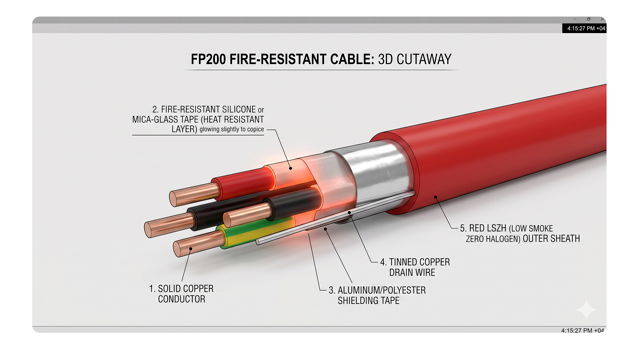
The industry standards for this are fire-resistant cables, commonly referred to by trade names like the FP200 fire resistant cable (for lighter duties like fire alarms) or FP400 (heavily armored for main power feeds). These cables are structurally engineered to survive the inferno. In addition to an LSZH outer sheath, the copper conductors are wrapped in a highly specialized, fire-resistant silicone rubber or mica-glass tape. When exposed to extreme heat, this tape transforms into an insulating ceramic-like ash, keeping the copper cores physically separated and the electricity flowing for up to 3 hours in a 950°C fire.
When to Use LSZH vs. Fire Resistant Cables
Mixing up the applications of these two cable types is a severe code violation and a massive financial risk. Designing for compliance requires a clear mapping of application zones.
The LSZH Application Zone
LSZH cables are deployed for general power, lighting, and data networks in public spaces, underground basements, and poorly ventilated areas. Their primary job is “Reaction to Fire”, ensuring that when the general building wiring eventually catches fire, it does not trap occupants in toxic, blinding smoke.
The Fire Resistant Application Zone
Fire Resistant cables (FP200/FP400) are exclusively reserved for active life-safety systems. They are the lifelines of the building. DCD mandates their use for:
- Fire alarm cable specification: The network connecting smoke detectors, manual call points, and the main Fire Alarm Control Panel (FACP).
- Emergency lighting wiring DCD: Central battery systems and exit path illumination.
- Smoke Extraction Systems: Powering the massive fans that pull smoke out of stairwells.
- Firefighting Elevators and Fire Pumps: Ensuring first responders have the water pressure and vertical mobility required to combat the blaze.
The Testing Standards (BS EN 50200 / CWZ)
In the GCC, claims of “fire resistance” must be backed by brutal, empirical testing. The benchmark for critical life-safety cables is the BS EN 50200 standard.
When specifying cables for critical applications, engineers look for the coveted “CWZ” rating. CWZ cable testing is not a simple heat test; it is designed to simulate the chaotic, violent reality of a collapsing, burning building.
- C (Fire): The cable is energized with its rated voltage and blasted with a 950°C gas burner flame for 3 hours.
- W (Water): While burning, the cable is sprayed with water to simulate the activation of the building’s sprinkler system, ensuring the sudden thermal shock and moisture do not cause a short circuit.
- Z (Mechanical Shock): While burning and being sprayed, the testing rig strikes the cable with a steel bar every 15 minutes to simulate falling debris and collapsing ceiling grids.
If the cable maintains uninterrupted electrical continuity through all three simultaneous tortures for 180 minutes, it earns the CWZ classification, making it fit for Dubai’s highest-risk towers.
Installation Strictures: It’s Not Just the Cable
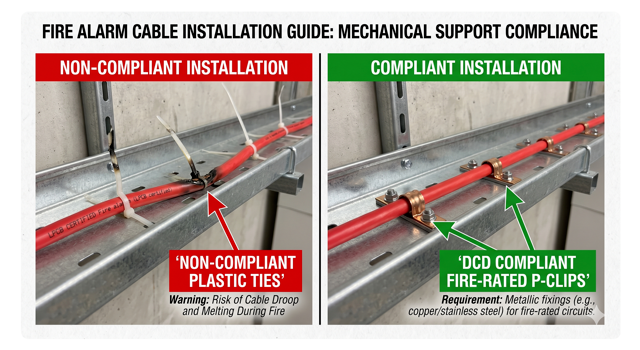
A chain is only as strong as its weakest link. A common and devastating contractor mistake is purchasing top-tier, CWZ-rated fire-resistant cables and then installing them using cheap, combustible plastic zip-ties or standard plastic wall anchors.
During a fire, plastic zip-ties melt in seconds. The heavy fire-resistant cable will detach from the ceiling slab, collapse under its own weight, snap its connections, and instantly kill the life-safety circuit.
Strict DCD cable installation rules mandate that the physical support system must match the survival rating of the cable. Installers must use specialized fire rated cable clips (commonly known as copper P-clips) or stainless steel ties, secured directly to the concrete slab using fire-rated metallic expansion anchors. This guarantees that the cable remains securely suspended and operational even as the surrounding room burns.
Splicing, Terminations, and Junction Boxes
The vulnerability of any electrical network lies in its connections. You cannot route a fire-resistant cable into a standard plastic junction box and connect the wires with standard plastic wire nuts.
In a fire, the plastic box and connectors will liquefy, causing the exposed copper cores to short circuit and fail the entire system. To maintain the 3-hour circuit integrity, the termination points must be armored against the heat.
- The Compliance Standard: Installers must use a certified fire rated junction box (typically made of powder-coated steel or specialized high-temperature thermoset plastics). Inside the box, the connections must be made using high-temperature ceramic terminal blocks. Ceramic does not melt or deform under 950°C heat, ensuring the copper conductors remain firmly locked in place and electrically isolated from one another.
Combating Counterfeits in the Supply Chain
Because genuine FP200 and LSZH cables utilize expensive, highly specialized materials (like mica tape and halogen-free polymers), they command a premium price. This has created a dangerous, shadow market of counterfeit fire cables infiltrating the GCC supply chain.
These fake cables may look identical and even feature forged standard markings printed on the sheath, but they lack the internal fire barriers and will fail catastrophically within minutes of a real emergency. Combating this requires rigorous supply chain auditing. Expert project lead engineering teams must trace factory batch numbers, demand original third-party type test certificates from labs like BASEC or LPCB, and conduct rigorous electrical material certification GCC reviews during the submittal phase to block fraudulent materials from ever reaching the site.
Managing Compliance and Liability Risk
The specification and installation of life safety systems carry an immense legal and financial burden. If a smoke extraction fan fails to operate during a fire because an incorrect, non-fire-resistant cable was specified, or because a contractor used plastic clips, the resulting loss of life transforms from a tragedy into a criminal liability investigation.
Consulting engineers and MEP contractors bear this electrical compliance liability directly. Ensuring that your designs and installations are bulletproof requires a multifaceted approach to risk. By integrating Net zero risk management solutions, engineering firms and developers can systematically audit their life safety architectures, verify DCD compliance, and shield themselves against the profound liabilities associated with high-stakes commercial and industrial builds. Proper life safety risk management is not just about passing an inspection; it is about guaranteeing the safety of the end-user under the absolute worst-case scenario.
Frequently Asked Questions (FAQ)
1. What is the difference between LSZH and FP200?
LSZH (Low Smoke Zero Halogen) cables are designed to burn cleanly without releasing blinding smoke or toxic acidic gases, aiding in safe evacuation. However, they will melt and stop conducting electricity. FP200 is a specialized fire-resistant cable that also has an LSZH sheath, but it contains internal fire-barriers (like mica tape) that allow it to continue conducting electricity for up to 3 hours in a raging fire to keep critical systems running.
2. Can I use plastic zip ties to support fire-resistant cables?
Absolutely not. Using plastic zip ties or plastic wall anchors completely invalidates the fire-resistant nature of the cable. In a fire, the plastic will melt in seconds, causing the heavy cable to fall, snap, and break the circuit. DCD codes strictly mandate the use of fire-rated metallic supports, such as copper P-Clips or stainless steel ties.
3. What is the CWZ test standard?
The CWZ rating comes from the BS EN 50200 standard for life-safety cables. It is the ultimate survival test. “C” stands for Resistance to Fire (950°C for 3 hours). “W” stands for Resistance to Water (simulating building sprinklers hitting the burning cable). “Z” stands for Resistance to Mechanical Shock (simulating falling debris striking the cable). The cable must survive all three simultaneously to earn the rating.
4. Where are regular LSZH cables required?
In the GCC, regular LSZH cables are typically required for general power, lighting, and data networks in highly populated public spaces, underground basements, shopping malls, and poorly ventilated areas where thick, toxic smoke from burning standard PVC cables would cause mass casualties.
5. How do I spot counterfeit fire cables?
Counterfeit cables often look identical to genuine ones. To spot them, you must demand original, third-party certification documents from recognized bodies like BASEC or LPCB. Furthermore, expert inspectors physically strip a sample of the cable to verify the presence, quality, and wrapping overlap of the internal mica-glass or silicone fire-barrier tape.
Conclusion & Next Steps: Designing with Integrity
In the realm of building design, fire performance cables are the ultimate, unseen insurance policy for your occupants. The distinction between an LSZH cable that reduces toxic smoke and an FP200 cable that survives a raging inferno is not a technical triviality; it is the fundamental architecture of survival.
Treating life-safety wiring as a standard electrical commodity, substituting materials to save costs, or failing to enforce strict installation protocols compromises the very core of a building’s emergency response capability.
Are you confident in the integrity of your life-safety schematics?
Do not leave your facility’s fire resilience to chance or contractor interpretation. Partner with an expert electrical engineering consultancy to ensure absolute alignment with rigorous DCD regulations. As premier GCC life safety consultants, Elecwatts provides the meticulous fire safety electrical design, material vetting, and installation oversight required to guarantee your critical systems will perform when they are needed most.
Elecwatts is ready to secure your building’s emergency infrastructure. Contact our team today for a comprehensive review of your fire performance cable specifications.