

Embarking on the construction of the world’s most ambitious gigaproject requires rewriting the rules of traditional infrastructure development. For global developers, EPC contractors, and master planners looking to participate in this vision, partnering with a premier net zero electrical engineering consultancy is a vital first step to navigate the technical shifts of this era. NEOM, the flagship of Saudi Arabia’s Vision 2030, is not merely a development; it is a living laboratory designed to showcase the future of human habitation.
Spanning distinct regions—including the hyper-dense linear city of The Line, the floating industrial hub of Oxagon, and the high-altitude mountain resort of Trojena—this Saudi gigaproject infrastructure demands unprecedented engineering solutions.
The defining mandate of NEOM is its commitment to zero-carbon operations. The entire development is engineered to operate on a $100\%$ renewable, cognitive energy grid, completely independent of legacy fossil-fuel generation. This clean-sheet approach means that standard utility grid codes and 20th-century design paradigms are obsolete.
For the electrical engineering community, NEOM electrical engineering represents both a monumental challenge and the greatest opportunity of the century, forcing us to pioneer new methodologies in energy transmission, vertical power flow, and real-time grid automation.
The 100% Renewable Energy Grid (ENOWA)
The physical and administrative engine driving NEOM’s utility revolution is ENOWA, NEOM’s energy, water, and hydrogen company. ENOWA is tasked with designing, building, and operating the world’s first municipal-scale, 100 percent renewable microgrid.
Powering a mega-city entirely through wind and solar energy presents a massive stability challenge. Without traditional fossil-fuel synchronous generators to provide a steady baseload, the grid is highly vulnerable to the natural intermittency of wind speeds and solar irradiance. To solve this, the ENOWA energy grid integrates massive utility-scale Battery Energy Storage Systems (BESS) acting as the primary buffer.
To model and maintain the grid’s stability, engineers utilize the State of Charge ($\text{SoC}$) of the BESS array as a dynamic control variable:
$$\text{SoC}(t) = \text{SoC}(0) + \frac{\eta_c}{C_{n}} \int_{0}^{t} P_c(\tau) d\tau – \frac{1}{\eta_d C_{n}} \int_{0}^{t} P_d(\tau) d\tau$$
Where $\text{SoC}(0)$ is the initial state of charge, $C_n$ is the nominal battery capacity, $P_c$ and $P_d$ represent charging and discharging power, and $\eta_c$ and $\eta_d$ are the respective round-trip efficiencies. Sizing this BESS network to maintain grid stability across multi-day low-generation periods requires a level of energy storage capacity never before attempted in municipal history.
The Line: Vertical Electrical Distribution
Perhaps the most architecturally challenging component of NEOM is The Line—a revolutionary vertical city designed to stretch $170\text{ km}$ long, rise $500\text{ m}$ high, and span only $200\text{ m}$ wide, housing up to 9 million residents.
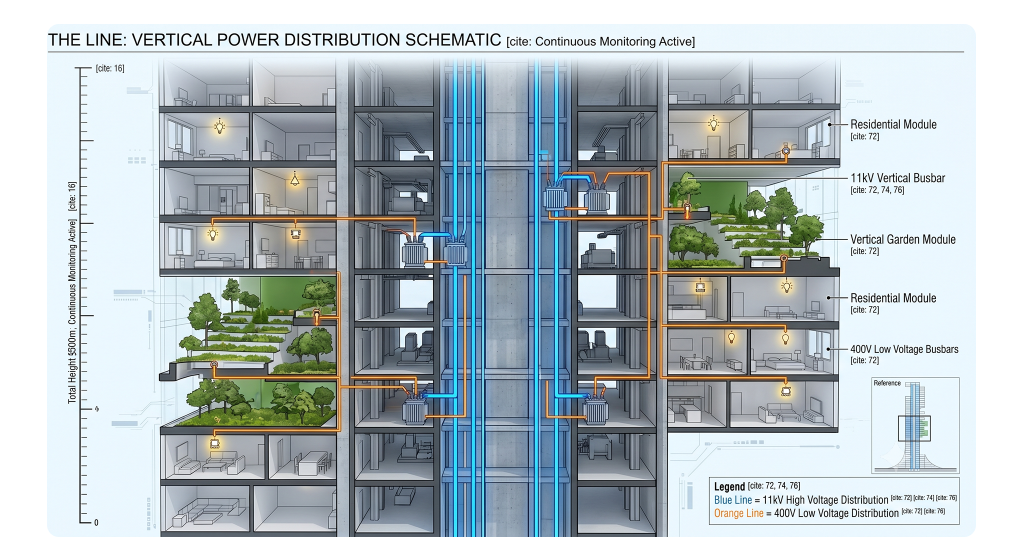
This hyper-dense vertical configuration completely upends traditional horizontal distribution methodologies. In a standard city, power is distributed via underground cables sprawling across miles of flat land. In The Line electrical design, power must travel vertically up sheer concrete walls to reach residential modules, vertical farms, and high-altitude mechanical floors.
- The Voltage Drop Challenge: Travelling hundreds of meters vertically creates severe voltage drop challenges, requiring precise calculation:
- $$V_{drop} = \sqrt{3} \times I \times (R \cos\phi + X \sin\phi) \times H_{vertical}$$
- Where $H_{vertical}$ represents the vertical lift height.
- Engineering the Solution: To prevent massive electrical losses, designers cannot rely on standard copper cables. The vertical risers utilize ultra-high-capacity, sand-insulated vertical busbar trunking systems.
- High-Altitude Substations: Furthermore, rather than keeping transformers on the ground, engineers must deploy a system of high-altitude substations. High-capacity, dry-type (cast resin) transformers are physically hoisted and installed on dedicated mechanical floors hundreds of meters in the air, transforming medium-voltage $11\text{ kV}$ distribution down to low-voltage $400\text{ V}$ closer to the consumer modules, representing a masterclass in vertical power distribution coordination.
The Cognitive Grid and AI Integration
NEOM is moving far beyond the concept of a standard “smart” grid; it is deploying a fully unified, “cognitive” grid. This system does not merely record electrical data; it actively thinks, predicts, and auto-corrects.
The cognitive grid NEOM relies upon is managed by a centralized, deep-learning AI system.
- The Predictive Engine: The AI continuously monitors real-time weather satellite telemetry, predicting cloud movement over vast solar arrays and wind speed drops across the mountains of Trojena.
- Automated Balancing: By executing ultra-fast AI electrical load balancing algorithms, the grid can instantly predict generation drops minutes in advance. Instead of firing up dirty diesel generators, the cognitive system auto-adjusts demand-side loads—such as temporarily throttling the energy consumption of district cooling heat-exchangers or modulating water desalination pump speeds—perfectly balancing the grid’s frequency and voltage without human intervention or localized blackouts.
High Voltage Direct Current (HVDC) Transmission
The primary solar and wind generation assets of NEOM are located in the vast, sunny desert interior and windy mountain passes. However, the primary load centers—like Oxagon and the dense residential modules of The Line—are situated hundreds of kilometers away along the Red Sea coast.
Transporting gigawatts of renewable power over these distances via standard Alternating Current (AC) transmission lines is highly inefficient due to immense inductive reactance and line losses.
- The Solution: NEOM is investing heavily in massive HVDC transmission Saudi Arabia projects.
- The Infrastructure: The NEOM power grid utilizes high-voltage direct current lines operating at $\pm 525\text{ kV}$ or higher. HVDC lines eliminate the reactive losses associated with AC transmission, allowing gigawatts of power to travel hundreds of kilometers with minimal thermal losses.
- The Converter Stations: This requires the design and construction of colossal Voltage Source Converter (VSC) stations at key nodes. These converter stations physically transform the generated AC solar/wind power into DC for long-distance transport, and then convert it back into synchronized AC at the coastal microgrids, creating an incredibly resilient, low-loss transmission highway.
Green Hydrogen: The Export Powerhouse
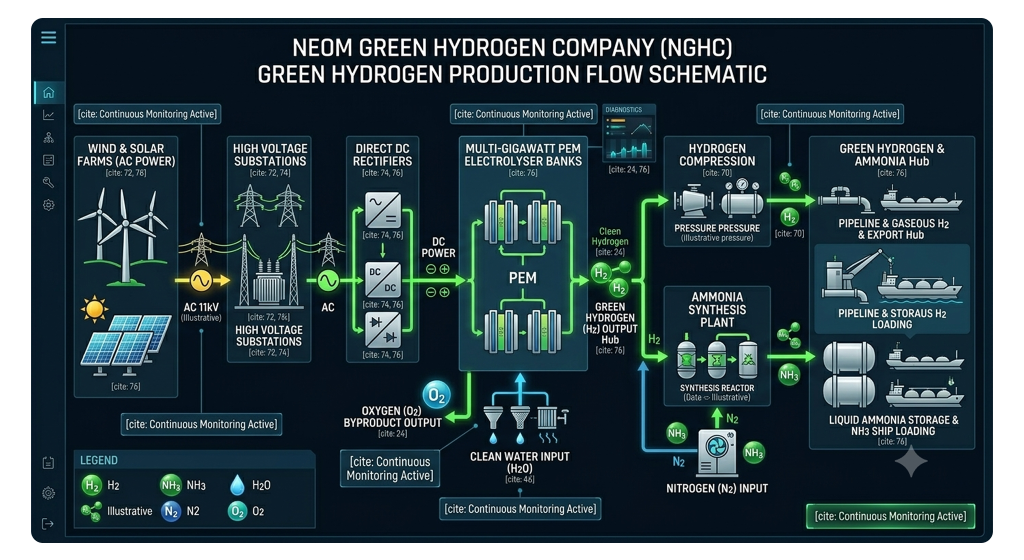
NEOM’s ambition is not only to power itself with clean energy but to export carbon-free fuel to the global market. The primary vehicle for this export is the NEOM Green Hydrogen Company (NGHC)—a joint venture building the world’s largest commercial-scale green hydrogen plant in Oxagon.
The scale of the NGHC power infrastructure is staggering, requiring dedicated, multi-gigawatt solar and wind generation assets isolated solely to feed the hydrogen plant.
- The Rectification Challenge: Converting water into hydrogen requires massive banks of polymer electrolyte membrane (PEM) electrolysers. These electrolysers run on Direct Current (DC).
- The Engineering Handshake: Designing the high-capacity, multi-megawatt rectifiers and specialized step-down transformers to feed these electrolysers is a highly complex task. Utilizing an expert net zero electrical engineering consultancy during the early planning phase is vital to ensure the green hydrogen electrical design can handle the extreme harmonic distortion and high-current demands of these industrial loads without destabilizing the surrounding power networks.
Microgrids and Islanding Capabilities
A centralized failure on a standard power grid can cause a cascading blackout that leaves millions of people in the dark. In a vertical city like The Line, a total blackout is a severe life-safety threat, as vertical transportation, ventilation, and water pumping would instantly halt.
To eliminate this vulnerability, the NEOM microgrid design relies on a highly modular, self-healing architecture.
- Self-Contained blocks: The Line and the industrial zones of Oxagon are physically divided into highly localized, self-contained microgrid blocks.
- Executing Island Mode: If a major high-voltage transmission line is severed or a primary converter station faults, the affected city block can instantly trigger islanding mode electrical protocols. The local block disconnects from the main ENOWA grid in milliseconds, utilizing its own localized rooftop solar arrays, fuel cells, and dedicated BESS to run independently and maintain $100\%$ life-safety operations indefinitely until the main transmission fault is resolved.
Extreme Environment Cable Routing
To link the diverse regions of NEOM, electrical cables must navigate some of the most hostile, diverse, and geographically challenging environments on Earth.
- The Mountains of Trojena: High-voltage cables must climb frozen mountain peaks, subjected to sub-zero temperatures, ground shifting, and heavy snow loads.
- The Coast of Oxagon: Cables must descend into highly saline, corrosive coastal muds and sabkha soils, where standard armored cables would degrade within years.
- The Desert Interior: Cables must pass through shifting, hot sands where the ground thermal resistivity can reach extremely high levels.
Routing cables across these zones requires advanced engineering. By leveraging expert Cable engineering services, planners specify advanced cross-linked polyethylene (XLPE) cables insulated with specialized moisture-barrier lead sheathing, anti-termite additives, and heavy-duty double steel tape armor, ensuring the extreme environment cable routing can survive the brutal multi-climatic conditions of the Trojena electrical infrastructure.
Navigating Grid Codes: SEC vs. ENOWA
For contractors and developers accustomed to working in standard Saudi Arabian cities, entering NEOM represents a major regulatory shock.
While the Saudi Electricity Company (SEC) and SASO codes govern the rest of the Kingdom, NEOM operates under its own independent regulatory framework.
- The ENOWA Grid Code: The ENOWA grid code is built from a completely clean slate, prioritizing $100\%$ inverter-based resources (solar PV, wind, BESS) and HVDC transmission over traditional synchronous generation.
- The Inertia Challenge: Traditional SEC codes rely on the natural “rotating inertia” of massive gas turbines to maintain frequency. Because ENOWA’s grid lacks this physical mass, the SEC vs NEOM regulations diverge drastically. To secure an connection approval, consultants must perform advanced modern power system analysis utilizing completely new dynamic modeling parameters (such as grid-forming inverter control and fast frequency response – FFR) to prove their facilities will not introduce voltage or frequency instability into ENOWA’s ultra-responsive network.
Frequently Asked Questions (FAQ)
1. What is ENOWA and how does it differ from the SEC?
ENOWA is NEOM’s independent energy, water, and hydrogen utility company. Unlike the Saudi Electricity Company (SEC), which manages conventional, fossil-fueled grid assets across Saudi Arabia, ENOWA is designing and operating a completely independent, $100\%$ renewable, cognitive smart grid tailored specifically to the unique geographical and carbon-neutral mandates of NEOM.
2. How is vertical voltage drop managed in The Line?
Vertical voltage drop over hundreds of meters is managed by avoiding long, low-voltage cable runs. Instead, high-voltage $11\text{ kV}$ lines are routed vertically up the building’s concrete shafts using specialized, heavy-duty busbar trunking systems. These feed into cast-resin, dry-type transformers placed on intermediate mechanical floors, transforming the power down to $400\text{ V}$ closer to the consumer modules to minimize losses.
3. Why is an HVDC system preferred over AC for NEOM’s transmission?
Because NEOM’s massive solar and wind assets are located hundreds of kilometers away from the primary coastal load centers (The Line and Oxagon), transmitting AC power over these distances would result in massive inductive reactance and line losses. High Voltage Direct Current (HVDC) transmission eliminates these reactive losses, allowing gigawatts of power to travel long distances with minimal thermal losses.
4. What is a “cognitive” grid and how does it use AI?
A cognitive grid moves beyond a smart grid by using predictive AI algorithms to balance the system. The AI continuously analyzes real-time weather telemetry, predicting solar and wind generation changes minutes in advance. It then auto-adjusts demand-side loads (like building cooling systems or water desalination pumps) to perfectly balance the grid’s frequency without requiring fossil-fuel generation or causing blackouts.
5. Why do NEOM’s electrical systems require special “islanding” capabilities?
Because The Line is a vertical city, a total power blackout would immediately freeze elevators, ventilation, and water supply, posing a severe life-safety threat. To prevent this, NEOM is built around modular microgrids that can instantly isolate themselves (“island” mode) from the main grid during a fault, running independently on localized solar and BESS arrays to maintain $100\%$ operations.
The Frontier of Engineering
Successfully designing, procuring, and commissioning electrical infrastructure inside the futuristic boundaries of NEOM is a monumental task that requires engineering teams to completely abandon 20th-century paradigms. From the $500\text{m}$ vertical distribution challenges of The Line to the multi-gigawatt direct-current requirements of the world’s largest green hydrogen electrolysers and the complex stability dynamics of ENOWA’s inverter-only grid, every connection is a step into the future of our discipline.
Relying on generic designs or standard SEC utility codes is a direct path to immediate design rejection and project delays.
Bidding on or designing a development inside NEOM?
Do not let conventional design methods stall your progress in the world’s most advanced smart city. Partner with a specialized NEOM electrical consultant to secure your design approvals and navigate the ENOWA grid code seamlessly. Elecwatts delivers the advanced dynamic modeling, certified technical due diligence, and pioneering renewable integration expertise required to power your assets flawlessly on the frontier of the future of electrical engineering.
Contact Elecwatts today to secure your ENOWA approvals and energize your NEOM infrastructure.