

Dubai’s iconic man-made archipelagos, including the Palm Jumeirah, the World Islands, and Bluewaters, are marvels of modern civil engineering. However, transforming these dredged sandbars into thriving, illuminated luxury destinations requires overcoming immense electrical hurdles. To successfully navigate these harsh maritime conditions, developers must engage a specialized electrical engineering consultancy in dubai at the very inception of the master plan. The primary enemies of island electrical infrastructure are relentless: highly corrosive saltwater, dynamic tidal movements, and severe galvanic corrosion.
Supplying Dubai man-made islands power is not a standard utility job; it is a complex marine operation. Unlike a mainland high-rise where power is routed through predictable, dry concrete shafts, island grids require pushing 11kV and 33kV high-voltage power under the seabed, across breakwaters, and into substations exposed to 100% humidity and extreme salinity. A single compromised cable sheath or a poorly ventilated ring main unit (RMU) can result in catastrophic, multi-million-dirham failures that leave ultra-luxury resorts and residential fronds in total darkness. This comprehensive guide details the rigorous engineering, DEWA compliance standards, and specialized submarine cable technologies required to conquer the coastal elements and deliver unfailing power to Dubai’s offshore developments.
DEWA Specifications for Marine Environments
The Dubai Electricity and Water Authority (DEWA) recognizes that the Arabian Gulf coast is one of the most aggressive electrical operating environments on the planet. Standard commercial electrical equipment will disintegrate here within months.
The Coastal and Marine Mandate
When designing substations and distribution networks within a specific proximity to the coastline (or directly on a reclaimed island), consultants must adhere to stringent DEWA coastal regulations.
- Enclosure Materiality: Standard mild steel enclosures are strictly prohibited for outdoor installations. DEWA mandates the use of Glass Reinforced Plastic (GRP) or high-grade Marine Stainless Steel (SS316L) for all outdoor feeder pillars, distribution boards, and RMU housings to prevent rapid oxidation.
- Ingress Protection (IP): The marine IP rating electrical standards are uncompromising. Equipment must typically meet IP65 or IP66 ratings, ensuring that not only is the enclosure completely dust-tight against desert sandstorms, but it can also withstand high-pressure jets of saltwater or tidal splashing without allowing a single drop of moisture into the live busbars.
Submarine Cable Engineering and Selection
Bridging the gap between the mainland grid and an offshore island requires the arteries of the marine grid: high-voltage submarine cables. These are not simply standard underground cables dropped into the water; they are highly specialized, heavily armored conduits of power.
Anatomy of a Subsea Cable
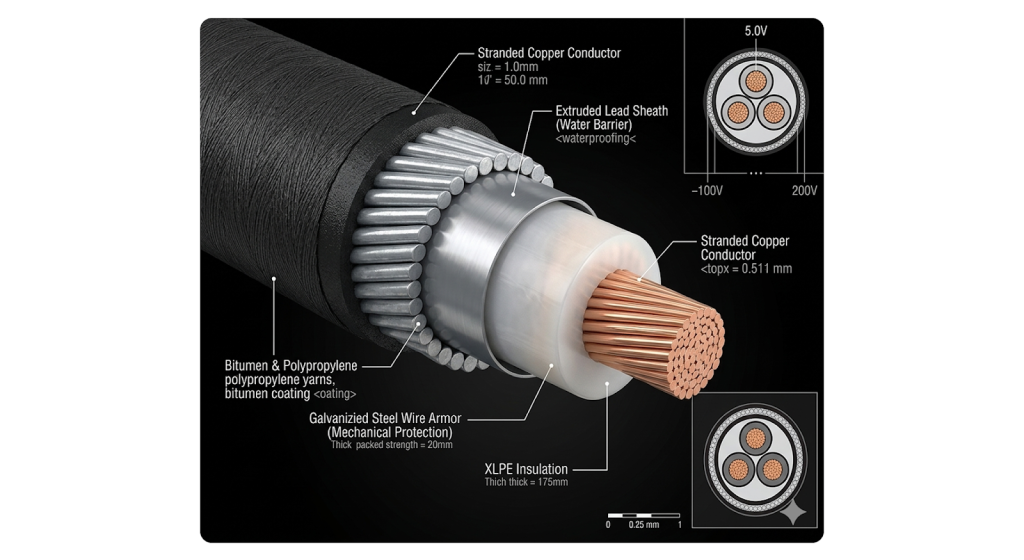
A typical 11kV or 33kV submarine power cable design features multiple layers of critical protection:
- The Conductor: High-purity stranded copper.
- The Insulation: Cross-linked polyethylene (XLPE marine cable), which provides excellent dielectric strength and can withstand high operating temperatures.
- The Radial Water Barrier: This is the most critical layer. A continuous, seamless extruded lead alloy sheath encompasses the insulation. Lead is completely impermeable, guaranteeing that not a single molecule of water can penetrate the electrical core.
- The Mechanical Armor: To protect against boat anchors, shifting seabed rocks, and tidal friction, the cable is wrapped in heavy-duty Galvanized Steel Wire Armor (GSWA) or sometimes dual-layers of steel tape.
- The Outer Serving: A robust layer of polypropylene yarn and bitumen to resist marine biological growth and provide a final layer of abrasion resistance.
Thermal Derating in the Seabed
Water is an excellent coolant, but the seabed is not. Specialized Cable Design Engineering in dubai is required to calculate precise ampacity derating factors. When cables are buried deep in saturated seabed sand, the thermal resistivity of that specific marine soil must be tested. If the sand cannot dissipate the heat generated by the loaded cables, the XLPE insulation will melt. Engineers must run complex thermal models to correctly size the copper conductors for these unique subsea environments.
Trenching, Routing, and Environmental Protection
Installing a massive submarine cable is a delicate balance of heavy industrial force and strict environmental stewardship. The cable must be laid deep enough to be safe from maritime traffic, but the installation process cannot destroy the fragile coastal ecosystem.
Installation Methodologies
Submarine cable laying utilizes several distinct techniques depending on the seabed topography and the distance from the shore.
- Cable Plowing/Trenching: Specialized ROVs (Remotely Operated Vehicles) or towed plows utilize high-pressure water jets to fluidize the sandy seabed, creating a trench. The cable is simultaneously laid into the trench, and the sand naturally collapses back over it, providing immediate burial protection (typically 1.5 to 3 meters deep).
- Horizontal Directional Drilling (HDD): When the cable must cross beneath a critical structure, such as the massive rock breakwaters protecting the Palm Jumeirah or a delicate coral reef, trenching is impossible. Horizontal directional drilling electrical teams bore a continuous subterranean tunnel deep beneath the obstacle, pulling a heavy-duty HDPE pipe through the hole, and subsequently winching the high-voltage cable safely through the conduit without disturbing the surface environment.
Cathodic Protection Systems for Submerged Infrastructure
When you place thousands of meters of galvanized steel (the cable armor) into a massive saltwater bath (the Arabian Gulf), you create the perfect conditions for a massive battery. The resulting electrochemical reaction is known as galvanic corrosion, and it will rapidly eat away the protective armor of the cable and the grounding grids of the offshore substations.
The Science of Corrosion Mitigation
To combat this, electrical engineers deploy cathodic protection electrical systems. This technology artificially shifts the electrical potential of the protected metal, turning it into the “cathode” of an electrochemical cell, effectively halting the corrosion process.
Impressed Current vs. Sacrificial Anodes
- Sacrificial Anode System: Large blocks of zinc or aluminum alloys are welded to the submerged infrastructure. Because these metals are more electrically “active” than steel, they corrode (sacrifice themselves) instead of the cable armor.
- ICCP System Design: For massive island networks, passive anodes are insufficient. Engineers design Impressed Current Cathodic Protection (ICCP) systems. This involves installing an onshore transformer-rectifier that pumps a continuous, calculated DC current into the seawater via virtually indestructible titanium anodes. This blanket of protective current forces the entire submarine cable armor to remain in a protected state, extending its operational lifespan from 5 years to 40+ years.
Combating Moisture Ingress and Condensation
While the submarine cable is protected by a lead sheath, the electrical switchgear sitting above ground on the island faces a different, silent killer: condensation.
The Dew Point Dilemma
The climate on Dubai’s islands features 100% humidity nights followed by searing 45°C days. As the sun sets, the temperature inside a metal substation enclosure drops. The trapped humid air reaches its dew point, and liquid water condenses directly onto the 11kV busbars, insulators, and sensitive protection relays. This localized “indoor rain” leads to tracking, arcing, and explosive short circuits.
Engineered Enclosure Defenses
Designing marine electrical enclosures requires mastering thermal dynamics.
- Anti-Condensation Heaters: DEWA mandates the installation of thermostatically and hygrostatically controlled switchgear condensation heater elements inside every medium-voltage and low-voltage compartment. These heaters activate automatically to keep the internal air temperature just a few degrees above the dew point, preventing moisture from condensing on the live copper.
- Gore-Tex Vents: High-end marine enclosures utilize specialized breathable membranes (similar to Gore-Tex) that allow the enclosure to “breathe” and equalize pressure during temperature swings while blocking the ingress of liquid water and salt aerosols.
Specialized Terminations and Splicing
A submarine cable is virtually indestructible in its unbroken state. The overwhelming majority of electrical failures in marine environments occur at the connection points: the joints and terminations.
The Weakest Link
When an 11kV subsea cable reaches the island substation, it must be stripped back to connect to the switchgear. Removing the protective lead sheath and steel armor exposes the inner XLPE insulation to the harsh coastal air.
Marine-Grade Terminations
Standard indoor cable terminations will fail rapidly in this environment due to “tracking” (where salt deposits create a conductive path along the surface of the insulation, leading to a flashover).
- The Solution: A marine cable termination utilizes highly specialized anti-tracking heat-shrink or cold-shrink polymeric tubes. Furthermore, the “trifurcating” joint (where the three internal phases split apart) must be meticulously sealed with moisture-blocking mastic. For an 11kV subsea joint (where two lengths of submarine cable are spliced together underwater), the entire splice is housed in a massive cast-iron or stainless steel torpedo joint and filled completely with a two-part polyurethane potting resin, permanently locking out the ocean.
Managing Project Logistics on the Water
The engineering design of an island grid is only half the battle; the physical execution requires an armada. Constructing a 33/11kV substation on an unconnected frond of the World Islands presents staggering logistical hurdles.
The Weight of Power
A single continuous length of 33kV submarine cable can weigh over 20 tons per kilometer. A cast-resin transformer weighs 5 tons. You cannot dispatch a standard flatbed truck to deliver these items.
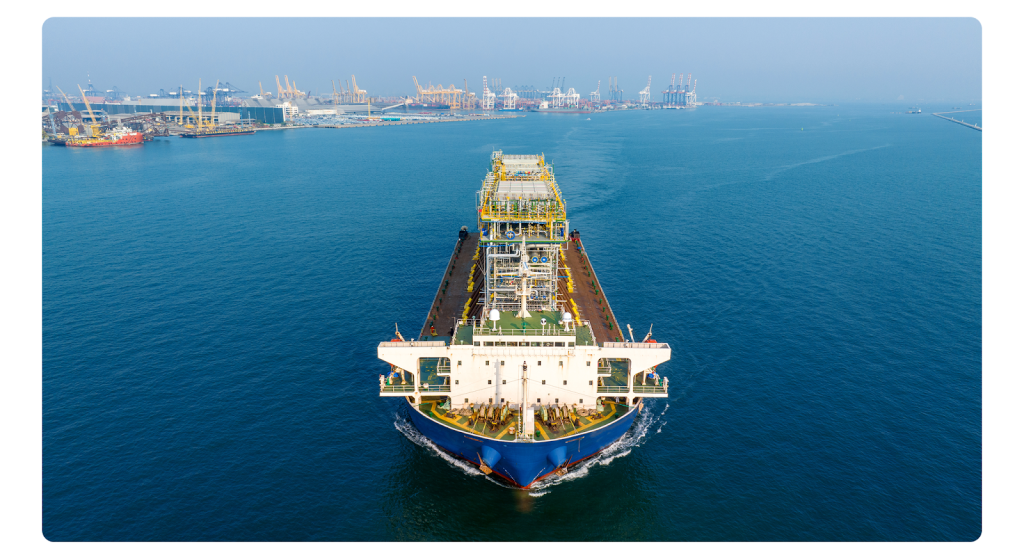
- Marine Operations: Marine electrical logistics requires chartering specialized shallow-draft landing crafts and heavy-lift crane barges. Deliveries must be meticulously timed with the high tide to ensure the barges do not run aground on the artificial sandbanks.
- The Coordination Challenge: Flawless Project Lead Engineering & Management in dubai is required to coordinate marine vessel schedules with DEWA’s strict testing and energization dates. If a barge carrying the main 11kV switchgear is delayed by rough seas for a week, it can derail the critical path of the entire island resort’s construction schedule. Offshore project management requires contingency planning, precise weather monitoring, and deep expertise in maritime transport regulations.
Routine Maintenance and Fault Finding Underwater
Once the island is energized and the luxury villas are occupied, the utility network is largely forgotten by the residents. But for the engineers, the challenge shifts from installation to maintenance. If a mega-yacht drops anchor in the wrong channel and severs an 11kV feed, how do you fix it?
Pinpointing the Break
You cannot simply dig a hole to find the fault. Submarine cable fault location relies on advanced diagnostics.
- Time Domain Reflectometry (TDR): Engineers connect a TDR device to the onshore end of the cable. It sends a high-frequency electrical pulse down the line. When the pulse hits the fault (the severed armor or a water-filled short circuit), it bounces back. By measuring the time it takes for the echo to return, engineers can calculate the exact distance to the fault with meter-level accuracy.
Subsea Intervention
Once the fault location is calculated computationally, visual confirmation is required.
- ROV Deployment: Specialized marine contractors deploy ROV underwater inspection vehicles equipped with sonar and high-definition cameras to scan the seabed. Once the damaged section is located, a specialized repair barge is anchored directly above. The cable is cut, lifted to the surface deck, spliced with a new marine joint, and carefully lowered back into the seabed trench.
Frequently Asked Questions (FAQ)
1. Why are submarine cables made with a lead sheath instead of plastic?
While plastic (like PVC or PE) is highly water-resistant, it is not perfectly impermeable at a molecular level. Over decades underwater, microscopic amounts of moisture will migrate through plastic. Lead is a solid metal; it is 100% impermeable, ensuring the high-voltage electrical core remains completely dry for the 40-year lifespan of the cable.
2. Can a standard electrical contractor work on Palm Jumeirah projects?
For interior villa wiring, standard DEWA-approved contractors are sufficient. However, for the primary infrastructure, substations, and ring main units (RMUs), developers must hire contractors with specific, proven experience in marine electrical installations and DEWA coastal compliance. Submarine cable splicing requires highly specialized, internationally certified jointers.
3. How does DEWA prevent power outages if a boat anchor cuts the submarine cable?
Island electrical networks are designed with strict “Ring” or “Mesh” redundancy topologies. For example, a frond on the Palm Jumeirah is fed by two separate submarine cables approaching from different directions. If a boat anchor severs Cable A, the automated RMU switches instantly detect the loss of voltage and reroute the power to Cable B, ensuring the villas do not lose power while Cable A is repaired.
4. What is the difference between IP65 and IP67 for marine enclosures?
An IP65 enclosure is “dust-tight” and protected against “water jets” from any direction (like a heavy rainstorm or being hosed down). An IP67 enclosure is “dust-tight” and protected against “temporary immersion” in water up to 1 meter deep. For most outdoor coastal substations, DEWA accepts IP55/IP65, provided the enclosure material is GRP or SS316L to prevent corrosion.
5. What is the lifespan of a submarine power cable?
When properly designed with appropriate XLPE insulation, a continuous lead moisture barrier, robust steel armor, and protected by an active ICCP cathodic protection system, a high-voltage submarine cable installed in the Arabian Gulf is expected to operate reliably for 30 to 40 years before requiring replacement.
Conclusion & Next Steps: Conquering the Coastal Elements
Powering Dubai’s man-made islands is a triumph of modern electrical engineering over the relentless forces of nature. The ocean is an unforgiving environment that actively seeks to destroy metallic infrastructure through corrosion, hydrostatic pressure, and moisture ingress. In island electrical engineering, there is absolutely zero room for error or cost-cutting; the sea always finds the weak point.
Achieving a resilient, DEWA-compliant offshore power network requires moving far beyond the standards of mainland commercial construction. It demands mastery of submarine cable thermodynamics, sophisticated cathodic protection, maritime logistics, and rigorous anti-condensation design. By treating the marine environment with the engineering respect it demands, developers can ensure their luxury island destinations remain brilliantly illuminated for decades to come.
Are you developing a coastal or island property in the UAE?
Do not let the harsh maritime environment jeopardize your project’s power security. Partner with a specialized coastal electrical consultant to ensure your infrastructure outlasts the elements. At Elecwatts, our deep expertise in marine power systems UAE, DEWA coastal regulations, and complex subsea engineering guarantees that your offshore development is powered safely, reliably, and permanently.
Contact Elecwatts today to engineer an uncompromising electrical strategy for your island mega-project.