

The transition of the iconic Expo 2020 site into District 2020, now globally recognized and operating as Expo City Dubai, marks a historic milestone in urban evolution and circular economy principles. However, transforming a sprawling, 4.38-square-kilometer site engineered to host 24 million visitors over six high-intensity months into a permanent, mixed-use smart city presents a profound technical challenge. To successfully adapt these hyper-specialized assets for long-term residential and commercial use, developers must engage a specialized electrical engineering consultancy in dubai early in the redesign phase. The core engineering challenge lies in fundamentally rewiring an Expo 2020 legacy infrastructure designed for massive, transient peak loads into a highly efficient, sustainable network capable of supporting the nuanced rhythms of everyday urban living.
During the event, the Expo City Dubai electrical grid operated under extreme conditions. Mega-pavilions drew immense power for theatrical lighting, continuous high-definition AV broadcasting, and intense HVAC systems fighting the body heat of tens of thousands of daily visitors. Today, those same structures are being repurposed into corporate headquarters, boutique residential lofts, and innovation hubs. This transition is not a simple matter of changing the locks and moving in furniture. It requires a complete strategic overhaul of the electrical distribution network, from high-voltage substation reconfiguration down to the reprogramming of individual lighting controllers. This guide explores the critical electrical adaptation strategies required to seamlessly transition Expo 2020 legacy assets into the future of Dubai’s smart city landscape.
The Dramatic Shift in Electrical Load Profiling
The most significant engineering hurdle in repurposing an Expo pavilion is the radical shift in its electrical load profile. The mathematical assumptions made during the initial 2018 design phase are no longer valid for a permanent, mixed-use building in 2024 and beyond.
Understanding the Post-Event Diversity Factor
During the exhibition, pavilions operated with a highly synchronized, maximum-demand profile. Shows ran simultaneously, and cooling systems operated at 100% capacity from 10:00 AM to midnight. The diversity factor (the ratio of the maximum demand of a system to the total connected load) was uniquely high, often approaching 0.9 or 1.0 for show periods.
- The New Reality: An office building or residential block has a naturally lower diversity factor (typically 0.4 to 0.6). People leave for work, offices close at night, and HVAC demands fluctuate based on occupancy rather than showtimes.
- The Cost of Oversizing: If an adaptive reuse electrical load assessment is not performed, the building will be left operating on grossly oversized transformers. A 2000kVA transformer operating at only 15% load suffers from terrible efficiency due to constant “no-load” (iron) losses. Over a 20-year lifecycle, this wasted energy translates to massive, unnecessary utility costs. Electrical consultants must meticulously recalculate post event load profiling to determine if existing transformers should be swapped for appropriately sized, high-efficiency units.
Leveraging the Existing Siemens Smart Grid
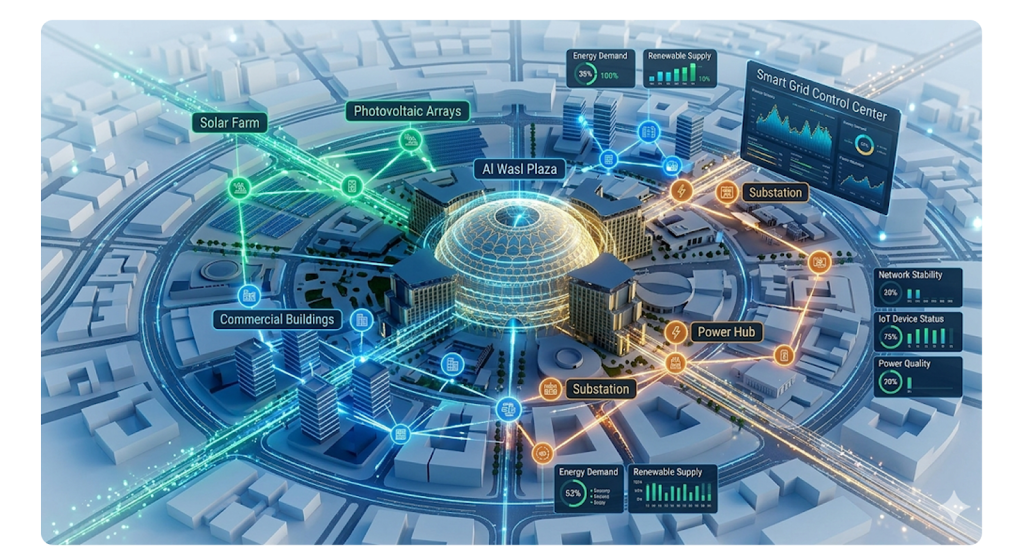
One of the greatest advantages of inheriting an Expo 2020 asset is the underlying digital infrastructure. The site was built as a blueprint for the future, underpinned by a state-of-the-art Siemens smart grid Expo implementation, utilizing the MindSphere operating system and Desigo CC building management platforms.
Plugging into the IoT Network
Unlike retrofitting older buildings in Deira or Bur Dubai, adapting an Expo pavilion means tapping into a pre-existing, world-class Industrial Internet of Things (IIoT) network.
- Real-Time Visibility: The electrical switchgear, smart meters, and HVAC controllers are already embedded with sensors. Building owners and facility managers can leverage this IoT power distribution network to gain granular, real-time visibility into their energy consumption.
- The Engineering Task: The adaptation strategy requires software engineering as much as physical rewiring. The existing SCADA and BMS (Building Management System) parameters must be reprogrammed. Thresholds for automated fault detection, demand-response load shedding, and predictive maintenance alerts must be adjusted to reflect the new commercial or residential operational baseline, ensuring the building integrates seamlessly into the broader Expo City digital ecosystem.
Substation Reconfiguration and Plot Subdivision
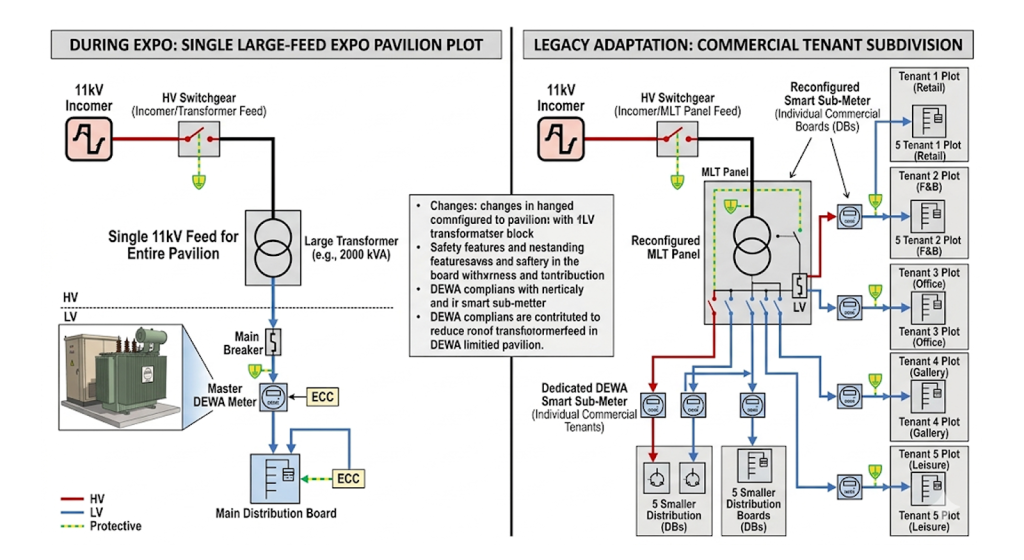
Many of the international participant pavilions were massive, single-tenant structures fed by a dedicated 11kV Ring Main Unit (RMU) and a single, massive DEWA tariff meter. The legacy plan often involves subdividing these mega-structures into multiple, independent commercial offices, retail spaces, and F&B outlets.
The Subdivision Challenge
You cannot simply run extension cords to new tenants. Dividing a master plot into multiple leasable units requires a complete 11kV substation reconfiguration and a rigorous redesign of the Low Voltage (LV) distribution network.
- DEWA Coordination: The developer must apply for a new DEWA plot power allocation. This involves submitting revised Single Line Diagrams (SLDs) that break down the master load into distinct, individually metered sub-loads.
- Metering Architecture: The adaptation strategy must introduce a complex network of DEWA-approved smart sub-meters. This often requires physically rebuilding the Main Low Tension (MLT) panels to accommodate new breaker sections and specialized CT (Current Transformer) chambers that comply with DEWA’s strict spatial and technical requirements for multi-tenant tariff metering.
Maintaining LEED and CEEQUAL Sustainability Certifications
Expo 2020 Dubai was a triumph of sustainable construction, with over 120 buildings achieving LEED (Leadership in Energy and Environmental Design) Platinum or Gold certification, and the wider site achieving high CEEQUAL ratings for civil engineering sustainability.
The Risk of Retrofitting
When stripping out temporary exhibition fit-outs and installing new commercial infrastructure, there is a severe risk of violating the stringent energy models that earned the building its green certification.
- Rigorous Compliance: Any electrical modifications require the oversight of an expert net zero electrical engineering consultancy to ensure strict LEED electrical compliance.
- Energy Modeling: If new lighting fixtures, HVAC motors, or distribution transformers are installed, their efficiency ratings must meet or exceed the rigorous ASHRAE 90.1 baselines utilized in the original Expo energy models. Sustainable electrical retrofits must be documented meticulously; failure to specify premium-efficiency (IE3/IE4) equipment or interfering with the building’s automated daylight harvesting systems can result in the revocation of the building’s prestigious LEED status, drastically lowering its commercial rental value.
Repurposing Distributed Solar Assets
Expo City Dubai is home to some of the most innovative distributed solar generation in the region, most notably the towering “Energy Trees” and the massive, cantilevered solar canopy of Terra, the Sustainability Pavilion.
From Event Showcase to Commercial Asset
During the event, these assets acted as a master-metered generation source for the entire site’s microgrid. In the legacy phase, integrating these assets into the new, subdivided commercial grid structures presents a complex regulatory and technical challenge.
- Shams Dubai Integration: The solar infrastructure must be formally transitioned into DEWA’s Shams Dubai net-metering program under the names of the new permanent building owners or the master community developer.
- Technical Adaptation: This Expo solar tree integration requires updating the Interface Protection (IP) panels. The relays that protect the grid from reverse power flows and islanding must be recalibrated. Legacy PV net metering architectures must be redesigned so that the solar generation is accurately credited to the correct newly subdivided utility accounts, maximizing the financial return for the new long-term tenants.
HVAC and District Cooling Electrical Adjustments
The cooling infrastructure for Expo 2020 was designed to battle the peak GCC summer heat while accommodating the metabolic heat of hundreds of thousands of densely packed visitors inside the pavilions.
Recalibrating for Reality
With the transition to standard office or residential occupancy, the cooling load plummets. The massive chilled water pumps and Air Handling Units (AHUs) are now grossly oversized for the permanent baseline load.
- The VFD Dilemma: While these motors are equipped with Variable Frequency Drives (VFDs) to modulate their speed, running a massive 500kW motor continuously at 15% or 20% capacity is incredibly inefficient. Furthermore, VFDs operating at very low speeds generate significant harmonic distortion, which pollutes the building’s electrical network.
- Optimization Strategies: District cooling electrical adjustment involves a complete system re-evaluation. Electrical engineers may need to optimize the Motor Control Centers (MCCs), adjust the harmonic filtering, or in some cases, replace massive primary motors with smaller, appropriately sized units to ensure long-term efficiency and prevent power quality penalties from DEWA. VFD optimization is critical to ensure the motors operate within their ideal efficiency curves based on the new, much lower thermal loads.
Transitioning Lighting Systems for Urban Living
The lighting design for an international exhibition is inherently dramatic. It relies on high-draw theatrical rigs, massive LED facade screens, and intense, color-changing architectural highlights. A permanent residential and commercial smart city requires a fundamentally different approach.
From Theatrical to Functional
The adaptation strategy involves physically removing the energy-intensive show lighting and transitioning to functional, smart-sensor street and landscape lighting.
- Light Pollution and Compliance: The intense facade lighting must be toned down or removed to comply with Dubai’s light pollution standards for residential areas, ensuring a high quality of life for the new inhabitants.
- Digital Reprogramming: The entire site utilizes advanced DALI (Digital Addressable Lighting Interface) and POE (Power over Ethernet) lighting networks. DALI lighting reprogramming is a major task. Motion sensors, daylight harvesting photocells, and time-clock schedules must be completely rewritten to provide safe, comfortable, and energy-efficient urban landscape lighting power that aligns with the rhythm of a normal city, rather than a 14-hour-a-day festival.
Asset Testing and Re-commissioning
Between the closing ceremony of Expo 2020 and the final handover of a repurposed building in Expo City Dubai, significant time has passed. In the aggressive climate of the GCC, electrical assets that sit idle or under-utilized are at high risk of degradation.
The Danger of the Idle Asset
Fine desert dust infiltrates switchgear, and humidity variations can cause condensation within transformer housings, compromising electrical insulation.
- Rigorous Re-testing: Before a newly adapted pavilion is fully re-energized under its new commercial load, a comprehensive testing protocol must be executed. This is not a simple visual inspection. It requires primary and secondary injection testing of protection relays, Megger (insulation resistance) testing of all main cables, and potentially Dissolved Gas Analysis (DGA) for any oil-filled transformers.
- Project Management Interface: Proper Electrical Project Management is absolutely critical during this phase. Attempting to bring an idle, dust-laden 11kV RMU back online without proper switchgear re-commissioning and electrical asset testing Dubai protocols can result in catastrophic arc flashes, destroying the equipment and severely delaying the building’s commercial opening.
Frequently Asked Questions (FAQ)
1. Who is responsible for the electrical infrastructure in Expo City Dubai?
While the master developer (Expo City Dubai Authority) manages the overarching smart grid, district cooling networks, and primary substations, individual building owners or long-term leaseholders are responsible for adapting and maintaining the electrical infrastructure within their specific plot limits, subject to DEWA regulations and Expo City’s master community guidelines.
2. Can we keep the theatrical facade lighting on our purchased pavilion?
Generally, no. The master community guidelines for Expo City Dubai have strict light pollution and energy consumption regulations suited for a permanent, mixed-use residential and commercial smart city. Most dynamic, high-intensity show lighting must be decommissioned, removed, or heavily restricted to comply with new operational permits.
3. How do we transfer the Shams Dubai solar connection to a new tenant?
If a mega-pavilion is subdivided, the existing Shams Dubai NOC must be updated. You must engage a DEWA-approved electrical consultant to submit a revised design showing how the existing solar inverters will be electrically connected and metered against the new, specific DEWA tenant accounts, ensuring the solar credits are allocated correctly.
4. Is the Siemens MindSphere smart grid mandatory to use?
Yes, integration is a core component of operating within Expo City Dubai. Building owners must ensure their internal Building Management Systems (BMS) and electrical smart meters remain connected and properly communicating with the central Siemens platform to facilitate campus-wide energy optimization, billing, and automated fault response.
5. Do we need to upgrade the earthing system during the transition?
It is highly recommended to perform a complete test of the earthing system. While the original installation was world-class, the GCC soil dries out over time, which can increase earth pit resistance. An electrical audit will verify if the system still meets DEWA’s strict (<1 ohm) requirements or if soil-enhancement chemical treatments are required before re-commissioning.
Conclusion & Next Steps: Engineering the City of the Future
Expo City Dubai is not merely a repurposed event space; it is the ultimate blueprint for sustainable urban adaptation and circular engineering. The transition of these magnificent structures from temporary exhibition pavilions to permanent, future-proofed commercial and residential hubs represents a monumental achievement in electrical engineering and smart city design.
However, realizing the full value of these legacy assets requires moving beyond superficial renovations. It demands a rigorous, data-driven approach to load profiling, smart grid integration, and precise regulatory compliance with DEWA and LEED standards. Failing to properly adapt the heavy-duty event infrastructure for everyday urban efficiency will result in stranded assets, exorbitant utility bills, and compromised sustainability ratings.
Are you ready to adapt your Expo legacy asset for the future?
Navigating the complex transition of these hyper-specialized buildings requires unparalleled engineering expertise and a deep understanding of Dubai’s smart city vision. If you need guidance on transforming your facility, our specialized team at Elecwatts is ready to assist. We provide the comprehensive Expo legacy engineering and project management services required to seamlessly recalibrate, re-commission, and future-proof your electrical infrastructure for the next generation of Dubai smart city electrical living.
Contact Elecwatts today to successfully transition your Expo City asset into a highly efficient, sustainable, and permanent urban landmark.