

In the boardrooms of Riyadh, Dubai, and Doha, operational expenditure (OPEX) is scrutinized down to the last dirham or riyal. Facility managers track maintenance schedules, optimize supply chains, and negotiate energy tariffs. Yet, a silent financial hemorrhage often goes unnoticed until a catastrophic failure occurs: Poor Power Quality.
In the harsh climatic and industrial environment of the Gulf Cooperation Council (GCC), electrical equipment is already operating at the edge of its thermal envelope. When you introduce “dirty power”, voltage sags, harmonics, or transients, into this stressed environment, the degradation of assets accelerates exponentially.
Industry data suggests that strictly “mechanical” failures are rare. A study by the Electric Power Research Institute (EPRI) indicates that widely varying power quality costs the US economy billions annually. In the GCC, where industrial unplanned downtime in petrochemical or aluminum smelting sectors can cost upwards of $260,000 per hour, the stakes are higher.
Power Quality Analysis is not just about keeping the lights on; it is a forensic electrical engineering consultancy discipline that protects the lifespan of your multimillion-dollar capital assets. It is the difference between a motor lasting its rated 15 years or burning out in 3.
The GCC Power Quality Challenge: Why Desert Conditions Amplify Problems
To understand why power quality analysis GCC is critical, we must look at the environment. In temperate Europe or North America, electrical equipment benefits from natural cooling. A transformer running slightly hot due to harmonic distortion might survive for decades because the ambient air is 20°C.
The Thermal Multiplier Effect
In the Gulf, ambient temperatures regularly exceed 50°C in the summer.
- Reduced Headroom: Electrical equipment is rated for a specific temperature rise over ambient. If the ambient is already bordering on the equipment’s limit, there is zero thermal headroom for the extra heat generated by poor power quality.
- The Dust Factor: Fine desert sand ingress increases contact resistance at busbar joints and breaker contacts. High resistance creates heat and voltage drops. When combined with utility-side voltage fluctuations, this creates a compound risk of failure that standard international standards often fail to address adequately.
Metric 1: Voltage Variations – The Foundation of Equipment Stress
Voltage is the “pressure” of the electrical system. Ideally, it should be constant. In reality, especially in heavy industrial zones in Jebel Ali or Jubail, it fluctuates constantly.
Sags, Swells, and Interruptions
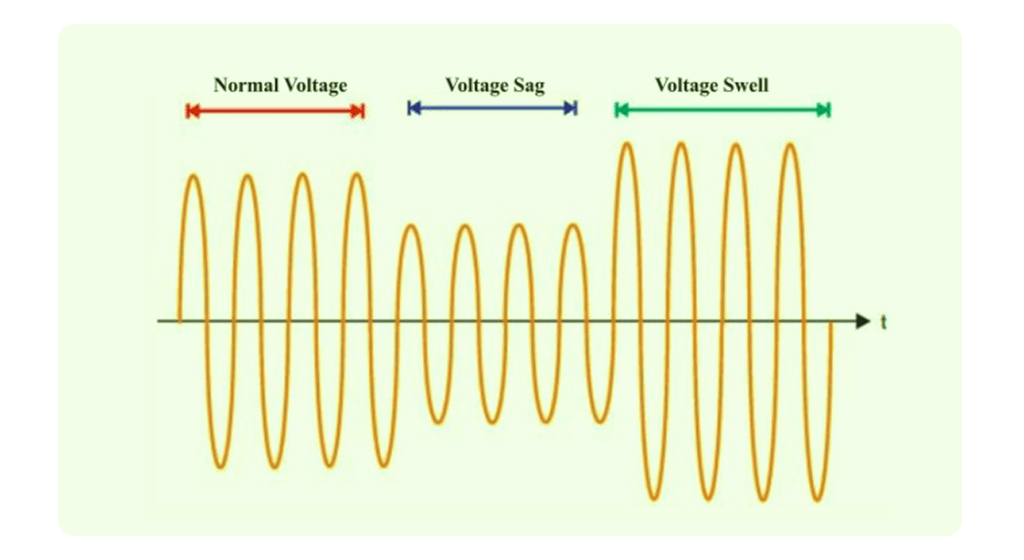
- Voltage Sag (Dip): A momentary drop in voltage (e.g., to 80% of nominal) caused by the starting of large motors or faults on the utility grid.
- GCC Impact: In the intense heat, air conditioning and cooling chillers are critical. A voltage sag can trip these chillers offline. By the time they restart (10-15 minutes later), the facility’s internal temperature may have spiked, damaging sensitive products or processes.
- Voltage Swell: A temporary spike in voltage.
- GCC Impact: Swells degrade the insulation of cables and motors, which is already brittle from UV and thermal aging.
The Impact on Motors
Induction motors, the workhorses of GCC industry, are extremely sensitive to voltage imbalance. A mere 3.5% voltage imbalance can cause a 25% increase in motor heating. In a 50°C desert environment, this extra heat destroys the winding insulation, leading to short circuits and motor burnout.
Regional Standards
Utilities like DEWA (Dubai), SEC (Saudi Arabia), and KAHRAMAA (Qatar) have strict grid codes specifying permissible voltage variations (typically ±5% or ±10%). Voltage regulation GCC studies ensure your facility’s internal electrical system design maintains these levels even when the external grid fluctuates.
Metric 2: Harmonic Distortion – The Invisible Current That Overheats
If voltage variations are the waves on the ocean, Harmonics are the undercurrents. They are phantom currents at multiples of the fundamental frequency (e.g., 150Hz, 250Hz) caused by non-linear loads.
The Source of the Problem
Modern GCC facilities are incredibly efficient, utilizing:
- Variable Frequency Drives (VFDs) for pumps and fans.
- LED Lighting systems.
- Uninterruptible Power Supplies (UPS).
- Rectifiers for aluminum or chlorine production.
While efficient, these devices chop up the electrical waveform, injecting harmonics back into the system.
The Heat Penalty
Harmonics cause “Skin Effect” and eddy currents, which generate intense heat in transformers and neutral conductors.
- The GCC Danger: A standard transformer loaded to only 70% of its capacity can still overheat and fail if the power systems analysis of the Middle East reveals high levels of Total Harmonic Distortion (THD). The harmonics heat the core steel and windings from the inside out.
- IEEE 519 Standard: This is the global benchmark for limiting harmonic distortion. Adherence is mandatory for connection to most GCC utility grids to prevent polluting the public network.
Metric 3: Transients and Surges – The Instantaneous Equipment Killers
Transients are high-energy, short-duration bursts of energy, lightning strikes or switching surges, that can reach thousands of volts.
The Myth of “Lightning-Free” Deserts
While rain is rare, the transition seasons in Saudi Arabia and the UAE often bring violent electrical storms. A single strike near a facility can send a destructive pulse through the grounding system.
Switching Surges
More common in industrial cities are “Switching Transients.” When the utility switches a large capacitor bank or re-energizes a line, it sends a surge through the grid.
- Cumulative Damage: These surges act like a hammer blow to the microscopic structure of semiconductor chips in PLCs, VFDs, and control systems. They create “pitting” in wire insulation. Over time, this cumulative damage weakens the system until it fails under normal operation, a phenomenon often misdiagnosed as “old age.”
Regional Protection
Effective electrical transients GCC mitigation requires a tiered approach to Surge Protection Devices (SPDs), sized specifically for the high-isokeraunic (lightning activity) levels of specific regions like the Asir mountains in KSA or the mountainous regions of the UAE.
Metric 4: Frequency Stability – The Grid’s Pulse and Your Equipment
Frequency (50Hz or 60Hz) is the heartbeat of the grid. It must remain perfectly stable for generators and motors to operate in sync.
Grid Interconnection
The GCC Interconnection Authority (GCCIA) links the grids of the six Gulf nations, greatly improving stability. However, disturbances in one country can ripple through the network.
- Island Mode Risks: Many remote O&G facilities operate in “Island Mode” (disconnected from the grid) using their own turbines. In these isolated systems, starting a large motor can cause the frequency to dip.
- Impact: If frequency drops, turbines slow down. If it drops too low, under-frequency relays will trip the generators to protect them, causing a site-wide blackout. Frequency stability analysis is critical for designing load-shedding schemes that sacrifice non-critical loads to save the plant during such events.
Metric 5: Power Factor – The Efficiency Metric With Hidden Consequences
Power Factor (PF) measures how effectively your facility uses electricity. A PF of 1.0 is perfect; 0.7 is poor.
True vs. Displacement Power Factor
In the past, poor PF was caused by inductive loads (motors). Today, harmonics from VFDs cause “True Power Factor” to drop, even if the “Displacement Power Factor” looks okay. Standard capacitor banks cannot fix harmonic-induced PF issues; they can actually explode due to resonance.
The Thermal Consequence
A low power factor means you are drawing more current than necessary to do the same amount of work.
- I²R Losses: More current means more heat in your cables and transformers. In the GCC summer, this unnecessary extra heat can push cables over their thermal limit, leading to insulation failure.
- Utility Penalties: Power factor penalties DEWA and SEC are significant. Utilities charge premiums for low PF because it wastes grid capacity. Correcting PF is often the fastest ROI project an industrial facility can undertake.
The Measurement Methodology: Continuous vs. Spot Analysis
How do you diagnose these invisible threats? There are two approaches.
Spot Analysis (The Check-Up)
An engineer connects a portable analyzer for 24-48 hours.
- Pros: Low cost.
- Cons: Misses seasonal variations. In the GCC, the electrical load profile in January (low cooling load) is drastically different from August (peak cooling). A spot check in winter might miss the voltage sags caused by peak summer demand.
Continuous Monitoring (The ICU Monitor)
Installing permanent Power Quality Meters (PQMs) at critical switchgear.
- Pros: Captures every event, 24/7/365. Allows for trend analysis (e.g., “Harmonics are increasing by 2% every month, why?”).
- Recommendation: For critical GCC industries, continuous monitoring is the only way to catch intermittent issues before they cause downtime. Modern systems integrate with Building Management Systems (BMS) for real-time alerts.
The Lifespan Impact Matrix: Quantifying Equipment Degradation
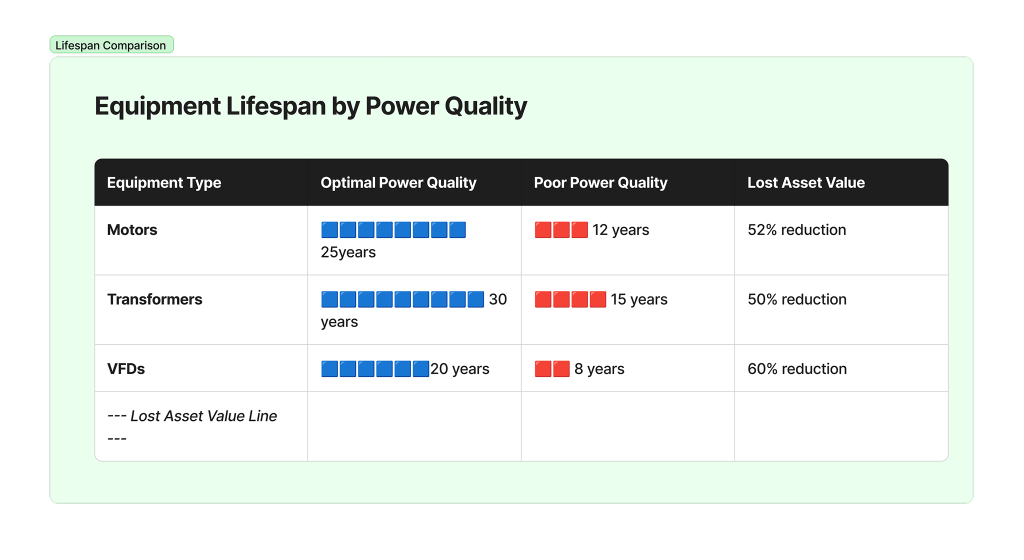
The cost of poor power quality is quantifiable in years of lost asset life.
| Metric | Critical Equipment | Impact of Poor Quality (GCC Climate) | Est. Lifespan Reduction |
| Voltage Sags | Chillers / HVAC | Compresses restart cycles, overheating windings. | -20% to -30% |
| Harmonics (THD) | Transformers | Core and winding overheating (Hotspots). | -40% to -50% |
| Transients | VFDs / PLCs | Semiconductor degradation, logic corruption. | -30% (plus random failure risk) |
| Voltage Imbalance | Induction Motors | Extreme stator heating. | -50% |
| Low Power Factor | Power Cables | Insulation aging due to higher thermal load. | -15% to -25% |
Table: The cumulative impact of power quality issues on asset life in high-ambient temperature environments.
[Placement for Image 2]
Next Steps: From Analysis to Action Plan
Knowledge is only power if applied. To protect your facility:
- Baseline Audit: Commission a comprehensive Power Quality Audit covering at least one full operational cycle (including peak summer).
- Harmonic Mitigation: If THD is high, install Active Harmonic Filters (AHF) rather than passive ones to adapt to changing loads.
- Surge Protection: Audit your grounding and lightning protection systems. Install Type 1 and Type 2 SPDs at critical distribution boards.
- Monitoring Strategy: Shift from reactive repairs to predictive maintenance by installing permanent PQ meters on main incomers.
- Compliance Check: Ensure your facility meets the latest GCC electrical compliance standards (SASO, ADDC, etc.) to avoid fines and ensure safety.
Frequently Asked Questions (FAQ)
1. Can I use standard capacitor banks to fix Power Factor in a plant with many VFDs?
No. This is dangerous. Standard capacitors can interact with the harmonics produced by VFDs, creating a “resonance” condition that amplifies the current and can cause the capacitors to explode or catch fire. You must use “Detuned” reactor banks or Active Harmonic Filters.
2. How often should we perform a Power Quality Analysis?
If you rely on spot checks, an audit should be performed annually, ideally during the peak load season (July/August). However, for critical infrastructure (hospitals, data centers, oil & gas), continuous monitoring is the industry standard.
3. Why do my LED lights flicker even though the voltage seems steady?
Flicker is often caused by rapid, small voltage fluctuations (interharmonics) that a standard multimeter cannot see. It can also be caused by harmonic incompatibility between the LED driver and the dimming system. A high-resolution PQ analyzer is needed to diagnose this.
4. What is the “K-Factor” rating for transformers?
The K-Factor rates a transformer’s ability to handle harmonic heat. A standard transformer is K-1. A transformer serving a data center or office with many computers should be K-13 or K-20. Using a K-1 transformer for non-linear loads in the GCC will lead to rapid overheating and failure.
5. Does the utility company pay for damage caused by their voltage sags?
Generally, no. Most utility contracts in the GCC state that the customer is responsible for protecting their own equipment against grid disturbances. This makes internal power quality protection your responsibility, not theirs.
Conclusion: The ROI of Clean Power
In the demanding industrial landscape of the Gulf, Power Quality Analysis is not a luxury, it is an insurance policy for your assets. By understanding and managing the five key metrics, Voltage, Harmonics, Transients, Frequency, and Power Factor, you do more than just satisfy a code requirement. You unlock the full lifespan of your equipment, reduce unscheduled downtime, and secure the operational resilience of your business.
Stop guessing about your grid health.
Hidden power quality issues are likely already degrading your equipment. Elecwatts is the region’s premier power quality analysis GCC specialist. We use state-of-the-art metering and simulation software to diagnose the invisible threats in your network and design robust, cost-effective mitigation strategies tailored to the desert climate.
Contact Elecwatts today to schedule your comprehensive Power Quality Health Check.