

In the complex, high-stakes world of modern electrical infrastructure, ensuring grid stability and safety requires unparalleled precision. For engineers tasked with modern power system analysis in Dubai, relying on manual calculations or outdated spreadsheets is no longer feasible. The margin for error is virtually zero, and utility regulations are stricter than ever. Today’s electrical networks represent a highly dynamic ecosystem of renewable energy, massive industrial motors, and interconnected grids, all of which demand a sophisticated “digital brain” to simulate and predict behavior under stress.
This absolute necessity has given rise to highly advanced power system studies software. While numerous platforms exist, the global market and the GCC region are overwhelmingly dominated by three industry heavyweights: ETAP, DIgSILENT (PowerFactory), and SKM PowerTools. Conducting a thorough electrical engineering software comparison is a critical strategic decision for any consultancy or project developer. Choosing the wrong platform can lead to rejected utility submissions, inaccurate equipment sizing, and costly project delays. This guide provides an in-depth comparison of these three titans, exploring their strengths, regional acceptance, and ideal use cases to help you make the right engineering choice.
ETAP: The GCC Industry Standard
Electrical Transient Analyzer Program (ETAP) is arguably the most recognized name in the Middle Eastern electrical engineering sector. Originally developed for the nuclear power industry, it has evolved into a comprehensive, full-spectrum analytical tool.
The Preferred Choice for Regional Utilities
In the Gulf Cooperation Council (GCC), ETAP enjoys a massive market share. It is the de facto standard for many major utility providers. For instance, when submitting a design for a new commercial tower or a solar integration project in Dubai, ETAP is universally recognized as the premier DEWA approved electrical software.
Core Strengths in Industrial Modeling
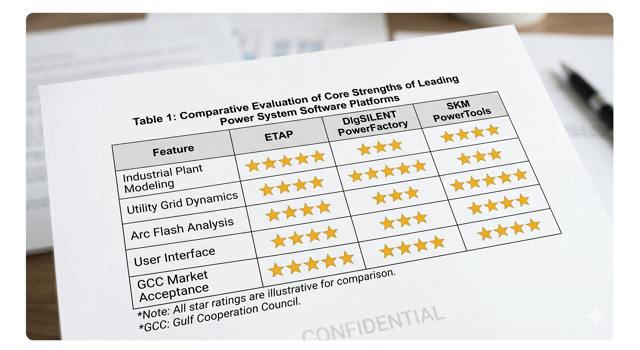
ETAP software analysis truly excels in commercial and heavy industrial plant modeling. Its modules for Load Flow, Short Circuit, and Motor Starting are incredibly robust and user-friendly. ETAP provides extensive, verified libraries of manufacturer-specific cables, transformers, and circuit breakers, allowing engineers to build highly accurate digital twins of industrial facilities rapidly. If your project involves sizing switchgear, optimizing cable runs, or proving basic grid compliance for a standard facility, ETAP is often the most efficient and widely accepted tool in the region.
DIgSILENT PowerFactory: The Master of Grid Dynamics
While ETAP dominates the industrial plant space, German-engineered DIgSILENT PowerFactory reigns supreme when the scale shifts from individual facilities to massive, interconnected utility grids.
Unmatched Dynamic Simulation
The true power of DIgSILENT lies in its unparalleled capability to handle complex, dynamic simulations. It is the definitive grid transient stability software. When modeling the transient behavior of a national grid after the loss of a 400kV transmission line or the tripping of a gigawatt-scale gas turbine, DIgSILENT PowerFactory capabilities are unmatched. It handles massive mathematical matrices with incredible speed and stability.
The Choice for Complex Renewable Integration
For complex analysis involving massive utility-scale renewable energy farms, weak grids, and advanced microgrids, DIgSILENT is often the most robust choice. It allows engineers to write custom, highly detailed control algorithms for inverters and power system stabilizers using its proprietary DSL (DIgSILENT Simulation Language). This makes it the software of choice for transmission system operators (TSOs) and independent power producers (IPPs) who need to prove stringent dynamic grid code compliance to authorities like the GCC Interconnection Authority (GCCIA).
SKM PowerTools: The Arc Flash and Industrial Specialist
SKM PowerTools for Windows (PTW) is a veteran in the power systems analysis arena, with a deeply entrenched history in commercial, institutional, and industrial facility modeling, particularly in the North American market.
The Undisputed Leader in Arc Flash
While ETAP and DIgSILENT both offer Arc Flash modules, SKM is widely considered the industry benchmark for this specific safety study. Its “ArcFlash” module is highly sophisticated, frequently updated to reflect the latest IEEE 1584 and NFPA 70E standards, and generates the most detailed, customizable, and compliant warning labels in the industry. When performing an arc flash software comparison, safety engineers frequently favor SKM for its precision and ease of use in generating life-safety documentation.
Protective Device Coordination
Another standout among SKM PowerTools features is its “Captor” module for protective device coordination. It offers an incredibly intuitive interface for plotting Time-Current Curves (TCCs), allowing engineers to quickly click, drag, and fine-tune breaker settings to achieve perfect selectivity. For facilities managers looking to optimize their internal protection schemes and prevent nuisance tripping, SKM remains a highly formidable and specialized tool.
Comparing Renewable Energy and BESS Modeling
The transition to clean energy is forcing software platforms to rapidly evolve their capabilities regarding renewable energy modeling software and Battery Energy Storage Systems (BESS).
Handling the Inverter Challenge
Traditional generators are easy to model; inverters are not. They lack physical inertia and respond to grid faults based on complex, proprietary software logic.
- DIgSILENT: Offers the highest fidelity for BESS integration analysis and solar parks at the transmission level. It allows for deep, custom modeling of the Phase-Locked Loop (PLL) and grid-forming capabilities of specific inverters.
- ETAP: Has made massive strides in recent years, introducing highly capable, user-friendly modules for microgrid control and renewable integration, making it excellent for behind-the-meter commercial solar projects (like Shams Dubai).
- Harmonic Modeling: Both ETAP and DIgSILENT offer excellent harmonic analysis tools necessary for identifying the high-frequency distortion injected by massive arrays of solar inverters, ensuring the design includes proper active or passive filtering.
User Interface, Usability, and Learning Curve
The most powerful calculation engine is useless if engineers cannot navigate the software efficiently.
Visual Aesthetics and Workflow
- ETAP: Boasts a highly polished, modern, and intuitive graphical user interface. The ETAP user interface is logical, and dragging and dropping components onto the one-line diagram is visually satisfying. The learning curve is relatively moderate; a graduate engineer can become proficient in basic load flow and short circuit studies within a few weeks of dedicated use.
- DIgSILENT: Functions more like a vast, deeply nested database with a graphical overlay. The interface is dense, highly technical, and less intuitive. The learning curve is notoriously steep. Mastering DIgSILENT requires a deep understanding of power system mathematics and coding logic.
- SKM: Features a practical, functional, though somewhat dated, interface. It is straightforward and gets the job done efficiently, especially for protection coordination.
Training in the GCC
For electrical modeling software training, ETAP has a massive advantage in the Middle East. There are numerous certified training centers, dedicated local support offices, and a vast community of users across the UAE and Saudi Arabia, making troubleshooting and staff onboarding significantly easier.

Utility Acceptance and Formatting Requirements
In the GCC, the software you use must align with the expectations of the regulatory authority reviewing your submission.
The Grid Code Hurdle
Securing a No Objection Certificate (NOC) relies heavily on your GCC grid code submission.
- Local Distribution (DEWA/ADDC): For standard commercial, residential, and light industrial projects, ETAP is almost universally expected. The utilities are highly familiar with ETAP’s report formats.
- Transmission and Heavy Industry (TRANSCO/SEC): When dealing with the transmission network or massive generation assets, utilities often use DIgSILENT internally for their own grid planning. Submitting an ETAP dynamic stability report to a utility that strictly requires native DIgSILENT (.pfd) files can cause severe translation issues, model discrepancies, and weeks of project delays. Choosing the right utility compliance software requires knowing your off-taker’s internal preferences before starting the design.
Integration with BIM and Plant Design Tools
Modern engineering is no longer siloed. Electrical data must flow seamlessly into the broader 3D architectural and mechanical models.
The Rise of the Digital Twin
The push toward Building Information Modeling (BIM) requires analytical software to interface with drafting tools like Revit and AutoCAD.
- Data Exchange: Advanced platforms now allow for BIM electrical integration. An engineer can layout the spatial routing of a cable in Revit, and that precise length and routing data can be automatically exported to ETAP or SKM.
- This seamless software integration streamlines overall electrical system design and clash detection. It ensures that the electrical digital twin software used for voltage drop calculations precisely matches the physical reality of the constructed building, eliminating discrepancies between the electrical model and the mechanical reality.
Cost Analysis vs. ROI for Consultancies
Acquiring these software suites requires significant capital investment, and pricing models vary drastically.
Modular Pricing vs. Package Deals
- The Investment: The ETAP license cost and DIgSILENT pricing are typically modular. You pay a base fee for the core engine and add modules (e.g., Transient Stability, Harmonics, Arc Flash) at an additional cost. Fully loaded enterprise licenses can easily exceed tens of thousands of dollars, plus annual maintenance and support fees.
- The Return on Investment: While the upfront cost is high, the engineering software ROI is undeniable. Using the right software prevents massive over-specification of equipment (saving CAPEX) and catches catastrophic design flaws (like under-rated switchgear) before construction begins. For a consultancy, holding licenses for the software preferred by local utilities is the price of entry to win high-value engineering contracts.
Frequently Asked Questions (FAQ)
1. Which software is best for modeling large-scale solar parks?
For utility-scale solar parks connecting to national transmission grids, DIgSILENT PowerFactory is generally considered superior due to its unmatched dynamic simulation capabilities and detailed inverter control modeling. For smaller, commercial rooftop solar integrations, ETAP is highly capable and often preferred for local utility submissions.
2. Will DEWA accept a Short Circuit study done in SKM or DIgSILENT?
While DEWA may accept studies from various recognized platforms if the data is sound, ETAP is their de facto standard and preferred software format. Submitting in ETAP often results in a smoother, faster review process, as their engineers are most familiar with its reporting formats.
3. Which software has the easiest learning curve for new engineers?
ETAP is widely considered to have the most intuitive and user-friendly interface. A graduate engineer can generally learn to build a basic one-line diagram and run Load Flow and Short Circuit studies in ETAP much faster than they could master the dense, data-driven architecture of DIgSILENT.
4. Why is SKM PowerTools famous for Arc Flash analysis?
SKM has dedicated a massive amount of development specifically to its ArcFlash module. It is renowned for being incredibly precise, rapidly updating to reflect the newest IEEE 1584 standards, and featuring the best custom label-generation tools in the industry, making it the top choice for pure life-safety hazard analysis.
5. Do these software platforms integrate directly with Revit?
Yes, modern versions of ETAP and SKM offer plugins or data-exchange protocols that allow them to interface with Autodesk Revit. This allows engineers to import exact cable lengths and load data from the 3D BIM model directly into the electrical analysis software, drastically reducing manual data entry errors.
Conclusion & Next Steps: Making the Right Choice
Ultimately, there is no single “best” software; there is only the best software for your specific project scope.
If you are designing an industrial plant, a commercial skyscraper, or submitting standard distribution studies to DEWA, ETAP is the undisputed king of efficiency and regional acceptance. If your focus is specialized safety and protection coordination, SKM PowerTools remains a brilliant, surgical tool. However, if you are integrating a 500MW solar park into the national transmission grid and need to prove complex dynamic stability to the GCCIA, DIgSILENT PowerFactory is the heavy-duty engine you require.
Ensure your studies are accepted the first time.
Navigating the complex requirements of GCC utilities requires more than just owning the software; it requires the expertise to wield it perfectly. Need studies run on industry-leading platforms? Leverage our electrical engineering services to meet your exact utility requirements. As an expert electrical analysis consultant, Elecwatts utilizes the right power system software solutions to deliver rigorous, compliant, and optimized engineering designs.
Contact Elecwatts today to discuss the analytical requirements for your next major electrical project.