

In the lifecycle of any heavy industrial, commercial, or utility development in the Gulf region, the transition from construction to operations is a high-stakes gate. Before utility power is allowed to surge through your infrastructure, engaging a leading electrical consultancy is critical to establish a rigorous safety firewall. The pre-energisation phase represents the single most critical and dangerous moment in a project’s timeline.
When megawatt-scale currents are introduced to newly installed busbars and transformers, any undetected physical defect, wiring error, or insulation failure will result in catastrophic arc flashes, equipment destruction, or fatal injuries. A robust, meticulously documented pre energisation checklist is not just a regulatory hurdle; it is an uncompromising defense system. Systematizing this phase through structured electrical commissioning GCC protocols ensures that every connection, relay, and safety barrier is verified under zero-power conditions before the main utility breakers are closed.
Step 1: Verification of Statutory and Utility Approvals
No switch can be flipped until the administrative and legal foundation of the project is verified as complete and fully approved by the local government bodies.
The commissioning team must physically assemble and audit the complete compliance package. This starts with a thorough utility NOC verification, ensuring that formal No Objection Certificates and design approvals from authorities like DEWA (Dubai), SEC (Saudi Arabia), or KAHRAMAA (Qatar) are physically present on site.
Simultaneously, engineers must execute a rigorous as built drawing check. The physical on-site installation of switchgear, protection relays, and transformer cabling must perfectly mirror the final, utility-stamped drawings. If unauthorized modifications were made during construction without securing revised municipal approvals, the commissioning process must be halted immediately to avoid statutory violations and grid-connection rejections.
Step 2: Visual and Mechanical Inspections
Once the paperwork is verified, the physical walkthrough of the electrical substations begins. This is a sensory audit, relying on meticulous close-up visual and mechanical checks.
Commissioning engineers must execute a comprehensive switchgear visual inspection on every panel board and Ring Main Unit (RMU). This involves:
- Checking for loose structural bolts and verifying that busbar torque marks are properly aligned.
- Ensuring all temporary shipping braces on transformers and breakers have been removed.
- Inspecting internal panel compartments for dust, moisture, or metallic debris (such as loose washers or copper shavings) left behind by construction crews.
Furthermore, securing absolute electrical room clearance is mandatory. All temporary scaffolding, construction tools, plastic wrappings, and non-essential materials must be cleared from the substation. Electrical rooms must be completely swept, sealed, and dust-free, with HVAC systems running continuously to maintain stable ambient temperatures before power-on.

Step 3: Cable Integrity and Megger Testing
Power cables are the highly expensive energy highways of your facility. Even the most perfect Cable Design Engineering layout is rendered useless if a cable sheath is nicked or punctured during the installation phase.
Before energisation, the commissioning team must run a comprehensive cable megger test on all medium and low-voltage feeders. This involves applying high-voltage Direct Current (DC) to verify the dielectric strength of the insulation.
This rigorous insulation resistance check must be performed core-to-core and core-to-earth, measuring the resistance in Megohms ($M\Omega$) or Gigohms ($G\Omega$). If the test reveals abnormally low resistance, it indicates that the cable has suffered moisture ingress, mechanical crushing, or sharp cuts during the pulling phase. Energizing such a cable would cause an immediate, explosive phase-to-ground fault, meaning any failed cable must be identified, isolated, and replaced before proceeding.
Step 4: Earthing and Bonding Verification
The grounding grid is the ultimate life-safety system of an electrical installation, designed to route dangerous fault currents safely away from human operators and into the earth.
Verification starts with rigorous earth pit resistance testing. Commissioning engineers use high-resolution earth testers (employing the fall-of-potential method) to measure the resistance of individual earth pits and the overall grounding grid. In the dry, sandy, and highly resistive soil of the GCC, achieving the utility’s maximum allowable ohms limit (typically $<1\text{ }\Omega$ for primary substations and $<5\text{ }\Omega$ for low-voltage panels) requires absolute precision.
Simultaneously, an exhaustive equipotential bonding check must be conducted. Every metallic cable tray, building steel column, water pipe, and electrical enclosure must be physically and visibly connected to the grounding network using copper bonding conductors, ensuring no voltage differences can occur between metallic surfaces during a fault.
Step 5: Protection Relay Injection and Settings
When a fault occurs, the protection relays are the digital “brains” that must detect the anomaly and command the circuit breakers to open within milliseconds.
Testing these brains requires a highly specialized process known as relay injection testing. Commissioning technicians connect secondary injection test sets to the relays, simulating overcurrent, earth fault, under-voltage, and differential fault currents. This physical test proves that the relay’s internal logic operates correctly and that the trip signals physically command the breaker’s shunt trip coil to fire.
Furthermore, engineers must verify that the programmed parameters inside every relay exactly match the approved protection coordination settings generated during the design phase. If the relay settings are mismatched, the system will either trip continuously under normal loads (nuisance tripping) or fail to trip during a severe short circuit, leading to catastrophic equipment destruction.
Step 6: Phase Rotation and Polarity Checks
Before synchronizing multiple power sources or starting massive industrial motors, verifying the physical alignment of the electrical waveforms is an absolute safety requirement.
The commissioning team must perform a precise phase rotation check at the main incomer and across all sub-distribution boards. This ensures that the phase sequence (Red-Yellow-Blue or $L1-L2-L3$) matches the utility grid standard and rotates in a consistent, clockwise direction.
Executing comprehensive electrical polarity testing is equally vital for all current transformers (CTs) and voltage transformers (VTs). If a single CT is wired with reversed polarity, the protective relay will read the current flow backward, leading to a complete failure of the differential protection scheme. Most critically, starting massive compressor or pump motors with reversed phase rotation will cause them to spin backward, resulting in catastrophic mechanical destruction of the driven equipment.
Step 7: Interlocks and Functional Testing
Modern electrical switchgear relies on complex safety interlocks to prevent operators from making fatal switching mistakes.
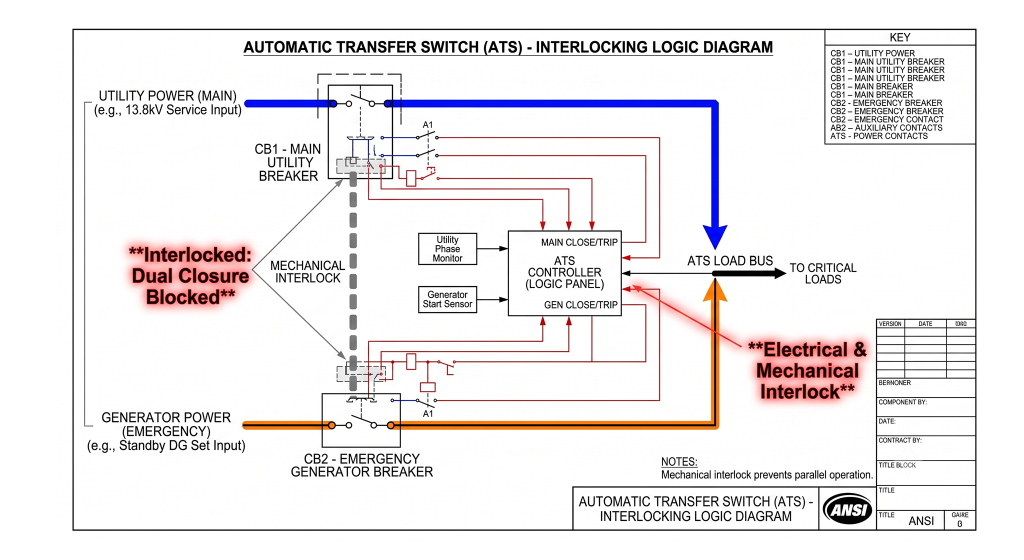
Commissioning teams must perform a rigorous switchgear interlock test on all mechanical and electrical key systems (such as Castell locks). These tests must mathematically and physically prove that:
- A maintenance worker cannot physically open a switchboard door while the main busbars are energized.
- The main utility incomer breaker and the emergency standby generator breaker can never be closed simultaneously, preventing dangerous back-feeding into the utility grid.
Additionally, comprehensive ATS functional testing must be executed on all Automatic Transfer Switches. Under simulated “dead-bus” conditions (cutting utility power), the ATS controller must instantly detect the voltage drop, signal the standby generators to start, verify the generator voltage and frequency, and seamlessly transfer the critical building loads to the emergency source within the utility-mandated timeframe.
Step 8: Lockout/Tagout (LOTO) and Safety Barriers
As the physical moment of energisation approaches, the project transition zone becomes a highly hazardous area. The focus shifts from technical testing to strict, military-grade site safety management.
Hours before the power is turned on, the commissioning lead must enforce a strict LOTO procedure electrical protocol. Every single breaker, isolator, and switch that has been tested and cleared must be physically locked in the “OFF” position using dedicated padlocks, and marked with highly visible “DANGER – DO NOT OPERATE” warning tags.
Implementing comprehensive energization safety protocols is mandatory. This involves erecting physical plastic barriers around the substation perimeter, mounting highly visible warning signs, and completely clearing all non-essential construction and painting personnel from the facility. The only individuals permitted within the safety zone are the authorized commissioning engineers and utility operators executing the switching sequence.
Frequently Asked Questions (FAQ)
1. What is the difference between cold commissioning and hot commissioning?
Cold commissioning (pre-commissioning) involves testing, inspecting, and verifying all electrical equipment and cables under completely de-energized conditions (zero power) to ensure safety and integrity. Hot commissioning (commissioning) occurs after the main utility breakers are closed, testing the physical operation of the energized system, including phase synchronization, voltage levels, and thermal performance under load.
2. Why is insulation resistance (Megger) testing so critical before energisation?
Cables can easily suffer microscopic cuts, punctures, or stretching when being pulled through concrete trenches or metallic trays during construction. A megger test applies high-voltage DC to measure the resistance of the insulation. If the insulation is compromised, the test will detect a low resistance, preventing the catastrophic short circuits and explosions that would occur if the damaged cable were energized with utility power.
3. What happens if the phase rotation of a motor is reversed?
If the phase rotation ($L1-L2-L3$) is reversed, the magnetic field inside an induction motor will rotate in the opposite direction. This forces the motor’s shaft to spin backward. For massive industrial equipment—like high-pressure water pumps, HVAC chillers, or ventilation fans—running backward can cause immediate and catastrophic mechanical failure of the impellers, gears, and drive shafts.
4. Why must “wet services” be completely isolated from electrical rooms?
Water and high-voltage electricity are a lethal combination. If a pressurized water pipe, sewage line, or AC condensation drain passing above or through an electrical room leaks, it can drop water onto live switchgear or busbars. This triggers explosive arc flashes, equipment failure, and poses an extreme electrocution risk to maintenance personnel, violating strict utility safety codes.
5. Who is responsible for executing the LOTO procedures before energisation?
The Lockout/Tagout (LOTO) procedures are managed and executed exclusively by the designated Commissioning Manager or the “Authorized Electrical Person” (AEP) who holds the legal competency license for the site. They are the sole custodians of the safety keys, ensuring that no breaker is closed without formal clearance and verifying that all non-essential personnel are evacuated from the hazard zone.
Turning on the Power Safely
Executing a pre-energisation checklist is an uncompromising, systematic discipline that leaves absolutely zero room for shortcuts, assumptions, or rushed timelines. In high-voltage utility environments, a single skipped step, an untested relay, or an unverified ground connection is a recipe for catastrophic physical and financial disaster.
By structuring your pre-energisation phase into clear, sequential milestones—from statutory approval verification to visual inspections, megger testing, earthing checks, and strict LOTO protocols—you protect your multimillion-dirham capital assets and guarantee the safety of your personnel.
Need to ensure your facility is ready for power?
Do not gamble your project’s safety on generic checklists or unverified contractor claims. Partner with an independent specialist to oversee your pre-energisation audits. Contact Elecwatts to leverage our premier Electrical Construction & Commissioning Management services. As a leading regional electrical consultancy, we provide the expert oversight, certified testing verification, and rigorous commissioning management GCC methodologies required to achieve a flawless, safe electrical energization for your next mega-project.
Contact Elecwatts today to secure your pre-energisation compliance and commission your infrastructure safely.