

For utility asset managers and industrial directors across the GCC, the cost of maintaining electrical infrastructure is a massive, recurring burden. Traditional “calendar-based” maintenance schedules require crews to inspect and service equipment whether it needs it or not, consuming vast resources. Yet, despite this high spend, unexpected failures still occur, causing costly downtime.
As we move through 2026, the pressure to improve grid reliability while tightening financial efficiency has never been higher. This brings us to a critical question: Can a shift from schedule-based to AI-powered condition-based maintenance deliver a tangible 20% reduction in operational costs? The answer is yes. Predictive maintenance substation AI technologies are no longer futuristic concepts; they are ROI-driven investments transforming substation maintenance cost structures today.
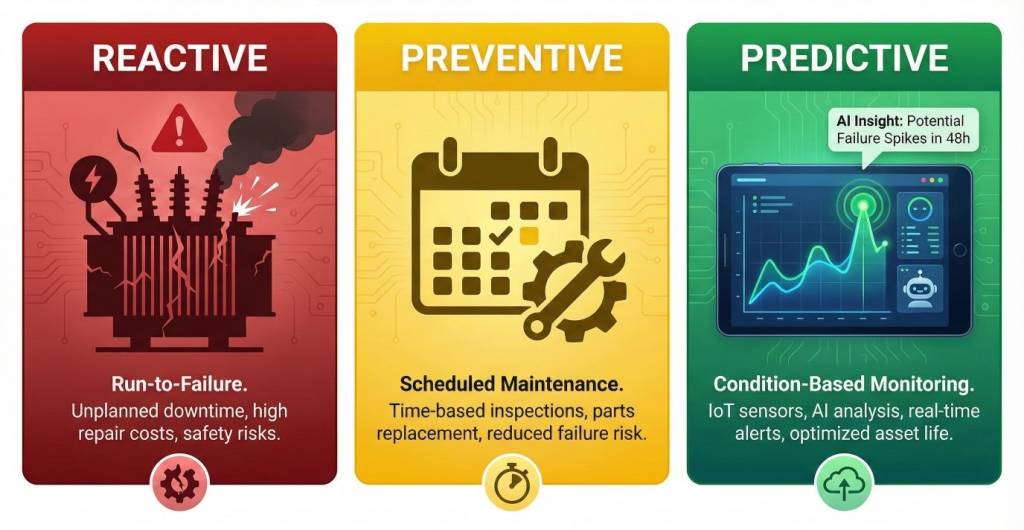
Alt Text for SEO: “Comparison of reactive, preventive, and AI-driven predictive maintenance strategies for substations.”
The Cost of the Status Quo: Reactive vs. Preventive Maintenance
To understand the savings, we must first look at the inefficiencies of the current models.
- Reactive Maintenance: Running to failure is the most expensive strategy. The cost of transformer failure includes not just the replacement, but the emergency mobilization premiums, environmental cleanup, and the massive financial hit of lost load.
- Preventive Maintenance: While safer, this approach is financially inefficient. It relies on time (e.g., “service every 6 months”), regardless of the asset’s actual condition. This leads to the limitations of preventive maintenance: wasting labor hours on healthy assets and replacing components that still have significant remaining useful life.
Is your asset strategy optimized? Explore our Asset & Audit Management services.
How AI-Driven Predictive Maintenance Works: The Data-to-Decision Pipeline
This isn’t magic; it is engineering math applied at scale. The process turns raw data into actionable financial decisions.
1. Data Acquisition: The Sensory Nervous System
It starts with data. We aggregate streams from existing SCADA systems, DGA monitoring AI sensors (Dissolved Gas Analysis), Partial Discharge (PD) monitors, thermal cameras, and smart breaker relays.
2. The AI/ML Engine: Pattern Recognition at Scale
Machine learning for asset health algorithms analyze this data to establish a “healthy baseline” for every specific asset. They detect subtle anomalies—like a micro-trend in hydrogen gas generation or a slight vibration shift—that indicate a developing fault weeks or months before a human operator would notice.
3. The Prescriptive Output: From Alert to Action
The outcome isn’t just an alarm; it is a prescription. The system generates an asset health dashboard that forecasts Remaining Useful Life (RUL) and prioritizes work orders, ensuring you only spend maintenance budget on the assets that actually need it.
Deconstructing the 20% OPEX Savings: A Line-Item Breakdown
Where does the 20% figure come from? It is the aggregate of savings across five key operational categories.
| OPEX Category | Traditional Approach | AI-Predictive Approach | Source of Savings |
| Routine Maintenance Labor | High cost, fixed schedule. | Optimized, based on actual need. | Reducing unnecessary site visits, truck rolls, and inspections by ~30%. |
| Spare Parts & Inventory | Large capital tied up in “just-in-case” stock. | Just-in-time procurement based on RUL forecasts. | Lower inventory carrying costs and reduced part obsolescence. |
| Unplanned Outages & Repair | Very high cost (emergency crews, revenue loss). | Nearly eliminated for monitored failure modes. | Avoids catastrophic repair bills and massive operational expenditure savings. |
| Energy Losses | Inefficient, degrading equipment wastes power. | Identifies issues causing losses (e.g., loose connections/hot spots). | Direct reduction in technical network losses. |
| Asset Lifespan | Shortened by undetected stress or intrusive maintenance. | Optimized intervention points. | Extends life by avoiding pre-failure damage, deferring CAPEX. |

Alt Text for SEO: “Interactive calculator graphic demonstrating 20% OPEX savings from predictive maintenance.”
The Implementation Roadmap: From Pilot to Full Scale
Implementing AI doesn’t mean ripping out your existing infrastructure. We recommend a phased approach.
Phase 1: Asset Criticality & Data Readiness Assessment
We identify your most critical, high-value assets (e.g., EHV transformers). We audit your existing sensor data availability and plan cost-effective sensor retrofits where gaps exist.
Phase 2: Pilot Project on a Single Substation
Prove the concept and ROI predictive analytics on a controlled scale. Focus on 1-2 specific failure modes, such as predicting bushing degradation via online monitoring.
Phase 3: Scale-Up & Integration
Once the ROI is proven, expand the model to other substations. Crucially, integrate the AI dashboard with your existing CMMS integration (Computerized Maintenance Management System) to automate work order generation.
The GCC Advantage: Why the Region is Ripe for Adoption
The GCC is uniquely positioned to benefit from this technology in 2026.
- Extreme Climate: AI models can specifically learn and predict the stress caused by 50°C heat and sandstorms on equipment, which generic manufacturer guidelines often miss.
- National Visions: Adopting smart, data-driven operations aligns perfectly with Vision 2030 asset management goals for efficient, tech-driven infrastructure.
- High Asset Value: The sheer scale and cost of grid infrastructure in the region justify the investment in protecting these multi-million dollar assets.
Frequently Asked Questions (FAQs)
Q1: Isn’t this technology only for giant, wealthy utilities?
No. Cloud-based AI platforms and “Software-as-a-Service” (SaaS) models have dramatically lowered entry costs. A large industrial plant with just a few critical substations is an ideal starting point and can often see a faster ROI than a sprawling utility due to streamlined decision-making.
Q2: How accurate are the AI predictions?
For well-understood failure modes with good historical data (e.g., transformer insulation breakdown or OLTC failures), advanced models can achieve over 90% accuracy in predicting issues months in advance. The system’s accuracy improves continuously as it ingests more of your specific site data.
Q3: What about cybersecurity risks with more connected sensors?
This is a valid concern. The implementation must follow GCC smart infrastructure and OT cybersecurity best practices. This includes using data diodes for one-way communication from the substation to the cloud, strict network segmentation, and encrypted data streams.
Q4: Do we need to hire data scientists?
Not necessarily. The leading approach is to use domain-specific software platforms developed by engineering firms (like ElecWatts). These platforms embed the AI expertise, allowing your existing engineers and asset managers to use the insights via intuitive dashboards without needing to write code.
Conclusion
Predictive maintenance is no longer a luxury; it is an operational and financial imperative. It transforms maintenance from a fixed cost center into a strategic, data-driven function that protects capital and ensures reliability.
Ready to transform your substation OPEX from a fixed cost into a variable, optimized investment? Our asset management and smart grid specialists can conduct a feasibility study, build your business case, and partner with you to implement a tailored AI-driven predictive maintenance program.Contact us to calculate your potential savings and start your journey toward a smarter grid.