

While the world marvels at the glittering, hyper-modern skyline of Downtown and Dubai Marina, the true cultural heartbeat of the city resides along the Creek. Areas like Deira, Bur Dubai, and the Al Fahidi Historical Neighbourhood are the irreplaceable soul of Dubai’s trading legacy. However, preserving these vibrant districts while adapting them for modern commercial and residential use presents a monumental engineering hurdle. To successfully modernize these structures, partnering with an expert electrical engineering consultancy in dubai is essential before any renovation begins. The core challenge lies in the unseen infrastructure: upgrading the power capacity in buildings that were fundamentally not designed to support modern electrical loads.
Fifty years ago, a typical building in Deira required power for basic lighting, ceiling fans, and perhaps a few window air conditioning units. Today, those same buildings are being repurposed into boutique hotels, modern retail spaces, and high-density apartments requiring central HVAC, commercial kitchens, and robust IT networks. The process of retrofitting Old Dubai buildings is not a simple matter of pulling new wires. It is a delicate, complex operation of heritage site electrical modernization that requires navigating extreme space constraints, deciphering decades-old undocumented wiring, and meeting the uncompromising safety standards of modern DEWA and Dubai Civil Defense (DCD) regulations, all without destroying the structural and historical integrity of the property.
The Space Constraint Conundrum
In modern Dubai construction, the allocation of space for electrical infrastructure is dictated by strict DEWA spatial guidelines during the architectural concept phase. Dedicated, ground-floor electrical rooms with massive clearances are the norm. In the 1970s and 1980s, these rules did not exist in their current form.
The Missing Electrical Room
Older buildings in Bur Dubai and Deira often completely lack a dedicated electrical room. Main Distribution Boards (MDBs) and utility meters are frequently found crammed under stairwells, in narrow basement corridors, or even exposed in public alleyways.
- The Challenge: When a building undergoes a load upgrade to accommodate modern HVAC, DEWA often requires the installation of new, significantly larger switchgear, and sometimes even a dedicated on-site transformer or Ring Main Unit (RMU). Maneuvering these massive, heavy components into tight heritage basements with low ceilings and narrow access doors is physically impossible without structural demolition.
- The Solution: Engineers must utilize ultra-compact switchgear Dubai solutions. This often involves specifying Gas Insulated Switchgear (GIS) which has a drastically smaller footprint than traditional Air Insulated Switchgear (AIS). Furthermore, consultants must negotiate customized spatial NOCs with DEWA, presenting engineered solutions for custom-built, modular panels that can be assembled in-situ within the existing electrical room space constraints, ensuring mandatory maintenance clearances are achieved creatively.
Deciphering Legacy Wiring and Outdated Schematics
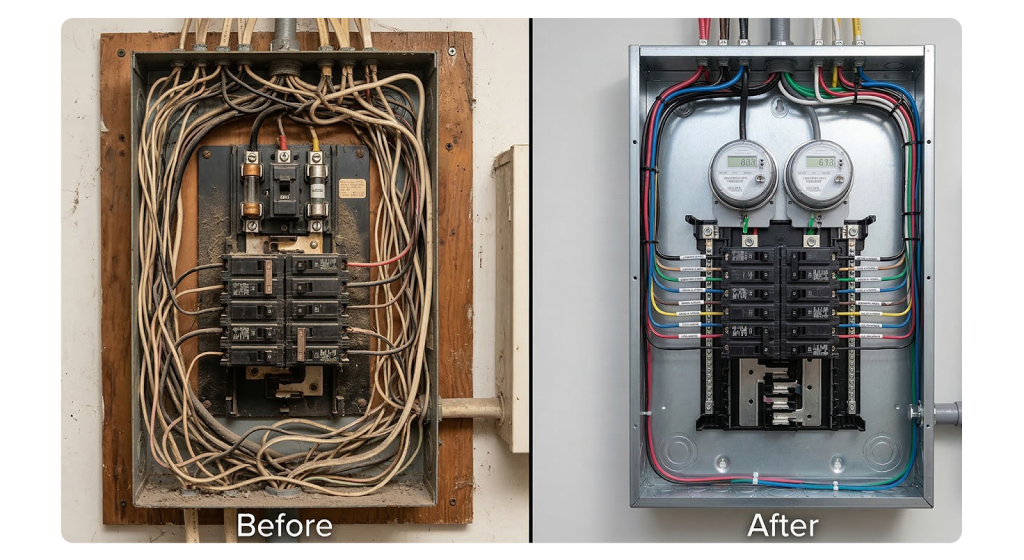
Walking into the electrical closet of a 40-year-old building in the Gold Souk is often an exercise in archaeology. The electrical systems have typically been subjected to decades of ad-hoc repairs, undocumented modifications, and “temporary” fixes that became permanent.
The Danger of the Unknown
The most critical risk in these environments is the physical degradation of the materials. Legacy cables often used vulcanized rubber or early-generation PVC insulation, which, after decades of exposure to Dubai’s ambient heat, becomes brittle and cracks, exposing live copper.
- The Challenge: To compound the danger, as-built electrical drawings for these properties are almost universally missing or hopelessly inaccurate. Upgrading a single circuit without knowing where it originates or what else it feeds is a severe fire hazard.
- The Solution: Before any legacy wiring replacement can begin, a specialized electrical engineering team must conduct a comprehensive forensic audit. This involves “ringing out” and tracing every circuit using advanced tone generators and thermal imaging to reverse-engineer a new set of accurate schematic diagrams. Only once the existing chaotic web is fully mapped and understood can a safe, methodical strip-out and rewiring strategy be designed.
Upgrading Earthing Systems to Current DEWA Standards
An electrical system is only as safe as its grounding. The earthing systems installed in early Dubai buildings are frequently severely compromised by age, undetected corrosion, or changing soil conditions.
The Evolution of Grounding Requirements
Historically, many older installations relied on water pipes for grounding, or utilized primitive earth pits that have long since dried out or degraded. Modern DEWA earthing standards are exceptionally rigorous, requiring precise earth loop impedance values (typically less than 1 ohm for the main earth terminal) to ensure that modern Earth Leakage Circuit Breakers (ELCBs) function instantly during a fault to prevent electrocution.
- The Challenge: Drilling new, deep earth pits in the densely packed, narrow streets of old Deira, or underneath buildings with fragile, shallow foundations, is fraught with risk. Hitting an undocumented water main or destabilizing a load-bearing column is a constant threat.
- The Solution: Retrofitting electrical grounding in these environments requires precision. Engineers often specify the installation of multiple, shallow, interconnected earth rods driven at strategic, structurally safe angles. To achieve the required low resistance in the dry sub-soil without deep drilling, advanced conductive ground enhancement materials (chemical earthing compounds) are used to surround the copper rods, dramatically improving their performance and compliance with DEWA regulations.
Handling Increased HVAC and Modern Loads
The most common trigger for a heritage building retrofit is the failure of the existing power supply to cope with modern cooling demands. The transition from individual, low-efficiency window AC units to centralized VRF (Variable Refrigerant Flow) systems or district cooling connections creates a massive surge in electrical demand.
The Power Upgrade Process
Adding a 100-ton centralized AC system to a building wired in 1985 will instantly overload the main incomer and trip the utility breaker.
- The Challenge: Attempting an HVAC electrical load upgrade requires officially requesting more power from the utility. The DEWA power upgrade process requires the submission of detailed load schedules, diversity calculations, and new Single Line Diagrams (SLDs) proving that the internal distribution can handle the new load safely.
- The Solution: If DEWA determines that their local street network cannot support the additional load, the developer may be forced to carve out space for a new local substation on their property, a near-impossible task in a fully built-up souk. The engineering solution involves extreme load balancing. Consultants must specify the most highly efficient, inverter-driven HVAC equipment available to suppress the peak demand curve. Additionally, deploying smart building management systems (BMS) to interlock non-critical loads (shedding water heater loads when AC compressors spike, for example) can keep the total maximum demand just under the existing DEWA threshold, avoiding the need for a massive network infrastructure upgrade.
Fire Safety and Civil Defense Compliance
Bringing a heritage building up to modern electrical standards is inextricably linked with fire safety. Electrical faults are the leading cause of fires in older buildings, making Dubai Civil Defense (DCD) compliance a top priority during any retrofit.
Modern Life Safety in Historic Shells
The UAE Fire and Life Safety Code of Practice has strict chapters regarding existing buildings.
- The Challenge: You cannot simply leave a 1980s fire alarm system in place during a major renovation. DCD will mandate the installation of modern, fully addressable fire detection systems, interconnected voice evacuation, and robust emergency lighting that operates for 3 hours during a total blackout.
- The Solution: Achieving DCD electrical compliance requires meticulous fire safety retrofitting Dubai strategies. The new emergency systems require specialized, fire-resistant cabling (e.g., FP200 or mineral-insulated cables). Finding pathways to route these thick, rigid cables through historic buildings without tearing down heritage ceilings or coral-stone walls requires immense coordination between the electrical designer, the architect, and the DCD inspector to find acceptable, discreet routing solutions.
The Threat of Structural Damage During Installation
In areas like the Al Fahidi Historical Neighbourhood, buildings are constructed using traditional methods, coral stone, gypsum, and palm fronds (Arish). Even in the older concrete structures of Deira, the concrete may have degraded over time.
The Core Drilling Risk
Modern electrical installation heavily relies on power tools: core drills to punch through floor slabs for cable risers, and wall chasers to bury conduits in plaster.
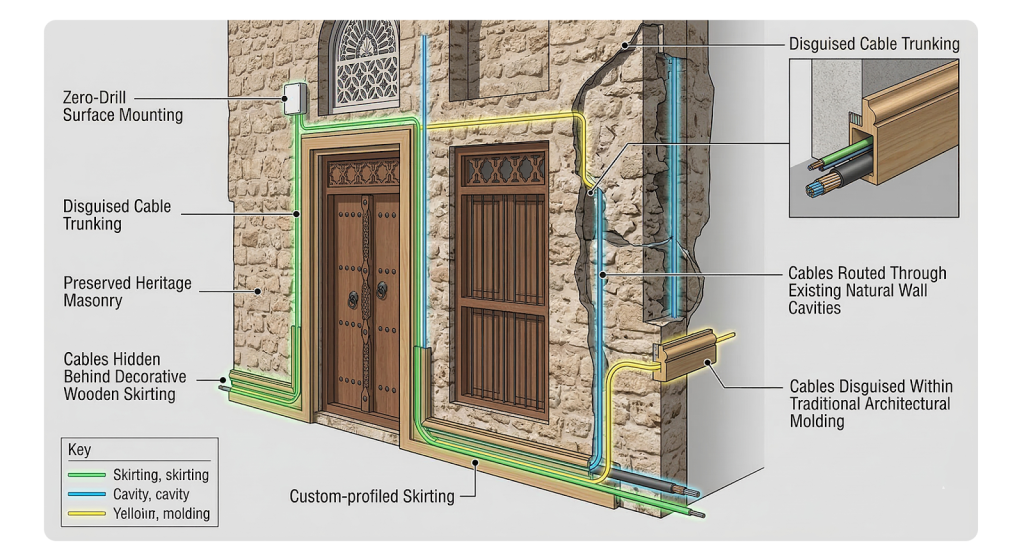
- The Challenge: Applying heavy vibrations and core drilling to a 60-year-old unreinforced masonry wall or a degraded concrete slab can cause catastrophic structural cracking or partial collapse.
- The Solution: Heritage building electrical installation demands a “touch-nothing” philosophy wherever possible. Engineers must design non-invasive cable routing strategies. This includes utilizing the building’s existing natural cavities, such as disused chimney flues or old ventilation shafts, as primary cable risers. Where surface mounting is unavoidable, the design shifts from modern industrial PVC to aesthetic solutions, using disguised skirting-board trunking, or embracing the industrial heritage look with surface-mounted, polished copper or brass conduits that complement the historical architecture rather than destroying it.
Managing Insurance and Liability Risks
Property owners frequently initiate retrofits not just for modernization, but out of financial necessity driven by the insurance market.
The Liability of the Obsolete
As building codes evolve, insurance underwriters become increasingly wary of outdated electrical systems. A commercial building operating with uncertified 40-year-old wiring is viewed as an extreme fire hazard.
- The Challenge: In the event of an electrical fire, loss adjusters will investigate the root cause. If the investigation reveals degraded legacy wiring that was not maintained to current standards, the insurer may declare the policy void, leaving the building owner liable for millions of dirhams in property damage and business interruption losses.
- The Solution: A comprehensive electrical fire risk assessment is the first step in heritage building insurance compliance. By commissioning an independent electrical engineering consultancy to conduct a full audit, thermal imaging scan, and subsequent certified retrofit, building owners effectively transfer this liability. The resulting compliance certificates and testing reports serve as empirical proof to underwriters that the risk has been mitigated, securing coverage and often drastically reducing annual insurance premiums.
Phased Execution to Minimize Disruption
Retrofitting an empty building is challenging; retrofitting an occupied, operational building in the heart of Old Dubai is an intricate logistical ballet. Many of these buildings house ground-floor retail shops, restaurants, or gold merchants that operate 14 hours a day, 7 days a week.
The “Live Building” Strategy
Shutting down power to an entire souk building for a month to rewire it is financially ruinous for the tenants.
- The Challenge: The contractor must execute the live building electrical upgrade while keeping the businesses operational, the air conditioning running, and the security systems active.
- The Solution: This requires a highly detailed phased electrical retrofit plan. The engineering team designs a temporary “bypass” distribution network.
- Phase 1: Install the new Main Distribution Board (MDB) alongside the old one while the old one remains live.
- Phase 2: During the lowest-impact hours (e.g., 2:00 AM to 6:00 AM), electricians migrate individual circuits from the old board to the new board, one by one.
- Phase 3: By the time the shops open at 8:00 AM, the lights are on, but they are now being fed by the modernized infrastructure. This phased timeline template ensures zero unplanned downtime and maintains the commercial viability of the property during the renovation.
Frequently Asked Questions (FAQ)
1. Does DEWA have special regulations for heritage buildings?
While DEWA’s core safety and technical regulations (cable sizing, earthing, protection) apply universally, they do exercise some flexibility regarding spatial requirements (like electrical room sizes) in older buildings if the engineering consultant can present a safe, justifiable alternative design that proves modern clearances cannot be physically met without destroying the property.
2. Can we just replace the main breaker and leave the old wiring in the walls?
No. Upgrading the Main Distribution Board (MDB) without verifying the condition of the downstream wiring is highly dangerous. If the old wiring has degraded insulation, putting a new, higher-capacity breaker on it might allow more current to flow during a fault before tripping, directly causing an electrical fire inside the walls. A full insulation resistance test must be performed on all legacy circuits.
3. How do we get original as-built drawings for a building built in 1978?
In most cases, you cannot. They are either lost or the building has been modified so many times that the drawings are useless. The only safe approach is to commission a complete “As-Found” electrical survey where engineers physically trace and document the current state of the wiring to create a new, accurate baseline schematic.
4. What is the most expensive part of an electrical retrofit in Old Dubai?
Often, it is not the electrical equipment itself, but the enabling works. The cost of carefully dismantling heritage ceilings to run cables, executing phased night-shift work to keep tenants operational, and the specialized, non-invasive installation techniques required by DCD and conservation authorities drive up the project budget.
5. Will retrofitting my old building lower my utility bills?
Yes, significantly. Old buildings suffer from terrible power factors and inefficient legacy equipment. By retrofitting with modern, properly sized cables (reducing heat loss), installing capacitor banks for power factor correction, and transitioning to LED lighting and smart HVAC controls, the building’s overall energy consumption and monthly DEWA bills will drop dramatically.
Conclusion & Next Steps: Preserving the Past, Powering the Future
The districts of Old Dubai are a testament to the city’s enduring legacy. Preserving their architectural charm while ensuring they remain commercially viable, safe, and efficient for the 21st century is a critical endeavor. Retrofitting the electrical infrastructure of these heritage sites is undeniably complex, fraught with spatial constraints, legacy hazards, and rigorous regulatory oversight. However, when executed correctly, the return on investment is profound, yielding vastly increased property values, drastically reduced insurance liabilities, and the peace of mind that comes with uncompromising safety.
Achieving this requires moving beyond basic contracting to sophisticated, forensic engineering. It demands a delicate touch, predictive planning, and a deep mastery of Dubai’s specific regulatory landscape.
Don’t let outdated wiring become a liability for your historic property.
Navigating the complexities of Dubai building modernization requires a specialized partner who understands the nuances of heritage infrastructure. Elecwatts provides comprehensive electrical audit older buildings and end-to-end retrofit design services. From deciphering legacy schematics to negotiating complex power upgrades with DEWA, we engineer solutions that protect the past while powering the future.
Contact Elecwatts today to schedule a comprehensive assessment of your heritage property’s electrical infrastructure.