

As Saudi Arabia undergoes an unprecedented infrastructure boom driven by Vision 2030 megaprojects, navigating the complex regulatory landscape of the Kingdom is paramount. For developers and contractors, securing power is the ultimate milestone. This requires partnering with a specialized provider of electrical engineering services to master the rigorous SEC electrical requirements. The Saudi Electricity Company (SEC) acts as the primary gatekeeper for the Kingdom’s grid, ensuring that all new developments meet world-class safety and reliability benchmarks.
Securing a Saudi Electricity Company approval is not a simple administrative task; it is a highly technical engineering gateway. SEC regulations are notoriously strict, deeply integrated with SASO (Saudi Standards, Metrology and Quality Organization) codes, and rigidly enforced across every region from Riyadh and Jeddah to the massive new developments on the Red Sea coast. Failing to understand these specific Saudi parameters during the design phase will inevitably lead to rejected submissions, costly equipment replacements, and catastrophic project delays. This comprehensive guide details the step-by-step requirements for mastering the SEC electrical submission process.
Understanding the SEC Grid Code
The foundation of any successful electrical design in Saudi Arabia is strict adherence to the Saudi Arabian Grid Code (SAGC). This document is the absolute law for anyone connecting to the national network.
The Rules of Engagement
Achieving Saudi Grid Code compliance involves demonstrating that your facility will act as a responsible citizen on the electrical network. The code governs everything from load integration and frequency stability to strict power quality limits (like acceptable harmonic distortion and power factor thresholds).
Connection Voltage Thresholds
The complexity of the submission scales dramatically with the size of your facility:
- Low Voltage (LV): Standard commercial and residential connections (400V/230V). Submissions focus heavily on load distribution, safety, and basic metering.
- Medium Voltage (MV): Heavy industrial plants, large commercial malls, and master community developments typically require an SEC medium voltage connection (13.8kV or 33kV). This demands comprehensive protection coordination studies, custom switchgear approvals, and rigorous substation design.
- High Voltage (HV): Gigaprojects and massive industrial complexes connecting at 110kV or 380kV require exhaustive transient stability analyses and direct coordination with the National Grid SA.
Initial Power Supply Request (Kahraba Portal)
The journey to energization officially begins in the digital realm. The entire application process is centralized through the SEC online system.
Navigating the Portal
The first administrative step is logging into the SEC Kahraba portal (Alkahraba) to submit the initial load application. This digital gateway is where developers officially register their project coordinates and expected power demand.
Inter-Agency Coordination
Submitting a Saudi electrical load request is deeply intertwined with broader municipal approvals. The application cannot proceed in a vacuum; it requires strict coordination with the Ministry of Municipal and Rural Affairs (MOMRA). SEC will cross-reference your electrical application with your approved MOMRA building permits. If the total connected load requested on the Kahraba portal contradicts the approved architectural limits or zoning parameters set by the municipality, the application will be immediately rejected.
The Engineering Package: SLDs and Load Schedules
Once the preliminary administrative steps are cleared, the core technical submission begins. SEC engineers review design packages with intense scrutiny, looking for exact adherence to their specific formatting and calculation standards.
Schematic Formatting
A common pitfall for international consultants is submitting drawings formatted for European (IEC) or UAE (DEWA) standards. While physically similar, the SEC single line diagram (SLD) requires very specific Saudi conventions. It must clearly delineate SEC-owned utility assets from customer-owned assets, mandate specific types of SEC-approved tariff metering configurations, and clearly display the exact fault levels at the Point of Common Coupling (PCC).
Load Schedule Specifics
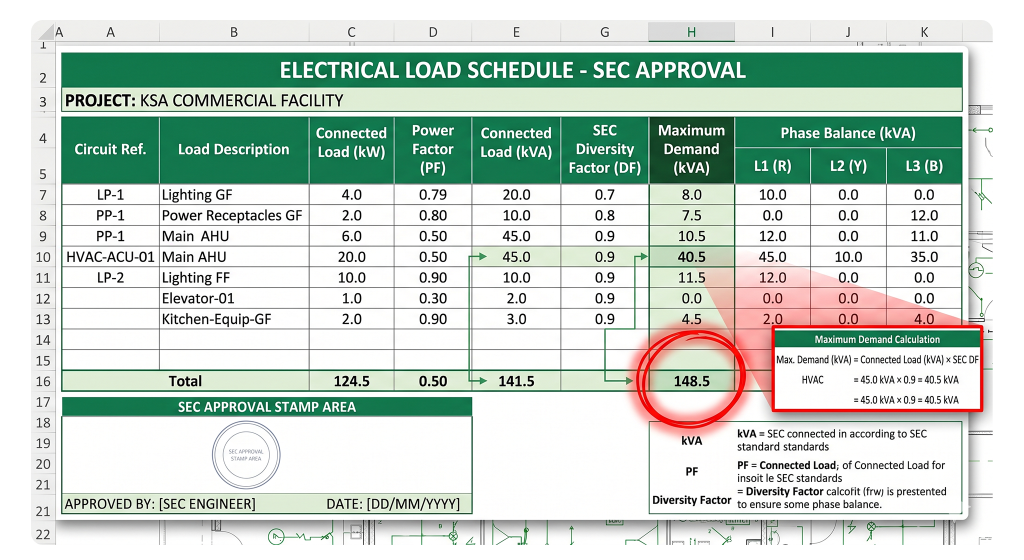
The Saudi electrical load schedule format is equally rigid. It requires precise documentation of connected loads, categorized meticulously to apply SEC’s specific diversity factors.
- Proving Stability: For large facilities, providing a basic spreadsheet is insufficient. Executing precise power systems analysis is mandatory to prove to SEC that massive industrial loads—such as starting massive chiller motors—won’t cause grid voltage dips that violate the Saudi Grid Code.
Strict SASO Compliance for Materials and Equipment
Designing a compliant system on paper is meaningless if the physical equipment procured does not meet Saudi Arabian standards. The Kingdom protects its infrastructure fiercely from sub-standard imports.
The Certificate of Conformity
There is an absolute necessity to ensure that all cables, transformers, breakers, and switchgear possess a SASO Certificate of Conformity (CoC) via the SABER electronic platform. SASO electrical standards often dictate specific environmental testing requirements (e.g., performance at 50°C to 55°C ambient temperatures) that generic IEC equipment may not meet.
Energy Efficiency Mandates
Furthermore, equipment must align with the Saudi Energy Efficiency Center (SEEC). SEC inspectors and Saudi customs officials will flatly reject and impound imported equipment (such as massive HVAC motors, chillers, or lighting fixtures) lacking proper SEEC labeling or failing to meet the minimum Energy Efficiency Ratio (EER) mandates. Utilizing only SEC approved materials from pre-vetted vendors is the only way to avoid catastrophic procurement delays.
Earthing and Lightning Protection in Arid Terrain
Achieving a safe electrical ground is one of the most difficult physical engineering challenges in Saudi Arabia due to the unique geology of the Arabian Peninsula.
The Challenge of Rocky Soil
Much of the Kingdom consists of exceptionally dry, rocky terrain with massive limestone deposits. This soil has incredibly high electrical resistivity, acting more like an insulator than a conductor.
Deep-Driven Solutions
To overcome this, SEC earthing requirements are intensely rigorous. Standard shallow earth rods are often entirely useless. Achieving proper Saudi electrical grounding frequently requires deep-drilled earth electrodes (sometimes exceeding 20 meters into the bedrock) and the extensive use of specialized, moisture-retaining conductive chemical backfill compounds. SEC enforces a strict maximum permissible earth resistance limit (typically 1 ohm for substations), and inspectors will physically test these pits before allowing energization.
Substation Design for Large Developments
If a project’s electrical demand exceeds standard low-voltage thresholds, SEC shifts the infrastructure burden onto the developer.
The Utility Plot Mandate
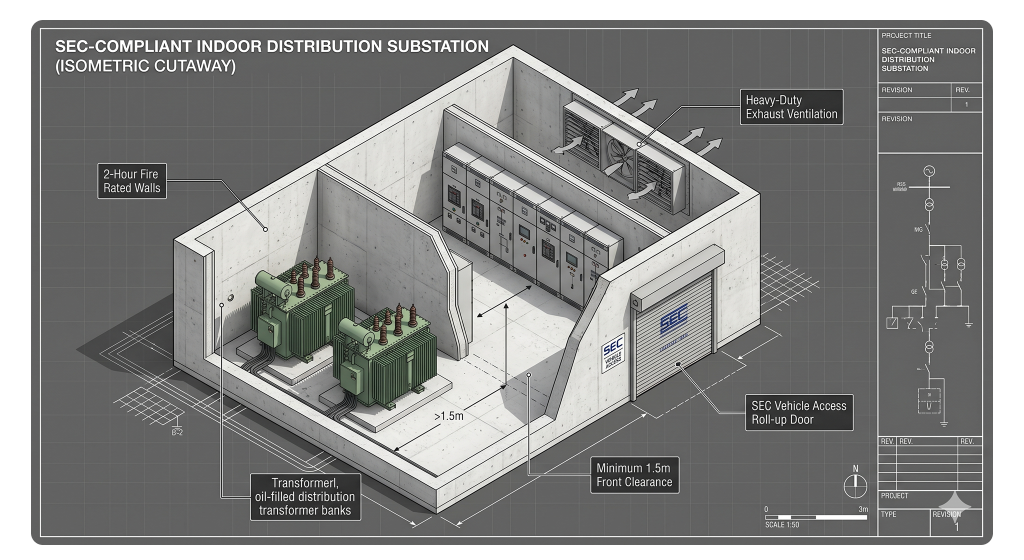
For large commercial malls, hospitals, or industrial plants, SEC mandates the allocation of dedicated, unencumbered plot space for a utility-owned primary substation entirely within the developer’s property lines.
Architectural Strictures
This brings intense architectural constraints. SEC substation design dictates highly specific structural requirements. Saudi utility room dimensions are non-negotiable, requiring exact clearances for heavy truck access, blast-resistant walls, and specific fire-rated doors. Furthermore, if the substation is an indoor unit, the developer must design and install heavy-duty, redundant HVAC ventilation systems capable of keeping the massive transformers cool during a 50°C Riyadh summer, all engineered exactly to SEC’s approval.
Factory Acceptance Testing (FAT) with SEC Engineers
For high-value, critical infrastructure, SEC does not wait until the equipment arrives on site to verify its quality.
The Witness Protocol
For custom-built medium-voltage or high-voltage equipment (like 13.8kV or 33kV switchgear, RMUs, and power transformers), the developer must facilitate an official Factory Acceptance Test (FAT). This involves officially inviting SEC engineers to the manufacturer’s facility—whether it is in Dammam, Germany, or South Korea—to physically witness the dielectric, mechanical, and functional testing of the equipment.
Protecting the Procurement Pipeline
Failing an SEC-witnessed FAT is a logistical nightmare. Expert Electrical Plant Procurement ensures that vendors intimately understand and strictly adhere to SEC’s rigid testing protocols before the SEC engineers ever board a plane. This rigorous oversight guarantees SEC FAT testing success, securing your Saudi switchgear approval and ensuring the equipment is cleared for shipping to the Kingdom without delay.
The Commissioning and Energization Phase
The final hurdle before turning the lights on is proving that the physical installation perfectly matches the approved paper design.
Site Acceptance Testing (SAT)
The SEC commissioning process is exhaustive. Specialized, SEC-approved testing agencies must execute rigorous site testing protocols. This includes high-voltage Megger (insulation resistance) testing of all primary cables, primary and secondary injection testing of all protection relays, and strict verification of the protection coordination settings to ensure the plant is safe to connect to the national grid.
The Final Handover
Once all Saudi electrical testing is passed and the reports are stamped, the final administrative sequence begins. The developer officially hands over the utility-facing assets (like the primary ring main units and meters) to SEC. Only after this transfer of custody is formalized will SEC crews execute the final connection to the street network and energize the facility.
Frequently Asked Questions (FAQ)
1. Do I need an SEC-approved consultant to submit drawings?
Yes. SEC operates a strict registry of approved engineering consultants and contractors. Submissions must be stamped and uploaded to the Kahraba portal by a licensed entity possessing the required Saudi Council of Engineers (SCE) accreditations and SEC pre-qualifications.
2. What is the standard distribution voltage in Saudi Arabia?
Historically, Saudi Arabia operated on a split 127V/220V system. However, the Kingdom has mandated a total transition to the international standard of 230V/400V (Single Phase/Three Phase) at 60Hz. All new electrical submissions must be designed for this 230V/400V standard.
3. How long does the SEC approval process take?
The timeline varies drastically depending on project size. A standard low-voltage commercial connection can be approved in weeks. A massive medium-voltage industrial connection requiring custom substation design, load flow studies, and FAT scheduling can take several months. Flawless initial documentation is the only way to prevent severe delays.
4. What is the SABER system and why is it important for electrical materials?
SABER is an electronic platform launched by SASO to register and certify imported and locally manufactured consumer products and industrial materials before they enter the Saudi market. If your electrical cables, breakers, or light fixtures are not registered and certified through SABER, they cannot clear Saudi customs.
5. Will SEC allow a non-firm (interruptible) grid connection for my factory?
For critical continuous-process industrial plants, developers usually require a “firm” connection for absolute reliability. SEC will evaluate the local grid capacity. If the grid is constrained, they may offer a connection but require the facility to install sophisticated load-shedding relays or massive on-site generator backups to protect the SEC grid during peak demand events.
Conclusion & Next Steps: Mastering the Saudi Market
Achieving successful energization in the Kingdom of Saudi Arabia requires far more than basic electrical engineering. It demands a profound, localized fluency in bureaucratic workflows, a deep respect for SEC’s uncompromising safety and grid stability mandates, and absolute precision regarding SASO engineering codes.
For developers driving the Vision 2030 megaprojects, treating the SEC approval process as a simple administrative checklist is a fatal error. It is a highly complex, multi-tiered engineering gateway that dictates the operational timeline of your entire investment.
Are you planning a mega-project or industrial facility in KSA?
Do not risk your project timeline on non-compliant submissions or sub-standard material procurement. Partner with our dedicated team of engineers to navigate the complexities of the Saudi grid seamlessly. As a premier SEC approval consultant and expert Saudi electrical engineering firm, we provide the comprehensive electrical engineering services required to design, procure, and commission your infrastructure flawlessly, ensuring your project powers up on schedule.
Contact Elecwatts today to secure your SEC electrical approvals and master your Saudi Arabian infrastructure deployment.